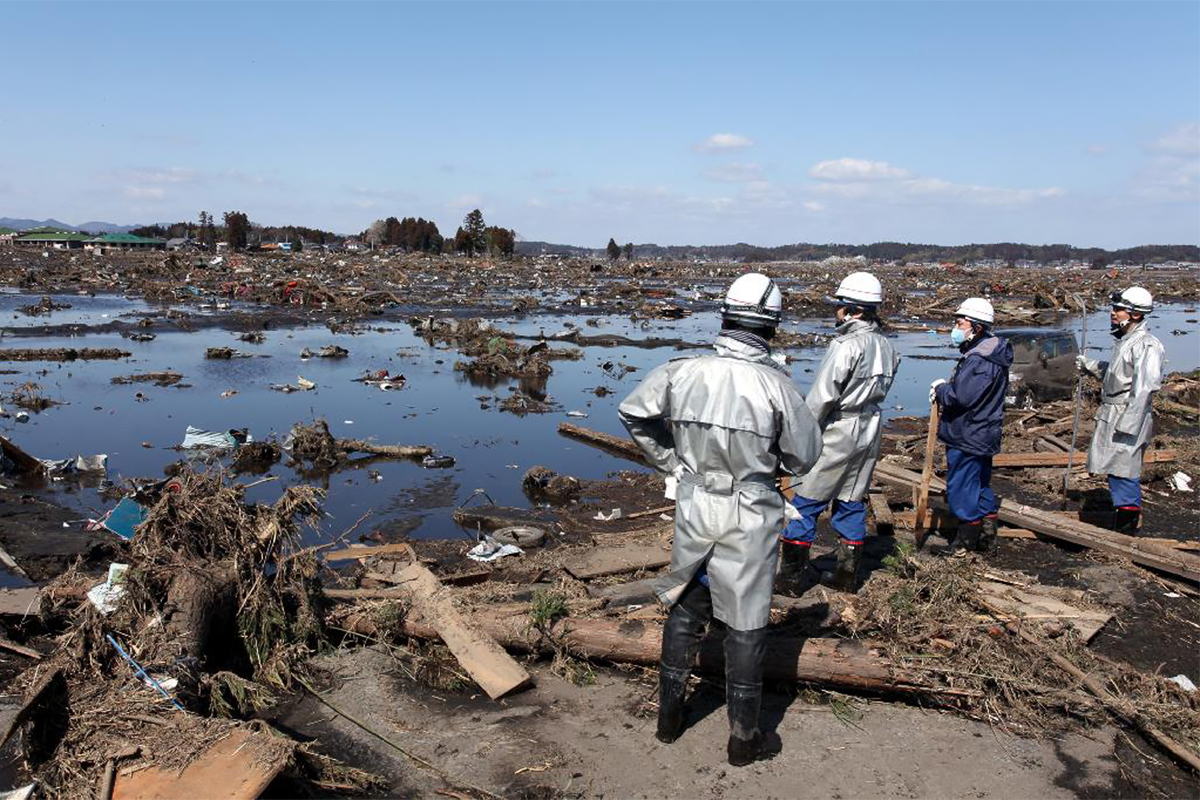
The aftermath of the 2011 Fukushima Daiichi nuclear accident encompasses an unprecedented multi-decade decommissioning program, extensive environmental decontamination, and major shifts in global energy policy. Under international supervision, technical teams are managing radioactive waste, releasing treated water, and extracting nuclear fuel debris while public health studies show minimal radiation-induced physical health effects despite significant psychosocial disruption.
1. Immediate Fallout and Environmental Remediation
The March 11, 2011, Great East Japan Earthquake (magnitude 9.0) and subsequent tsunami triggered a station blackout at the Fukushima Daiichi Nuclear Power Station, operated by the Tokyo Electric Power Company (TEPCO). The loss of electrical power rendered core cooling systems inoperable in Units 1, 2, and 3, resulting in nuclear meltdowns, hydrogen explosions, and substantial atmospheric releases of volatile radionuclides, primarily Iodine-131, Cesium-137, and Cesium-134.
In response to the radioactive fallout, the Japanese government established an evacuation zone around the facility, displacing over 150,000 residents. Environmental remediation efforts began swiftly, representing one of the largest landscape decontamination projects in modern history.
- 2011: Disaster occurs; 20-km evacuation zone established.
- 2012: Remediation framework created; topsoil stripping begins.
- 2017: Interim Storage Facility opens in Okuma and Futaba.
- 2023: ALPS-treated water discharge begins under IAEA oversight.
- 2024+: Trial retrieval of melted fuel debris (corium) initiated.
- 2041–2051: Target timeline for full decommissioning completion.
Decontamination Strategies and Waste Management
The Japanese Ministry of the Environment divided decontamination operations into targeted administrative zones based on annual radiation dose projections. Remediation teams systematically addressed non-agricultural, residential, and agricultural lands:
- Topsoil Stripping: Removing the uppermost 5 centimeters of soil, where radiocesium bound strongly to clay minerals.
- Surface Washing and Scraping: High-pressure washing of paved surfaces, roofing, and public infrastructure to strip atmospheric deposits.
- Vegetation Clearing: Pruning forest borders adjacent to inhabited spaces to lower background radiation levels.
These activities generated approximately 14 million cubic meters of contaminated soil and organic debris. The material was initially collected in temporary flexible container bags before transport to the Interim Storage Facility surrounding the Fukushima Daiichi site in the towns of Okuma and Futaba. According to the Japan Ministry of the Environment, national law mandates that soil stored at the interim facility must undergo final disposal outside Fukushima Prefecture by 2045.
Evacuation Zone Redesignation and Resettlement
Radiation levels declined over time due to natural radioactive decay (notably for Cesium-134 with a 2.06-year half-life) and physical remediation. The Japanese government progressively revoked evacuation orders across designated areas:
- Areas where evacuation orders have been lifted: Annual cumulative radiation doses fall below 20 millisieverts (mSv) per year, and basic infrastructure has been restored.
- Restricted-access areas: Doses remain elevated, but daytime access is permitted for infrastructure repair and business preparation.
- Difficult-to-Return Zones: Areas where estimated annual doses exceed 50 mSv/year. Special Reconstruction and Revitalization Bases within these zones have undergone deep decontamination to allow eventual repopulation.
Despite the lifting of evacuation orders in many municipalities, population recovery remains modest. Demographics in returned communities lean significantly older than pre-2011 baselines, influenced by prolonged displacement, economic transition, and ongoing public anxiety regarding low-dose radiation exposure.
2. Decommissioning Fukushima Daiichi: Engineering Challenges and Progress
Decommissioning the damaged reactors at Fukushima Daiichi is expected to take 30 to 40 years. Managing three melted reactor cores alongside spent fuel pools requires custom robotics, continuous water cooling, and containment engineering.
- Fukushima Daiichi Reactor Core
- Continuous Cooling Loop (Freshwater)
- Melted Fuel Debris (Corium) Storage
- Radioactive Water Accum. (Groundwater Ingress)
- ALPS Treatment System
- Tritium Dilution & Ocean Discharge
- ALPS Treatment System
- Continuous Cooling Loop (Freshwater)
Fuel Debris Retrieval (Corium)
The primary engineering hurdle is the localization and extraction of approximately 880 metric tons of melted nuclear fuel and structural debris (corium) distributed across Units 1, 2, and 3. The extreme radiation fields inside the primary containment vessels (PCVs) prevent human access, requiring remotely operated vehicles (ROVs) and custom robotic arms.
- Unit 1: Sufferred extensive core damage and containment floor erosion; robotic submersibles have mapped severe structural damage and debris distribution beneath the pressure vessel.
- Unit 2: Retains a more stable internal configuration; trial extractions using a specialized telescopic robotic arm successfully retrieved tiny milligram-scale samples of corium for chemical and structural analysis.
- Unit 3: Fuel debris remains submerged in water; debris characterization continues alongside preparations for larger-scale mechanical extraction.
Spent Fuel Pool Clearance
Prior to core debris extraction, TEPCO prioritized removing spent nuclear fuel assemblies stored in cooling pools located on the upper levels of the reactor buildings:
- Unit 4: All 1,535 spent and unspent fuel assemblies were safely transferred to the common site storage pool by December 2014.
- Unit 3: Clearance of all 566 fuel assemblies was completed in February 2021.
- Units 1 and 2: Removal operations are scheduled following the construction of structural protective covers and remote fuel-handling equipment.
3. The ALPS Treated Water Management Program
Cooling the melted fuel debris requires continuous water injection. Additionally, natural groundwater and rainwater penetrate the damaged reactor basements, producing radioactive liquid waste daily.
Advanced Liquid Processing System (ALPS) Capabilities
To manage contaminated water, TEPCO deployed the Advanced Liquid Processing System (ALPS), a multi-stage radio-chemical filtration system. ALPS uses adsorption and coagulation-precipitation techniques to strip 62 different radionuclides—including Cesium-137, Strontium-90, Cobalt-60, and Iodine-129—to levels below statutory discharge limits.
However, ALPS cannot remove tritium (a radioactive isotope of hydrogen, $^3\text{H}$) because tritium forms part of the water molecule itself ($\text{HTO}$).
- Raw Contaminated Water
- ALPS Filtration System — Removes 62 Radionuclides (Cs-137, Sr-90, I-129, etc.)
- Treated Water Storage — Contained in 1,000+ On-Site Steel Tanks
- Seawater Dilution Stage — Dilutes Tritium to <1,500 Bq/L (<1/7th WHO drinking limit)
- Offshore Ocean Release — Discharged 1 km Coastwise via Undersea Tunnel
Release Protocols and Regulatory Limits
By 2023, more than 1,000 storage tanks at the site contained over 1.3 million metric tons of treated water, filling available land needed for fuel debris storage and decommissioning infrastructure. In April 2021, the Japanese government approved a plan to release the ALPS-treated water into the Pacific Ocean, with operations commencing in August 2023.
| Parameter | Standard / Limit Value | Release Operational Target |
|---|---|---|
| Regulatory Limit (Japan) | 60,000 Bq/L (Tritium) | < 1,500 Bq/L (Post-Dilution) |
| WHO Drinking Water Quality | 10,000 Bq/L (Tritium) | < 1,500 Bq/L (Post-Dilution) |
| Annual Discharge Limit | 22 Trillion Bq/Year | Ceiling set to pre-accident baseline |
| Discharge Distance | N/A | 1 kilometer offshore via undersea tunnel |
Before release, ALPS-treated water is mixed with vast volumes of seawater, lowering tritium concentration below 1,500 Becquerels per liter (Bq/L)—less than one-seventh of the World Health Organization standard for drinking water.
International Oversight and Monitoring
The International Atomic Energy Agency (IAEA) established a permanent monitoring presence at the site. The IAEA Safety Review concluded that Japan’s plan aligns with international safety standards, noting that the radiological impact on humans and the marine environment is scientifically negligible.
To verify compliance independently, third-party laboratories from South Korea, China, Switzerland, and the United States perform regular sampling of sea water, marine life, and discharge stream samples.
4. Public Health, Ecological Science, and Social Impacts
Understanding the health and environmental impact of the Fukushima disaster requires separating direct radiation effects from secondary social disruptions.
Health Findings: Radiation vs. Psychosocial Impacts
Comprehensive investigations by the United Nations Scientific Committee on the Effects of Atomic Radiation (UNSCEAR) and the World Health Organization show no attributable increase in cancer rates, leukemia, or birth defects from radiation exposure among the general public.
- Fukushima Health Findings
- Physical Health Impacts
- No radiation-induced deaths.
- UNSCEAR: No discernible cancer rate increases.
- Elevated thyroid cancer rates linked to screening sensitivity.
- Psychosocial Impacts
- ~2,300 secondary deaths (evacuation trauma).
- Severe psychological distress & displacement.
- Persistent social stigma & economic disruption.
- Physical Health Impacts
key public health evaluations highlight:
- Radiation Exposure: Radiation doses to residents were generally low because of prompt evacuations, consumption restrictions on affected food products, and rapid agricultural management.
- Thyroid Screening and Overdiagnosis: Comprehensive ultrasound screening of over 300,000 children in Fukushima Prefecture detected early-stage thyroid carcinomas. Epidemiological consensus attributes this high detection rate to screening sensitivity (overdiagnosis of subclinical, non-harmful nodules) rather than radiation-induced cellular damage.
- Evacuation Trauma: The abrupt displacement of vulnerable populations—particularly nursing home residents and elderly hospital patients—resulted in over 2,300 disaster-related secondary deaths caused by medical disruption, hypothermia, and stress during evacuation.
Ecological and Agricultural Recovery
Terrestrial and marine monitoring networks track radionuclide bioaccumulation in surrounding ecosystems:
- Marine Bioaccumulation: Fish and shellfish collected near the Fukushima coast show low contamination levels. Strict regulatory testing sets a action threshold of 100 Bq/kg for radiocesium in food—significantly stricter than international standards (such as the EU's 1,250 Bq/kg standard).
- Terrestrial Fauna: Wild boar and mushroom species in closed mountain forests continue to show elevated Cesium-137 levels because forest floors recycle nutrients within closed biological loops. These items remain barred from commercial distribution.
5. Global Energy Policy and Re-evaluation of Nuclear Power
The Fukushima disaster prompted a worldwide re-examination of nuclear safety, risk modeling, and long-term energy strategies.
- Global Energy Policy Trajectories Post-Fukushima
- Phase-Out Approach
- Germany: Shutdown of all nuclear reactors completed by 2023.
- Belgium/Switzerland: Slow phase-out plans (with modern adjustments).
- Reassessment & Expansion
- Japan: NRA safety overhauls; reactor restarts (30-40% target).
- France/UK: Investment in EPR & Small Modular Reactors (SMRs).
- Phase-Out Approach
Japan's Strategic Energy Transition
Prior to 2011, nuclear power supplied approximately 30% of Japan’s electricity, with planned expansions to 50%. Immediately following the accident, Japan shut down all 54 commercial reactors for structural reviews and established an independent regulator, the Nuclear Regulation Authority (NRA).
The shutdown forced Japan to import substantial quantities of liquefied natural gas (LNG) and coal, raising carbon emissions and utility costs. To balance decarbonization commitments with energy security, Japan updated its Strategic Energy Plan:
- Safety Overhauls: Operators installed high-level sea walls, hardened back-up power facilities, and filtered containment venting systems before securing NRA restart approvals.
- Restart Allocations: Japan reactivated multiple pressurized water reactors (PWRs), targeting a 20–22% nuclear contribution to the national energy mix alongside expanded renewable energy production.
- Next-Generation Reactors: Government policies now permit extending reactor operational lifespans beyond the standard 40-year window (up to 60 years) and encourage developing next-generation advanced light-water reactors.
International Regulatory Responses
The global response varied depending on national resource availability, political consensus, and grid infrastructure:
- Accelerated Phase-Outs: Germany enacted a rapid nuclear phase-out (Atomausstieg), closing its final three nuclear reactors in April 2023. Switzerland voted to phase out nuclear power gradually without replacing existing assets.
- Safety Enhancements and Expansion: Countries such as France, the United States, China, and the United Kingdom performed comprehensive stress tests on existing plants, leading to mandatory back-up power and thermal management upgrades. Many of these nations now back nuclear energy as a zero-carbon baseload power source, investing in Small Modular Reactors (SMRs) and Generation IV nuclear technology.
6. Summary Matrix: Key Dimensions of the Fukushima Aftermath
| Dimension | Primary Impact / Activity | Status / Quantitative Target | Key Oversight / Advisory Body |
|---|---|---|---|
| Site Decommissioning | Removal of fuel debris; spent fuel pool clearance | Estimated completion: 2041–2051; corium extractions ongoing | TEPCO, Nuclear Damage Compensation and Decommissioning Facilitation Corporation (NDF) |
| Water Treatment (ALPS) | Radionuclide filtration; tritium dilution and ocean release | Tritium diluted to <1,500 Bq/L; released via 1 km sea tunnel | International Atomic Energy Agency (IAEA), NRA Japan |
| Land Remediation | Topsoil removal, structure washing, interim waste containment | Soil shifted to Interim Storage; final out-of-prefecture disposal due by 2045 | Ministry of the Environment (Japan) |
| Public Health | Health monitoring, epidemiological tracking, psychosocial care | No physical health radiation impacts; ongoing support for displaced populations | UNSCEAR, World Health Organization (WHO), Fukushima Medical University |
| Energy Policy Reform | NRA safety mandates, reactor restarts, energy security balance | Targeting 20-22% nuclear share in electricity grid; adoption of advanced SMR concepts | Ministry of Economy, Trade and Industry (METI), NRA |
7. Frequently Asked Questions
Is the seafood from Fukushima safe to eat?
Yes. Seafood from Fukushima Prefecture undergoes multi-stage radiological testing before distribution. Japan enforces a strict safety limit of 100 Becquerels per kilogram (Bq/kg) for radiocesium in commercial food—five to ten times stricter than standard regulatory limits in the United States or the European Union. Extensive sampling by Japanese authorities and independent international organizations shows that market samples consistently comply with safety regulations.
Why cannot tritium be filtered out by the ALPS equipment?
Tritium is a naturally occurring radioactive isotope of hydrogen with a half-life of roughly 12.3 years. Because tritium chemically behaves identically to normal hydrogen atoms, it integrates directly into water molecules ($\text{HTO}$). Standard physical and chemical filtration systems, including ion-exchange resins and reverse osmosis membranes, cannot filter tritium from liquid water. Isotopic separation technologies exist at smaller industrial scales, but processing millions of tons of diluted liquid waste remains technically and economically impractical.
How much fuel debris remains inside the Fukushima reactors?
An estimated 880 metric tons of melted fuel debris (corium)—composed of nuclear fuel, damaged zirconium cladding, and melted concrete baseboards—remains distributed across the bottom containment vessels of Units 1, 2, and 3. Trial retrievals using robotic arms and submersibles have begun extracting gram-scale samples to analyze structural properties before full-scale retrieval operations.
What were the immediate casualties of the Fukushima accident?
No direct deaths were caused by acute radiation sickness during the nuclear accident. Three workers suffered physical injuries from the initial hydrogen explosions. However, the evacuation of surrounding areas caused approximately 2,300 secondary deaths among vulnerable populations, including elderly nursing home residents and hospitalized patients, due to stress, hypothermia, and disruption of critical medical care.
How long will the complete decommissioning process take?
The Japanese Government and TEPCO maintain a projected decommissioning timeframe of 30 to 40 years from the 2011 event, placing target completion between 2041 and 2051. Technical challenges—particularly retrieving melted fuel debris, maintaining structural integrity, and managing secondary waste—could alter this operational schedule.
Practical Action and Information Resources
Stakeholders, energy analysts, and researchers tracking the long-term developments of the Fukushima site should focus on verified data streams:
- Monitor Environmental Data: Track real-time radiation readings and environmental reports via the official portal of the Japan Ministry of the Environment.
- Review IAEA Technical Reports: Consult independent monitoring updates on the ALPS water discharge and overall site progress provided by the IAEA Fukushima Dashboard.
- Evaluate Energy Market Shifts: Examine official policy publications from the Ministry of Economy, Trade and Industry (METI) regarding Japan's NRA reactor safety approvals and long-term Strategic Energy Plans.