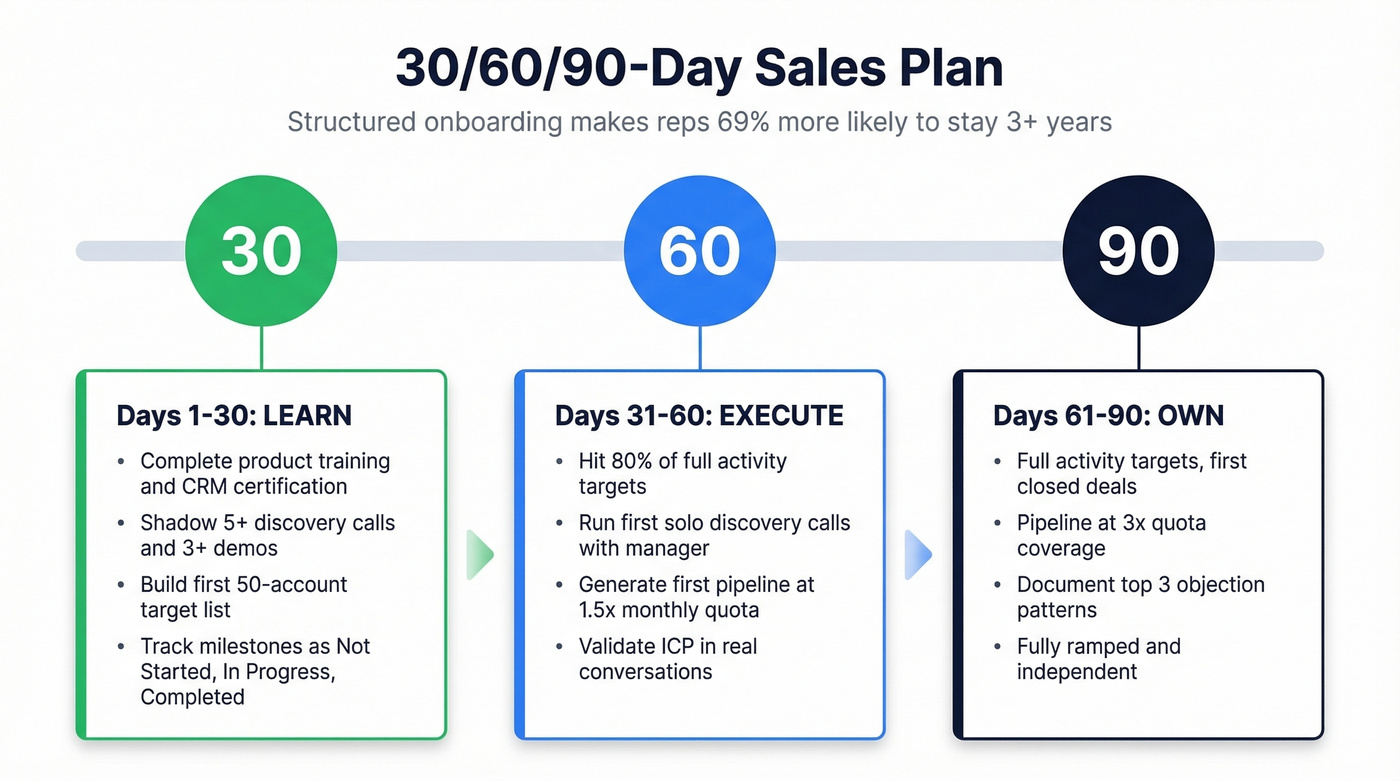
A 30 day 60 day 90 day sales plan is a structured onboarding and performance roadmap that breaks a salesperson’s initial or quarterly objectives into three distinct thirty-day phases focused on learning, execution, and mastery. It helps new hires achieve quota faster and enables veteran reps to realign territories, launch new products, or systematically scale pipeline generation.
Understanding the Purpose and Structure of a Sales Roadmap
A structured sales roadmap changes how a professional approaches territory development, quota attainment, and skill integration. Rather than leaving performance to chance or overwhelming a representative with year-end quotas on day one, a segmented blueprint breaks execution down into digestible intervals.
For a newly hired account executive or business development representative, the primary friction point is cognitive overload. They must learn complex product features, internal tech stacks, buyer personas, and competitive differentiation while simultaneously trying to close deals. A phased plan honors this learning curve. It prevents the trap of premature pitching—where a rep sells before they understand the customer's true pain points—while establishing accountability checkpoints for managers.
Similarly, for experienced sales professionals entering a new quarter or taking over a restructured territory, a 30-day, 60-day, 90-day framework acts as a strategic reset. It provides a methodical lens through which to evaluate historical pipeline data, re-engage dormant accounts, and build predictable revenue streams. The framework moves a professional along a continuum from passive absorption to active contribution, and finally to autonomous ownership.
Phase 1 (Days 1–30): The Learning, Absorption, and Discovery Period
The first thirty days of any sales plan must be anchored in knowledge acquisition rather than aggressive outbound generation. Attempting to force pipeline growth before understanding the product architecture or buyer ecosystem often leads to burned leads, eroded brand trust, and early burnout.
Internal Systems and Product Mastery
A representative cannot sell what they do not deeply understand. The initial two weeks require intensive study of the company’s product or service suite. This involves reviewing technical documentation, sitting in on customer success calls, and testing the product firsthand if applicable.
Concurrently, reps must master the internal tech stack. Modern revenue teams rely on customer relationship management (CRM) platforms, sales engagement tools, intent data providers, and quoting software. By the end of day thirty, entering data cleanly, building custom views, and automating follow-up sequences must become second nature.
Buyer Persona and Competitive Landscape Analysis
Beyond the product, a sales professional must immerse themselves in the target audience. This means reviewing recorded discovery calls, analyzing win-loss reports, and studying buyer personas—including their primary motivations, daily challenges, and key performance indicators (KPIs).
Furthermore, understanding the competitive landscape is non-negotiable. Reps must identify primary competitors, analyze feature parity, and internalize battle cards that highlight distinct competitive advantages. Knowing why deals are lost historically is just as important as knowing why they are won.
Establishing Baseline Metrics
While outbound activity is typically low during this phase, input metrics should be tracked. Success in the first thirty days is measured by completion milestones rather than closed revenue:
- Completing product certification or training modules.
- Shadowing a designated quota of senior sales calls or demonstrations.
- Mapping the assigned territory or target account list.
- Conducting internal informational interviews with product, marketing, and customer success teams.
Phase 2 (Days 31–60): The Execution, Pipeline Building, and Prospecting Period
With foundational knowledge secured, the second month shifts focus to execution, active prospecting, and initial pipeline generation. The training wheels come off, and the representative begins direct engagement with the market.
Transitioning from Theory to Practice
During days thirty-one through sixty, the sales professional initiates outbound prospecting campaigns, handles inbound inquiries, and begins running independent discovery calls. The emphasis here is on volume and consistency of top-of-funnel activity. Whether through cold calling, strategic email sequencing, social selling, or partner channel outreach, the goal is to test messaging and refine the pitch based on real-world prospect feedback.
Refining the Value Proposition
The initial messaging developed during onboarding rarely survives first contact with the market unedited. Sales professionals must use this phase to listen carefully to prospect objections, frequently asked questions, and points of hesitation.
By analyzing which value propositions resonate and which fall flat, the representative can tailor their communication style to align with how buyers actually talk about their problems. This feedback loop should also be shared proactively with the marketing and product teams.
Pipeline Generation Milestones
Activity must translate into pipeline value during this window. Key performance indicators for the second month typically include:
- Hitting weekly outbound activity targets (calls, emails, meetings booked).
- Conducting a specific number of first-time discovery meetings independently.
- Adding a predetermined multiple of quota (e.g., 3x pipeline coverage) to the early-stage CRM pipeline.
- Advancing initial opportunities past the qualification stage into solution presentation or demo phases.
Phase 3 (Days 61–90): The Mastery, Closing, and Optimization Period
By the final phase, the sales professional is operating at near-full capacity. The focus shifts from generating raw pipeline to managing deal velocity, negotiating terms, closing business, and establishing repeatable habits for ongoing success.
Advanced Deal Management and Negotiation
Closing complex B2B deals requires orchestrating multiple stakeholders, navigating procurement hurdles, and addressing security or legal compliance questions. In days sixty-one through ninety, the representative takes full ownership of the deal cycle from initial contact to signature.
This involves mastering objection handling around pricing, contract length, and implementation timelines. Reps must learn how to identify economic buyers, build consensus among technical evaluators, and create a sense of urgency without resorting to aggressive discounting.
Establishing Scalable Habits and Forecasting Accuracy
A mature sales professional does not rely on erratic bursts of activity to hit quota. The final month of the plan is dedicated to building predictable routines:
- Conducting weekly pipeline reviews and accurate forecasting.
- Identifying expansion or cross-sell opportunities within newly closed accounts.
- Collaborating with account management to ensure smooth handoffs for customer onboarding.
- Analyzing personal conversion rates across each stage of the funnel to identify areas for ongoing self-correction.
Comparing Sales Plan Focus Areas Across Phases
To visualize how priorities shift throughout the lifecycle of the plan, the following table breaks down the core objectives, primary activities, and success metrics for each thirty-day block.
| Phase | Core Objective | Primary Activities | Key Success Metrics |
|---|---|---|---|
| Days 1–30 | Absorption & Discovery | Product training, tech stack mastery, persona research, call shadowing. | Completed certifications, territory mapping, internal alignment. |
| Days 31–60 | Execution & Prospecting | Outbound outreach, running discovery calls, refining messaging, pipeline generation. | Meeting quotas hit, 3x pipeline coverage established, qualified leads advanced. |
| Days 61–90 | Mastery & Closing | Deal negotiation, managing complex sales cycles, accurate forecasting, closing revenue. | Quota attainment progress, predictable close rates, clean CRM pipeline management. |
Common Pitfalls When Implementing a Sales Plan
Even the most thoughtfully constructed plans can fail if specific operational traps are not avoided. Understanding these common missteps allows managers and representatives to adjust their execution before momentum stalls.
Overestimating Early Output
One of the most frequent mistakes leadership makes is expecting immediate revenue generation from a new hire or a newly realigned territory. Pressuring a representative to close deals before they understand product limitations or buyer personas often results in mis-sold accounts that churn quickly and strain customer success teams. Allow adequate time for the absorption phase.
Neglecting Cross-Functional Collaboration
Sales does not operate in a vacuum. A common failure mode is treating the sales plan as an isolated exercise between the rep and their direct manager. Sales professionals must actively build bridges with marketing (for lead quality feedback), product (for feature requests and roadmap visibility), and customer success (for retention insights). A plan that ignores these touchpoints remains superficial.
Failing to Iterate and Review
A 30-day, 60-day, 90-day plan is not a static document to be filed away on day one and forgotten. It requires weekly check-ins and monthly evaluations. If market conditions shift, product releases are delayed, or pipeline velocity falls below projections, the plan must be adjusted dynamically to address those bottlenecks.
Frequently Asked Questions About Sales Plans
Who is responsible for writing the 30 day 60 day 90 day sales plan?
Typically, the sales manager drafts the foundational plan for a new hire to align with team expectations. However, high-performing organizations encourage the sales professional to collaborate on or customize the plan during their first week to reflect their unique strengths and territory nuances.
How does this plan differ for enterprise versus transactional sales?
The fundamental structure remains the same—learning, prospecting, closing—but the timeline and metrics scale significantly. In transactional, high-velocity sales, a rep might be expected to close deals by day sixty. In long-cycle enterprise sales, day ninety often culminates in securing a strategic evaluation, proof of concept, or multi-stakeholder presentation rather than a signed contract.
What happens if a salesperson misses their day ninety targets?
Missing targets triggers a diagnostic review rather than immediate punitive action. Managers and reps analyze funnel metrics to pinpoint the breakdown: Is the issue top-of-funnel prospecting volume, discovery quality, or closing technique? Targeted coaching and revised activity thresholds are then implemented to correct the trajectory.
Can existing sales representatives benefit from a 90-day plan?
Yes. Veteran sales professionals frequently use a 30-day, 60-day, 90-day framework at the start of a new fiscal year, when entering a new territory, or when launching a newly introduced product line to maintain discipline and strategic focus.
Final Recommendations for Execution
To maximize the impact of your sales roadmap, treat it as a living contract between the representative and leadership. Schedule weekly 1-on-1 reviews dedicated exclusively to auditing progress against the plan's milestones, and use data-driven insights rather than subjective impressions to guide coaching conversations. By balancing rigorous learning with disciplined execution, sales professionals can build sustainable, predictable revenue engines.