The Depo-Provera lawsuit landscape centers on personal injury and failure-to-warn claims alleging that long-term use of the injectable contraceptive Depo-Provera (medroxyprogesterone acetate) substantially increases the risk of developing intracranial meningiomas. Plaintiffs seek financial compensation for medical expenses, surgical treatments, lost income, and long-term neurological injury caused by these brain tumors.
Medical Background: Depo-Provera and Meningioma Risk
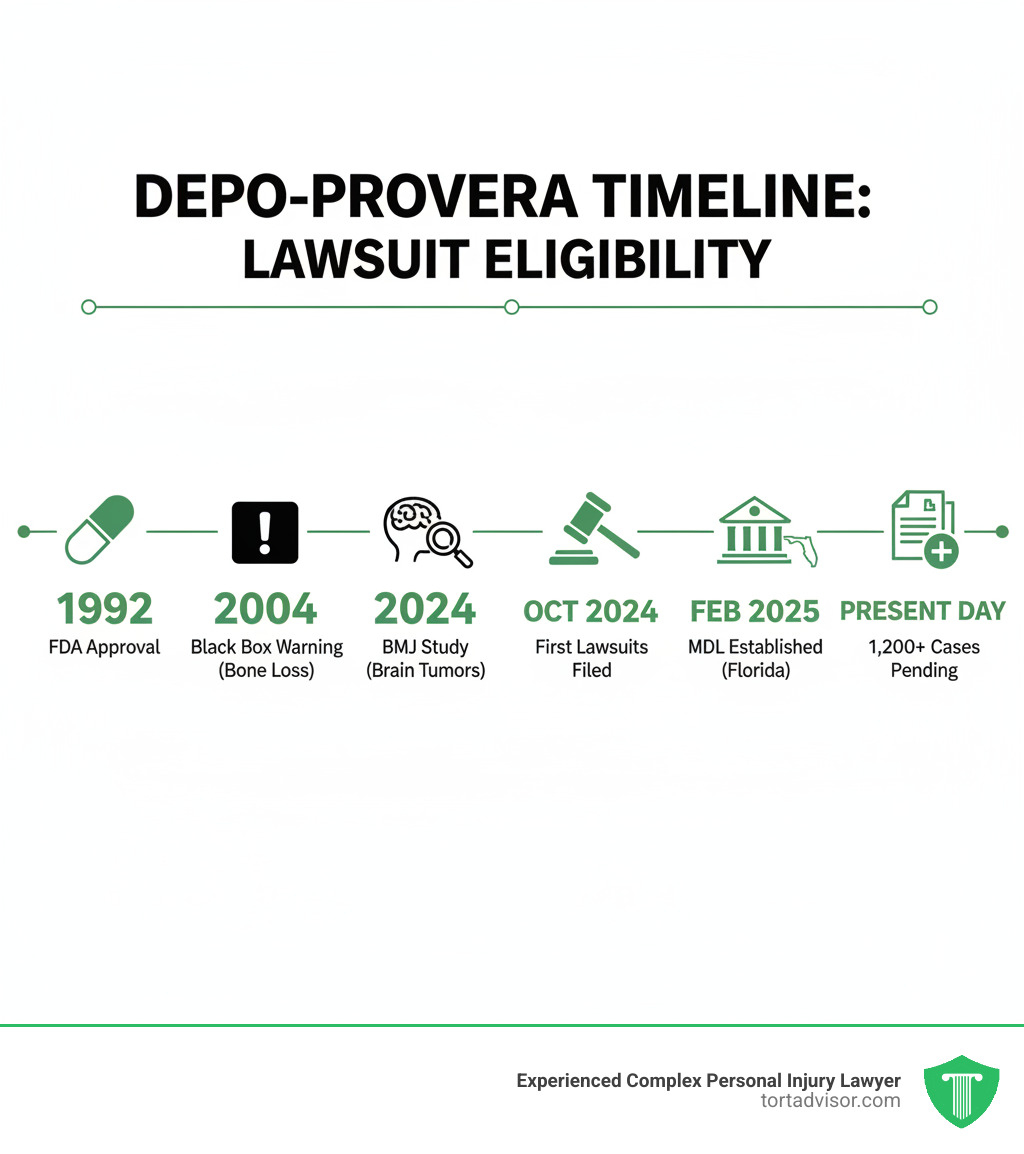
Depo-Provera, manufactured primarily by Pfizer and available in generic formulations as medroxyprogesterone acetate (MPA), is a long-acting progestin injectable contraceptive administered every 12 to 13 weeks. First approved by the U.S. Food and Drug Administration (FDA) in 1992, the injection delivers a high dose of synthetic progesterone to suppress ovulation, thicken cervical mucus, and thin the endometrial lining. While effective as birth control and as a treatment for conditions like endometriosis, the biological mechanism relies on sustained, systemic hormone exposure.
Progesterone receptors are abundant in the meninges—the protective layers of tissue enveloping the brain and spinal cord. Scientific literature has long acknowledged that certain hormone-sensitive tissues react to synthetic progestogens. However, explicit warnings regarding brain tumors were historically absent from U.S. patient packaging and prescribing information.
- Long-Term Medroxyprogesterone Acetate (MPA) Exposure
- Sustained Binding to Progesterone Receptors in Meningeal Tissue
- Accelerated Cellular Proliferation in Meninges
- Development or Growth of Intracranial Meningioma (Brain Tumor)
The evidentiary turning point for litigation occurred in March 2024, when a comprehensive nationwide case-control study conducted by French researchers was published in The BMJ. Analyzing health data from millions of women, the study evaluated the association between various progestogen medications and the incidence of intracranial meningioma requiring surgery or radiotherapy.
The findings revealed that prolonged use (defined as one year or longer) of medroxyprogesterone acetate was associated with a 5.55-fold increased risk of developing intracranial meningioma compared to non-users.
Understanding Meningiomas and Their Impact
A meningioma is a tumor that arises from the meninges. Although typically classified as histologically benign (Grade I according to World Health Organization standards), intracranial meningiomas are non-malignant only in the sense that they rarely metastasize to distant organs. Within the confined space of the skull, a growing meningioma exerts mass effect, displacing brain parenchyma, compressing cranial nerves, and obstructing cerebrospinal fluid flow.
Clinical manifestations depend heavily on tumor location and size, often including:
- Severe, persistent headaches resistant to standard analgesics.
- Visual disturbances, including double vision, blurred vision, or partial vision loss due to optic nerve compression.
- Seizures resulting from cortical irritation.
- Cognitive and behavioral changes, including memory impairment, personality shifts, and executive dysfunction.
- Motor deficits and sensory loss, such as localized weakness, numbness, or loss of balance.
Treatment frequently requires invasive neurosurgery (craniotomy) to resect the mass, followed in many cases by targeted radiation therapy or stereotactic radiosurgery if complete surgical removal is precluded by proximity to critical neurovascular structures. Patients often face prolonged rehabilitation, permanent neurological deficits, and the ongoing psychological burden of annual brain imaging to monitor for tumor recurrence.
Core Legal Allegations in Depo-Provera Litigation
The central claim across federal and state court complaints is that the drug’s manufacturers knew, or reasonably should have known, about the association between high-dose synthetic progestins and meningioma growth, yet failed to adequately warn prescribers and patients.
- Manufacturer Duty of Care & Knowledge
- Foreign Regulatory Warnings (EU/UK Mandated Disclosures)
- U.S. Prescribing Labeling (Omitted Meningioma Risks)
- Failure-to-Warn & Strict Liability Legal Claims
1. Failure to Warn (Inadequate Labeling)
Under product liability doctrine, pharmaceutical manufacturers possess an ongoing duty to monitor post-market scientific literature, report adverse events, and update drug product labeling to reflect emerging safety risks. Plaintiffs contend that Pfizer and subsidiary entities possessed scientific data for years indicating that progestins stimulate meningioma cell proliferation.
Despite this body of knowledge, the U.S. package insert for Depo-Provera focused warnings predominantly on bone mineral density loss, thromboembolic events, and breast cancer risks, omitting explicit warnings regarding intracranial meningiomas until legal and regulatory pressure escalated.
2. Regulatory Disparity and Foreign Warning Label Updates
A critical pillar of the failure-to-warn argument involves international regulatory disparity. In several jurisdictions outside the United States, including European Union member states and the United Kingdom, regulatory authorities like the European Medicines Agency (EMA) and the UK Medicines and Healthcare products Regulatory Agency (MHRA) initiated reviews and mandated explicit warnings on progestogen products after observing signal data linking high-dose progestins to meningiomas.
Plaintiffs argue that drug makers provided clear warnings to European physicians and patients while failing to update U.S. labeling with equivalent warnings. This geographical divergence in safety communications forms strong evidence of failure to exercise reasonable care under U.S. tort law.
3. Design Defect and Negligence
Alongside failure-to-warn counts, complaints typically include causes of action for:
- Strict Product Liability (Design Defect): Alleging that the risks inherent in the high-dose formulations of medroxyprogesterone acetate outweigh the therapeutic benefits, particularly when safer contraceptive alternatives are available.
- Negligent Misrepresentation: Alleging that manufacturers actively marketed Depo-Provera as safe for long-term administration without performing adequate long-term safety studies on brain tissue impact.
- Breach of Express and Implied Warranties: Asserting that the product failed to perform safely under its intended and directed conditions of use.
Procedural Status and Litigation Structure
As individual lawsuits mounted throughout late 2024, plaintiffs’ attorneys petitioned the Judicial Panel on Multidistrict Litigation (JPML) to consolidate federal actions into a Multidistrict Litigation (MDL). Consolidation streamlines pre-trial discovery, avoids duplicative depositions, prevents conflicting pre-trial rulings across federal districts, and establishes a centralized forum for bellwether trials.
- Individual Lawsuits Filed in Federal District Courts
- JPML Consolidation Motion (Establishment of Federal MDL)
- Coordinated Discovery & Motion Practice (Master Docket)
- Bellwether Selection & Representative Trials
Federal MDL Motion and State Court Coordination
Federal Depo-Provera actions filed across multiple U.S. district courts focus on common legal and factual questions, primarily whether medroxyprogesterone acetate causes intracranial meningiomas and whether the manufacturer provided adequate warnings.
In addition to federal MDL proceedings, coordinated state court litigations have been established in key jurisdictions such as California and Pennsylvania, where major pharmaceutical defendants maintain operations or corporate presences. State court proceedings often move on parallel tracks, serving as additional indicators of claim viability and defense strategies.
The Role of Bellwether Trials
Once the federal MDL structure is finalized, the presiding judge selects a representative sample of cases for "bellwether" trials. These trials test legal theories, expert testimony, and jury reactions in real-world courtroom settings. While bellwether verdicts are not binding on other cases within the MDL, their outcomes heavily influence global settlement evaluations and risk assessments for both defense counsel and plaintiffs' steering committees.
Summary Framework of the Depo-Provera Litigation
The following matrix outlines the primary legal, medical, and procedural dimensions of the Depo-Provera meningioma litigation.
| Aspect | Key Details & Specifications |
|---|---|
| Primary Chemical Entity | Medroxyprogesterone Acetate (MPA) 150 mg/mL injection |
| Primary Defendants | Pfizer Inc., Pharmacia & Upjohn Co., and authorized generic distributors |
| Pivotal Study | The BMJ (March 2024; 384:e078011) demonstrating a 5.55x increased meningioma risk for prolonged MPA use |
| Core Neurological Injury | Intracranial Meningioma (Grade I–III), requiring surgery, radiation, or ongoing monitoring |
| Primary Legal Cause of Action | Strict liability failure to warn, design defect, negligent marketing |
| Core Eligibility Criteria | Verified Depo-Provera use (typically 1+ years / 4+ injections) prior to meningioma diagnosis |
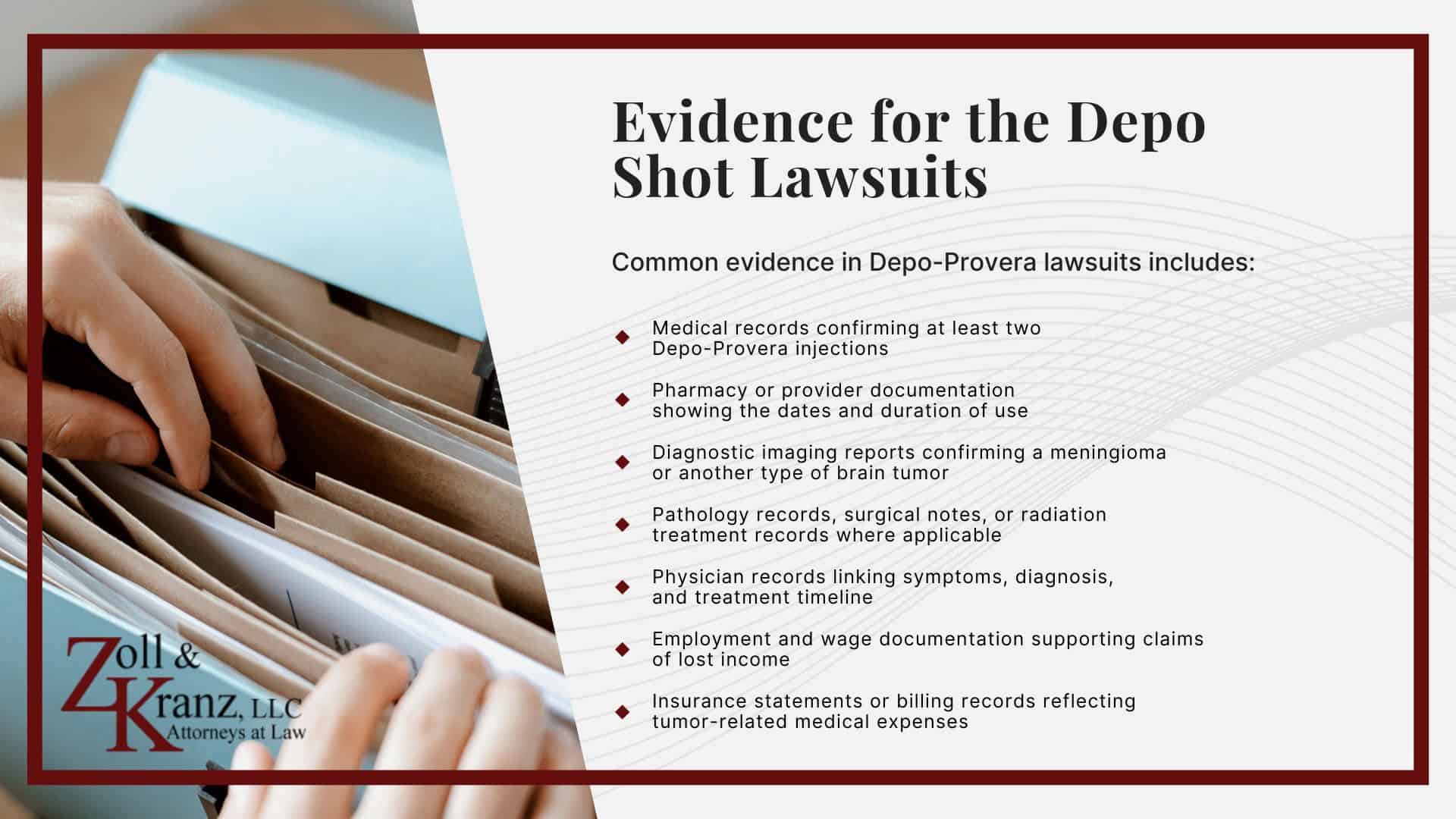
| Key Evidentiary Documents | Pharmacy dispense records, administration charts, MRI/CT neuroimaging reports, surgical pathology |
| Litigation Structure | Federal Multidistrict Litigation (MDL) and parallel state court coordinated proceedings |
Claim Eligibility and Required Documentation
Building a viable Depo-Provera meningioma claim requires establishing clear proof of product exposure and an unequivocal medical diagnosis. Law firms managing these cases apply strict screening criteria to ensure claims meet court-mandated evidentiary standards.
- Core Claim Qualification Checklist
- Exposure Proof: 1+ Years of Depo Prescriptions
- Diagnostic Record: Confirmed Brain Tumor (MRI/CT)
- Causal Timing: Diagnosis Follows Depo Exposure
Qualification Criteria
To qualify for legal review, prospective plaintiffs must generally satisfy three baseline prerequisites:
- Documented Exposure: Proof of receiving Depo-Provera (or an authorized generic equivalent) over an extended duration. Most legal frameworks prioritize claimants who received injections over a period of at least one year (four or more consecutive injections).
- Confirmed Diagnosis: Objective medical imaging (Brain Magnetic Resonance Imaging [MRI] or Computed Tomography [CT] scans) or surgical pathology reports confirming an intracranial meningioma diagnosis.
- Temporal Relationship: The meningioma diagnosis must occur either during active Depo-Provera use or after a documented period of long-term use. Cases where the tumor was diagnosed prior to starting Depo-Provera are generally excluded unless evidence shows substantial accelerated growth directly linked to subsequent hormone administration.
Mandatory Medical and Prescribing Evidence
Documenting a pharmaceutical product liability claim relies heavily on contemporaneous medical records rather than personal recall. Essential records include:
- Prescribing and Dispensing Records: Prescriptions from treating gynecologists, primary care providers, or family planning clinics, along with pharmacy logbooks verifying brand-name Depo-Provera or generic MPA dispensing.
- Administration Records: Medical clinic charting indicating exact dates, dosage amounts, injection sites, and lot numbers for each administered shot.
- Neuroimaging Reports: Formal radiologist readings of brain MRIs or CT scans detailing tumor measurements, location (e.g., sphenoid wing, olfactory groove, parasagittal), and structural mass effect on surrounding brain tissue.
- Operative and Pathology Reports: If surgical resection or biopsy was performed, neurosurgical operative notes and pathology reports confirming histological diagnosis of meningioma are essential to prove injury severity.
Damages and Compensation Metrics in Brain Tumor Litigation
Because intracranial meningiomas often necessitate high-risk neurosurgical interventions and can cause lasting neurological impairment, damage assessments in these cases reflect significant physical, economic, and emotional losses.
- Total Claim Compensation
- Economic Damages
- Medical & Surgical Bills
- Future Neuro-Rehab Costs
- Lost Income & Capacity
- Non-Economic Damages
- Physical Pain & Suffering
- Emotional Distress
- Loss of Life Quality
- Economic Damages
Calculations for potential compensation fall into two primary classifications under civil tort law:
Economic Damages (Hard Financial Losses)
- Past and Future Medical Expenses: Covers craniotomies, hospital stays, neurosurgeon fees, radiation treatments, specialized diagnostic imaging, medication costs, and ongoing neurological follow-ups.
- Rehabilitation Costs: Expenses related to post-surgical physical therapy, occupational therapy, speech therapy, and cognitive rehabilitation.
- Lost Wages and Loss of Earning Capacity: Compensation for time taken off work during diagnosis, surgery, and recovery, as well as long-term reductions in earning potential caused by permanent cognitive or physical disability.
- Life Care Planning: For catastrophic cases involving severe neurofunctional deficits, formal life care plans project lifetime expenditures for home health assistance, home modifications, and assistive technology.
Non-Economic Damages (Quality of Life Impacts)
- Physical Pain and Suffering: Compensation for the intense physical pain caused by intracranial pressure, invasive surgical procedures, and post-operative recovery.
- Emotional Distress and Psychological Impact: Addressing anxiety, depression, terror, and emotional trauma associated with facing a brain tumor diagnosis and neurosurgery.
- Permanent Disability and Impairment: Financial recovery for lasting brain damage, visual loss, persistent seizures, memory deficits, or motor impairments.
- Loss of Enjoyment of Life: Compensation for the inability to participate in family life, hobbies, career pursuits, and daily activities enjoyed prior to the injury.
Statutes of Limitations and Critical Legal Deadlines
A critical challenge in Depo-Provera litigation involves navigating state-specific Statutes of Limitations (SOL). A statute of limitations sets a strict legal deadline by which an injured party must file a lawsuit. Failing to file before this window closes permanently bars the plaintiff from seeking compensation.
- Date of Brain Tumor Diagnosis / Symptoms Discovered
- Discovery Rule Clock Begins Running
- State Limitation Window (Typically 1 to 3 Years)
- FINAL FILING DEADLINE (Failure to file bars claim)
Applying the "Discovery Rule"
In latent injury and drug safety litigation, many states apply the Discovery Rule. Under this doctrine, the statute of limitations clock does not automatically start on the day the drug was injected, or even necessarily on the day the meningioma first began growing undetected. Instead, the statutory period typically begins when the plaintiff:
- Discovered (or reasonably should have discovered) the meningioma diagnosis; AND
- Discovered (or reasonably should have discovered) a causal connection between the injury and the defendant’s product (e.g., public reports linking Depo-Provera to meningiomas).
Because state laws differ significantly—ranging from one-year filing windows in states like California, Kentucky, and Louisiana to three-year windows in states like New York and Washington—prompt legal evaluation is critical.
Steps to Take If You Were Diagnosed with a Meningioma After Depo-Provera Use
If you or a family member used Depo-Provera for an extended period and were subsequently diagnosed with an intracranial meningioma, systematic preparation is essential to protect your health and legal rights.
- Step 1: Prioritize Neurological Care & Treatment
- Step 2: Request Complete Medical & Prescription History
- Step 3: Document Symptom Timeline & Work Impact
- Step 4: Consult a Specialized Product Liability Attorney
1. Prioritize Medical Management and Follow Treatment Plans
Your health and safety remain the primary concern. Continue working closely with your neurosurgeon, neuro-oncologist, and primary care physicians. Strictly adhere to recommended treatment protocols, follow-up imaging schedules, and rehabilitation therapies.
2. Request Complete Pharmacy and Medical Records
Contact your prescribing physicians, health systems, and dispensing pharmacies to secure complete copies of your medical charts. Specifically request:
- Medical records showing every date Depo-Provera was prescribed or administered.
- Pharmacy printouts reflecting all fills for medroxyprogesterone acetate.
- Complete radiology records, including original MRI/CT scan reports and image files (DICOM format on CD/DVD).
- Operative notes and pathology reports if surgical resection was conducted.
3. Maintain a Detailed Symptom and Expense Log
Document the daily impact of your condition. Keep a dedicated journal detailing:
- Physical symptoms, pain levels, sensory loss, or cognitive difficulties experienced daily.
- Dates of missed work, modified duties, or complete inability to perform job functions.
- Out-of-pocket expenses for medical visits, prescriptions, travel for specialized care, and home assistance.
4. Consult Experienced Legal Counsel Promptly
Product liability lawsuits against major pharmaceutical corporations require substantial legal resources, expert medical witnesses, and complex litigation experience. Schedule a consultation with a law firm specializing in mass torts and pharmaceutical litigation. Initial case evaluations are typically conducted at no upfront cost, and legal representation is generally provided on a contingency fee basis (meaning legal fees are collected only if compensation is successfully recovered).
Frequently Asked Questions
What is the link between Depo-Provera and meningiomas?
A major epidemiological study published in The BMJ in March 2024 revealed that long-term use (one year or longer) of medroxyprogesterone acetate (Depo-Provera) is associated with a 5.55-fold increased risk of developing intracranial meningiomas. Progesterone receptors located within the meninges (the tissue surrounding the brain) can react to sustained high doses of synthetic progestins, triggering or accelerating tumor growth.
Are all brain tumors covered in the Depo-Provera lawsuits?
Current litigation focuses specifically on intracranial meningiomas, which are tumors arising from the meningeal tissue surrounding the brain. Other types of brain tumors, such as glioblastomas, astrocytomas, or metastatic lesions from other cancer types, do not share the same established progestin-receptor link and are generally not part of these claims.
What if I used a generic version of Depo-Provera?
Generic formulations contain the same active ingredient—medroxyprogesterone acetate—as brand-name Depo-Provera. Legal eligibility for generic claims depends on specific state laws and legal precedent surrounding generic manufacturer preemption. An attorney specializing in drug litigation can evaluate whether your specific generic manufacturer can be held liable under applicable state tort laws.
How long do I have to file a Depo-Provera lawsuit?
The time frame to file depends on the statute of limitations in your state, which typically ranges from one to three years. Under the "discovery rule," this period generally starts when you knew or reasonably should have known about both your meningioma diagnosis and its potential link to Depo-Provera. Because statutes of limitations are strictly enforced, consulting legal counsel as early as possible is recommended.
Do I have a claim if my meningioma was benign and non-cancerous?
Yes. The vast majority of intracranial meningiomas are non-malignant (Grade I), but they remain serious medical conditions. Due to the enclosed space within the skull, even non-cancerous tumors cause severe nerve compression, brain tissue displacement, seizures, and visual impairment, often requiring open neurosurgery (craniotomy) or radiation therapy. Compensation claims are based on the severity of the injury and treatment, not solely on whether the tumor was malignant.
Final Guidance and Next Actions
If you or a loved one used Depo-Provera long-term and subsequently developed an intracranial meningioma, taking prompt, structured action is critical.
Start by obtaining your comprehensive medical and prescription records, preserving all radiology files, and consulting a qualified mass tort attorney. Early legal evaluation helps ensure that statutory deadlines are met, evidence is properly preserved, and your legal rights are fully protected as the federal and state litigation progresses.