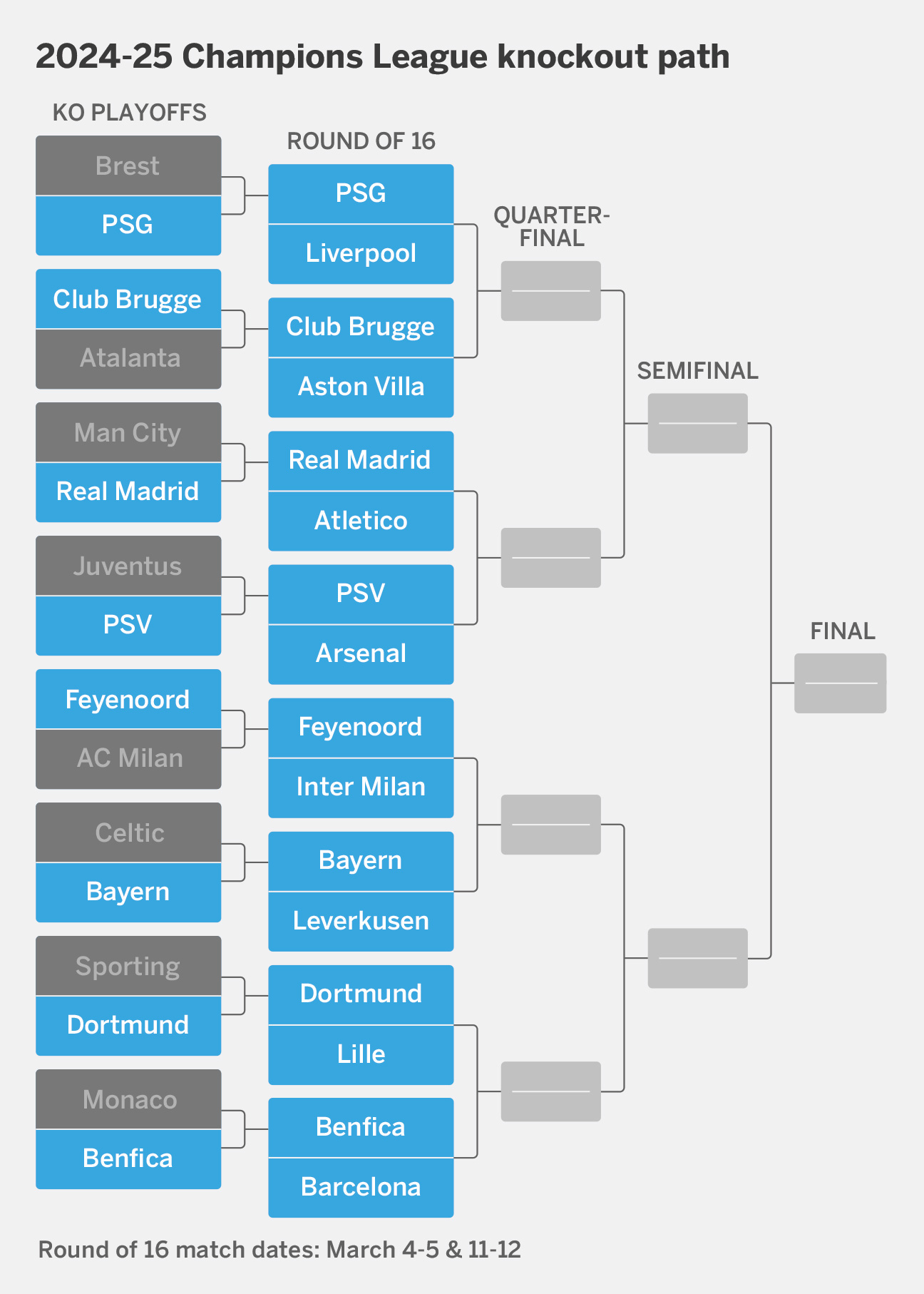
The 2024–25 UEFA Champions League bracket represents the most radical structural overhaul in the history of Europe's premier club football competition, replacing the traditional group stage with a 36-team single-league phase followed by a revamped knockout tournament path.
Introduction to the Expanded 2024–25 Champions League Format
The 2024–25 UEFA Champions League season introduced a massive transformation to European club football. For decades, fans and analysts grew accustomed to the classic group stage format, which featured 32 teams divided into eight groups of four. However, starting with the 2024–25 campaign, European football governing body UEFA implemented the "Swiss Model" league phase. This structural shift expanded the competition to 36 participating clubs, unified them into a single giant league table, and permanently altered how the tournament bracket functions from the opening matchday through to the final.
Understanding this new bracket layout requires navigating several moving parts, including qualification mechanics, the mechanics of the league phase draw, the seeding process, and the updated path to the knockout rounds. Whether you are tracking your favorite club's progression, managing fantasy football rosters, or analyzing tactical trends, grasping the new mechanics is essential. This comprehensive guide details the structure, scheduling, tactical impacts, and bracket progression of the 2024–25 UEFA Champions League.
Historical Shift: Moving from the Traditional Group Stage to the Swiss Model
To understand the 2024–25 bracket, it is necessary to examine why the traditional format was abandoned. For over twenty years, the Champions League group stage consisted of home-and-away round-robin matches within eight discrete groups. While this system produced legendary nights, it frequently suffered from dead rubbers—matches played in the final two matchdays where qualification or elimination was already mathematically sealed, leading to heavily rotated squads and diminished competitive intensity.
The newly adopted Swiss Model, borrowed from chess and adapted for association football, eliminates traditional groups entirely. Instead of playing three opponents twice, every club plays eight matches against eight different opponents in the league phase.
| Feature | Traditional Group Stage (Pre-2024) | New League Phase (2024–25 Onward) |
|---|---|---|
| Total Teams | 32 clubs | 36 clubs |
| Stage Structure | 8 groups of 4 teams | 1 single unified league table |
| Opponents per Team | 3 opponents (home and away) | 8 opponents (single matches) |
| Matches per Club | 6 matches in the group stage | 8 matches in the league phase |
| Qualification Direct | Top 2 from each group (16 teams) | Top 8 in the single league table |
| Knockout Playoffs | None (direct to Round of 16) | 9th through 24th place play a two-legged playoff |
This structural evolution ensures that clubs face a broader variety of opponents and keeps the league table mathematically dynamic right up to the final whistle of the league phase.
Qualification and Seeding for the 36-Team League Phase
The journey to the 2024–25 Champions League bracket begins well before the first ball is kicked in autumn, governed by stringent UEFA coefficient rankings and domestic league finishes.
Allocation of the Four Additional Spots
The expansion from 32 to 36 teams introduced four new entry berths, distributed as follows:
- The Fifth Association Spot: Awarded to the association ranked fifth in the UEFA national association coefficient ranking (which went to the French Ligue 1, granting an additional direct entry).
- The European Performance Spot: Awarded to the two associations whose clubs achieved the highest collective coefficient performance during the previous European season (which resulted in extra places for Italy's Serie A and Germany's Bundesliga in 2024–25).
- The Champions Path Extension: An extra spot added to the Champions Path of the qualifying rounds, raising the number of teams qualifying through the preliminary rounds from four to five.
Seeding Pots and the Draw Procedure
Prior to the league phase draw, the 36 qualified teams are divided into four seeding pots, each containing nine clubs. Pot 1 consists of the titleholder and the top eight clubs in the UEFA club coefficient rankings. Pots 2, 3, and 4 are ordered according to the remaining club coefficients.
Unlike previous draws where teams were manually drawn into lettered groups (A through H), the 2024–25 draw utilized an automated hybrid system. Software randomly assigned each team two opponents from each of the four seeding pots. Every club plays one home match and one away match against opponents from each pot. Crucially, clubs cannot face opponents from their own domestic association during the league phase, and a team can be drawn against a maximum of two clubs from any single foreign association.
Navigating the League Phase Table and Standings
The single-league table acts as the foundation of the entire 2024–25 tournament. With 36 teams competing for progression, the margin for error is narrow, and goal difference carries immense weight.
Points and Ranking Criteria
Teams earn three points for a win, one point for a draw, and zero points for a defeat. If two or more teams finish level on points during the league phase standings, UEFA applies the following tie-breaking criteria in strict sequential order:
- Superior goal difference in the league phase.
- Higher number of goals scored in the league phase.
- Higher number of away goals scored in the league phase.
- Higher number of matches won in the league phase.
- Higher number of away matches won in the league phase.
- Higher collective points obtained by league phase opponents.
- Superior collective goal difference of league phase opponents.
- Higher collective goals scored by league phase opponents.
- Lower disciplinary points total based strictly on yellow and red cards received (red card = 3 points, yellow card = 1 point, expulsion for two yellow cards = 3 points).
- Better club coefficient ranking.
The Three Bracket Tiers
At the conclusion of the eight-match league phase, the 36-team table splits into three distinct competitive tiers that dictate the makeup of the knockout bracket:
- Tier 1: Direct Qualification (Positions 1 through 8) The top eight finishing clubs secure direct entry into the Round of 16. They also earn the tactical advantage of playing the second leg of their Round of 16 ties at home.
- Tier 2: The Knockout Phase Play-offs (Positions 9 through 24) Teams finishing from 9th to 24th enter a two-legged knockout play-off round. Teams placed 9th to 16th are seeded and play the return leg at home against the unseeded teams placed 17th to 24th.
- Tier 3: Elimination (Positions 25 through 36) Teams finishing from 25th down to 36th are eliminated entirely from European competition for the season. Unlike past iterations, there is no longer a safety net transfer down to the UEFA Europa League knockout rounds.
The Knockout Phase Bracket and Path to the Final
Once the league phase concludes and the knockout play-offs are resolved, the traditional bracket format returns, though with distinct pairing rules rooted in the league phase finish.
- League Phase: Top 8
- Advances to: Round of 16 (Seeded)
- Play-offs: 9th-24th
- Advances to: Round of 16 Play-offs
- Leads to: Quarter-Finals
- Leads to: Semi-Finals
- Leads to: Final
The Knockout Phase Play-off Draw
The play-off matchups for teams finishing 9th through 24th are not entirely random. The draw is paired based on league rankings:
- Teams ranked 9th and 10th are paired to face either the 23rd or 24th ranked team.
- Teams ranked 11th and 12th face either the 21st or 22nd ranked team, and so forth. This seeding structure rewards clubs that finish higher up the league table by matching them against lower-ranked opponents and granting home-field advantage for the second leg.
The Round of 16 and Bracket Protection
The eight winners of the knockout play-offs advance to the Round of 16, where they join the top eight teams that qualified directly from the league phase.
To maintain competitive integrity and reward consistency during the league phase, the top four finishing teams (1st, 2nd, 3rd, and 4th) are protected in the draw. They are placed on opposite sides of the bracket, ensuring they cannot face one another until the semi-finals or the final. Similarly, teams placed 5th through 8th are paired against the winners of the play-offs involving the 9th through 16th ranked league finishers.
From the quarter-finals onward, standard open draws determine the path to the semi-finals and the grand finale, which is hosted at a pre-determined neutral venue.
Common Strategic Challenges and Misconceptions
The introduction of the expanded 2024–25 format generated considerable discussion among managers, players, and supporters. Navigating this new landscape exposes several tactical hurdles and common misconceptions.
Fixture Congestion and Squad Depth
One of the primary criticisms of the expanded bracket is the increase in fixture volume. Under the old system, teams played six group matches. Under the Swiss Model, every team in the league phase plays eight matches—two additional fixtures that must be accommodated into an already packed domestic and international calendar. For elite clubs competing for domestic league titles, domestic cups, and European silverware, squad rotation becomes an absolute necessity. Managers cannot rely solely on an elite starting eleven; they must trust their bench depth to secure results during winter fixture congestion.
The Goal Difference Misconception
In traditional group stages, goal difference was primarily used as a tie-breaker between two teams that finished level on points. In the single 36-team league table of the 2024–25 Champions League, goal difference is a global currency that affects every single position. Because dozens of teams can finish on the exact same points total, a single goal conceded in the closing minutes of Matchday 8 can drop a club from 8th place (direct qualification) to 9th place (forcing them into an extra two-legged play-off round). Consequently, teams often continue attacking or defending aggressively deep into matches regardless of the immediate scoreline.
Frequently Asked Questions About the 2024–25 Champions League Bracket
How many teams qualify for the 2024–25 UEFA Champions League league phase?
Thirty-six teams participate in the league phase of the 2024–25 UEFA Champions League. This represents an increase of four teams compared to the 32-team format used in previous seasons. The expansion includes slots awarded based on domestic league positions, association coefficients, and qualifying rounds.
What happens if two teams finish with the same number of points in the league phase?
If teams finish level on points, the primary tie-breaker is overall goal difference in the league phase, followed by total goals scored, away goals scored, matches won, away matches won, and collective opponent metrics. Disciplinary records and club coefficients serve as secondary tie-breakers if teams remain deadlocked.
Do teams from the same country play each other in the league phase?
No, UEFA rules explicitly state that clubs cannot face opponents from their own domestic association during the league phase. A team can be drawn against a maximum of two clubs from any single foreign association, ensuring geographical variety across the eight fixtures.
Are teams eliminated from the Champions League transferred to the Europa League?
No. Under the previous format, teams finishing third in their Champions League groups dropped down into the UEFA Europa League knockout round play-offs. Starting in the 2024–25 season, this practice was abolished. Teams that finish from 25th to 36th in the single league table are eliminated from European competition entirely for the remainder of the season.
How are the Round of 16 matchups determined after the league phase?
The top eight teams from the league phase qualify directly for the Round of 16 and are seeded in the draw. Teams finishing 9th through 24th enter a two-legged knockout play-off round. The winners of those play-offs advance to fill the remaining eight slots in the Round of 16, where they face the top-tier seeded clubs based on pre-determined bracket pairings.
Summary and Practical Next Actions
The 2024–25 UEFA Champions League bracket revolutionized European football by replacing predictable group stages with a high-stakes, 36-team single league table. To stay fully informed as a supporter, analyst, or fantasy manager, monitor the live league standings closely, account for goal difference as a primary ranking metric, and keep track of squad rotation schedules as teams balance domestic priorities with the expanded eight-match league phase. Review official UEFA match schedules and coefficient updates regularly to track qualification paths and upcoming knockout fixtures accurately.