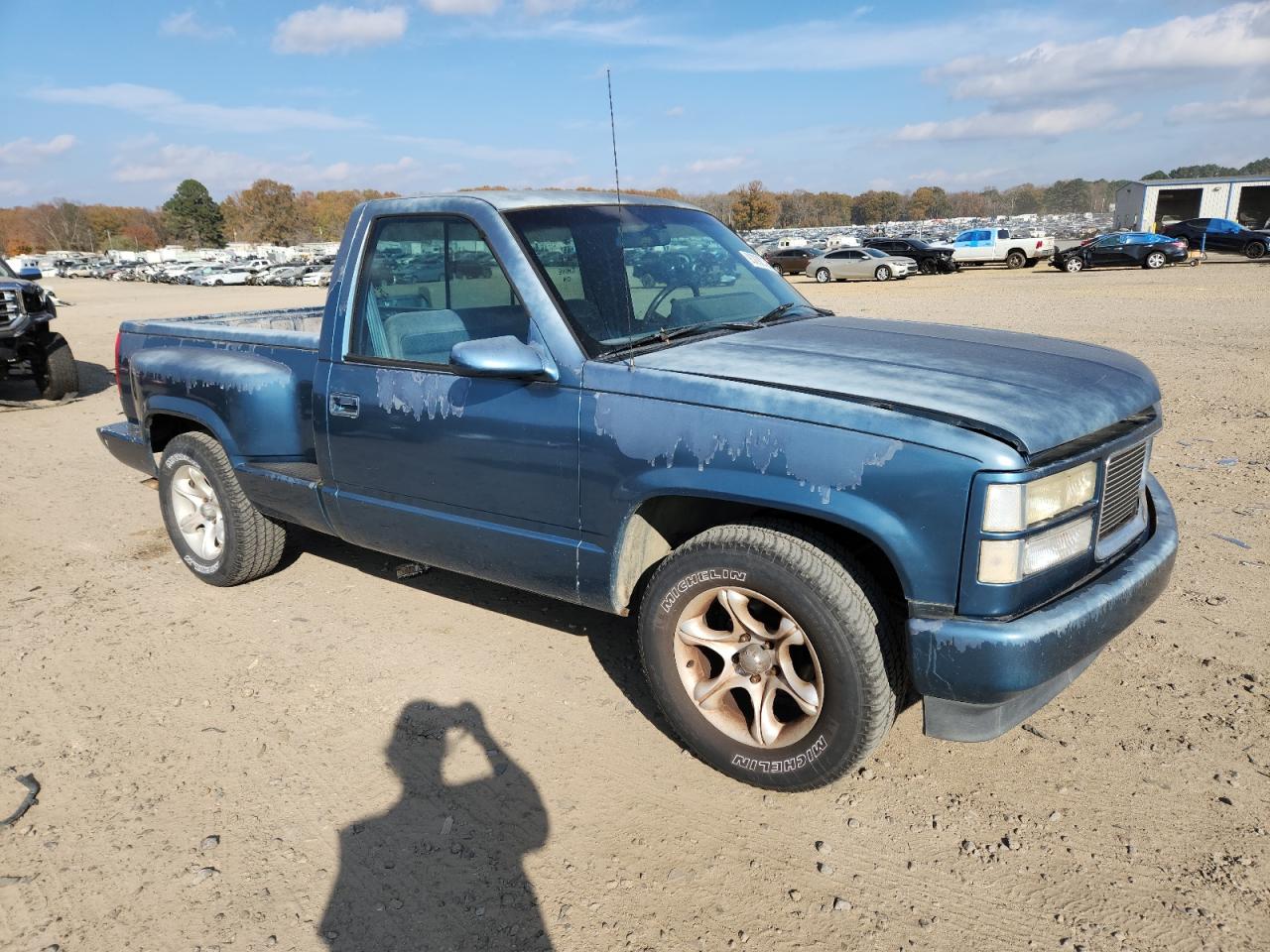
The 1990 Chevrolet C1500 is a pivotal half-ton pickup truck from the GMT400 platform era, celebrated for introducing independent front suspension and aerodynamic styling to the full-size truck market. As of 2026, it remains a highly sought-after "Old Body Style" (OBS) classic, valued for its 5.7L TBI V8 reliability, the introduction of the 454 SS performance model, and its car-like interior ergonomics.
The Dawn of the GMT400 Revolution
The 1990 model year represents the third year of the GMT400 platform, which originally debuted in 1988 to replace the aging "Square Body" (R/V series) that had been in production since 1973. By 1990, Chevrolet had refined the manufacturing processes for this new generation, solidifying the C1500 (the "C" denoting two-wheel drive) as the benchmark for American pickups.
This era marked a fundamental shift in how trucks were designed. Before the GMT400, pickups were primarily utilitarian tools with rigid ride qualities and boxy, wind-resistant shapes. The 1990 C1500 featured a more sculpted, aerodynamic exterior with flush-mounted side glass and a narrower frontal area to improve fuel efficiency and reduce wind noise. Underneath, the transition to an independent front suspension (IFS) with torsion bars on four-wheel-drive models and coil springs on two-wheel-drive models like the C1500 provided a level of ride comfort previously unseen in the segment.
Engineers at General Motors focused heavily on the "lifestyle" buyer during this period. While the truck maintained its ladder-frame durability, the inclusion of a more ergonomic dashboard, better sound insulation, and a wider cab made it a viable alternative to the family sedan. This cultural shift in 1990 helped pave the way for the modern luxury truck market we see in 2026.
1990 C1500 Engine and Powertrain Options
In 1990, Chevrolet offered a diverse lineup of engines for the C1500, ranging from economical six-cylinders to massive big-block V8s. The primary technology across the gasoline range was Throttle Body Injection (TBI). While TBI is often viewed in 2026 as a bridge between carburetion and modern multi-port fuel injection, it was prized for its simplicity and improved cold-start reliability compared to the carburetors of the 1980s.
The 5.7L 350 V8: The Workhorse
The most common and arguably the best engine for the 1990 C1500 was the 5.7L (350 cubic inch) L05 V8. Producing 210 horsepower and 300 lb-ft of torque, this engine provided a balanced mix of towing capability and longevity. Its cast-iron block and head design made it nearly "bulletproof," provided the basic cooling system was maintained. In the current secondary market, trucks equipped with the 5.7L command a premium because of the vast availability of affordable replacement parts.
The 4.3L V6 and 5.0L V8
For buyers focused on fuel economy or light-duty tasks, the 4.3L LB4 V6 was the standard offering. Essentially a 350 V8 with two cylinders removed, it shared many internal components with its larger sibling, making it incredibly durable. The 5.0L (305 cubic inch) V8 sat in the middle of the lineup, though many buyers opted to step up to the 5.7L for the significant increase in torque with only a marginal penalty in fuel consumption.
The 1990 454 SS: A High-Performance Milestone
1990 was the inaugural year for the legendary C1500 454 SS. This was a dedicated performance truck that stuffed a 7.4L (454 cubic inch) big-block V8 into a short-bed, regular-cab chassis.
- Performance: 230 hp and 385 lb-ft of torque.
- Aesthetics: Only available in Onyx Black with a Garnet Red interior.
- Hardware: It featured a heavy-duty 3.08 rear axle ratio (later upgraded in 1991), Bilstein shocks, and a quicker steering ratio. The 454 SS remains the crown jewel for 1990 collectors in 2026, representing the precursor to the modern "super-truck" era.
Chassis, Suspension, and Handling
The 1990 C1500 utilized a fully welded frame with a boxed front section for increased rigidity. This was a major departure from the C-channel frames of earlier decades, which were prone to significant flex. By stiffening the front of the frame, GM allowed the suspension to do the work, resulting in more predictable handling.
The front suspension on the C1500 used unequal-length A-arms with coil springs and a stabilizer bar. This setup allowed each front wheel to react to road imperfections independently, drastically reducing the "bump steer" common in older trucks. The rear suspension remained a traditional live axle with semi-elliptic multi-leaf springs, ensuring the truck could still handle its rated payload—typically ranging from 1,400 to 1,900 pounds depending on the configuration.
Braking in 1990 was handled by a power-assisted system featuring front discs and rear drums. A significant safety feature for the time was the inclusion of a Rear-Wheel Anti-lock Brake System (RWAL), which helped prevent rear-wheel lockup during heavy braking in an unloaded state, a common cause of fishtailing in older pickups.
Interior Trims and Comfort Features
The 1990 C1500 was offered in three primary trim levels: Cheyenne, Scottsdale, and Silverado. These trims allowed the truck to scale from a bare-bones fleet vehicle to a well-appointed daily driver.
- Cheyenne: The base work truck. It typically featured vinyl bench seats, rubber floor mats, and minimal chrome. It was designed for ease of cleaning and maximum utility.
- Scottsdale: The mid-tier trim, which added better cloth upholstery, some carpeting, and additional exterior trim pieces.
- Silverado: The top-of-the-line trim. In 1990, a Silverado-trimmed C1500 felt like a luxury vehicle compared to its predecessors. It included full carpeting, high-back reclining bucket seats (optional), power windows, power locks, and air conditioning.
The 1990 dashboard is famous among enthusiasts for its "Moonie" gauges. These clusters used a unique electronic display with rolling film-style indicators for oil pressure, battery voltage, and temperature, rather than traditional needles. While aesthetically distinct, these are a common failure point that collectors in 2026 often have to refurbish or replace with later-style needle clusters from 1992–1994 models.
Technical Specifications Comparison
The following table outlines the key performance metrics for the primary engines available in the 1990 Chevrolet C1500.
| Engine | Displacement | Horsepower | Torque (lb-ft) | Fuel System |
|---|---|---|---|---|
| 4.3L V6 (LB4) | 262 cu in | 160 hp @ 4000 RPM | 235 lb-ft @ 2400 RPM | TBI |
| 5.0L V8 (L03) | 305 cu in | 175 hp @ 4000 RPM | 270 lb-ft @ 2400 RPM | TBI |
| 5.7L V8 (L05) | 350 cu in | 210 hp @ 4000 RPM | 300 lb-ft @ 2800 RPM | TBI |
| 7.4L V8 (L19) | 454 cu in | 230 hp @ 3600 RPM | 385 lb-ft @ 1600 RPM | TBI |
| 6.2L Diesel | 379 cu in | 135 hp @ 3600 RPM | 240 lb-ft @ 2000 RPM | Mechanical Inj. |
Critical Maintenance and Common Mechanical Issues
Owning a 1990 C1500 in 2026 requires an understanding of its specific mechanical quirks. While these trucks are famous for lasting 300,000 miles or more, they do have documented weaknesses that buyers should inspect.
Transmission Longevity
The automatic transmission used in the 1990 C1500 was the 700R4 (later renamed the 4L60). This was a four-speed overdrive unit that significantly improved highway fuel economy. However, the 700R4 relies on a Television (TV) cable to regulate internal line pressure based on throttle position. If this cable is misadjusted even slightly, it can lead to premature clutch failure and total transmission collapse.
Fuel System Challenges
The TBI system is generally reliable, but the dual injectors located atop the throttle body can develop leaks or "drip" rather than spray a fine mist. This leads to poor idle quality and reduced fuel economy. Additionally, the fuel pumps in these trucks are known to fail if the truck is frequently run with less than a quarter-tank of gas, as the fuel acts as a coolant for the pump.
Exterior and Body Issues
The paint used in the early 1990s by GM was notorious for "delamination," where the clear coat would peel away from the base coat, particularly on the hood and roof. Furthermore, while the GMT400 frame is robust, the cab corners and rocker panels are highly susceptible to rust in northern climates.
Dashboard and Electrical
The 1990 "Moonie" gauges often suffer from cracked solder joints on the circuit boards, causing the gauges to bounce or fail entirely. The dashboard plastic itself is also prone to UV damage, often cracking near the defrost vents if not protected by a dash cover.
The 1990 C1500 in 2026: Market Value and Collectibility
In 2026, the 1990 C1500 has moved firmly out of "used truck" territory and into the "classic vehicle" category. The market for these trucks—often referred to as the OBS (Old Body Style) market—has seen significant appreciation over the last decade.
- Standard C1500 (Clean Condition): A well-maintained Silverado trim with the 5.7L V8 and under 150,000 miles typically sells for between $12,000 and $18,000.
- Short Bed Regular Cab (Sport Look): These are the most desirable configurations for enthusiasts looking to build "street trucks." Prices for rust-free examples can exceed $20,000.
- 454 SS Models: As a limited-production performance icon, a 1990 454 SS in survivor condition can fetch between $35,000 and $55,000 at auction, with pristine examples occasionally climbing higher.
The GM Heritage Center provides extensive documentation on the production numbers and original brochures for these vehicles, which has helped collectors verify the authenticity of their trucks. Furthermore, resources like Hagerty provide real-time valuation data that confirms the steady climb in OBS Chevy values.
Frequently Asked Questions
Is the 1990 C1500 fuel-injected?
Yes, the 1990 C1500 uses Throttle Body Injection (TBI) for all gasoline engines. This system uses two fuel injectors located in a housing that looks similar to a carburetor. It provides better reliability and cold-start performance than older carbureted systems but is less efficient than the sequential multi-port fuel injection systems that became standard later in the 1990s.
What is the difference between a C1500 and a K1500?
The "C" designation indicates a two-wheel-drive (RWD) truck, while the "K" designation indicates a four-wheel-drive (4WD) truck. The C1500 generally has a lower ride height, better fuel economy, and uses a coil-spring front suspension, whereas the K1500 uses a torsion-bar front suspension and a transfer case for off-road capability.
Can you LS-swap a 1990 C1500?
LS-swapping is one of the most popular modifications for the 1990 C1500 in 2026. Because the engine bay is spacious and the GMT400 platform was used for many years, there is an enormous aftermarket for motor mounts, wiring harnesses, and headers specifically designed to put a modern LS-series V8 into this chassis. This allows owners to keep the classic look while gaining 400+ horsepower and modern reliability.
How much can a 1990 C1500 tow?
When properly equipped with the 5.7L V8 and the 3.42 or 3.73 rear axle ratio, a 1990 C1500 has a maximum towing capacity of approximately 6,000 to 6,500 pounds. However, for consistent heavy towing, the C2500 or C3500 models were recommended due to their heavier-duty cooling systems and transmissions.
Are parts still available for the 1990 C1500?
Yes, the 1990 C1500 is one of the best-supported classic trucks in the world. Between GM genuine parts and a massive secondary market, almost every single component—from body panels and interior trim to engine internals—is still in production. This makes the 1990 C1500 an excellent choice for a first-time restorer.
Practical Recommendation for Buyers
If you are looking to purchase a 1990 Chevrolet C1500 in 2026, prioritize body integrity over mechanical perfection. Because mechanical parts for the 350 V8 and 700R4 transmission are inexpensive and widely available, a truck with a blown engine but a rust-free frame and cab is often a better investment than a running truck with significant "cab corner" rot.
Seek out the "Silverado" trim for the best interior experience, but be prepared to address the common "Moonie" gauge failures and sagging headliners. For those looking for the ultimate investment, the 454 SS is the clear choice, though its fuel consumption makes it strictly a weekend cruiser rather than a daily driver. Regardless of the trim, the 1990 C1500 remains a hallmark of American engineering that successfully bridged the gap between the rugged trucks of the past and the comfortable, tech-heavy pickups of the modern era.