Aristotle’s views on government center on the belief that the state (polis) is a natural development intended to facilitate the "good life" for its citizens. He classified governments based on who rules and whose interest they serve, ultimately advocating for a "Polity"—a balanced, middle-class-led constitutional government—as the most stable and practical system.
Aristotle (384–322 BCE) remains a cornerstone of Western political thought. Writing in a period of significant Greek political volatility, his work Politics moved away from the idealistic utopias of his teacher, Plato, toward an empirical analysis of how societies actually function. As of 2026, his observations on institutional stability, the importance of the middle class, and the rule of law continue to inform modern constitutional theory and political science.
The Foundational Philosophy: Teleology and the Polis
To understand Aristotle’s views on government, one must first grasp his teleological worldview. Teleology is the study of ends or purposes. Aristotle argued that every natural thing has a "telos"—a goal it is meant to achieve. For human beings, that end is eudaimonia, often translated as "flourishing" or "living well."
Aristotle posited that the state is not an artificial construct or a necessary evil; rather, it is the highest form of human association. He traced the evolution of the state through a logical progression:
- The Family: Formed for the satisfaction of daily needs (reproduction and survival).
- The Village: A collection of families formed to meet non-daily needs through cooperation.
- The Polis (City-State): A collection of villages that reaches a level of full self-sufficiency.
According to Aristotle, while the state "comes into existence for the sake of life," it "continues to exist for the sake of the good life." Because humans can only achieve their full moral and intellectual potential within a community, the state is naturally prior to the individual in terms of importance and function.
Man as a Political Animal (Zoon Politikon)
One of Aristotle's most famous assertions is that "man is by nature a political animal." This does not merely mean that humans are social; many animals, like bees or ants, are social. Instead, Aristotle argued that humans are unique because they possess logos (speech and reason).
While other animals can express pleasure or pain through sound, humans use speech to deliberate on what is "expedient and inexpedient" and, more importantly, what is "just and unjust." Because the perception of these values is what constitutes a household and a city, the ability to participate in political life is what defines human nature. A person who can live without a state, Aristotle famously remarked, is either "a beast or a god."
The Classification of Governments: The Six-Fold Typology
Aristotle’s empirical method involved the study of 158 different Greek city-state constitutions. From this research, he developed a systematic classification of government types based on two criteria:
- How many people rule? (One, a few, or many).
- In whose interest do they rule? (The common good or the private interest of the rulers).
This resulted in three "true" or "correct" forms of government and three "perverted" or "deviant" forms.
The Classification Matrix
| Number of Rulers | True Form (Common Good) | Perverted Form (Self-Interest) |
|---|---|---|
| Rule by One | Monarchy (Kingship): Rule by a virtuous individual for the benefit of all. | Tyranny: Rule by a single person for their own benefit and pleasure. |
| Rule by a Few | Aristocracy: Rule by the "best" (the most virtuous) for the common good. | Oligarchy: Rule by the wealthy for the benefit of the rich. |
| Rule by the Many | Polity (Constitutional Gov): Rule by the citizens for the general welfare. | Democracy: Rule by the needy/poor for their own class interest. |
The True Forms
- Monarchy: Aristotle viewed an ideal monarchy as the highest form of government, provided the king was a person of transcendent virtue. However, he recognized this as practically impossible to maintain over generations.
- Aristocracy: Literally "rule by the best." This system places power in the hands of those with the highest merit and virtue. It differs from an oligarchy because the focus is on character and public service rather than wealth.
- Polity: This is Aristotle’s "practicable ideal." It is a constitutional government that blends elements of oligarchy (rule by the rich) and democracy (rule by the poor). It is characterized by the rule of law and a dominant middle class.
The Perverted Forms
- Tyranny: The worst form of government because it is the most removed from the common good. The tyrant uses the state's resources for personal enrichment and maintains power through fear.
- Oligarchy: In an oligarchy, the wealthy few use the machinery of the state to protect their property and increase their riches, often at the expense of the poor.
- Democracy: Modern readers are often surprised that Aristotle labeled democracy a "perverted" form. In the Greek context, democracy meant "rule by the many" (the demos), which in practice meant the poor. Aristotle feared that a pure democracy would lead to "mob rule," where the poor would use their numbers to confiscate the property of the rich, leading to instability.
The Doctrine of the Mean and the Middle Class
Aristotle’s political views are deeply integrated with his ethical philosophy, specifically the Doctrine of the Mean. In ethics, virtue is the middle ground between two extremes (e.g., courage is the mean between cowardice and recklessness). He applied this same logic to politics.
He argued that a stable state must avoid the extremes of wealth and poverty.
- The Very Wealthy: Often become arrogant, incapable of being ruled, and prone to "great crimes."
- The Very Poor: Often become malicious, incapable of ruling, and prone to "petty crimes."
The Middle Class (Mesoi), therefore, is the vital ingredient for a healthy state. Members of the middle class are more likely to follow reason and less likely to be motivated by the intense envy or ambition found at the socioeconomic extremes. A state with a large middle class is more stable because this group acts as a buffer, preventing either the rich or the poor from monopolizing power and engaging in class warfare.
Citizenship and the Role of Justice
Aristotle defined a citizen not by where they live, but by their participation in the administration of justice and in office. To Aristotle, being a citizen is an active role, not a passive status.
Requirements for Citizenship
Aristotle’s view of citizenship was highly exclusive by modern standards. He believed that to be a good citizen, one must have leisure. Leisure is necessary to study philosophy and engage in the demanding work of governance. Consequently, he excluded:
- Laborers and Mechanics: He argued their work made them "mean" and unable to exercise virtue.
- Women: Following the cultural prejudices of his time, he believed women lacked the authoritative deliberative faculty required for politics.
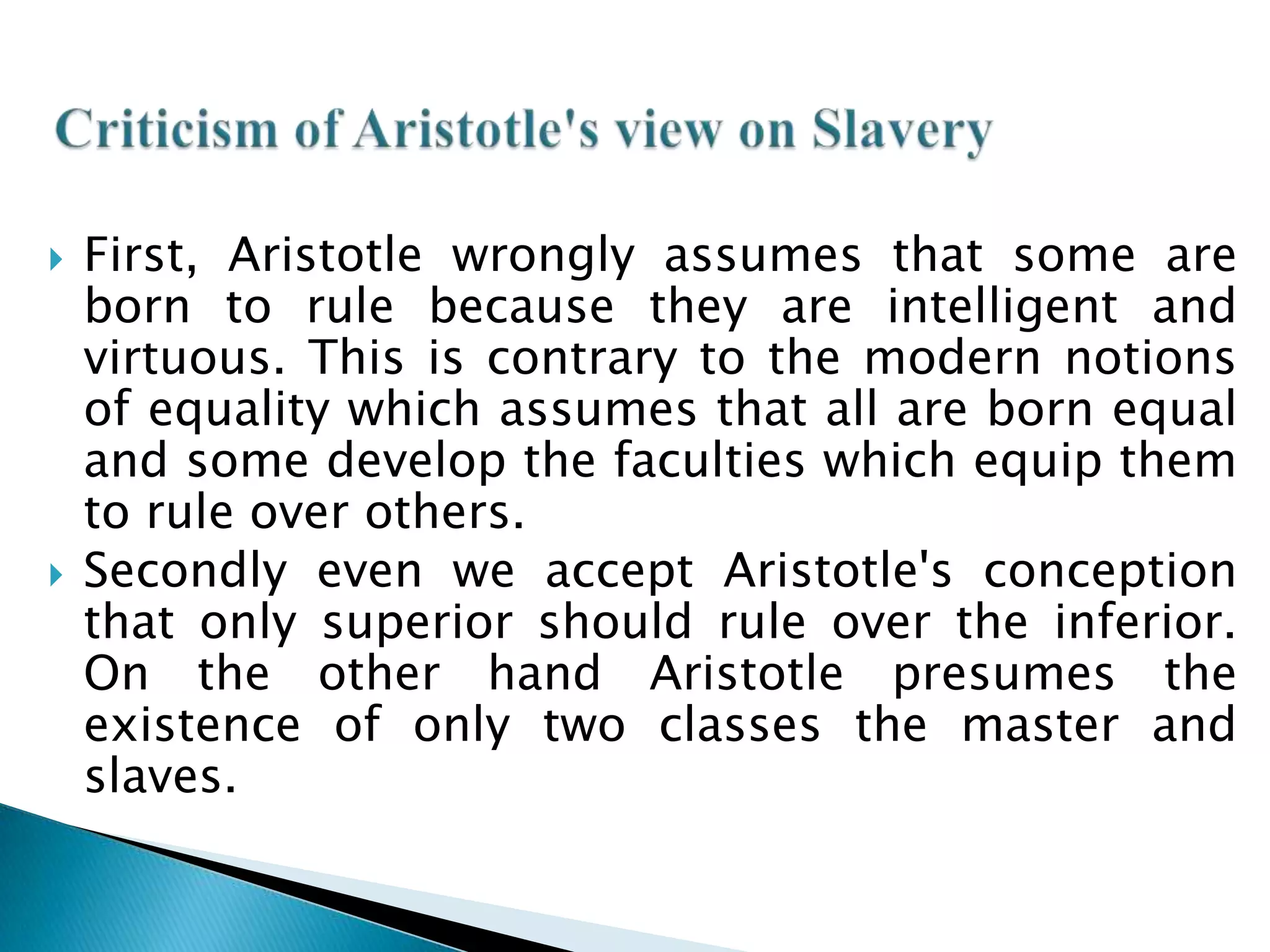
- Slaves: He held a controversial theory of "natural slavery," suggesting some people were naturally suited to be ruled rather than to rule.
Distributive and Rectificatory Justice
Justice is the "bond of men in states." Aristotle distinguished between two types:
- Distributive Justice: This concerns how the state distributes honors, wealth, and offices. Aristotle argued that these should be distributed based on merit (axia). Those who contribute most to the excellence of the state deserve the greatest share of its rewards.
- Rectificatory (Corrective) Justice: This deals with transactions between individuals, such as contracts or crimes. It seeks to restore a balance that has been disturbed, treating all parties as equals regardless of their social standing.
Stability, Revolution, and Constitutional Preservation
A significant portion of Politics is dedicated to the causes of "stasis" (factional conflict or revolution) and how to prevent it. Aristotle’s analysis was remarkably psychological. He argued that the primary cause of revolution is a sense of injustice or inequality.
- In Democracies, revolutions occur when the rich feel they are being treated as equals despite their greater contribution to the state's resources.
- In Oligarchies, revolutions occur when the many feel they are being excluded despite being equal in their status as free men.
To preserve a constitution, Aristotle recommended:
- Education: Citizens must be educated in the "spirit of the constitution." If the state is a democracy, children must be taught democratic virtues.
- Small Changes: Authorities must watch out for small, incremental illegalities that can eventually undermine the rule of law.
- External Threats: Sometimes, an external threat can unite a divided citizenry, though he did not suggest this as a primary strategy.
- Short Terms of Office: This prevents the buildup of entrenched power and allows more citizens to participate.
Comparisons with Platonic Thought
Aristotle’s political thought is often defined by its contrast with Plato’s Republic.
- Unity vs. Diversity: Plato sought a unified state (the "One") where the ruling class shared everything in common. Aristotle argued that the state is naturally a "Plurality." Trying to make it a perfect unity would destroy its essence as a collection of diverse individuals.
- Private Property: Plato advocated for the abolition of private property for the guardians. Aristotle defended private property, arguing that people take better care of what is their own. However, he suggested that while property should be private, its use should be common—encouraging a culture of philanthropy and shared benefits.
- Practicality: While Plato searched for the "Ideal State" ruled by Philosopher-Kings, Aristotle looked for the "Best Practicable State" that could work for flawed human beings in the real world.
Frequently Asked Questions
What did Aristotle mean by "the Golden Mean" in politics?
In a political context, the Golden Mean refers to the "Polity." It is a system that avoids the extremes of Oligarchy (rule by the few/rich) and Democracy (rule by the many/poor). It seeks a middle ground where power is distributed broadly but guided by a constitutional framework and a stable middle class.
Why did Aristotle believe the middle class was so important?
Aristotle viewed the middle class as the most rational and stable segment of society. They are not prone to the arrogance of the wealthy or the desperation and envy of the poor. Because they are "moderate and in the middle," they are less likely to form factions, which Aristotle identified as the primary cause of state collapse.
How did Aristotle’s view of democracy differ from the modern view?
Aristotle viewed "democracy" as a perverted form of government because, in his time, it often meant the unbridled rule of the poor majority over the wealthy minority, leading to the violation of property rights and the rule of law. Modern democracy is closer to what Aristotle called a "Polity"—a constitutional system that protects individual rights and operates under the rule of law.
Did Aristotle support the rule of law over the rule of men?
Yes. Aristotle argued that "the law should be supreme." Even the best ruler is subject to passion and bias, whereas "the law is reason unaffected by desire." He believed that a government of laws is more stable and just than a government dependent on the whims of even a virtuous individual.
What is the difference between a "Polity" and an "Aristocracy"?
An Aristocracy is a "true form" of government ruled by a few people of exceptional virtue. A Polity is also a "true form" but is more inclusive, involving a larger number of citizens. While an Aristocracy is based on merit and virtue, a Polity is a practical blend of democratic and oligarchic elements, designed for a broader range of states.
Practical Recommendation: Applying Aristotelian Principles
For those studying or practicing political science in 2026, Aristotle’s views suggest several practical actions for maintaining healthy governance:
- Prioritize Economic Balance: Policy should aim to strengthen the middle class, as extreme wealth inequality is a historically proven precursor to political instability and factionalism.
- Uphold Constitutional Supremacy: Ensure that institutional rules apply equally to all, preventing "rule by decree" which Aristotle equated with tyranny.
- Invest in Civic Education: A constitution only survives if the citizens believe in its underlying principles. Education should focus on the duties of citizenship as much as the rights.
- Promote Meritocratic Distribution: Offices and honors should be distributed based on contribution and competence to ensure that those who lead are the most capable of serving the common good.
By focusing on the "Polity"—a system where laws govern and the middle class flourishes—modern societies can achieve the stability and "good life" that Aristotle first conceptualized over two millennia ago.