Agile methodology in the Software Development Life Cycle (SDLC) is an iterative and incremental approach that prioritizes flexibility, customer collaboration, and the rapid delivery of functional software. Unlike traditional linear models, Agile breaks projects into small, manageable cycles called sprints, allowing teams to adapt to evolving requirements and deliver high-quality solutions in dynamic environments.
Understanding the Agile Philosophy in SDLC
The Agile methodology is more than a set of rules; it is a fundamental shift in how organizations perceive value and progress. Born from the need to move away from the rigid, documentation-heavy processes of the late 20th century, Agile was formally defined in the Agile Manifesto of 2001. By 2026, this philosophy has matured into the global standard for software development, integrating seamlessly with modern technologies like artificial intelligence and cloud-native architectures.
At its core, Agile values individuals and interactions over processes and tools. While tools are necessary for tracking progress, the success of a project depends on the communication between team members and stakeholders. This human-centric approach ensures that technical debt is managed through constant dialogue rather than ignored in favor of meeting a static deadline. Agile also emphasizes working software over comprehensive documentation. While documentation is still created, the primary measure of progress is the functionality and stability of the code delivered at the end of each iteration.
Customer collaboration is the third pillar of the Agile philosophy. In a traditional Waterfall model, the customer is often involved only at the beginning (requirements) and the end (delivery). In an Agile SDLC, the customer is an active participant. Their feedback at the end of every sprint ensures that the development team is building what the market actually needs, rather than what was envisioned months or years prior. Finally, responding to change over following a plan allows organizations to pivot when market conditions shift or new technologies emerge, a necessity in the fast-paced landscape of 2026.
Key Components of the Agile SDLC Model
The Agile SDLC model operates on a rhythmic cycle of planning, executing, and evaluating. This structure is designed to minimize risk by creating shorter feedback loops. When a project is broken down into two-to-four-week intervals, the cost of a mistake or a misunderstood requirement is capped at the length of that interval.
Iterative Development and Sprints
The most recognizable feature of Agile is the sprint. A sprint is a time-boxed period during which specific work must be completed and made ready for review. Each sprint is essentially a mini-project that includes all the phases of a traditional SDLC: requirements analysis, design, coding, testing, and deployment. By repeating this cycle, the software "evolves" over time. This evolution allows the product to grow in complexity while maintaining a stable core, as each new feature is integrated and tested against the existing codebase.
User Stories and Backlog Management
In Agile, requirements are often captured as "User Stories." These are short, simple descriptions of a feature told from the perspective of the person who desires the new capability, usually a user or customer of the system. A typical format is: "As a [user type], I want [goal] so that [reason]." These stories are housed in the Product Backlog, a prioritized list of everything that might be needed in the product. The Product Owner is responsible for maintaining this list, ensuring that the most valuable features are at the top, ready to be pulled into the next sprint.
Continuous Integration and Deployment
Modern Agile practices in 2026 are inseparable from Continuous Integration (CI) and Continuous Deployment (CD). CI involves frequently merging code changes into a central repository, where automated builds and tests are run. This prevents "integration hell," where developers find that their code is incompatible with others' work only at the end of a long development cycle. CD takes this a step further by automatically deploying every change that passes the automated tests to a staging or production environment, ensuring that software is always in a release-ready state.
Popular Agile Frameworks Used in 2026
While Agile provides the overarching principles, frameworks provide the specific structures and roles needed to implement those principles. Different frameworks suit different team sizes, project types, and organizational cultures.
Scrum: The Most Widely Adopted Framework
Scrum remains the dominant framework in 2026 due to its balance of structure and flexibility. It defines specific roles: the Product Owner (represents the customer), the Scrum Master (facilitates the process and removes blockers), and the Development Team (executes the work). Scrum ceremonies, such as the Daily Stand-up, Sprint Planning, Sprint Review, and Sprint Retrospective, provide the necessary touchpoints for transparency and continuous improvement.
Kanban: Visualizing Flow
Kanban is a framework that focuses on "Just-in-Time" delivery. Unlike Scrum, it does not necessarily use time-boxed sprints. Instead, it uses a Kanban Board to visualize the flow of work. Each column on the board represents a stage in the process (e.g., To Do, In Progress, Testing, Done). The primary goal of Kanban is to limit "Work in Progress" (WIP), which prevents bottlenecks and ensures that the team finishes what they start before taking on new tasks. This is particularly effective for maintenance projects or teams with highly unpredictable workloads.
Scaled Agile Framework (SAFe)
For large enterprises with hundreds of developers, SAFe provides a way to align multiple Agile teams toward a single strategic goal. It introduces layers of coordination, such as the "Agile Release Train," to ensure that different components of a massive software system are synchronized. While some critics argue it can become too bureaucratic, it remains a vital tool for organizations needing to maintain corporate governance while benefiting from Agile's speed.
Step-by-Step Implementation of Agile in the Software Lifecycle
Implementing Agile requires a disciplined approach to the various phases of development. Although these phases happen concurrently or in rapid succession, understanding their individual roles within the Agile context is crucial.
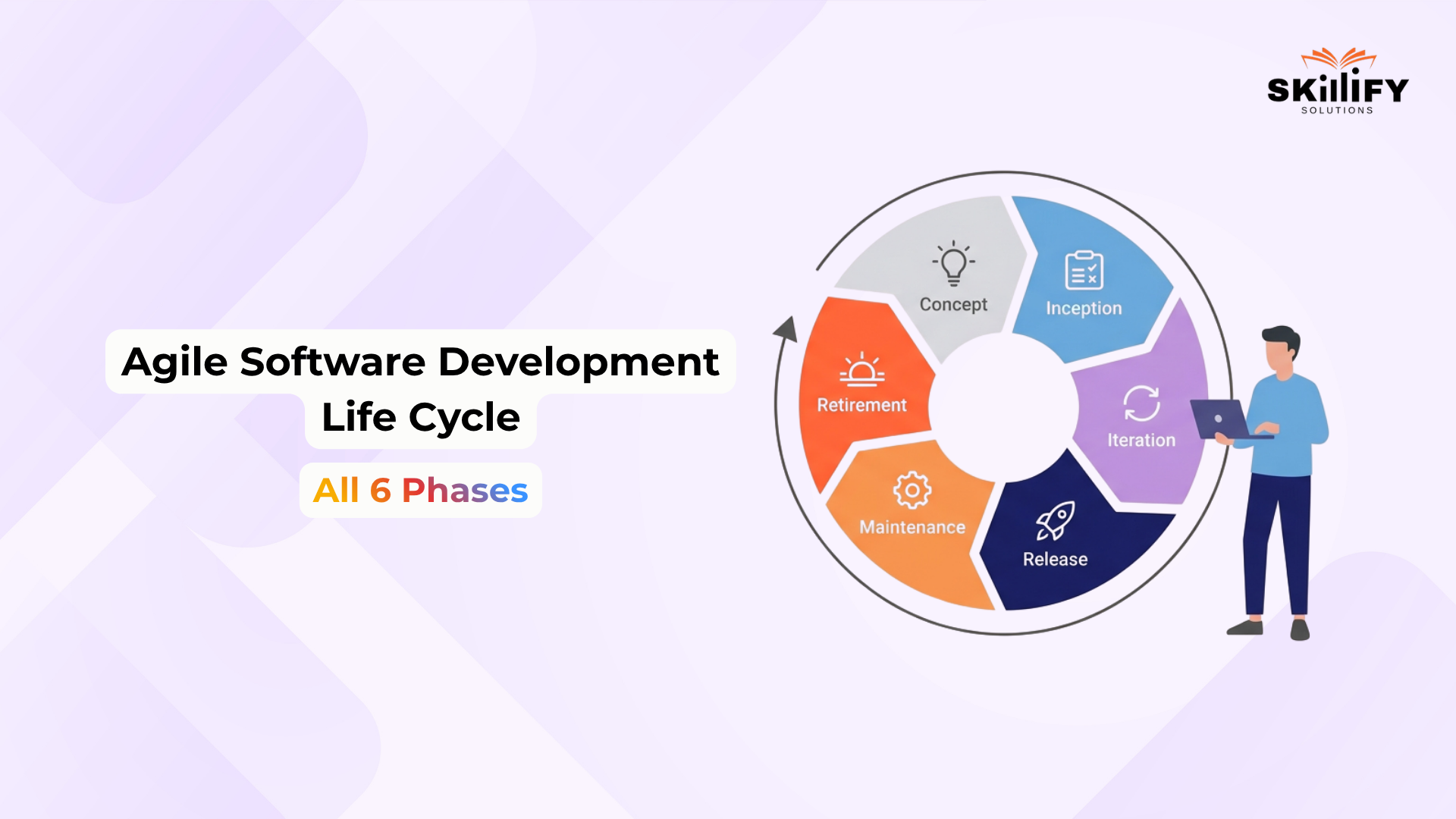
- Concept and Initiation: The high-level vision of the project is defined. Stakeholders identify the primary objectives and the return on investment. A broad roadmap is created, but it is understood that this roadmap will change.
- Inception/Requirements: The team begins to break down the vision into a Product Backlog. Initial user stories are written, and the architecture is discussed at a high level. The goal is not to have a perfect plan but enough information to start the first sprint.
- Iteration/Construction: This is where the bulk of the work happens. The team pulls stories from the backlog, develops the code, and performs unit and integration testing. Daily stand-ups keep everyone aligned on progress and obstacles.
- Release/Testing: Quality Assurance (QA) is integrated throughout the iteration. Once the software meets the "Definition of Done," it is prepared for release. In 2026, this often involves automated security scans and performance benchmarking.
- Production and Maintenance: The software is deployed to users. The team monitors performance and gathers user feedback, which informs the requirements for the next iteration.
- Retirement: While not part of every sprint, the Agile lifecycle also considers the end-of-life for software, ensuring data is migrated and services are decommissioned gracefully.
Comparative Analysis: Agile vs. Traditional SDLC
The choice between Agile and traditional models (like Waterfall) depends on project certainty and the need for speed. The following table highlights the critical differences as of 2026.
| Feature | Agile Methodology | Waterfall (Traditional) |
|---|---|---|
| Project Structure | Iterative and incremental cycles. | Linear and sequential phases. |
| Requirements | Evolving; captured as user stories. | Fixed; documented extensively at the start. |
| Customer Involvement | High; constant feedback throughout. | Low; primarily at the start and end. |
| Delivery Frequency | Every 2-4 weeks (Sprints). | Once, at the end of the project. |
| Risk Management | Low; risks identified and fixed early. | High; issues often found late in the cycle. |
| Flexibility | Highly adaptable to changes. | Rigid; changes are costly and difficult. |
| Testing | Continuous and integrated. | Separate phase after development. |
| Team Dynamic | Self-organizing and cross-functional. | Hierarchical and siloed. |
Best Practices for High-Performing Agile Teams
To maximize the benefits of Agile, teams must go beyond the mechanics of the framework and embrace specific operational habits.
- Maintain a Clean Backlog: A cluttered backlog leads to confusion. Product Owners must regularly "groom" or refine the backlog, deleting stories that are no longer relevant and splitting large "Epics" into smaller, actionable tasks.
- Invest in Automation: In 2026, manual testing is a significant bottleneck. High-performing teams automate as much as possible, from unit tests to UI regression suites. This allows the team to focus on creative problem-solving rather than repetitive verification.
- Foster Psychological Safety: For Agile to work, team members must feel safe admitting mistakes and pointing out flaws in the process. The Sprint Retrospective is the primary tool for this, but the culture must support honesty every day.
- Focus on Technical Excellence: Agile is not an excuse for "quick and dirty" coding. In fact, because the code will be modified frequently, it must be cleaner and more modular than in a Waterfall project. Principles like SOLID and design patterns are essential.
Common Challenges and Troubleshooting in Agile Adoption
Despite its ubiquity, many organizations struggle with Agile. One of the most common issues is "Agile in Name Only" (AINO) or "Water-Scrum-Fall," where a team uses daily stand-ups but still operates under a rigid, long-term plan with no flexibility.
Another challenge is Scope Creep. Because Agile welcomes change, stakeholders may continually add features without understanding the impact on the timeline. To solve this, the Product Owner must be empowered to say "no" or to negotiate trade-offs—if a new feature is added, something of equal effort must be moved down the backlog.
Cultural resistance is often the hardest hurdle. Middle management may feel threatened by self-organizing teams, as the traditional "command and control" style of leadership is incompatible with Agile. Overcoming this requires clear communication from executive leadership about the goals of the transition and providing adequate training for all roles involved.
The Future of Agile: AI and DevSecOps Integration in 2026
As we move through 2026, Agile is evolving through the integration of Artificial Intelligence (AI). AI-driven tools are now used to predict sprint velocity more accurately, identify potential bugs before code is even committed, and even generate boilerplate code from user stories. This "AI-Augmented Agile" allows teams to move faster while reducing the cognitive load on developers.
Furthermore, the boundary between Agile and DevSecOps has blurred. Security is no longer a checklist at the end of the SDLC; it is integrated into every sprint. Automated security testing (DevSecOps) ensures that vulnerabilities are caught in real-time, aligning perfectly with the Agile principle of continuous delivery. This holistic approach ensures that speed does not come at the expense of safety or compliance.
Frequently Asked Questions
What is the primary difference between Agile and Scrum?
Agile is a broad philosophy or set of principles for software development, while Scrum is a specific framework used to implement those principles. You can be Agile without using Scrum (for example, by using Kanban), but you cannot properly practice Scrum without adhering to Agile values. Scrum provides the specific roles, meetings, and artifacts that make Agile actionable.
Can Agile be used for fixed-price contracts?
Yes, but it requires a shift in how the contract is written. Instead of fixing the entire scope, the contract may fix the time and budget while allowing the scope to be flexible. This ensures the client gets the most valuable features within their budget, rather than a full set of features that might no longer be relevant by the time the project is finished.
Is documentation still necessary in Agile?
Yes. The Agile Manifesto states we value working software more than comprehensive documentation, not that documentation is eliminated. Essential documentation—such as API references, architectural overviews, and user guides—is still vital. The goal is to avoid "dark matter" documentation that no one reads and that becomes obsolete almost immediately.
How does Agile handle large-scale projects?
Large projects are handled through scaling frameworks like SAFe, LeSS (Large-Scale Scrum), or DaD (Disciplined Agile Delivery). These frameworks coordinate multiple small Agile teams, ensuring they are all working toward the same release goals and managing dependencies between different parts of the system.
Who is responsible for quality in an Agile team?
The entire team is responsible for quality. While there may be QA specialists on the team, the developers, Product Owner, and Scrum Master all play a role in ensuring the "Definition of Done" is met. High-quality code and rigorous testing are considered part of the development process, not a separate step performed by a different department.
Practical Recommendation
To successfully implement Agile methodology in your software development life cycle, start by assessing your team's current culture and technical maturity. Rather than attempting a "big bang" transformation, select a single pilot project and implement a lightweight framework like Scrum. Focus on establishing a consistent sprint cadence and fostering open communication with your stakeholders. As the team becomes comfortable with the iterative process, gradually introduce advanced practices like automated testing and CI/CD pipelines to further enhance delivery speed and software quality.
For authoritative guidance on Agile standards and certifications, refer to the Agile Alliance or Scrum.org. For technical implementation details regarding CI/CD and DevSecOps, the documentation provided by the Cloud Native Computing Foundation (CNCF) offers extensive resources on modern infrastructure practices.