Crafting an effective press release requires a strategic balance of journalistic news value, concise storytelling, and search engine optimization to capture the attention of journalists, editors, and modern digital readers.
Writing a press release in today’s media landscape demands moving away from overly promotional corporate jargon and focusing instead on delivering verifiable facts, clear timelines, and immediate newsworthiness. Whether you are announcing a major product launch, an executive appointment, a strategic partnership, or a significant corporate milestone, understanding the foundational rules of distribution ensures your message cuts through the noise of crowded newsrooms.
Below are five essential best practices designed to elevate your press release strategy, maximize media pickup, and enhance organic visibility across digital channels.
1. Craft a Compelling, Fact-Based Headline and Subheadline
The headline is the single most important element of any press release. Journalists and editors sift through hundreds of pitches daily, often deciding whether to open a release in a matter of seconds based solely on the headline. Your headline must be clear, concise, and immediately indicative of the core news value, avoiding clickbait or hyperbolic adjectives that trigger immediate skepticism.
When developing your headline, prioritize the primary news hook. Instead of writing a vague announcement like "Company X Announces Exciting New Innovations," opt for a specific, data-driven approach: "Company X Launches Automated Energy Management Software to Reduce Industrial Grid Waste by 30%." This immediately informs the reader what happened, who is involved, and why it matters.
- Keep it concise: Aim for a headline length between 60 and 80 characters so it displays fully in email inboxes and search engine result pages without truncation.
- Use the subheadline strategically: Treat the subheadline as an expansion of the headline. It should provide necessary context, secondary details, or quantifiable metrics that reinforce the main news hook.
- Incorporate core keywords naturally: Integrate relevant brand names, product identifiers, or industry terms that target journalists might search for within wire distribution databases.
2. Master the Inverted Pyramid Structure
Journalistic writing relies on the inverted pyramid structure, which places the most crucial information at the very beginning of the document and cascades down to secondary details, background information, and boilerplate copy. This structure accommodates editors who read from the top down and may trim text from the bottom to fit specific publication column spaces or digital layout constraints.
The opening paragraph—known as the lead or lede—must answer the foundational journalistic questions: Who, what, when, where, and why. If a reader stops reading after the first three sentences, they should still grasp the complete essence of the announcement.
- THE LEAD (LEDE)
- Who, What, When, Where, Why (Crucial Facts & Metrics)
- SUPPORTING DETAILS
- Quotes, Context, Background, Secondary Data
- BOILERPLATE & CONTACT
- Company Background, Media Contact Information
Following the lead paragraph, utilize the body of the release to provide supporting quotes from key stakeholders or executives, relevant industry context, and historical data points that validate the significance of the announcement. Avoid burying the main announcement halfway through the text or introducing unrelated product lines in the introductory paragraphs.
3. Prioritize Clarity and Neutral, Journalistic Tone
A press release is fundamentally an informational document intended for media professionals, not an aggressive sales brochure. Adopting a neutral, objective, and authoritative tone builds immediate credibility with reporters who value objective facts over subjective marketing fluff.
Eliminate superlative claims such as "industry-leading," "world-class," or "revolutionary" unless they are directly attributable to a verifiable third-party source, research study, or official industry certification. Instead of telling the reader that a product is groundbreaking, show them through concrete data points, performance benchmarks, or user adoption statistics.
- Attribute opinions: When including executive commentary, use direct quotes that offer genuine insight, future market vision, or strategic rationale behind the news, rather than generic statements of corporate pride.
- Avoid jargon and acronyms: If technical terminology is essential to the subject matter, define it clearly on first use to ensure general assignment reporters or readers outside your niche can comprehend the context.
- Check formatting and length: Restrict standard press releases to a single page or approximately 400 to 500 words. Long-form releases often overwhelm busy desk editors and dilute the core message.
4. Integrate Strategic Multimedia and Verified Links
Modern press releases live online, meaning traditional text-only distributions frequently underperform compared to multimedia-rich announcements. Embedding high-resolution imagery, video walkthroughs, infographics, or audio files significantly increases media engagement and gives digital publishers ready-to-publish assets.
However, multimedia assets must be optimized for fast loading speeds and hosted via reliable distribution networks or direct digital press rooms. Furthermore, linking strategy requires careful execution to maintain professional standards and SEO compliance.
| Element Type | Best Practice | What to Avoid |
|---|---|---|
| Images & Logos | High-res PNG/JPEG (300 DPI), clearly labeled file names, and direct download links. | Uncompressed massive files that crash email clients or proprietary formats. |
| Hyperlinks | 1 to 3 contextual, dofollow or branded links directed to official product pages or source documents. | Keyword-stuffed anchor text, affiliate links, or excessive outbound links. |
| Quotes | Authentic attribution with full executive titles and institutional affiliations. | Unattributed claims, anonymous assertions, or fabricated expert commentary. |
| Multimedia | Embedded video players (YouTube/Vimeo) or direct downloadable media kits. | Auto-playing audio/video files or broken external hyperlinks. |
When adding hyperlinks, anchor them naturally using brand names or specific resource titles rather than generic phrases like "click here." Ensure every linked URL resolves correctly and directs traffic to an active landing page that directly supports the claims made in the text.
5. Optimize for Distribution Channels and Search Engines
Even the most newsworthy press release will fail to generate traction if it is sent to the wrong audience or formatted improperly for search engine discovery. Selecting the appropriate distribution channels—whether targeting niche industry journalists via direct email pitches or utilizing major wire services like PR Newswire or Business Wire—depends on your target audience and geographical reach.
Concurrently, optimize the press release for search engines by treating the document like a high-value web page. Journalists frequently utilize search engines and news aggregators to source stories, making digital discoverability a core component of modern public relations.
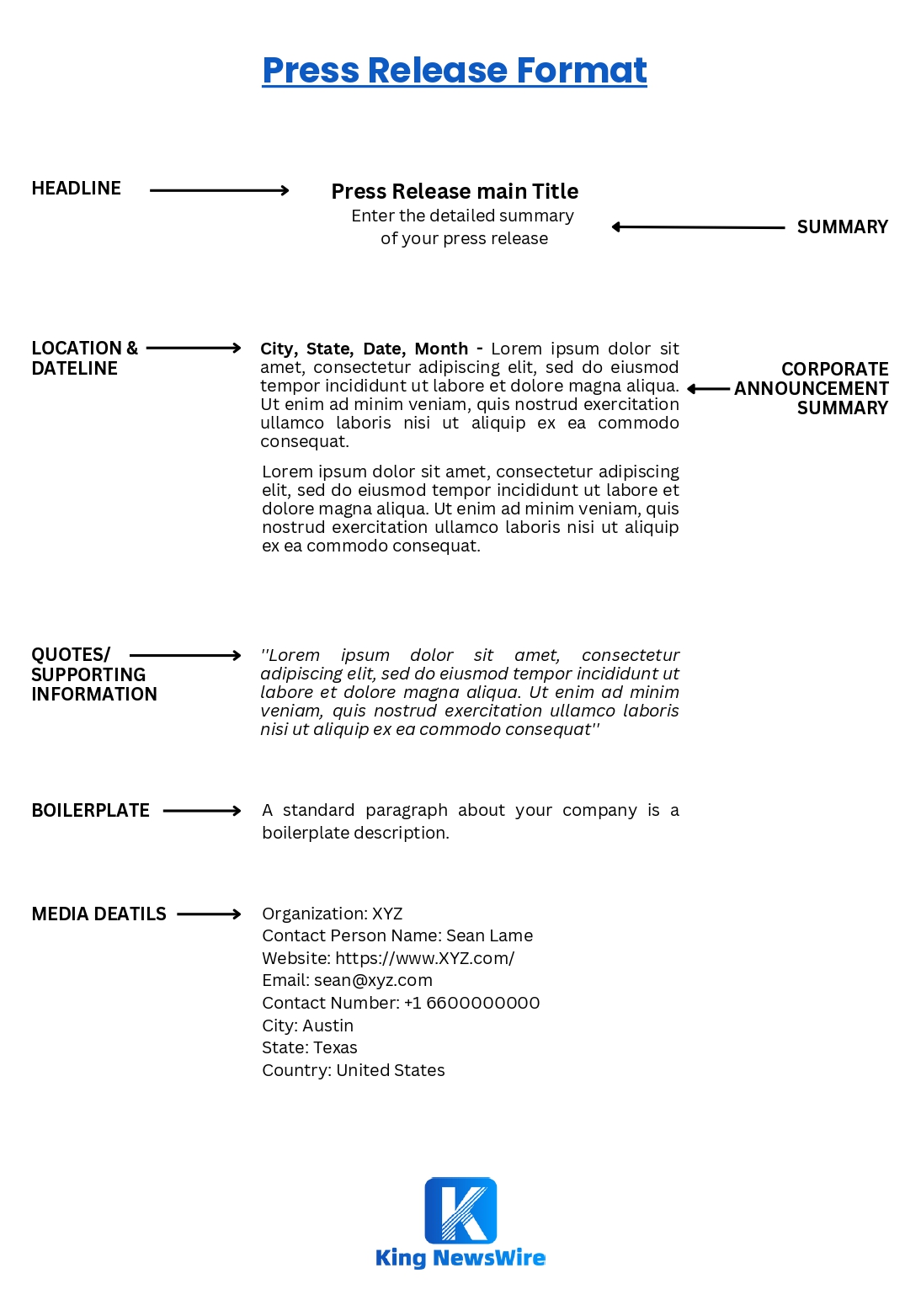
- Include a clear dateline: Begin the very first line of your release with the city and state (e.g., AUSTIN, Texas – [Date]) to establish immediate geographic and temporal context.
- Standardize contact information: Provide a dedicated media contact section at the bottom of the release, including a professional name, email address, direct phone number, and a link to your online press room.
- Conclude with a clean boilerplate: Finish the document with a standardized 3 to 4 sentence company overview (boilerplate) preceded by the standard "###" or "About [Company Name]" header, signaling the absolute end of the copy.
Comparison of Traditional vs. Modern Press Release Practices
| Feature | Traditional Approach | Modern Best Practice |
|---|---|---|
| Primary Audience | Print newspaper and magazine editors exclusively. | Multi-channel journalists, bloggers, aggregators, and digital consumers. |
| Distribution | Physical mail, fax, or basic wire services. | Targeted digital wire networks, customized email pitching, and online newsrooms. |
| Visual Assets | Seldom included or sent as separate physical prints. | Embedded high-res images, infographics, and video assets directly within the digital release. |
| Tone and Style | Formal, rigid, and strictly institutional. | Authoritative, transparent, conversational yet professional, and data-driven. |
| SEO Consideration | Ignored; focused entirely on print column inches. | Strategic integration of search terms, anchor text, and metadata for digital discoverability. |
Frequently Asked Questions About Press Releases
How long should an ideal press release be?
An ideal press release should be between 400 and 500 words, fitting neatly onto a single standard page. This length forces writers to be concise, placing the most important news at the top while respecting the limited time of busy journalists and editors.
Is it necessary to use a paid wire distribution service?
Paid wire distribution services are not strictly mandatory, but they provide guaranteed syndication across major news aggregators, search engines, and financial terminal networks. For hyper-local news or highly niche B2B industries, direct, personalized pitching to targeted journalists often yields higher quality coverage than broad wire distribution.
What is a boilerplate and why is it important?
A boilerplate is a short, standardized corporate description placed at the bottom of a press release. It explains who the company is, what markets it serves, and its core mission. It provides instant background context for journalists who may be unfamiliar with your brand.
Can I include hyperlinks inside a press release?
Yes, including 1 to 3 contextual hyperlinks is standard practice for digital distribution. Links should point to relevant landing pages, source studies, or product information using natural anchor text, avoiding excessive keyword stuffing or promotional links.
When is the best time to distribute a press release?
Historically, Tuesday, Wednesday, and Thursday mornings between 9:00 AM and 11:00 AM local time yield the highest open and engagement rates. Avoid sending major releases on Friday afternoons, weekends, or major holidays when newsrooms operate with minimal staff.
Next Actions for Effective Media Outreach
Before publishing or distributing your next announcement, audit your draft against these five best practices. Ensure your headline is punchy and factual, your lead paragraph answers all core journalistic questions, and your tone remains entirely objective. Build a targeted media list tailored specifically to your industry niche, double-check all contact information and hyperlinks, and choose the distribution channel that best aligns with your communication goals.