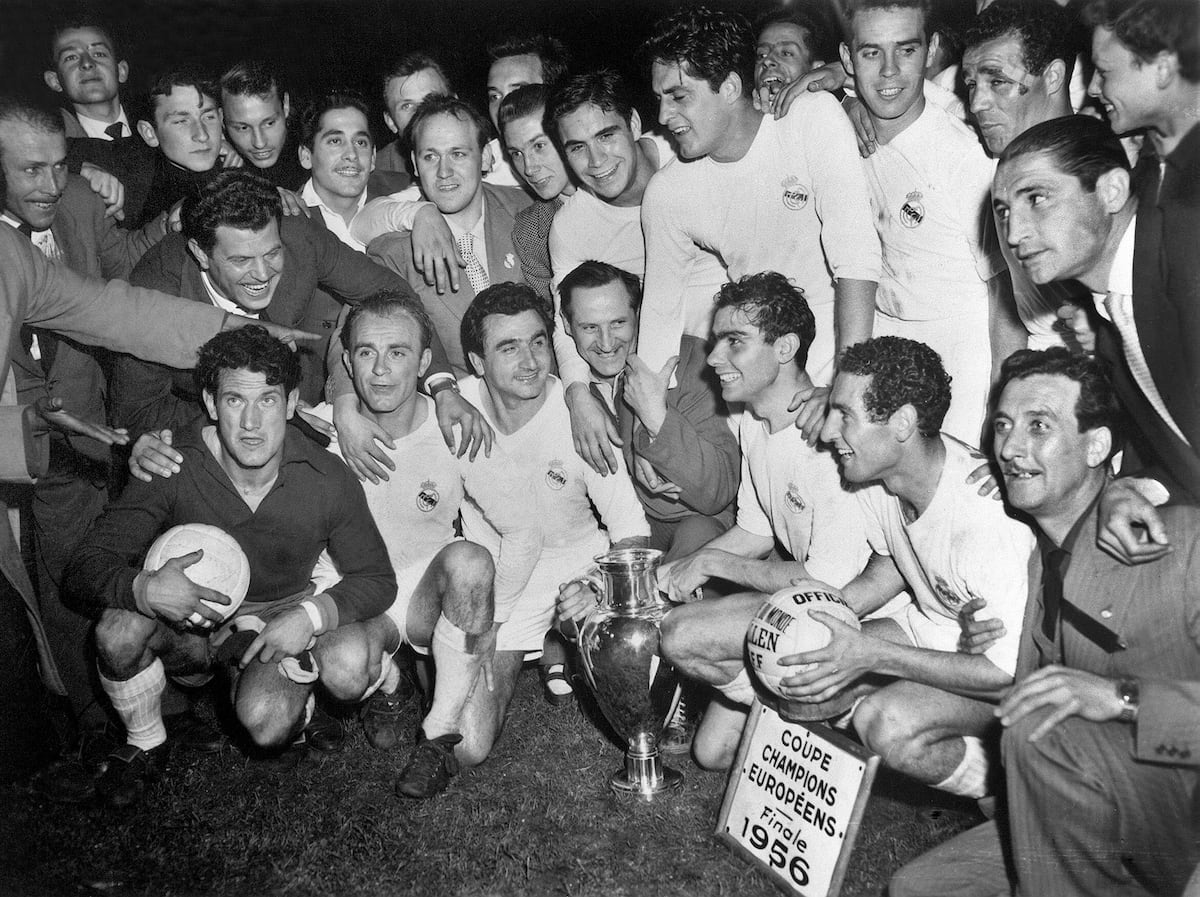
The 1956 Real Madrid squad represents the inception of a legendary era in football, securing the inaugural European Cup by defeating Stade de Reims 4-3 in the final at the Parc des Princes. Managed by José Villalonga, this team established the tactical blueprints and cultural identity of the club, anchored by the scoring prowess of Alfredo Di Stéfano and the leadership of Miguel Muñoz.
The Genesis of the European Cup and Real Madrid’s Ambition
In the mid-1950s, European football was searching for a unifying competition to determine the best club on the continent. Inspired by the success of international tournaments, Gabriel Hanot, the editor of the French newspaper L'Équipe, championed the creation of the European Champion Clubs' Cup. Real Madrid, under the presidency of Santiago Bernabéu, was one of the most enthusiastic proponents of this vision.
The 1955-1956 season marked the first edition of this tournament. For Real Madrid, the mission was clear: to prove that Spanish football, and specifically the team from the capital, could dominate on the continental stage. The squad assembled for this campaign was not just a collection of talented players; it was a carefully curated group designed to play an aggressive, attacking style of football that would later become synonymous with the club’s identity.
Tactical Philosophy: The Villalonga Era
José Villalonga took the reins of the team during a period of transition and high expectations. His tactical approach moved away from the more conservative structures prevalent in Spanish domestic football at the time. Instead, he favored a system that prioritized fluid movement, individual flair, and high-intensity attacking transitions.
The 1956 team utilized a formation that fluctuated between a traditional 3-2-5 or an early version of the 4-2-4 when in possession. The heavy reliance on technical proficiency meant that defenders were not merely destroyers; they were required to initiate play from the back. The midfield was the engine room, providing the defensive stability necessary to allow the star-studded attack to press the opposition relentlessly.
The Core Personnel: Profiles of the 1956 Squad
The 1956 squad was defined by a blend of tactical discipline and mercurial brilliance. While Alfredo Di Stéfano is the name that dominates historical discourse, the success of the team was a collective effort of highly specialized athletes.
The Defensive Line
Juan Alonso guarded the net, known for his agility and ability to organize the backline. In front of him, the defensive structure relied heavily on the versatility of players like Marcos Marquitos and Rafael Lesmes. These players were tasked with maintaining a high line, forcing opponents to play long balls that could be intercepted and recycled quickly to initiate counter-attacks.
The Midfield Orchestration
Miguel Muñoz served as the team’s captain and on-field tactical leader. His role was crucial; he acted as the bridge between the defense and the forward line, dictating the tempo of the match. Muñoz was an intelligent player who understood space and positioning, allowing him to neutralize opposition threats before they reached the defensive third. Beside him, José María Zárraga provided the tireless running and ball-winning capabilities that kept the team balanced.
The Attacking Powerhouse
The forward line was arguably the most feared in Europe. Alfredo Di Stéfano was the centerpiece—the "blonde arrow" who operated all over the pitch. He was the prototype of the modern total footballer. His teammates in the final, such as Héctor Rial and Joseíto, complemented him perfectly. Rial provided technical elegance and clinical finishing, while the wingers offered width that stretched opposing defenses to their breaking point.
Road to the Final: Overcoming Continental Adversity
Before the historic victory in Paris, the 1956 squad had to navigate a series of challenging knockout rounds. The competition featured formidable sides, including AC Milan and Partizan Belgrade.
- First Round: Madrid faced Servette, winning convincingly over two legs.
- Quarter-Finals: They met Partizan Belgrade. Despite a difficult away leg in Yugoslavia, Real Madrid’s collective resolve ensured they progressed.
- Semi-Finals: This was the true test, as they faced AC Milan. The tactical battle between the Italian defensive rigidity and Madrid’s expansive attacking style resulted in a high-scoring series that defined the season for the club.
These matches prepared the squad for the psychological demands of the final. The players learned how to adapt to hostile environments and overcome setbacks, such as conceding early goals—a resilience they would display again in the final against Reims.
Analysis of the 1956 Final: A Tactical Masterclass
The final against Stade de Reims on June 13, 1956, remains one of the most iconic matches in football history. Reims, led by the legendary Raymond Kopa, entered the match as the favorites. The French side took an early 2-0 lead, testing the resolve of the Madrid squad.
What followed was a display of pure attacking intent. Real Madrid refused to play defensively to protect the deficit. Instead, they pushed higher, with Di Stéfano acting as the catalyst for the comeback. The final score of 4-3 was a testament to a squad that believed in outscoring its opponents regardless of the situation. This match cemented the "Real Madrid DNA"—the belief that no lead is safe for the opponent and that the club possesses an innate ability to recover from desperate positions.
Squad Composition Table: The 1956 Final Lineup
| Position | Player | Key Contribution |
|---|---|---|
| Goalkeeper | Juan Alonso | Crucial saves during Reims' early pressure |
| Defender | Ángel Atienza | Defensive stability and ball distribution |
| Defender | Marquitos | Scored the goal that equalized at 3-3 |
| Defender | Rafael Lesmes | Consistent defensive coverage |
| Midfielder | Miguel Muñoz | Captain and tactical organization |
| Midfielder | José María Zárraga | Box-to-box engine and interception work |
| Forward | Joseíto | Width and attacking support |
| Forward | Ramón Marsal | Creative impetus in the final third |
| Forward | Alfredo Di Stéfano | Orchestrator and goalscoring threat |
| Forward | Héctor Rial | Scored two goals, including the winner |
| Forward | Francisco Gento | Pace on the wing, constant threat |
Historical Significance and Legacy
The victory of the 1956 squad was not merely the winning of a trophy; it was the birth of the European Cup’s most successful entity. By winning the first competition, Real Madrid set a standard of excellence that defined the subsequent decades. The team demonstrated that European football could be a platform for global marketing, prestige, and the recruitment of the world’s best talent.
Many of the players from the 1956 squad went on to form the nucleus of the team that would win four consecutive titles thereafter. This continuity allowed for the development of a unique chemistry, where players knew each other's movements instinctively. It established a culture where victory was not just an achievement but an expected standard—an ethos that persists in the club’s internal operations as of 2026.
FAQs Regarding the 1956 Squad
Who was the leading goalscorer for Real Madrid in the 1956 European Cup campaign? Alfredo Di Stéfano was the central figure in the scoring department. His ability to link play and finish clinically made him the most influential player in the competition, a status he maintained throughout his tenure at the club.
What was the significance of the 1956 final win for Real Madrid’s reputation? Winning the inaugural tournament instantly elevated Real Madrid to the status of a global superpower. It provided the club with the prestige necessary to attract world-class talent, setting the stage for future transfers and solidifying its brand in the international football community.
Did the 1956 squad play a defensive style? No, the team was built on an attacking philosophy. Under José Villalonga, the squad played with a high tempo, utilizing wide wingers and a free-roaming forward line. The emphasis was on maintaining possession in the attacking half and utilizing quick transitions.
How did the 1956 squad influence modern team building? The squad demonstrated the value of combining technical brilliance with defensive tactical structure. The reliance on a "leader" like Muñoz, combined with a "star" like Di Stéfano, created a blueprint for future generations of Real Madrid teams, focusing on the recruitment of high-impact individuals who can perform under extreme pressure.
Are there official records available for this squad’s performance? Yes, official UEFA records and the Real Madrid club archives provide comprehensive data regarding the 1956 campaign, including individual statistics, match reports, and documentation regarding squad registration, which remain accessible for researchers and fans today.
Recommendation for Further Research
For those looking to understand the mechanics behind this historic squad, I recommend reviewing the original match reports from the 1956 final provided by the UEFA historical archives. Additionally, examining the tactical notes of José Villalonga, which have been analyzed by several football historians, provides deep insight into how he managed the egos and tactical demands of such a talented group. Focusing on the transition from the 1955 domestic season to the 1956 European campaign offers the best context for how this specific team was forged in the heat of competition.