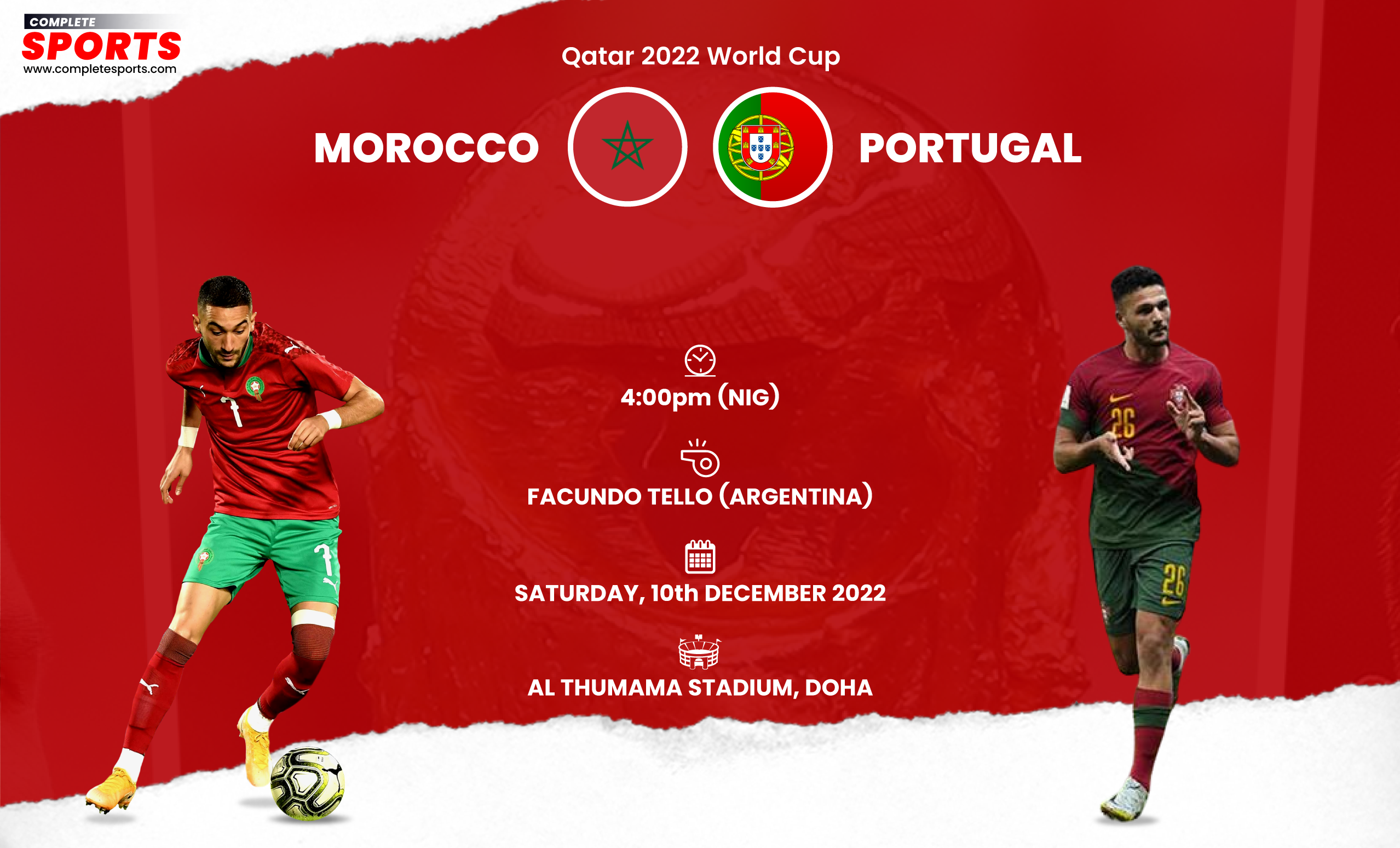
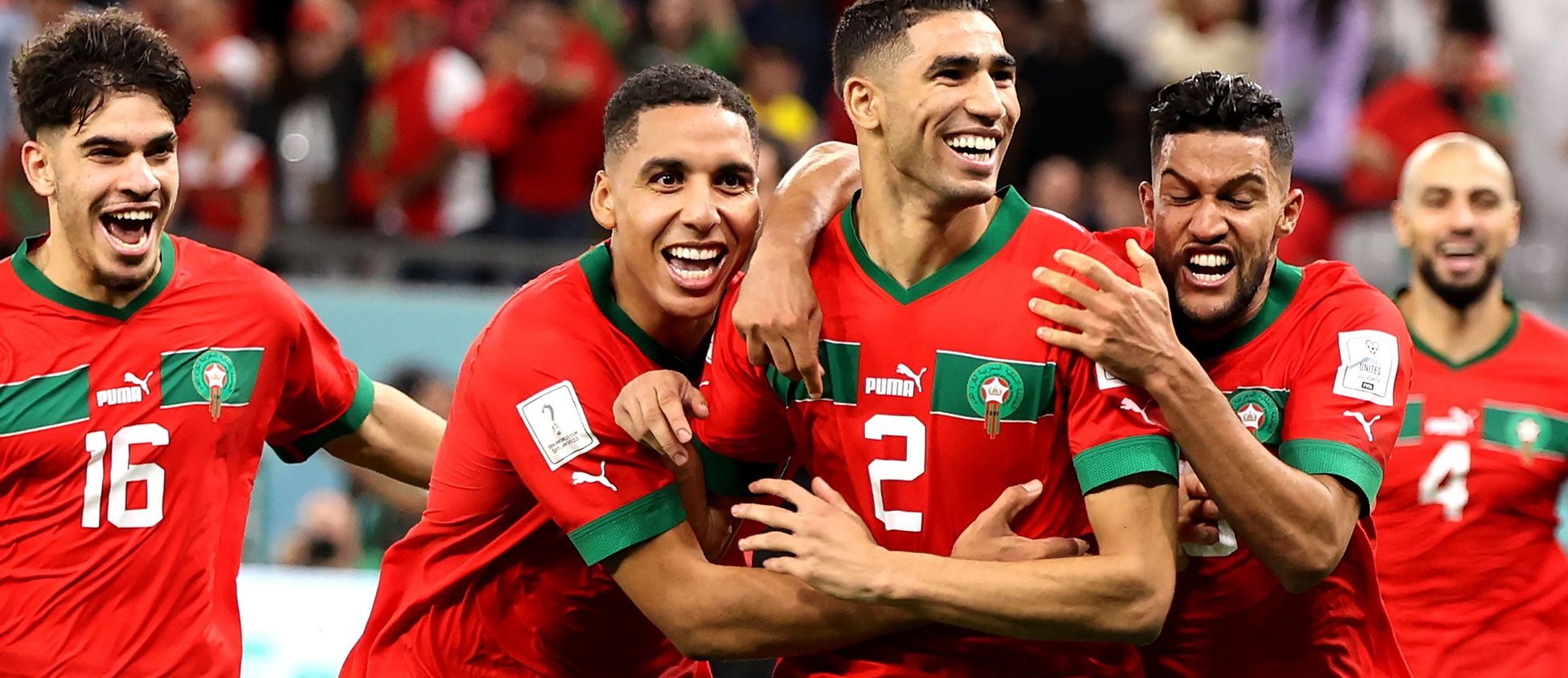
Morocco’s 1-0 victory over Portugal on December 10, 2022, at the Al Thumama Stadium remains a watershed moment in FIFA World Cup history. By securing this win, Morocco became the first African and Arab nation to reach a World Cup semi-final, fundamentally shifting the global perception of footballing hierarchies.
The Prelude: Paths to the Quarterfinal
The journey to the Al Thumama Stadium was vastly different for both nations. Portugal entered the 2022 World Cup as one of the favorites, boasting a squad depth that rivaled any in the tournament. Under Fernando Santos, they had navigated the group stage with relative ease and delivered a statement performance in the Round of 16, dismantling Switzerland 6-1. That match was particularly notable for Santos's decision to bench Cristiano Ronaldo in favor of Gonçalo Ramos, who responded with a hat-trick.
Morocco, conversely, arrived as the "underdogs" who refused to play the part. Under the leadership of Walid Regragui—who had taken over only months before the tournament—the Atlas Lions topped a group containing Croatia and Belgium. They then produced a defensive masterclass against Spain in the Round of 16, winning on penalties after a 0-0 draw. Their path was built on an almost impenetrable defensive structure and a collective spirit that resonated across the African continent and the Arab world.
By the time the quarterfinal arrived, the narrative was set: Portugal’s flair and individual brilliance against Morocco’s organized resilience. While Portugal sought to return to the semi-finals for the first time since 2006, Morocco carried the weight and hopes of multiple regions, aiming to break a historical ceiling for African football.
Tactical Setup: Regragui’s Masterclass vs. Santos’s Conundrum
The tactical battle between Walid Regragui and Fernando Santos was a study in contrasting philosophies. Regragui’s approach was pragmatic, focusing on a mid-to-low block that denied space in central areas, while Santos attempted to balance a high-possession game with the creative freedom of his attacking midfielders.
Morocco’s Defensive Structure and Transition
Morocco utilized a 4-1-4-1 formation that frequently shifted into a 4-5-1 during defensive phases. The key to this system was the discipline of the midfield line. Sofyan Amrabat acted as the defensive anchor, covering immense ground and screening the back four. Ahead of him, Azzedine Ounahi and Selim Amallah provided the energy required to press Portuguese playmakers like Bruno Fernandes and Bernardo Silva.
The defensive line, despite losing key personnel like Nayef Aguerd to injury, remained resolute. Romain Saïss and Jawad El Yamiq maintained a narrow distance, forcing Portugal to play the ball wide. Once the ball moved to the flanks, Achraf Hakimi and Yahia Attiyat Allah (standing in for Noussair Mazraoui) were supported by the wingers, Hakim Ziyech and Sofiane Boufal, to create 2-on-1 situations. This prevented Portugal’s fullbacks from overlapping effectively.
The Portuguese Strategy and Selection Controversy
Portugal opted for a 4-3-3 system. The most significant tactical decision was the continued exclusion of Cristiano Ronaldo from the starting lineup. Santos chose to stick with the winning formula from the Switzerland match, starting Gonçalo Ramos up front, flanked by João Félix and Bruno Fernandes.
The intent was to use quick combinations and rotations in the final third to pull Morocco’s defenders out of position. However, Portugal struggled with the lack of "verticality" in their play. They dominated possession but found it difficult to penetrate the "Moroccan Wall." The absence of a traditional target man early in the game meant that many of their crosses were comfortably dealt with by the Moroccan center-backs.
The Defining Moment: En-Nesyri’s Record-Breaking Header
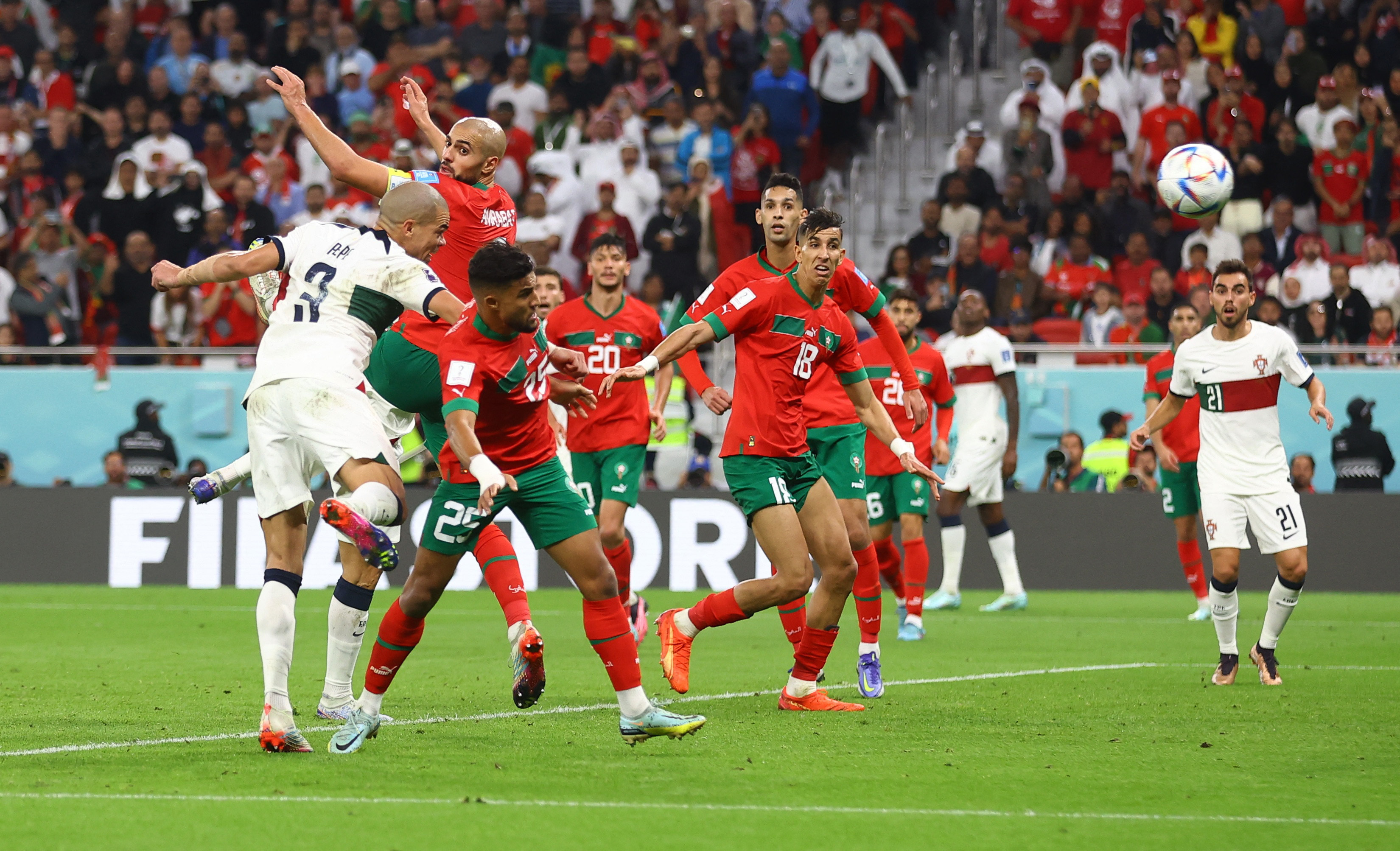
The deadlock was broken in the 42nd minute, producing one of the most iconic images of the 2022 World Cup. The goal was a product of Morocco’s ability to exploit moments of transition and individual errors.
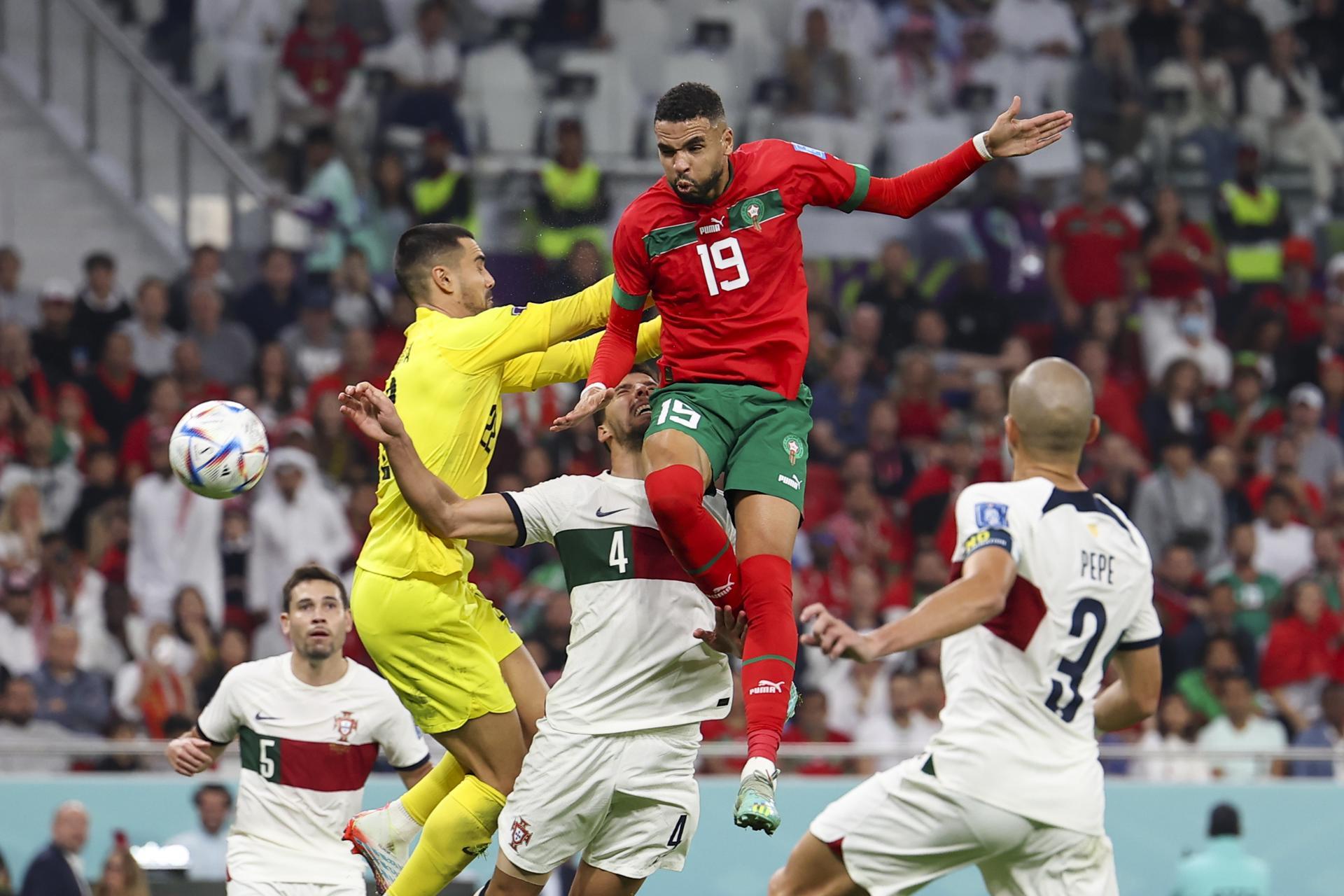
Yahia Attiyat Allah received the ball on the left wing and delivered a high, hanging cross into the box. While the cross seemed manageable for a goalkeeper of Diogo Costa’s caliber, the Portuguese keeper misjudged the flight of the ball and came off his line unsuccessfully. Youssef En-Nesyri, showcasing incredible athleticism, leaped to a recorded height of 2.78 meters (9 feet 1 inch)—surpassing the leap of many elite basketball players and even Cristiano Ronaldo’s famous header against Sampdoria.
En-Nesyri’s contact was clean, sending the ball into the empty net. This goal was more than just a tactical success; it was a physical manifestation of Morocco's height and ambition. It forced Portugal to abandon their patient buildup and chase the game, a situation that played directly into Morocco’s hands for the remaining 50 minutes of play.
The Second Half: Resilience Under Siege
The second half was an exercise in pure defensive endurance for Morocco. Portugal’s pressure was relentless, especially after the double substitution in the 51st minute that saw Cristiano Ronaldo and João Cancelo enter the fray.
The Cristiano Ronaldo Impact
Ronaldo’s introduction shifted Portugal’s shape toward a more direct 4-2-4 or 4-4-2. His presence in the box required Morocco to tighten their marking even further. Despite the narrative surrounding his decline, Ronaldo provided a focal point that Portugal had previously lacked. He managed one significant chance late in the game—a low shot that was expertly saved by Yassine Bounou—but he was largely marginalized by the disciplined marking of El Yamiq.
Yassine Bounou: The Wall of Casablanca
If En-Nesyri provided the spark, Yassine "Bono" Bounou provided the foundation. The Moroccan goalkeeper delivered a Man of the Match performance. His most spectacular save came in the 83rd minute, when he tipped a goal-bound curling effort from João Félix over the bar. Bounou’s composure under the high ball and his ability to command his area during the frantic final minutes were essential.
Morocco’s task became even harder in stoppage time when substitute Walid Cheddira received two yellow cards in quick succession, leaving the team with ten men. Yet, even with a numerical disadvantage, the Moroccan defense did not buckle. The final whistle signaled not just a win, but a seismic shift in the footballing world.
Statistical Overview: Efficiency Over Dominance
The statistics of the match highlight the "smash and grab" nature of Morocco's victory, though that term undersells the tactical brilliance involved. Portugal controlled the tempo, but Morocco controlled the space.
| Metric | Morocco | Portugal |
|---|---|---|
| Possession | 27% | 73% |
| Total Shots | 9 | 12 |
| Shots on Target | 3 | 3 |
| Pass Accuracy | 70% | 83% |
| Corners | 3 | 9 |
| Saves | 3 | 2 |
| Fouls Committed | 15 | 9 |
| Red Cards | 1 (Cheddira) | 0 |
These numbers demonstrate that while Portugal had the ball for nearly three-quarters of the match, they were unable to convert that possession into high-quality scoring opportunities. Morocco’s three shots on target were arguably more dangerous than Portugal’s, reflecting a highly efficient counter-attacking strategy.
The Cultural and Geopolitical Significance
The impact of Morocco's victory resonated far beyond the pitch. In 2022, the "Atlas Lions" became a symbol of pride for the entire African continent and the Arab world. For decades, African teams had come close to the semi-finals—Cameroon in 1990, Senegal in 2002, and Ghana in 2010—only to fall in the quarterfinals. Morocco finally broke that "glass ceiling."
The celebrations in Rabat, Casablanca, London, Paris, and Doha were a testament to the team's universal appeal. The sight of Moroccan players celebrating with their mothers on the pitch and the widespread use of the Palestinian flag during celebrations highlighted the cultural nuances of this specific World Cup. It was a tournament where the traditional "Global North" powers were challenged by the rising quality of teams from other confederations.
Long-term Legacy: The "Morocco Model" in 2026
As we look back from the vantage point of 2026, the Morocco vs. Portugal match is seen as the blueprint for mid-tier nations aiming to compete with the elite. The "Morocco Model"—which combines a high-tech national training center (the Mohammed VI Football Academy), a focus on the diaspora, and the appointment of local coaching talent—has since been emulated by several other federations.
For Portugal, the defeat marked the end of the Fernando Santos era. It led to a period of transition where the team had to integrate a new generation of talent while managing the twilight of Cristiano Ronaldo’s international career. The 2022 exit served as a catalyst for a more modern, high-pressing style of play that Portugal adopted in the subsequent years.
Frequently Asked Questions
Who scored the winning goal in Morocco vs. Portugal 2022?
Youssef En-Nesyri scored the only goal of the match in the 42nd minute. He scored with a header following a cross from Yahia Attiyat Allah. The goal is famous for the incredible height En-Nesyri reached, jumping approximately 2.78 meters.
Was Cristiano Ronaldo a starter in the quarterfinal?
No, Cristiano Ronaldo did not start the match. He was brought on as a substitute in the 51st minute, replacing Ruben Neves. This followed a trend from the previous Round of 16 match against Switzerland, where manager Fernando Santos also chose to start Gonçalo Ramos over Ronaldo.
Did Morocco receive a red card during the match?
Yes, Walid Cheddira was sent off in stoppage time (90+3') after receiving two yellow cards in a span of a few minutes. Despite playing the final moments with ten men, Morocco managed to hold onto their 1-0 lead.
Where was the Morocco vs. Portugal match played?
The match took place at the Al Thumama Stadium in Doha, Qatar. The stadium, designed to resemble a "gahfiya" (a traditional woven cap worn by men and boys across the Middle East), provided a fittingly atmospheric backdrop for the historic Arab victory.
What was the significance of Morocco winning this match?
The victory made Morocco the first African and the first Arab country to reach the semi-finals of a FIFA World Cup. It shattered a long-standing historical barrier and was celebrated globally as a milestone for footballing parity.
Final Recommendation: Studying the Tactical Film
For students of the game and tactical analysts, the Morocco vs. Portugal 2022 quarterfinal is essential viewing. It provides a masterclass in how to maintain defensive shape under extreme pressure. Those looking to understand modern football should focus on Sofyan Amrabat’s positioning and the "vertical" leap of En-Nesyri as key examples of physical and technical excellence. The match remains a primary reference point for how organized teamwork can overcome superior individual talent.