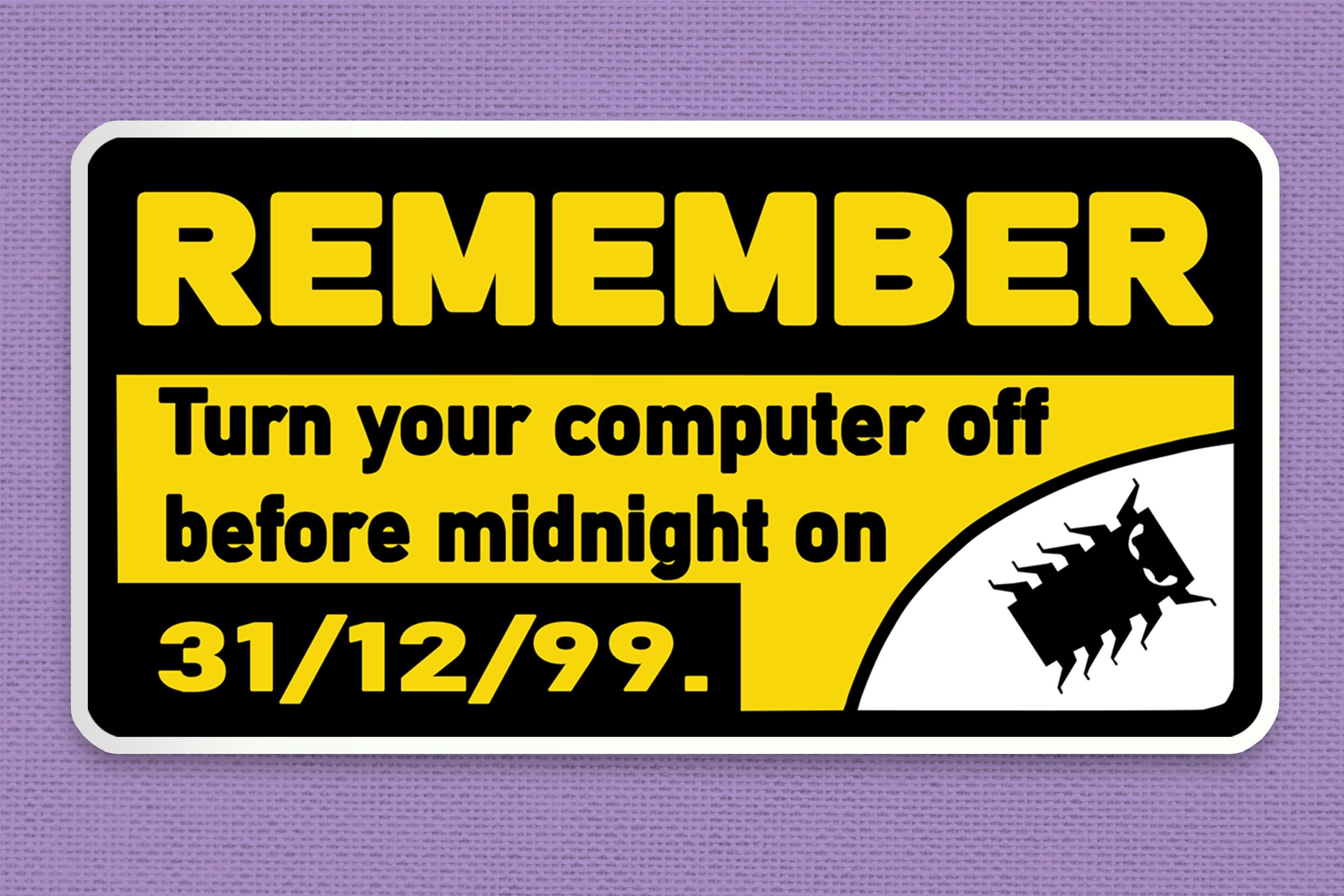
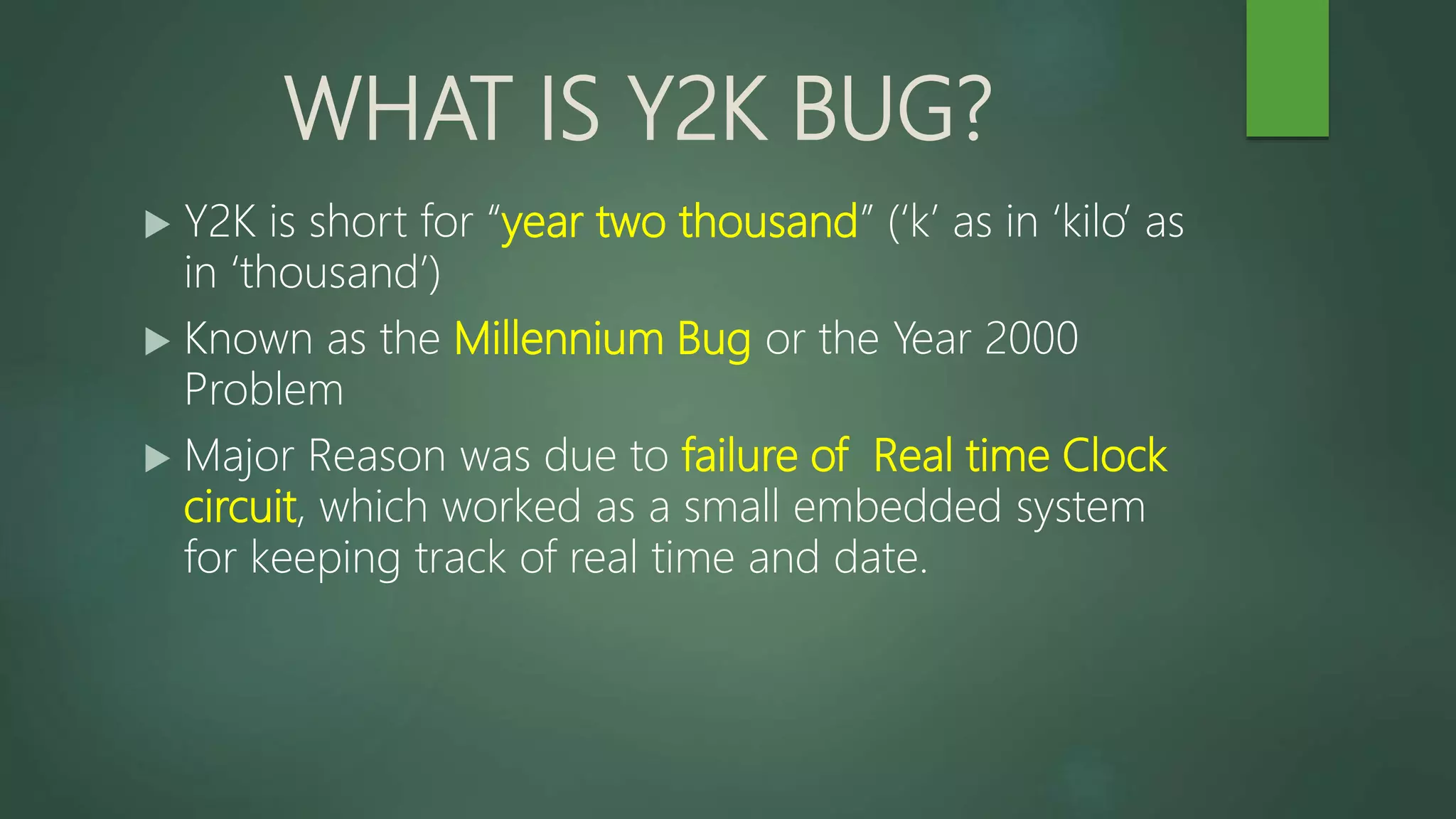
The Millennium Bug, commonly known as Y2K, was a widespread computer programming flaw caused by representing years with only two digits. As the year 2000 approached, experts feared systems would misinterpret "00" as 1900, causing catastrophic failures in global infrastructure. A massive international remediation effort successfully prevented major disasters, leaving a legacy of modern IT management.
What Was the Millennium Bug?
The Millennium Bug, or the Year 2000 (Y2K) problem, was a technical phenomenon rooted in the early days of computer programming. In the 1960s, 70s, and 80s, computer memory and storage were prohibitively expensive. To save precious space, programmers often used a two-digit format for years (e.g., "98" instead of "1998"). While this was an efficient use of resources at the time, it created a logical "dead end" for software logic when the calendar rolled over from December 31, 1999, to January 1, 2000.
The primary concern was that computers would interpret the "00" suffix as 1900 rather than 2000. Because date calculations are foundational to almost all administrative and industrial software, the potential for error was vast. For example, if a banking system calculated interest based on the number of years between 1995 and 2000, and it interpreted the latter as 1900, it would result in a negative number (-95), leading to account crashes or massive financial errors.
The bug was not limited to PC software. It extended to embedded systems, which are small microprocessors built into hardware like elevators, traffic lights, medical devices, and power plant controllers. The fear was that these systems would "freeze" or malfunction because they could not process the date change, leading to real-world physical dangers.
Why Two-Digit Years Were the Industry Standard
To understand why the Millennium Bug existed, one must look at the economic constraints of early computing. In the 1960s and 1970s, hard drive space and Random Access Memory (RAM) were measured in kilobytes, not gigabytes or terabytes. A single megabyte of storage could cost thousands of dollars.
Programmers were under immense pressure to optimize every byte. By shortening a year from four digits to two, they saved two bytes per date record. In a database containing millions of records, this resulted in significant cost savings. At the time, few developers believed the software they were writing would still be in use by the turn of the century. They assumed these legacy systems would be replaced by newer, more robust architectures long before the year 2000 became a reality.
However, many of these "legacy systems" became the backbone of global banking, telecommunications, and government infrastructure. They were patched and layered upon rather than replaced, meaning the two-digit date logic remained buried deep within critical COBOL and Fortran codebases decades later.
Potential Consequences and High-Stakes Risks
By the mid-1990s, the realization of the impending deadline sparked a global alarm. The risks were categorized into several high-stakes sectors:
Financial Services and Banking
This was perhaps the most vulnerable sector. Mortgages, insurance premiums, pension payments, and stock market trades all rely on precise date-based calculations. If systems reverted to 1900, millions of people could have seen their life savings vanish from digital ledgers, or credit card transactions could have been declined globally.
Public Utilities and Energy
There were significant concerns regarding the power grid. Control systems for nuclear power plants and water treatment facilities used date-sensitive logs. If the internal clocks failed or reported an impossible date, safety protocols might have triggered automatic shutdowns, leading to widespread blackouts or environmental hazards.
Transportation and Aviation
Aviation relies heavily on time-sensitive maintenance schedules and air traffic control coordinates. There were fears that flight navigation systems would malfunction mid-flight or that ground-based tracking would lose sight of aircraft. This led some airlines to voluntarily ground flights during the transition to ensure passenger safety.
Government and Defense
The US Department of Defense and other global military powers faced the prospect of "date-glitches" in weapons systems, satellite tracking, and intelligence databases. Maintaining the integrity of nuclear command and control systems was a top priority for both the United States and Russia during the transition.
The Global Remediation Effort
The reason Y2K did not result in a global collapse was due to an unprecedented level of international cooperation and technical labor. Beginning in the mid-1990s, corporations and governments spent an estimated $300 billion to $500 billion globally to fix the bug.
Identifying Vulnerable Systems
The first step was "inventory and assessment." Organizations had to scan millions of lines of code to find every instance of a date variable. This was a manual, grueling task because many of the original programmers had retired, and documentation was often missing.
Remediation Strategies
There were three primary ways programmers "fixed" the Millennium Bug:
- Date Expansion: This was the most permanent fix, where two-digit year fields were expanded to four digits (e.g., 00 became 2000). This required updating every database and every piece of software that interacted with that data.
- Windowing: This was a "shortcut" fix. Programmers told the computer that any two-digit year between 00 and 20 should be treated as 2000–2020, while 21 to 99 should be treated as 1921–1999. This bought organizations more time without requiring a full database overhaul.
- Encapsulation: This involved shifting the system's internal clock back by 28 years (a cycle where the calendar repeats exactly) and then "shifting" the output back to the correct year for the user.
Testing and Verification
The final phase involved "time-machine" testing. Large organizations set up isolated computer environments and manually rolled the system clocks forward to midnight on December 31, 1999, to observe the results. This allowed them to catch and patch errors before the actual event.
The "Nothing Happened" Myth and Survivorship Bias
When January 1, 2000, arrived with relatively few major incidents, a common narrative emerged: that Y2K was a "hoax" or a massive overreaction by the IT industry. However, this is a classic example of survivorship bias.
The reason nothing happened is exactly because the preparation was so thorough. While the public saw a smooth transition, IT professionals spent years working 80-hour weeks to ensure that smoothness. Despite the success, some glitches did occur:
- In Japan, radiation monitoring equipment at a nuclear power plant failed.
- In the UK, some credit card transactions were rejected or processed incorrectly.
- In the US, the Naval Observatory (the official timekeeper) reported the date as 19100 on its website for a brief period.
- Spy satellites operated by the US experienced data processing interruptions for several days.
According to the Computer History Museum, these minor incidents were a testament to the effectiveness of the remediation. If the work hadn't been done, these small glitches would have been the norm across every industry.
Technical Comparison: Y2K vs. Future Time-Based Bugs
The Millennium Bug is not the only time-based threat computers face. As we look forward from 2026, the next major hurdle is the Year 2038 problem.
| Feature | Millennium Bug (Y2K) | Year 2038 Problem (Y2K38) |
|---|---|---|
| Root Cause | Two-digit year formatting (logic error). | 32-bit signed integer overflow (hardware/OS limit). |
| Critical Date | January 1, 2000 | January 19, 2038 |
| Affected Systems | Legacy mainframes, COBOL apps, embedded systems. | Linux/Unix systems, older Android devices, 32-bit IoT. |
| Primary Fix | Code rewriting and date windowing. | Upgrading to 64-bit architectures and software. |
| Public Awareness | Extremely high in the late 1990s. | Growing, but largely technical at this stage. |
The Year 2038 problem occurs because many systems count time in seconds from January 1, 1970 (the Unix Epoch). A 32-bit integer can only count up to 2,147,483,647 seconds. On January 19, 2038, that number will be reached, and the counter will "flip" to a negative number, potentially resetting clocks to 1901.
Lessons Learned for the Modern Era
The legacy of Y2K continues to influence how we manage technology in 2026. It was the first time the world realized how deeply dependent society had become on digital infrastructure.
- Technical Debt is Real: The Millennium Bug proved that "temporary" fixes in software can last for decades. This has led to a greater emphasis on sustainable coding practices and regular system modernization.
- Disaster Recovery Planning: Y2K forced corporations to create business continuity plans. Many of the backup systems and protocols established for the year 2000 were later used during other crises, such as the 9/11 attacks and the 2020 pandemic.
- Global Cooperation: The crisis showed that competing nations and corporations could work together to solve a common technical threat. Information sharing through organizations like the International Organization for Standardization (ISO) was vital to the success of the remediation.
For more detailed historical archives, the National Institute of Standards and Technology (NIST) maintains records of the standards used to mitigate these risks.
FAQ
Was the Y2K bug a hoax?
No, it was a legitimate technical flaw. The lack of widespread disaster was the direct result of a multi-year, multi-billion-dollar global effort to patch systems. Documentation from government agencies and major corporations confirms that thousands of critical bugs were found and fixed during the lead-up to the year 2000.
What happened to the computers that weren't fixed?
Computers that weren't updated typically experienced one of two things: they either crashed entirely when they encountered a date they couldn't process, or they produced "logical errors." For example, some older computers showed the year as 1900 or 19100, and some administrative systems deleted "expired" records that were actually current.
How much did the Y2K fix cost?
Estimates vary, but the consensus is that the global cost was between $300 billion and $500 billion. The United States government alone spent approximately $8.5 billion to ensure its systems remained operational.
Will there be another Y2K?
The most direct equivalent is the "Year 2038 problem" (Y2K38), which affects 32-bit Unix-based systems. While modern 64-bit systems are immune, many older "Internet of Things" (IoT) devices and industrial controllers still use 32-bit architecture and will need to be replaced or updated before 2038.
Did anyone go to jail over Y2K?
No. The bug was not the result of malice but rather a side effect of the economic and technical limitations of early computing. It was considered a collective industry oversight rather than a criminal act.
Next Actions for IT Security
To avoid similar issues in the modern landscape, organizations should conduct regular audits of their legacy software. As we move further into the 2020s, ensuring your infrastructure is 64-bit compliant is the best way to prevent the upcoming 2038 glitch. Additionally, maintaining a comprehensive "Software Bill of Materials" (SBOM) can help identify where old, date-sensitive code might still be hiding in your supply chain.