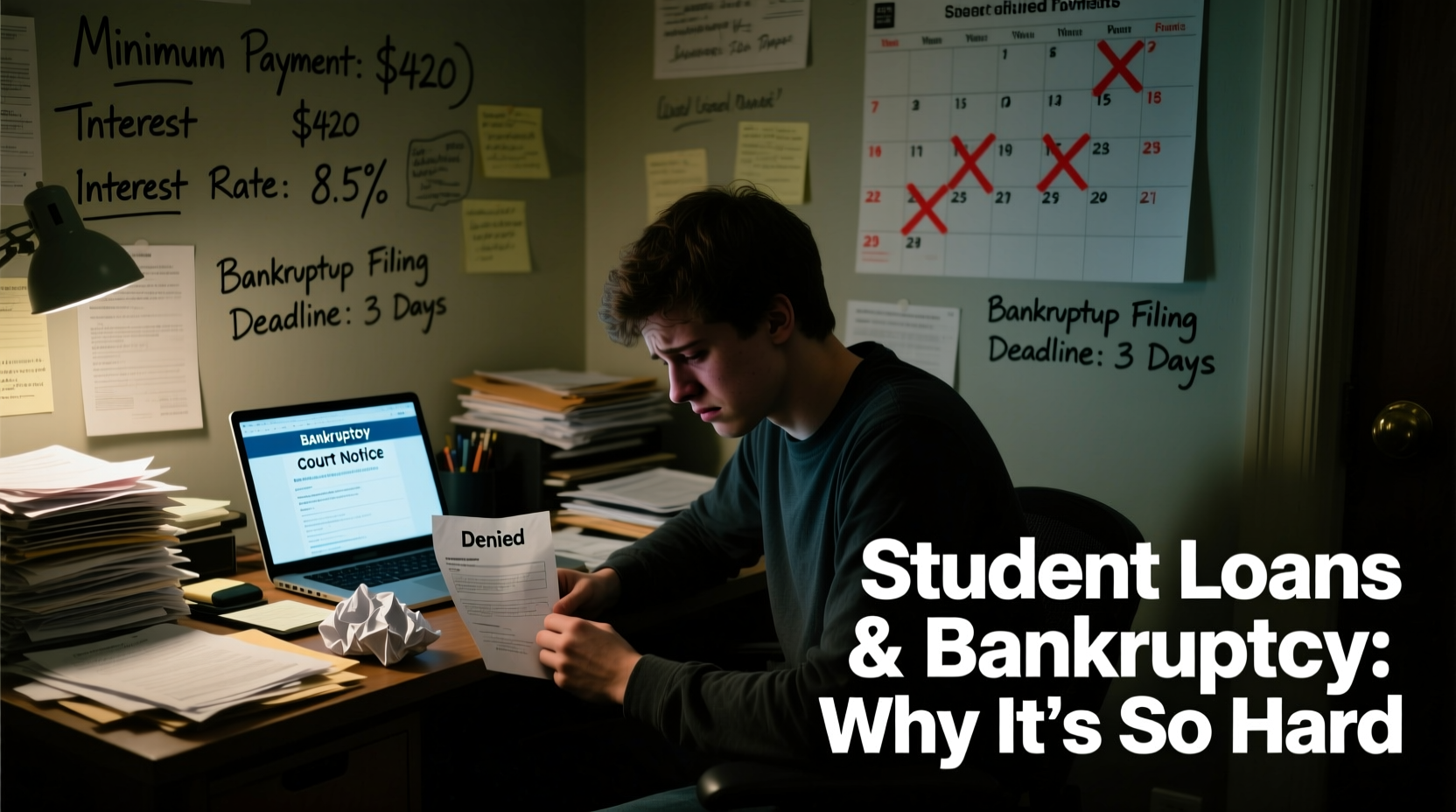
Student loans are not strictly exempt from bankruptcy, but they are treated differently than most other consumer debts. To eliminate student loan debt, you must prove that repayment would cause an "undue hardship" for you and your dependents. While this was historically difficult, streamlined federal guidelines introduced in recent years have made the process more predictable for many borrowers.
Student loan debt has long occupied a unique and often frustrating position within the United States bankruptcy code. Unlike credit card debt or medical bills, which are typically discharged automatically in a successful Chapter 7 filing, student loans are classified as "non-dischargeable" unless the borrower takes additional, specific legal action. As of 2026, the legal landscape has shifted toward a more structured evaluation of a borrower's financial reality, yet the fundamental requirement to prove "undue hardship" remains the cornerstone of the process.
The Legal Distinction: Exempt vs. Non-Dischargeable
To understand whether student loans are "exempt," one must first clarify legal terminology. In bankruptcy law, "exempt" usually refers to assets—like your home or car—that a creditor cannot seize to pay off your debts. Student loans are a liability, not an asset. The correct question is whether student loans are dischargeable.
Under 11 U.S.C. § 523(a)(8), most educational debts are protected from discharge. This includes federal loans, private loans, and even some types of educational overpayments. The law was designed to protect the solvency of the federal student loan program, based on the theory that students with high earning potential might otherwise file for bankruptcy immediately after graduation to wipe away their investment in their own education.
Consequently, student loans remain on your record after a standard bankruptcy discharge unless you specifically initiate a secondary lawsuit within your bankruptcy case, known as an adversary proceeding.
Proving "Undue Hardship" Through the Brunner Test
The most significant hurdle to discharging student loans is the "undue hardship" standard. Because the bankruptcy code does not explicitly define what constitutes an undue hardship, courts have historically relied on the Brunner Test, named after the 1987 case Brunner v. New York State Higher Education Services Corp.
To meet the Brunner Test, a borrower must prove three distinct elements:
- Poverty: Based on your current income and expenses, you cannot maintain a "minimal" standard of living for yourself and your dependents if forced to repay the loans.
- Persistence: Your current financial situation is likely to persist for a significant portion of the loan repayment period. This often requires showing a permanent disability, lack of job prospects in your field, or other long-term obstacles.
- Good Faith: You have made a good-faith effort to repay the loans before filing for bankruptcy. This includes applying for income-driven repayment (IDR) plans, seeking deferments, and attempting to maximize income while minimizing expenses.
In some jurisdictions, courts use the "Totality of the Circumstances" test instead of Brunner. This is generally considered a more flexible standard, allowing the judge to look at the borrower's entire financial picture rather than adhering to the strict three-part formula.
The 2022 DOJ and Department of Education Reform
A major turning point occurred in late 2022 when the Department of Justice (DOJ), in coordination with the Department of Education, issued new guidance to streamline the process for federal student loans. As of 2026, these protocols have become the standard operating procedure for government-held loans.
The reform introduced an Attestation Form that allows borrowers to provide their financial information directly to the government's attorneys. If the information shows that the borrower meets the criteria for undue hardship, the DOJ can stipulate to the discharge without a full-blown trial. This significantly reduces the cost and complexity for the borrower.
The criteria under this streamlined process focus on:
- Current Income and Expenses: Comparing the borrower's finances against IRS National and Local Standards.
- Future Ability to Pay: Presuming that the hardship will persist if the borrower is over age 65, has a disability, or has been out of the workforce for a specific period.
- Prior Loan Management: Assessing whether the borrower engaged with the Department of Education regarding repayment options.
Private vs. Federal Student Loans: Key Differences
The rules for discharging student loans in bankruptcy apply to both federal and private loans, but the path to relief can look very different.
| Feature | Federal Student Loans | Private Student Loans |
|---|---|---|
| Discharge Standard | Undue Hardship (11 U.S.C. § 523(a)(8)) | Undue Hardship (11 U.S.C. § 523(a)(8)) |
| Government Protocol | Streamlined DOJ Attestation available. | No standardized protocol; varies by lender. |
| Litigation Risk | Government may stipulate to discharge. | Lenders often fight the adversary proceeding. |
| Partial Discharge | Possible in some jurisdictions. | Possible, but less common in settlements. |
| Statute of Limitations | No statute of limitations on collection. | Subject to state statutes of limitations. |
It is important to note that some private "student" loans may actually be dischargeable without proving undue hardship. If a loan was not for "qualified education expenses" at an eligible institution—for example, a loan that exceeded the Cost of Attendance (COA) or a loan for a non-accredited program—it may be treated like standard consumer debt.
The Adversary Proceeding: A Lawsuit Within a Lawsuit
If you decide to seek a student loan discharge, you must file an adversary proceeding (AP). This is a formal lawsuit filed in bankruptcy court against your loan servicers.
The process typically follows these steps:
- Filing the Complaint: Your attorney files a document alleging that your student loans cause an undue hardship.
- Discovery: Both sides exchange information. For federal loans, this is where the DOJ Attestation Form is utilized. For private loans, the lender may request several years of bank statements, tax returns, and employment records.
- Negotiation/Mediation: Many student loan bankruptcy cases are settled before trial. The lender may agree to a full discharge, a partial discharge, or a modification of the loan terms.
- Trial: If a settlement is not reached, a bankruptcy judge hears the evidence and decides whether you have met the legal burden of proof.
Strategic Considerations: Chapter 7 vs. Chapter 13
The type of bankruptcy you file—Chapter 7 or Chapter 13—will influence how your student loans are handled.
Chapter 7 (Liquidation)
In a Chapter 7 bankruptcy, you seek to wipe out your unsecured debts entirely. If you win your adversary proceeding, your student loans are gone. However, if you do not win the AP, the student loans remain, and you are responsible for them as soon as the bankruptcy case closes. Chapter 7 is usually the preferred route for those with no disposable income.
Chapter 13 (Reorganization)
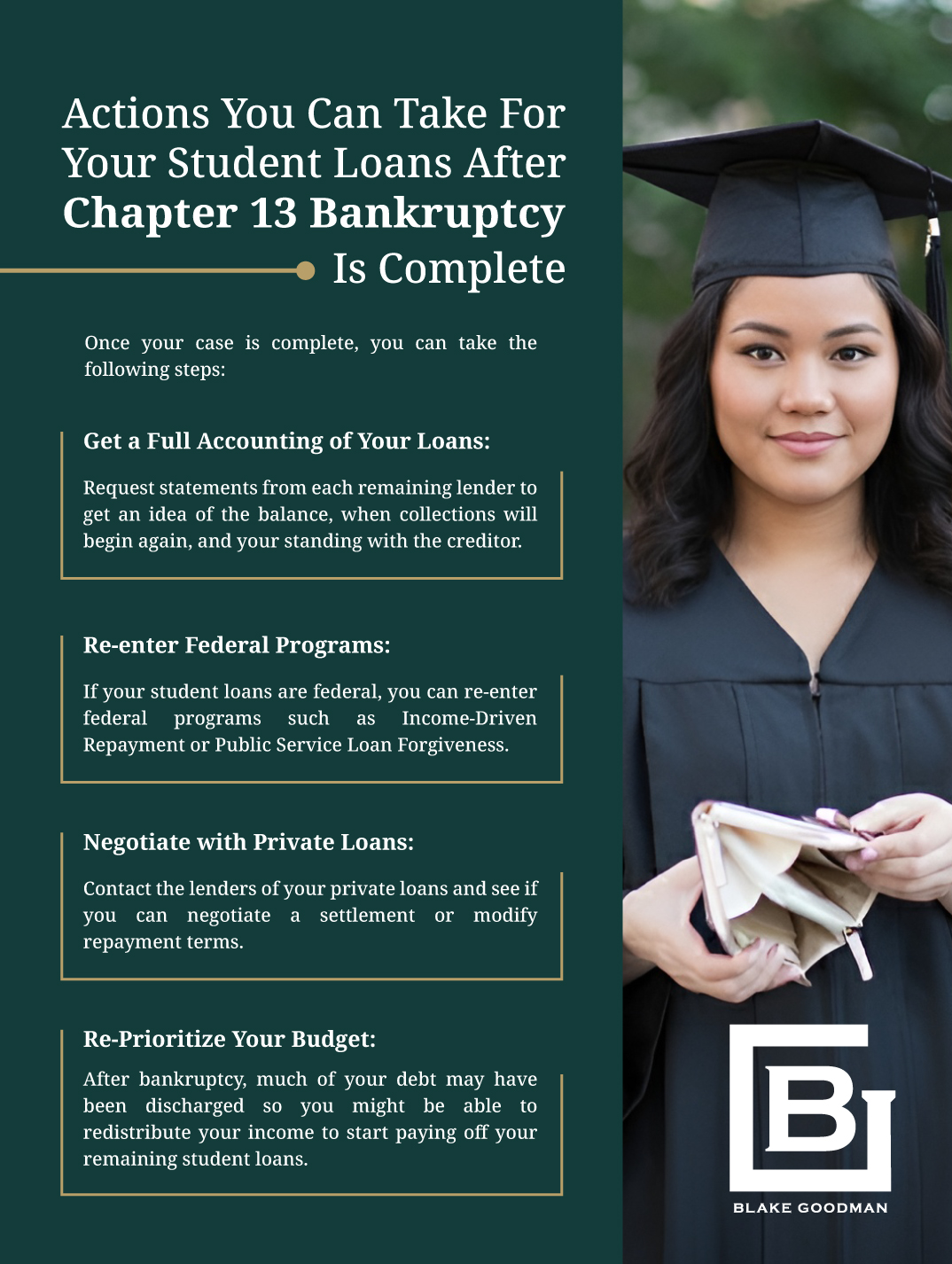
Chapter 13 involves a 3-to-5-year repayment plan. During this time, your student loan payments are usually determined by your "disposable income" rather than the original loan terms. In some cases, the Chapter 13 plan pays very little toward the student loans. At the end of the plan, you can still attempt an adversary proceeding to discharge the remaining balance. Chapter 13 is often used by borrowers who have some income but cannot afford their full student loan payments alongside other debts.
Common Mistakes to Avoid
- Assuming Automatic Discharge: Many people file for bankruptcy thinking their student loans will disappear like their credit card debt. Without an adversary proceeding, the loans stay with you.
- Filing Too Early: If your financial hardship is temporary (e.g., you are temporarily unemployed but have high earning potential), you are unlikely to meet the "persistence" requirement of the Brunner Test.
- Ignoring IDR Plans: If you have federal loans, a judge will almost always ask why you aren't on an Income-Driven Repayment plan. If your IDR payment is $0, the judge may argue that you don't have a hardship because the current system already accommodates your low income.
- Pro Se Representation: Navigating an adversary proceeding is technically demanding. Filing without an attorney ("pro se") significantly reduces your chances of success, especially when facing seasoned DOJ or private bank attorneys.
Alternatives to Bankruptcy Discharge
If the "undue hardship" standard feels insurmountable, there are other ways to manage student debt that may be more effective than bankruptcy:
- Income-Driven Repayment (IDR): Programs like SAVE or older versions like IBR and PAYE can lower your payments to a percentage of your discretionary income, sometimes as low as $0.
- Public Service Loan Forgiveness (PSLF): For those working in government or non-profit sectors, loans can be forgiven tax-free after 120 qualifying payments.
- Total and Permanent Disability (TPD) Discharge: If you are unable to work due to a physical or mental impairment that is expected to result in death or last for at least 60 months, you may qualify for a TPD discharge outside of the bankruptcy court.
- Administrative Discharges: These include Closed School Discharges, Borrower Defense to Repayment (for school misconduct), and False Certification Discharges.
Frequently Asked Questions
Can I discharge my student loans if I am currently employed?
Yes. Being employed does not automatically disqualify you. The court looks at whether your "minimal standard of living" can be maintained while paying the debt. If your income is low and your necessary expenses (housing, food, healthcare) consume all of it, you may still meet the poverty prong of the Brunner Test.
Does filing for bankruptcy stop student loan wage garnishment?
Yes, temporarily. When you file for bankruptcy, an "automatic stay" goes into effect, which prohibits most creditors from continuing collection actions, including wage garnishments. However, if the student loans are not discharged during the bankruptcy, the garnishment can resume once the case is closed or the stay is lifted.
How much does it cost to try to discharge student loans in bankruptcy?
Beyond the standard bankruptcy filing fees (approximately $338 for Chapter 7 in 2026), an adversary proceeding often involves additional legal fees. Some attorneys charge a flat fee for the AP, while others work on an hourly basis. Because of the 2022 reforms, the cost for federal loan discharges has decreased, but you should still expect to pay for the specialized legal work required.
What happens if I only get a "partial discharge"?
A partial discharge means the court wipes away some of your student loan debt but leaves you responsible for the rest. For example, if you owe $100,000, a judge might decide you can reasonably afford to pay back $20,000 over time and discharge the remaining $80,000. Not all jurisdictions allow partial discharges, so this depends on where you live.
Can I reopen an old bankruptcy case to discharge student loans?
In many cases, yes. If you filed for bankruptcy years ago but didn't know you could seek a student loan discharge, you may be able to petition the court to reopen your case to file an adversary proceeding. This is particularly relevant now that the DOJ guidance has made the process more favorable for borrowers.
Recommended Next Steps
If you are struggling with student debt and considering bankruptcy, your first step should be to consult with a bankruptcy attorney who has specific experience in student loan adversary proceedings.
Prepare for your consultation by gathering your last two years of tax returns, your most recent student loan statements, and a detailed list of your monthly living expenses. Ask the attorney to evaluate your case specifically under the 2022 DOJ/Education Department guidance if you have federal loans. Finally, check your eligibility for Income-Driven Repayment plans; even if they don't solve your long-term debt problem, participating in them can demonstrate the "good faith" necessary to win a bankruptcy discharge later.