In the physical sciences, a unit is a standardized quantity used as a benchmark for measuring physical properties. The primary framework governing these measurements is the International System of Units (SI), which defines seven base units—the meter, kilogram, second, ampere, kelvin, mole, and candela—that serve as the foundation for all derived physical quantities used in modern scientific research and engineering.
The Foundation: Understanding the International System of Units (SI)
The International System of Units, abbreviated as SI from the French Système international (d'unités), is the modern form of the metric system. It is the only system of measurement with an official status in nearly every country in the world. As of 2026, the SI is built upon seven defining constants of nature. By anchoring units to these constants—such as the speed of light in a vacuum and the Planck constant—the SI ensures that measurements are immutable, universal, and reproducible anywhere in the universe.
The system is designed to be coherent, meaning that the product or quotient of any two unit quantities yields the unit of the resulting quantity. This eliminates the need for conversion factors when calculating derived values, such as velocity or force, greatly reducing the potential for error in experimental physics and complex engineering calculations.
The Seven SI Base Units
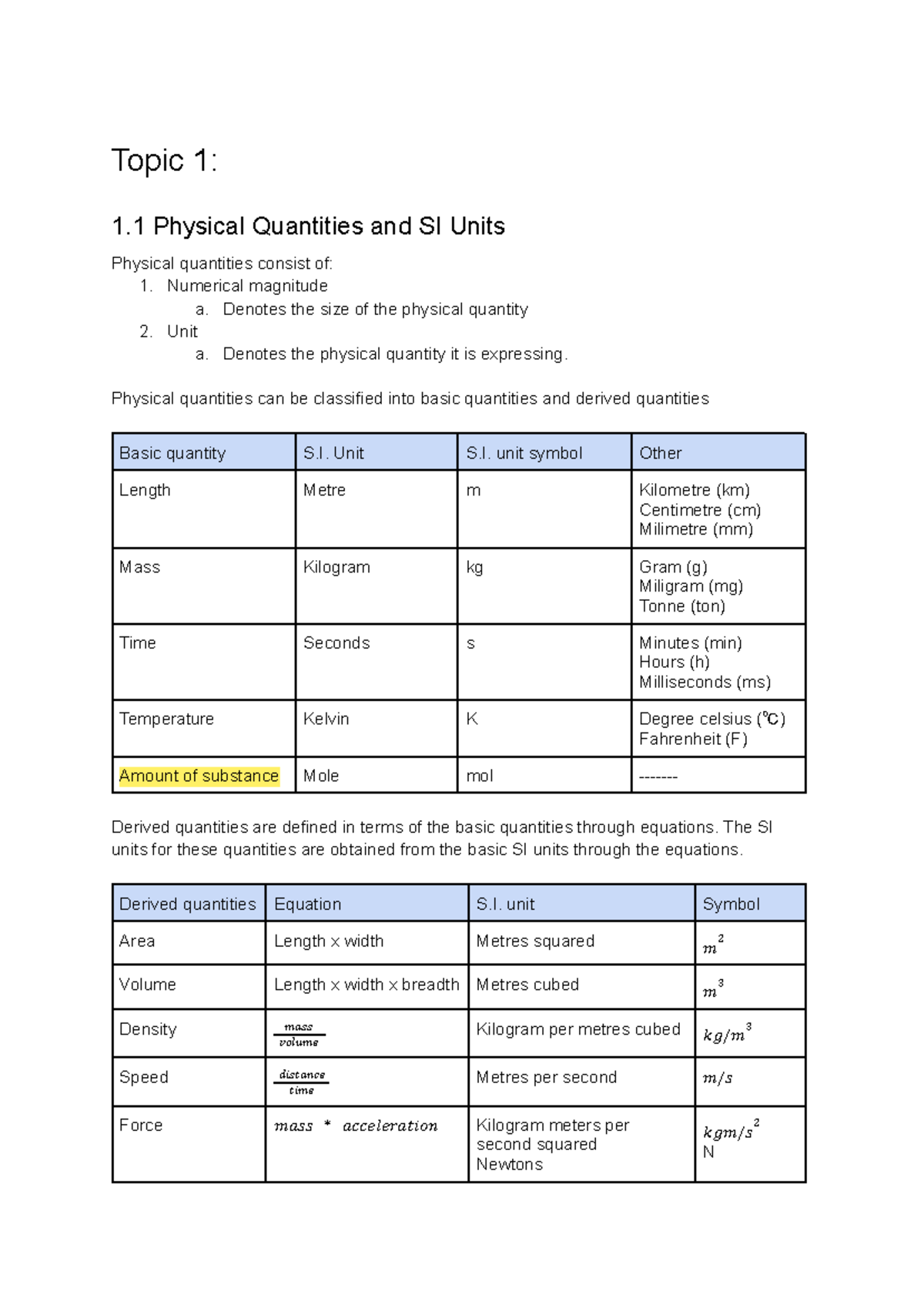
The base units form the core of the measurement system. Each unit is defined by a specific physical constant, ensuring that the unit remains constant over time regardless of technological advancements.
- Meter (m): The unit of length. It is defined by taking the fixed numerical value of the speed of light in a vacuum ($c$) as 299,792,458 when expressed in the unit m/s.
- Kilogram (kg): The unit of mass. It is defined by taking the fixed numerical value of the Planck constant ($h$) as $6.62607015 \times 10^{-34}$ when expressed in the unit $\text{J}\cdot\text{s}$ (which is equal to $\text{kg}\cdot\text{m}^2/\text{s}$).
- Second (s): The unit of time. It is defined by taking the fixed numerical value of the cesium frequency ($\Delta\nu_{Cs}$), the unperturbed ground-state hyperfine transition frequency of the cesium-133 atom, to be 9,192,631,770 when expressed in the unit Hz.
- Ampere (A): The unit of electric current. It is defined by taking the fixed numerical value of the elementary charge ($e$) as $1.602176634 \times 10^{-19}$ when expressed in the unit C (coulomb).
- Kelvin (K): The unit of thermodynamic temperature. It is defined by taking the fixed numerical value of the Boltzmann constant ($k$) as $1.380649 \times 10^{-23}$ when expressed in the unit $\text{J/K}$.
- Mole (mol): The unit of amount of substance. One mole contains exactly $6.02214076 \times 10^{23}$ elementary entities, this number being the fixed numerical value of the Avogadro constant ($N_A$).
- Candela (cd): The unit of luminous intensity in a given direction. It is defined by taking the fixed numerical value of the luminous efficacy of monochromatic radiation of frequency $540 \times 10^{12}$ Hz ($K_{cd}$) to be 683 when expressed in the unit $\text{lm/W}$.
Derived Units and Their Applications
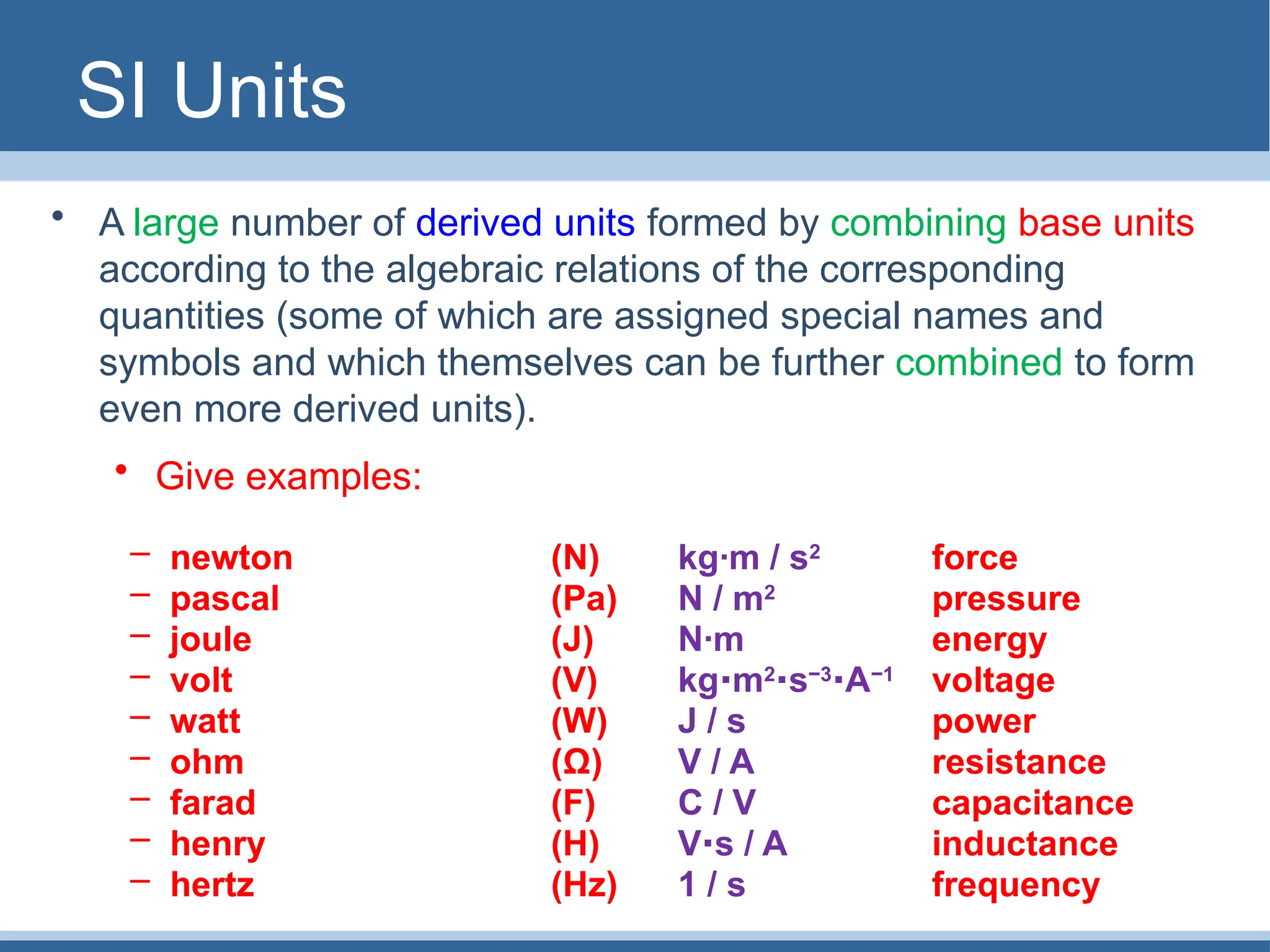
Derived units are created by multiplying or dividing base units to describe complex physical phenomena. Because these units are derived from the base SI units, they possess a direct mathematical relationship to the fundamental constants of the universe.
For example, force is expressed in Newtons (N). One Newton is defined as the amount of force required to accelerate a one-kilogram mass at a rate of one meter per second squared. Mathematically, $1\text{ N} = 1\text{ kg}\cdot\text{m/s}^2$.
Common derived units include:
- Joule (J): The unit of energy, equivalent to a Newton-meter.
- Watt (W): The unit of power, equivalent to a Joule per second.
- Pascal (Pa): The unit of pressure, equivalent to a Newton per square meter.
- Hertz (Hz): The unit of frequency, equivalent to one cycle per second.
Comparison of Unit Systems
While the SI is the standard for international science, historical systems or specific industry standards occasionally appear in literature. Understanding these helps in converting legacy data into the current standard.
| Quantity | SI Unit | CGS Unit | Imperial/US Customary |
|---|---|---|---|
| Length | Meter (m) | Centimeter (cm) | Foot (ft) |
| Mass | Kilogram (kg) | Gram (g) | Pound-mass (lbm) |
| Force | Newton (N) | Dyne (dyn) | Pound-force (lbf) |
| Energy | Joule (J) | Erg (erg) | British Thermal Unit (BTU) |
| Pressure | Pascal (Pa) | Barye (Ba) | Pound per sq inch (psi) |
Dealing with Large and Small Scales: SI Prefixes
Physics often deals with distances as vast as the observable universe and as small as the subatomic scale. To represent these values without using unwieldy strings of zeros, the SI utilizes a standard set of prefixes. These prefixes are multipliers based on powers of ten.
- Mega (M): $10^6$ (one million)
- Giga (G): $10^9$ (one billion)
- Tera (T): $10^{12}$ (one trillion)
- Milli (m): $10^{-3}$ (one thousandth)
- Micro ($\mu$): $10^{-6}$ (one millionth)
- Nano (n): $10^{-9}$ (one billionth)
- Pico (p): $10^{-12}$ (one trillionth)
Using these prefixes alongside base units is a standard practice in research reports and technical specifications. For instance, a microprocessor clock speed is typically cited in Gigahertz (GHz), while the wavelength of light might be expressed in nanometers (nm).
Common Mistakes in Unit Usage
- Improper Capitalization: Units named after people are capitalized when abbreviated (e.g., N for Newton, J for Joule, W for Watt), but the full name of the unit is written in lowercase (newton, joule, watt) unless it starts a sentence.
- Mixing Systems: Combining SI units with Imperial units in the same equation is the most frequent source of error in engineering. Always convert all variables to the same system before performing calculations.
- Ignoring Sig Figs: When calculating with units, ensure that the final result reflects the precision of the measurements provided. Adding or multiplying units does not justify increasing the implied accuracy of the data.
- Symbol Misuse: Symbols are not abbreviations and should not be followed by a period (unless at the end of a sentence). For example, use "kg" rather than "kgs" or "kg." for the plural.
Frequently Asked Questions
Why isn't the kilogram still defined by a physical object? Until 2019, the kilogram was defined by the International Prototype of the Kilogram (IPK), a platinum-iridium cylinder. It was replaced by a definition based on the Planck constant because physical objects are subject to contamination, wear, and environmental degradation, whereas the Planck constant is a fundamental, unchanging property of the universe.
Are there units outside of the SI that are still "official"? Yes. The International Bureau of Weights and Measures (BIPM) recognizes certain "non-SI" units that are accepted for use because of their widespread application, such as the minute, hour, day, degree (angle), liter, and electronvolt.
How do I convert between different units effectively? The safest method is the "factor-label" method (or dimensional analysis). This involves multiplying the value by a conversion factor expressed as a fraction equal to one (e.g., $100\text{ cm} / 1\text{ m} = 1$). By setting up the equation so that the unwanted unit cancels out, you ensure the mathematical result is correct.
What is the difference between mass and weight? In physics, mass is a measure of the amount of matter in an object, measured in kilograms (kg). Weight is the force exerted on that mass by gravity, measured in Newtons (N). A person's mass remains constant regardless of location, but their weight changes depending on the local gravitational field.
Are there different types of "tons"? Yes. This is a common source of confusion. A metric tonne is 1,000 kilograms. A short ton (used in the US) is 2,000 pounds (approximately 907 kg), and a long ton (used in the UK) is 2,240 pounds (approximately 1,016 kg). Always specify "metric" when working in scientific contexts.
Practical Recommendations for Professionals and Students
When recording data or performing calculations, always write the units alongside the numerical values at every step. This practice serves as a critical internal check: if your final units do not match the expected physical quantity—for example, if you end up with "meters" when you were calculating "energy"—you can instantly trace the error back through the equation.
For high-precision work, utilize the official publications provided by the BIPM (the Bureau International des Poids et Mesures), which maintain the current standards for the SI. If you are preparing technical reports, ensure your notation adheres to the ISO 80000 series, which governs the international standards for quantities and units. By maintaining strict discipline in unit usage, you ensure that your research remains replicable, professional, and accurate.