Organizations operating on Amazon Web Services (AWS) in 2026 can secure cyber insurance by leveraging the AWS Cyber Insurance Partner Program or by utilizing AWS Security Hub to provide verified security posture data to independent underwriters. While AWS is not a direct insurance provider, it facilitates streamlined underwriting through automated compliance assessments, allowing businesses to demonstrate their adherence to the Shared Responsibility Model to lower premiums and improve coverage eligibility.
Cyber security insurance has evolved from a luxury to a fundamental requirement for businesses of all sizes. In the current landscape of 2026, the complexity of cloud-native threats means that insurers no longer rely solely on static questionnaires. Instead, they demand real-time visibility into an organization’s cloud environment. For AWS customers, this means the path to a policy involves a blend of technical configuration, rigorous logging, and the strategic use of AWS-native security tools to prove "insurability."
The AWS Cyber Security Insurance Ecosystem in 2026
The relationship between AWS and the insurance industry is built on the concept of automated trust. In previous years, getting a quote for a cloud environment was a manual, error-prone process. Today, AWS has formalized this through the AWS Cyber Insurance Partner Program (CIPP). This program connects AWS customers with vetted insurance providers who understand the AWS Shared Responsibility Model.
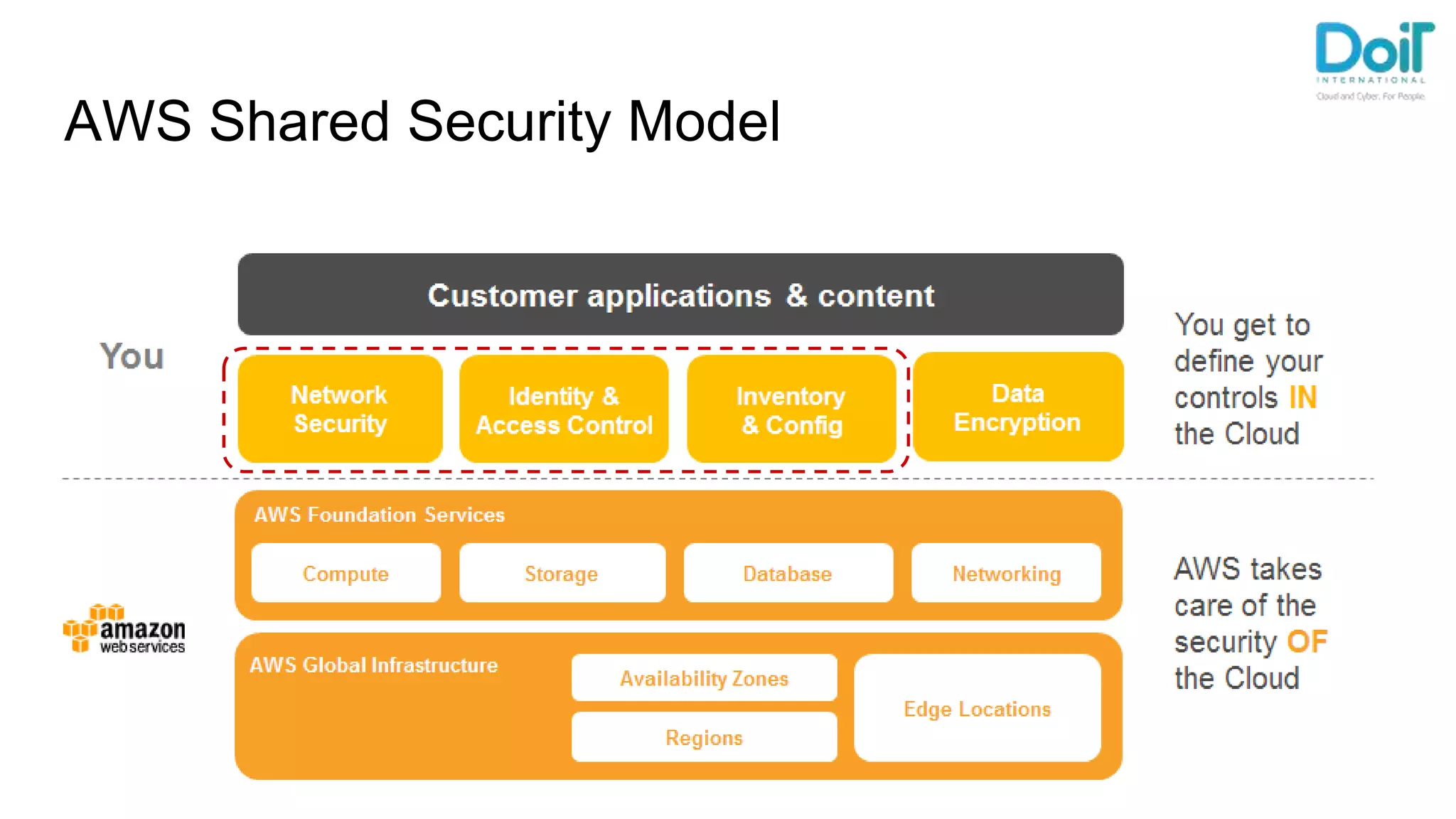
Under the Shared Responsibility Model, AWS manages the "Security of the Cloud" (hardware, software, networking, and facilities), while the customer is responsible for "Security in the Cloud" (data, identity management, and application configuration). Insurers focus almost exclusively on the customer’s side of this equation. If a breach occurs because an S3 bucket was left public or an IAM (Identity and Access Management) role was overly permissive, the liability falls on the customer. Cyber insurance is designed to mitigate the financial fallout of these "Security in the Cloud" failures.
The Role of the AWS Cyber Insurance Partner Program
The CIPP acts as a bridge. AWS partners with global brokers and underwriters to create a more transparent application process. By using AWS-native security APIs, these partners can analyze a customer's security posture with their permission, often leading to:
- Faster Quoting: Reducing the time to receive a quote from weeks to hours.
- Premium Discounts: Incentives for customers who maintain high scores in AWS Security Hub.
- Pre-approved Coverage: Specific policies tailored for cloud-native risks like ransomware, data exfiltration, and business interruption.
Technical Prerequisites for AWS Insurability
In 2026, underwriters look for specific technical markers before they will even offer a quote. Simply "being on AWS" is not enough; you must demonstrate that you are using the platform’s security features correctly.
1. Identity and Access Management (IAM) Maturity
Insurers now view Multi-Factor Authentication (MFA) as a non-negotiable baseline. Beyond MFA, they look for Least Privilege Enforcement. If your "root" account is used for daily operations or if users have broader permissions than their job requires, you may be deemed uninsurable. Insurers often request reports from AWS IAM Access Analyzer to verify that external sharing is limited and that unused credentials are being pruned.
2. Continuous Monitoring and Logging
You cannot insure what you do not monitor. To satisfy an underwriter, AWS CloudTrail must be enabled across all regions, with logs stored in an immutable S3 bucket (using S3 Object Lock). Furthermore, Amazon GuardDuty should be active to detect unauthorized behavior, such as crypto-mining or unusual API calls. In the event of a claim, these logs are the primary evidence used by forensic investigators to determine the scope of a breach.
3. Automated Security Assessments
AWS Security Hub has become the industry standard for cloud insurance assessments. It aggregates alerts from various AWS services and checks them against best practices like the CIS (Center for Internet Security) AWS Foundations Benchmark. Many insurers in 2026 require a "Security Hub Score" of 80% or higher to qualify for preferred rates.
How AWS Tools Impact Cyber Insurance Premiums
One of the most significant shifts in 2026 is the move toward performance-based premiums. Just as a telematics device in a car can lower auto insurance rates for safe drivers, AWS security tools can lower cyber insurance costs for proactive organizations.
Data Encryption and S3 Security
Insurers evaluate your "blast radius." If all data in Amazon S3 and Amazon EBS (Elastic Block Store) is encrypted using AWS Key Management Service (KMS), the risk of a catastrophic data leak is significantly reduced. If an attacker gains access to encrypted volumes but not the keys, the data remains useless. Demonstrating that you use "Default Encryption" at the account level is a powerful lever for premium negotiation.
Backup and Disaster Recovery
Ransomware coverage is the most expensive component of a cyber policy. To lower this cost, you must prove that you can recover without paying the ransom. AWS Backup provides a centralized way to manage backups across AWS services. Insurers specifically look for "Air-gapped" or "Cross-account" backups, ensuring that if a primary AWS account is compromised, the backups remain untouched in a separate, secured environment.
The Application Process: Step-by-Step
Securing a policy for an AWS-heavy workload requires a coordinated effort between the DevOps team, the CISO, and the finance department.
- Posture Assessment: Run a full scan using AWS Security Hub and the AWS Well-Architected Tool (specifically the Security Pillar). Address all "High" and "Critical" findings before approaching a broker.
- Select a Partner: Navigate to the AWS Marketplace or the AWS Cyber Insurance Partner page. Choosing a partner who is "AWS Aware" is critical; traditional insurers may not understand the nuances of serverless architecture (AWS Lambda) or container security (Amazon EKS).
- Grant Limited Read Access: Many modern insurers use "Read-Only" cross-account roles to verify your security settings. This eliminates the need for 50-page paper questionnaires.
- Review the Policy Limits: Ensure the policy covers "Cloud-Specific Risks." This includes the cost of notifying customers after a breach, the cost of the forensic investigation on AWS infrastructure, and the loss of revenue during an AWS region outage (if business interruption is included).
- Maintain Compliance: In 2026, insurance is not "set it and forget it." If your security posture drops significantly during the policy term, the insurer may have grounds to deny a claim.
Comparison: Traditional vs. AWS-Integrated Cyber Insurance
| Feature | Traditional Cyber Insurance | AWS-Integrated (CIPP) Insurance |
|---|---|---|
| Underwriting Method | Manual Questionnaires | Automated API-based Analysis |
| Verification | Self-attestation (Trust) | Real-time Telemetry (Verify) |
| Quoting Speed | 2–4 Weeks | 24–48 Hours |
| Pricing Model | Fixed Annual Premium | Performance-based / Dynamic |
| Coverage Focus | General IT Assets | Cloud-native Risks (S3, IAM, Lambda) |
| Compliance Mapping | Generic (SOC2/ISO) | AWS Foundational Security Best Practices |
Common Pitfalls and Challenges
Despite the advancements in 2026, many organizations struggle with the intersection of AWS and insurance. One common mistake is assuming that AWS Shield (DDoS protection) satisfies all security requirements. While Shield protects against availability attacks, it does not protect against data theft or social engineering, which are the primary drivers of insurance claims.
Another pitfall is the failure to define the scope of coverage. If your organization uses a hybrid cloud model, your "AWS Cyber Insurance" may only cover assets within the AWS environment. You must ensure there are no "coverage gaps" between your on-premises servers and your cloud instances.
Furthermore, many organizations neglect the Incident Response (IR) Plan. Most insurers require you to use their pre-approved forensic and legal vendors in the event of a breach. If your internal team begins an investigation on AWS without notifying the insurer, you may inadvertently violate the terms of your policy, leading to a denial of the claim.
Frequently Asked Questions
Does AWS provide cyber insurance directly?
No, AWS does not act as an insurance carrier. AWS provides the technical platform, security tools, and a partner ecosystem (CIPP) that allows third-party insurance companies to underwrite policies more accurately and efficiently. Customers must still sign a contract with an independent insurance provider or broker.
Will my AWS insurance cover me if an AWS region goes down?
This depends on whether your policy includes Dependent Business Interruption coverage. While AWS has high availability, regional outages are a known risk. Most standard cyber policies focus on breaches and hacks; you must specifically request coverage for "system failure" or "cloud provider downtime" to be protected against AWS infrastructure outages.
How does the AWS Shared Responsibility Model affect my insurance claim?
The model defines who is at fault. If a breach is caused by a failure in AWS's physical infrastructure, AWS is responsible (though their liability to you is limited by your Service Level Agreement). If the breach is caused by your misconfiguration of an AWS service, you are responsible. Insurance is primarily designed to cover the costs associated with your responsibilities under the model.
Can I get cyber insurance if I don't use MFA?
In 2026, it is virtually impossible to get a comprehensive cyber insurance policy without MFA enabled for all privileged accounts. Insurers view the lack of MFA as "gross negligence." If you manage to find a policy without MFA, the premiums will be prohibitively expensive, and the coverage limits will be very low.
Is AWS Security Hub mandatory for insurance?
While not legally mandatory, it is the preferred tool for insurers to verify security posture. Using AWS Security Hub provides a standardized language that insurers understand. Organizations that do not use Security Hub or a similar CSPM (Cloud Security Posture Management) tool often face higher scrutiny and more manual auditing during the application process.
Does insurance cover the cost of "Ransomware Remediation" on AWS?
Most modern cyber policies include ransomware coverage, which covers the cost of hiring negotiators, paying the ransom (if legal), and restoring data from backups. However, insurers will only pay if you can prove you had "Reasonable Security Measures" in place, such as encrypted backups and patched EC2 instances.
Practical Recommendation for 2026
To optimize your AWS cyber security insurance position, start by achieving 100% MFA adoption and enabling AWS Security Hub across all accounts in your AWS Organization. Use the AWS Well-Architected Tool to conduct a self-audit of your security pillar. Once your technical house is in order, approach a broker through the AWS Cyber Insurance Partner Program. This path provides the most technical alignment, ensuring that your policy is not just a piece of paper, but a robust financial backstop that understands the specific architecture of your cloud environment.