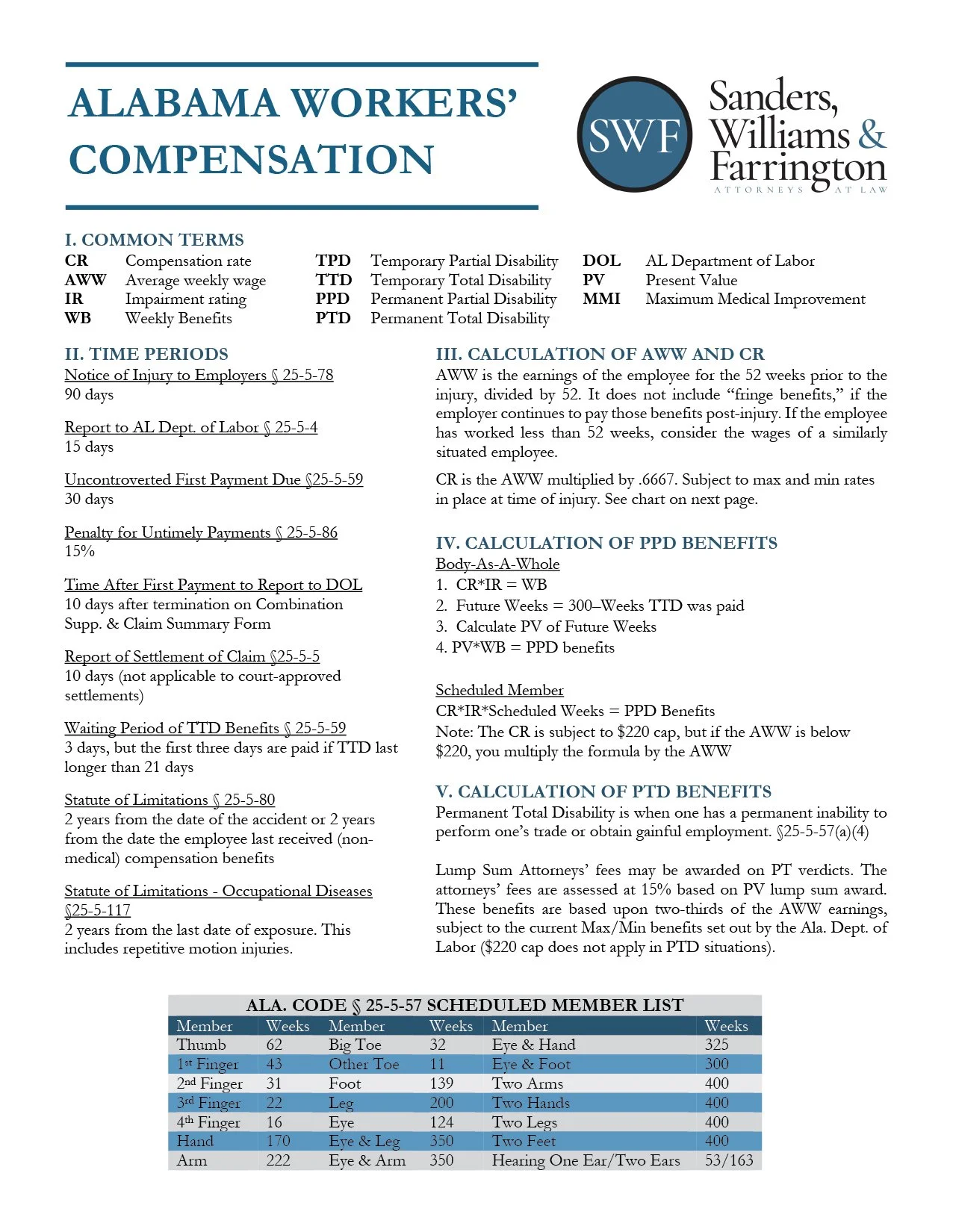
Temporary Total Disability (TTD) benefits in Alabama workers' compensation continue until an injured worker reaches Maximum Medical Improvement (MMI), the point at which their medical condition stabilizes and no further functional improvement is reasonably expected from ongoing medical treatment. This system ensures that employees who are entirely unable to work due to a workplace injury receive wage-replacement benefits, typically two-thirds of their average weekly wage, until their treating physician determines they can return to work or their condition has plateaued.
Navigating the Alabama workers' compensation system requires a solid understanding of how TTD benefits and MMI intersect. For injured employees across the state, managing medical treatment, dealing with insurance adjusters, and calculating wage benefits can create significant financial and emotional stress. This guide provides a comprehensive breakdown of how Alabama law governs TTD, the definition and implications of MMI, what happens when treatment concludes, and the legal remedies available if disputes arise.
The Foundation of Alabama Workers' Compensation: Understanding TTD
Under the Alabama Workers' Compensation Act, employees who suffer job-related injuries or occupational diseases are entitled to medical care and wage-replacement benefits. When an injury completely prevents an employee from performing their regular job duties or any light-duty work offered by the employer, the worker is classified as being temporarily totally disabled.
What Does Temporary Total Disability Mean?
Temporary Total Disability (TTD) refers to a status where an injured worker is completely incapacitated from working for a temporary period. "Temporary" means the condition is expected to improve or resolve, while "Total" means the employee cannot perform any gainful employment.
- Incapacity: The inability to perform the duties of the job held at the time of injury, as well as the inability to secure alternative work consistent with the employee's physical limitations.
- Medical Authorization: TTD status must be established and continuously verified by an authorized treating physician. Self-diagnosing or relying on unapproved medical professionals will not trigger legal TTD obligations for the employer's insurance carrier.
- Wage Replacement Rate: In Alabama, TTD benefits are generally paid at a rate of 66 2/3% (two-thirds) of the injured worker's average weekly wage (AWW), subject to statutory minimum and maximum caps set annually by the Alabama Department of Labor.
Determining the Average Weekly Wage (AWW)
The calculation of the AWW is critical because it dictates the weekly TTD check amount. Typically, the AWW is calculated by taking the employee's total gross earnings over the 52 weeks prior to the injury and dividing by 52. If the employee worked for the employer for a shorter period, a proportional method or comparison to similar workers is applied. Fringe benefits, overtime, and bonuses may be factored in depending on their consistency and structure under Alabama case law.
The Role and Definition of Maximum Medical Improvement (MMI)
Maximum Medical Improvement is a pivotal milestone in any workers' compensation claim. It does not necessarily mean the worker has fully recovered to their pre-injury state; rather, it signifies that the healing process has reached a plateau.
Defining MMI Under Alabama Law
MMI is reached when, in the medical opinion of the authorized treating physician, the employee's condition has stabilized and further medical recovery or correction of the condition cannot be reasonably anticipated. At this juncture, treatment shifts from curative (aimed at healing or improving the condition) to palliative (aimed at managing chronic pain or maintaining the current status).
- Physician's Authority: Only the authorized treating physician designated within the employer's approved panel of physicians can declare MMI. Independent medical evaluations (IMEs) requested by the employee or insurance carrier can influence disputes, but the treating physician's formal rating carries substantial weight in administrative proceedings.
- End of TTD: Once MMI is officially declared, Temporary Total Disability benefits cease. The legal theory is that the worker is no longer "healing temporarily," and their condition is now permanent.
- Transition to Permanent Disability: Reaching MMI triggers the evaluation of permanent impairment ratings, which determine eligibility for Permanent Partial Disability (PPD) or Permanent Total Disability (PTD) benefits.
| Disability Stage | Medical Status | Benefit Type | Duration |
|---|---|---|---|
| Temporary Total (TTD) | Actively healing; completely unable to work | 66 2/3% of AWW | From injury until MMI or return to work |
| Temporary Partial (TPD) | Healing; able to perform light-duty work | 66 2/3% of the wage loss | While working light-duty before MMI |
| Permanent Partial (PPD) | Reached MMI; permanent functional loss | Statutory schedule or loss of earning capacity | Set number of weeks or specific calculation |
| Permanent Total (PTD) | Reached MMI; permanently unable to work | 66 2/3% of AWW | For life or statutory limits |
What Happens Between Injury and MMI?
The timeline spanning from the date of injury to the formal declaration of MMI involves continuous medical management, reporting requirements, and potential disputes regarding light-duty assignments.
Authorized Treating Physicians and Panel Rules
Alabama law grants the employer the right to select the medical provider. Employers must maintain a certified " panel of physicians" containing at least four reputable medical providers (or more, depending on the size of the business and union agreements).
- The Panel Rule: Injured workers must generally seek treatment from the employer's designated panel. Seeking unauthorized medical treatment outside this panel can result in the employer and insurance carrier denying responsibility for the medical bills.
- Changing Physicians: If an employee is dissatisfied with the panel physician, Alabama law permits requesting a change of physician within the panel, or petitioning the Alabama Department of Labor or circuit court if the employer refuses proper care.
Light-Duty Work and the Refusal of Suitable Employment
Insurance carriers often attempt to terminate TTD benefits before MMI by offering "light-duty" or "modified-duty" work.
- Physician Restrictions: Any light-duty assignment must be explicitly approved by the authorized treating physician, who outlines specific physical restrictions (e.g., lifting limits, sitting vs. standing).
- Suitability: The employer must offer work that complies with these restrictions. If the employer provides suitable light-duty work and the employee refuses it without a valid medical or legal excuse, TTD benefits may be legally suspended or terminated.
- Temporary Partial Disability (TPD): If the employee returns to light-duty work at a lower wage than their pre-injury earnings, they may become eligible for Temporary Partial Disability benefits, which cover a portion of the wage differential.
Termination of TTD Benefits Prior to MMI
While TTD normally continues until MMI, Alabama workers' compensation statutes and case law outline specific scenarios where TTD benefits can legally stop before that milestone is reached.
Return to Work at Full Wages
If an injured worker recovers sufficiently before reaching MMI to return to their regular job duties at their pre-injury wage rate, TTD benefits naturally terminate upon the date of return.
Release to Light Duty and Employee Refusal
As noted above, if the treating physician releases the worker to perform restricted, light-duty work, and the employer makes a bona fide offer of such employment, the employee's unjustified refusal to report to work can justify stopping TTD payments.
Reaching Maximum Medical Improvement
The most common legal cessation of TTD occurs when the authorized physician formally assigns an MMI date in medical records and reports. At that moment, temporary disability ends, and permanent disability determinations begin.
Life After MMI: Permanent Disability Ratings and Settlements
Reaching MMI marks the transition from temporary wage replacement to permanent compensation. At this stage, the physician evaluates whether the worker has sustained any permanent impairment.
Permanent Impairment Ratings
Using the American Medical Association (AMA) Guides to the Evaluation of Permanent Impairment, the treating physician assigns a percentage rating representing the permanent loss of use of a body part or the body as a whole.
- Scheduled Injuries: Under Alabama Code § 25-5-57, injuries to specific body parts (arms, legs, hands, feet, eyes, ears) are categorized as "scheduled injuries." Compensation is strictly calculated based on a fixed number of weeks corresponding to the impairment percentage, regardless of actual wage loss.
- Unscheduled Injuries: Injuries to the back, spine, head, neck, or internal organs are "unscheduled." Compensation for these injuries is based on the permanent partial disability's impact on the worker's future earning capacity, requiring vocational and economic assessment.
Lump-Sum Settlements vs. Ongoing Benefits
Many Alabama workers' compensation claims culminate in a "clincher" agreement, which is a full and final lump-sum settlement.
- Clincher Agreements: This involves the employee trading future medical and indemnity benefits for a negotiated cash payout. Clincher agreements require court approval from an Alabama circuit judge to ensure the settlement is fair and in the best interest of the worker.
- Open Claims: If a settlement is not reached, the worker may retain the right to future medical treatment for the work injury, along with permanent disability payments determined by a court order.
Common Disputes and Legal Challenges
The path from TTD to MMI is frequently fraught with disagreements between injured workers and insurance adjusters. Understanding these common friction points helps claimants protect their rights.
Premature Cut-Off of TTD Benefits
Insurance carriers sometimes prematurely cut off TTD checks before an official MMI declaration or before the worker has actually been released to return to work. Workers should immediately request the written medical note or doctor's report upon which the insurance company relied. If no formal MMI has been declared, an attorney can file a motion for expedited relief with the court.
Disagreements Over MMI and Impairment Ratings
An employee may disagree with a physician's declaration of MMI, believing they still require surgery or active medical intervention. Conversely, a worker might dispute a low permanent impairment rating that undervalues their permanent disability.
- Second Opinions and IMEs: Injured workers in Alabama have the right to secure an Independent Medical Evaluation at their own expense to challenge the authorized treating physician's findings, which can be presented as evidence in court hearings.
- Statute of Limitations: In Alabama, a workers' compensation claim generally must be filed within two years of the date of the injury, or within two years of the last voluntary payment of compensation or medical benefits by the insurance carrier, whichever is later. Missing these deadlines bars recovery permanently.
Practical Guidance for Injured Workers in Alabama
Navigating the Alabama workers' compensation system requires meticulous record-keeping, adherence to medical advice, and proactive communication.
- Maintain Detailed Records: Keep copies of all medical notes, work restriction slips, TTD check stubs, and written correspondence with the insurance adjuster.
- Attend All Medical Appointments: Missing appointments with the authorized treating physician gives the insurance carrier grounds to request benefit suspensions for non-compliance.
- Communicate Restrictions Clearly: Ensure that any light-duty offers from your employer are reviewed against the exact written restrictions provided by your doctor. Never perform tasks outside your medical restrictions.
- Consult a Qualified Attorney: Because Alabama workers' compensation law involves complex statutory caps, medical panel rules, and procedural requirements, consulting an experienced Alabama workers' compensation lawyer early in the process can prevent costly mistakes and protect your entitlement to TTD until MMI.