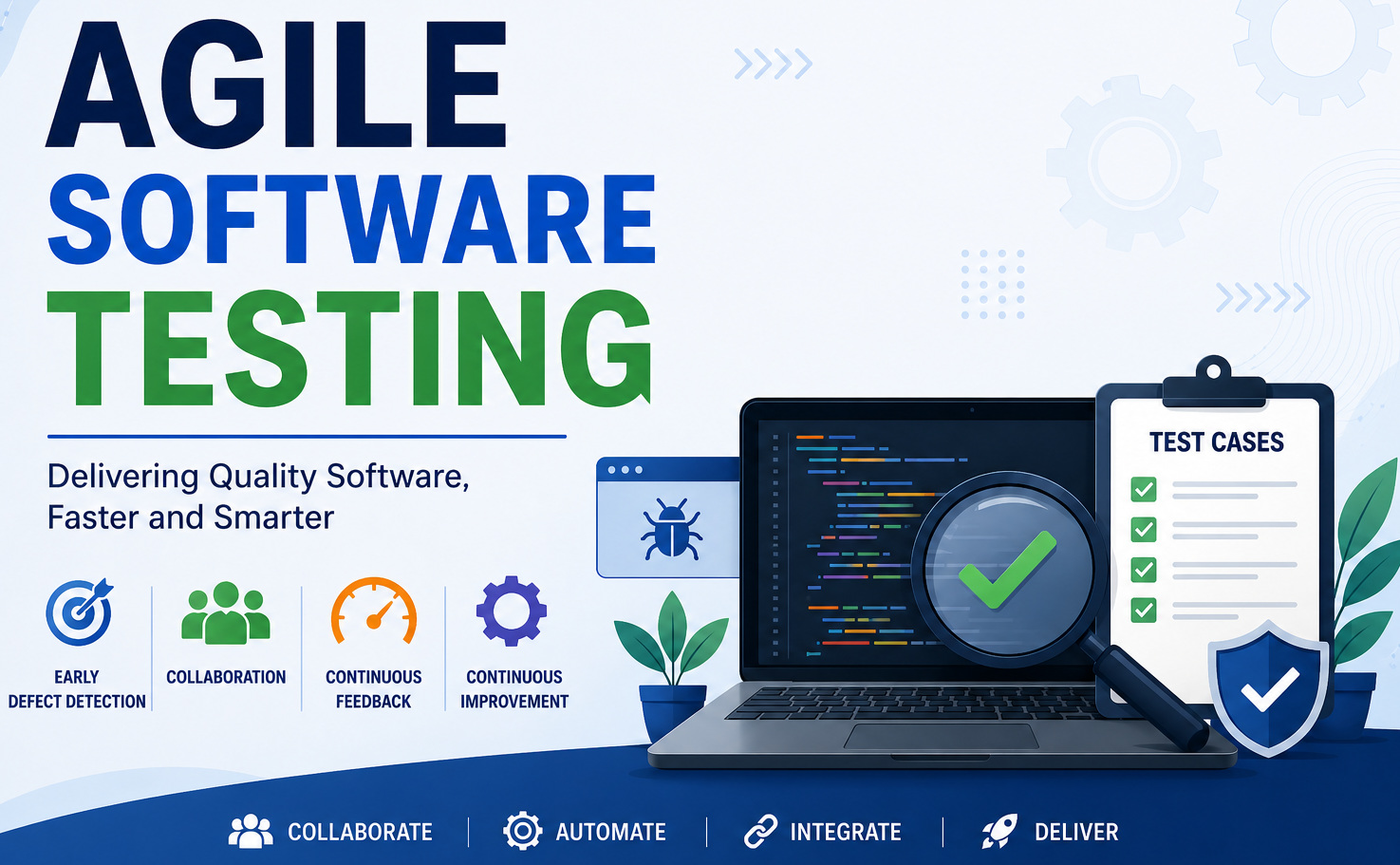
Agile QA testing for finance is a specialized methodology that integrates continuous quality assurance into the software development lifecycle to balance rapid delivery with strict regulatory compliance. By shifting testing to the earliest stages of development, financial institutions can identify vulnerabilities and logic errors before they reach production, ensuring security and operational stability.
The financial services landscape in 2026 is defined by extreme competition between traditional banks, fintech disruptors, and decentralized finance (DeFi) platforms. In this high-stakes environment, the traditional "Waterfall" approach—where testing occurs as a final, monolithic phase—is no longer viable. However, the move to Agile introduces significant risks if not managed correctly. Financial software must adhere to rigorous standards set by regulators such as the SEC, EBA, and various national authorities, all while protecting sensitive customer data and maintaining 99.999% uptime.
The Paradigm Shift: From Waterfall to Agile QA in Finance
Historically, financial institutions favored Waterfall methodologies because they offered a clear, documented path that satisfied auditors. Each phase—requirements, design, coding, testing—had a distinct "gate." In 2026, the demand for weekly or even daily feature releases has forced a transition to Agile Quality Assurance (QA).
Agile QA is not merely "testing faster"; it is the practice of embedding quality into every sprint. In a financial context, this means the QA team is involved from the moment a product owner defines a "user story." For instance, if a bank is developing a new cross-border payment feature, the QA engineer analyzes the story for compliance with Anti-Money Laundering (AML) and Know Your Customer (KYC) regulations before a single line of code is written.
This proactive approach prevents "compliance debt," a situation where a feature is functionally perfect but fails to meet legal requirements, necessitating an expensive and time-consuming redesign late in the cycle.
Core Components of a Finance-Centric Agile QA Strategy
Implementing Agile QA in finance requires a multi-layered strategy that addresses technical, regulatory, and cultural dimensions.
1. Shift-Left Testing
The "Shift-Left" philosophy moves testing activities to the earliest possible point in the development process. In finance, this involves:
- Static Code Analysis: Using automated tools to scan code for security vulnerabilities as developers write it.
- Unit Testing: Developers writing tests for individual components (e.g., an interest rate calculation module) to ensure they function in isolation.
- Requirement Validation: Testing the logic of business requirements to ensure they don't violate financial logic or regulatory constraints.
2. Continuous Integration and Continuous Deployment (CI/CD)
In 2026, the CI/CD pipeline is the backbone of financial software delivery. Every time a developer commits code, an automated suite of tests is triggered. This suite includes:
- Regression Testing: Ensuring new changes haven't broken existing functionality, such as core accounting ledgers or transaction processing.
- Smoke Testing: Rapidly verifying that the most critical functions (e.g., user login, balance inquiry) are operational.
- API Testing: Validating the connections between microservices, which is critical for Open Banking environments.
3. Test Data Management (TDM) and Privacy
One of the greatest hurdles in finance is the use of production data. Regulations like GDPR and CCPA (and their 2026 iterations) strictly forbid using real customer PII (Personally Identifiable Information) in lower environments. Agile QA teams must use:
- Data Masking: Obfuscating sensitive fields while maintaining the data's relational integrity.
- Synthetic Data Generation: Creating entirely artificial datasets that mimic the statistical properties of real financial transactions without containing real user information.
Navigating Regulatory Compliance in an Agile Framework
Auditors often view the "Agile" label with skepticism, fearing that speed equals a lack of documentation. To bridge this gap, Agile QA in finance must prioritize Automated Traceability.
Documentation as Code
In 2026, manual documentation is replaced by "Documentation as Code." Agile tools like JIRA or Azure DevOps are integrated with testing frameworks (like Selenium or Playwright) to automatically generate audit trails. When a test passes, the system logs the test case, the execution timestamp, the code version, and the environment details. This provides a transparent, tamper-proof record for regulators.
Compliance-Driven Development
Behavior-Driven Development (BDD) is particularly effective in finance. By using "Gherkin" syntax (Given/When/Then), business analysts and compliance officers can write test scenarios in plain English. For example:
- Given a user is attempting a transfer over $10,000
- When the user is not flagged as high-risk
- Then the system must prompt for secondary MFA (Multi-Factor Authentication)
These scenarios are then converted into automated tests, ensuring that compliance requirements are directly baked into the software.
Technical Execution: The Testing Pyramid for Financial Services
A balanced testing strategy follows the "Testing Pyramid" model, which emphasizes a high volume of low-level tests and a smaller number of high-level UI tests.
| Test Level | Scope in Finance | Primary Goal |
|---|---|---|
| Unit Tests | Individual functions (e.g., currency conversion). | Fast feedback; 100% logic coverage. |
| Integration Tests | Communication between services (e.g., Payment Gateway to Ledger). | Ensure data integrity across microservices. |
| API/Contract Tests | Validation of data formats and protocols. | Crucial for Open Banking and third-party integrations. |
| Security Tests (SAST/DAST) | Vulnerability scanning and penetration testing. | Protect against SQL injection, XSS, and data breaches. |
| End-to-End (E2E) Tests | Full user journeys (e.g., applying for a mortgage). | Verify the system works as a whole from the user's perspective. |
| UAT (User Acceptance) | Stakeholder and end-user verification. | Ensure the business value is delivered. |
Managing Security and Performance in 2026
Security cannot be a "final check" in financial Agile QA. It must be continuous. DevSecOps practices integrate automated security scanning into the pipeline. In 2026, this includes scanning for "Software Bill of Materials" (SBOM) vulnerabilities to ensure that third-party libraries used in the software do not contain known exploits.
Performance testing is equally critical. Financial systems must handle massive bursts of traffic, such as on "Black Friday" or during market volatility. Agile teams use "Performance as Code," where load tests are run automatically against every build to detect performance regressions early. This prevents situations where a new feature inadvertently slows down the core transaction processing engine.
Common Pitfalls in Agile QA for Finance
Despite the benefits, many institutions struggle with the transition. Identifying these common mistakes is the first step toward mitigation.
- Neglecting Legacy Systems: Many banks still rely on mainframe backends. Attempting to apply modern Agile QA to these systems without proper middleware or service virtualization can lead to bottlenecks.
- Insufficient Domain Knowledge: A QA engineer who understands automation but doesn't understand how a SWIFT payment works will miss critical logical errors. Finance QA requires "T-shaped" professionals with deep domain expertise.
- Automation Overkill: Automating 100% of tests is often counterproductive. Highly complex, rarely used edge cases are often better suited for manual exploratory testing, which allows human testers to use their intuition to find "unforeseeable" bugs.
- Ignoring the "Definition of Done": In Agile, a story isn't "Done" just because the code is written. For finance, the Definition of Done (DoD) must include successful automated testing, security clearance, and updated compliance documentation.
The Role of AI and Machine Learning in 2026 QA
By 2026, AI has become a standard component of Agile QA in finance. Autonomous Testing Agents can now analyze user behavior patterns to generate new test cases that human testers might not have considered. Furthermore, AI-driven "Self-Healing" scripts automatically update test code when a UI element changes, drastically reducing the maintenance burden on QA teams.
Predictive analytics also play a role. By analyzing historical defect data, AI can predict which areas of a financial application are most likely to contain bugs after a specific change, allowing teams to focus their testing efforts where they are most needed.
Frequently Asked Questions
How do you handle SOX compliance in an Agile environment?
Sarbanes-Oxley (SOX) compliance requires strict controls over financial reporting systems. In Agile, this is managed by ensuring that every change is linked to a documented requirement (User Story), requires peer review (Pull Requests), and passes automated regression tests. The CI/CD pipeline acts as the "control," and the logs generated by the pipeline serve as the primary evidence for auditors.
Can legacy mainframe systems truly be tested in an Agile way?
Yes, but it requires Service Virtualization. By creating a virtual "mock" of the mainframe, Agile teams can test their modern front-end and middleware components without needing constant access to the actual mainframe, which may be limited by cost or availability.
What is the ideal ratio of QA engineers to developers in a fintech squad?
While there is no universal rule, many successful 2026 fintech squads maintain a ratio of 1 QA engineer for every 3 to 4 developers. However, the goal of Agile is to make "Quality" a shared responsibility, where developers also write and maintain a significant portion of the automated tests.
How does BDD help with financial regulations?
Behavior-Driven Development (BDD) translates complex legal requirements into executable test scenarios. Because these scenarios are written in plain language, compliance officers can review and approve them. This ensures that the code's behavior exactly matches the regulatory intent, and the successful execution of these tests provides proof of compliance.
What is the biggest challenge for Agile QA in finance today?
The biggest challenge remains the balance between speed and risk. Financial institutions are under pressure to innovate like tech companies but are regulated like utilities. Overcoming this requires not just better tools, but a cultural shift where developers, QA, and compliance teams work as a single unit rather than in silos.
Practical Recommendations for Implementation
To successfully implement or optimize Agile QA for finance in 2026, organizations should take the following steps:
- Standardize the Toolchain: Ensure all squads use a unified set of tools for CI/CD, testing, and documentation to simplify reporting and auditing.
- Invest in Domain Training: Train QA engineers on the specific financial products they are testing, from retail banking to complex derivatives.
- Prioritize Test Data Privacy: Implement robust synthetic data generation to eliminate the risk of PII leaks in testing environments.
- Automate Compliance: Move toward "Compliance as Code" where regulatory checks are automated parts of the delivery pipeline.
- Foster a Quality Culture: Encourage developers to take ownership of unit and integration testing, allowing QA specialists to focus on high-level strategy and security.
By following these guidelines, financial institutions can leverage Agile methodologies to stay competitive without sacrificing the safety and integrity that their customers and regulators demand.