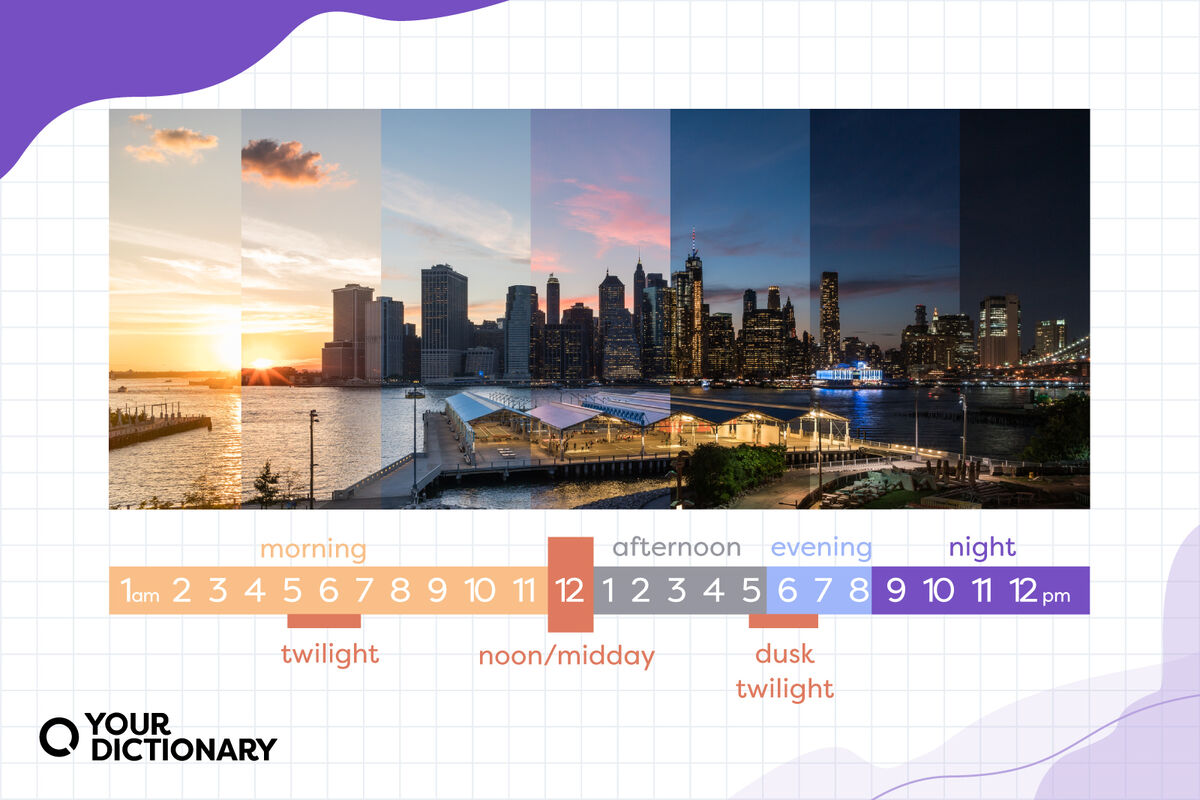
The phrase "afternoon turns to evening at five" reflects the standard cultural, linguistic, and operational consensus that 5:00 PM marks the transition from afternoon to evening. While solar patterns vary by season and location, dictionaries, formal etiquette guides, and business conventions generally recognize 5:00 PM as the operational boundary where afternoon ends and evening begins.
Defining the Temporal Boundary: Dictionary Definitions vs. Cultural Norms
Dividing the solar day into distinct named periods is both an art and a practical necessity. While clock time measures hours with mechanical precision, human language categorizes those hours into functional blocks based on sunlight, social activity, and biological rhythms. The boundary around 5:00 PM serves as the primary bridge between the active workday and the period of rest, dining, and social transition.
Linguistic Definitions of Afternoon and Evening
Lexicographers define day divisions using a combination of astronomical positions and social usage. According to major reference standards such as the Merriam-Webster Dictionary and the Oxford English Dictionary:
- Afternoon: The period of time extending from noon (12:00 PM) until evening or sunset.
- Evening: The period of late afternoon and early night, typically starting between 5:00 PM and 6:00 PM and ending at bedtime or nightfall.
Because the word "afternoon" literally means the time following noon, its start point is fixed precisely at 12:00 PM. However, its ending point is fluid. In casual speech, people frequently treat 5:00 PM as the default termination of the afternoon because it aligns with standard hourly groupings and late-day routine shifts.
| Morning | Afternoon | Evening |
|---|---|---|
| 12:00 AM - 11:59 AM | 12:00 PM - 4:59 PM | 5:00 PM - 9:59 PM |
The Historical and Social Roots of the 5:00 PM Shift
The informal designation of 5:00 PM as the turning point between afternoon and evening is deeply intertwined with labor history and the industrialization of time. Before widespread municipal streetlighting and standardized time zones, communities measured their days largely by solar position. Afternoon ended when the sun approached the horizon, forcing outdoor labor to wind down.
In the 20th century, the standardization of the eight-hour workday established 5:00 PM as the dominant boundary for civil life. The codification of the standard 9:00 AM to 5:00 PM schedule—enshrined in United States federal policy through the Fair Labor Standards Act of 1938—solidified 5:00 PM as the exact hour when public commerce shifts to personal leisure. Consequently, late-afternoon tasks give way to evening routines precisely at 5:00 PM in urban and corporate environments.
The Role of Daylight and Solar Cycles in Time Perception
While clock time sets a rigid benchmark at 5:00 PM (17:00 in 24-hour time), the natural environment operates on astronomical cycles. The physical sensation of afternoon turning into evening is dictated by solar elevation, atmospheric refraction, and seasonal variation.
- Sun High in Sky: Noon (12:00 PM)
- Sun Descending: Afternoon (12:00 PM – 4:59 PM)
- 5:00 PM Threshold: Operational Boundary to Evening
- Golden Hour / Dusk: Early Evening (5:00 PM – 7:00 PM)
- Civil Twilight: Evening (7:00 PM – 8:30 PM)
- Astronomical Night: Night (8:30 PM Onward)
Astronomical Factors vs. Fixed Clock Time
Astronomically, the transition from daylight to darkness is measured by solar zenith angle and twilight phases rather than specific clock minutes. The United States Naval Observatory (USNO Astronomical Applications Department) categorizes twilight into three distinct phases based on how far below the horizon the sun sits:
- Civil Twilight: Begins when the sun drops below the horizon and ends when the sun is 6 degrees below the horizon. Outdoor activities usually do not require artificial light during this time.
- Nautical Twilight: Occurs when the sun is between 6 and 12 degrees below the horizon. The horizon line remains visible at sea, but artificial illumination becomes necessary on land.
- Astronomical Twilight: Occurs when the sun is between 12 and 18 degrees below the horizon. The sky becomes completely dark for astronomical observations.
Because 5:00 PM is a fixed point on a mechanical clock, it does not always align perfectly with civil twilight. In equatorial regions, sunset occurs near 6:00 PM year-round, making 5:00 PM a late-afternoon hour illuminated by direct sunlight. Conversely, at higher latitudes, 5:00 PM can fall long after total darkness in winter or during full afternoon sun in midsummer.
Seasonal Shifts and Regional Variations
Human perception of the 5:00 PM boundary varies based on latitude and season:
- Winter Months: In temperate latitudes, sunset often occurs between 4:00 PM and 4:30 PM. By 5:00 PM, the sky is already in deep civil or nautical twilight. Under these conditions, people naturally categorize 5:00 PM as "evening" or even "night" due to the absence of daylight.
- Summer Months: Sunlight may persist until 9:00 PM or later in northern territories. At 5:00 PM, solar radiation remains strong, and temperatures are often at their daily peak. Despite bright daylight, modern social conventions maintain that 5:00 PM marks the official start of early evening in scheduling, dining, and broadcasting contexts.
Social Etiquette and Workplace Communication Standards
In formal communication, professional correspondence, and daily social interactions, knowing when to transition from afternoon terminology to evening terminology prevents subtle social missteps.
| TIME RANGE | GREETING / PHRASING | TYPICAL CONTEXT |
|---|---|---|
| 12:00 PM - 4:59 PM | "Good afternoon" | Business hours, regular work |
| 5:00 PM - 7:59 PM | "Good evening" | Post-work meetings, dinner, social |
| 8:00 PM - Bedtime | "Good evening" (Hello) | Formal gatherings, twilight events |
| Departure Only | "Good night" | Parting, leaving a social event |
Transitioning Greetings: From "Good Afternoon" to "Good Evening"
Standard etiquette rules establish clear guidelines for spoken and written greetings based on the hour of the day:
- "Good afternoon": Used from 12:00 PM up to 4:59 PM. Using "Good afternoon" at 3:30 PM is correct; using it at 5:15 PM sounds slightly outdated, as the receiver has entered early evening hours.
- "Good evening": The standard greeting starting at 5:00 PM. It remains appropriate throughout the late hours until late night. "Good evening" is exclusively a greeting used upon arrival or at the start of a speech or letter.
- "Good night": Unlike "Good afternoon" or "Good evening," "Good night" is never used as a greeting. It is strictly a valediction (a farewell statement) used when departing a meeting, leaving a social gathering, or going to sleep.
Scheduling and Professional Courtesy around 5:00 PM
In professional settings, the 5:00 PM shift represents a boundary between public access and private personal time. The etiquette surrounding correspondence around this time includes key rules:
- Email Timing: Sending an email labeled "Late Afternoon Update" is appropriate prior to 5:00 PM. Messages sent after 5:00 PM enter the evening hours, and senders should generally avoid expecting immediate responses unless the matter is marked as urgent.
- Meeting Schedules: Scheduling a meeting that begins at or after 5:00 PM requires explicit confirmation from participants, as it crosses from traditional business hours into personal evening time.
- Broadcasting and Public Speaking: Television news programs, public lectures, and formal dinners transitioning at 5:00 PM traditionally switch from daytime phrasing to evening phrasing (e.g., transitioning from "Good afternoon, welcome to the broadcast" to "Good evening").
Comprehensive Comparison Matrix of Daily Time Transitions
The table below breaks down the technical, cultural, and observational distinctions between day segments from early afternoon through late night.
| Day Segment | Clock Time Range | Sunlight / Solar Condition | Formal Salutation | Primary Activity / Focus |
|---|---|---|---|---|
| Early Afternoon | 12:00 PM – 2:59 PM | Peak daylight, sun descending from zenith | "Good afternoon" | Post-lunch tasks, primary productivity |
| Late Afternoon | 3:00 PM – 4:59 PM | Sun low in western sky, light softening | "Good afternoon" | Wrapping up business tasks, commuting prepare |
| Early Evening | 5:00 PM – 6:59 PM | Golden hour, solar descent, civil twilight | "Good evening" | End of standard shift, dinner preparation, travel |
| Late Evening | 7:00 PM – 9:59 PM | Nautical to astronomical twilight, dusk to darkness | "Good evening" | Leisure activities, dining, entertainment, social events |
| Night | 10:00 PM – 4:59 AM | Full astronomical darkness | "Good evening" (Arrival) / "Good night" (Farewell) | Rest, sleep, low human activity |
Behavioral and Psychological Effects of the 5:00 PM Transition
The change from afternoon to evening at 5:00 PM is not merely a social construct or clock measurement; it directly correlates with biological shifts in the human body and psychological changes in cognitive performance.
- Solar Radiation Drop: Cortisol Decreases (Lower Alertness)
- 5:00 PM Boundary: Transition to Personal Rhythms
- Dimming Environment: Melatonin Production Increases (Wind-Down)
Chronobiology and Circadian Rhythms
Human biological functions follow circadian rhythms regulated by the suprachiasmatic nucleus in the brain, which responds to ambient light levels. According to research published by the National Center for Biotechnology Information (NCBI), bodily functions experience predictable shifts during the late afternoon and early evening:
- Core Body Temperature: Peaks in the late afternoon (around 4:00 PM to 5:00 PM), providing maximum muscle strength and cardiovascular efficiency before gradually dropping as evening approaches.
- Cortisol Release: Cortisol, the hormone associated with alertness and stress responses, begins a steady decline in the late afternoon, dropping significantly after 5:00 PM.
- Melatonin Secretion: As sunlight dims into twilight during early evening, the pineal gland begins preparing for melatonin production, signaling to the brain that the active day is ending.
The Psychological Shift from Work to Personal Life
Psychologically, the 5:00 PM hour acts as a cognitive threshold known as a "boundary event." In industrial and corporate environments, reaching 5:00 PM triggers a subconscious change in mental state:
- Attentional Fatigue: Mental focus typically declines after 4:00 PM due to continuous cognitive exertion throughout the morning and early afternoon.
- Role Switch: At 5:00 PM, individuals mentally transition from their professional identities (employee, business owner, manager) to personal identities (parent, host, partner, individual).
- Time Perception Acceleration: Studies in temporal psychology suggest that people perceive early evening hours as passing faster than afternoon hours, driven by unstructured social activities and leisure routines replacing structured work schedules.
Technical Standards and International Variations
While colloquial language relies on words like "afternoon" and "evening," international standards bodies use strict numeric conventions to prevent ambiguity in aviation, logistics, science, and computing.
ISO 8601 and 24-Hour Time Conventions
The International Organization for Standardization (ISO Standard 8601) sets international rules for representing date and time. ISO 8601 avoids terms like "afternoon" or "evening" altogether because they carry regional and cultural ambiguity.
- 12-Hour System: 12:00 PM to 4:59 PM (Afternoon) | 5:00 PM to 11:59 PM (Evening/Night)
- 24-Hour System: 12:00 to 16:59 | 17:00 to 23:59
Under the 24-hour clock system widely used in international logistics, aviation, military, and digital systems:
- 12:00 to 16:59: Represents the afternoon hours.
- 17:00: The exact equivalent of 5:00 PM, marking the beginning of the late-day period.
- 17:00 to 21:59: Operates as the numerical window corresponding to evening in civil applications.
Cross-Cultural Variations in Time Names
Different languages and cultures partition late-day hours differently based on climate, dining customs, and historic habits:
- Spanish (La Tarde vs. La Noche): In many Spanish-speaking countries, la tarde (afternoon) extends past 5:00 PM, often continuing until sunset or dinner time around 8:00 PM. La noche (night/evening) begins much later than the English 5:00 PM benchmark.
- Japanese (Yūgata vs. Yoru): Japanese distinguishes between hiru (daytime/afternoon), yūgata (late afternoon/early evening around sunset, roughly 4:00 PM to 6:00 PM), and yoru (evening/night).
- Scandinavian Countries: In high-latitude northern countries, summer days have no dark evening at 5:00 PM, while winter days become dark by 3:00 PM. Consequently, Scandinavian usage often separates clock-based daily schedules from physical daylight descriptions.
Common Misconceptions and Ambiguities
Navigating the transition between afternoon and evening involves addressing several common misunderstandings about etiquette, solar terminology, and scheduling conventions.
Misconception 1: Sunset Determines the Start of Evening
Many people assume that evening begins strictly at sunset. While sunset marks a visual milestone, standard civil etiquette treats 5:00 PM as the operational start of evening regardless of whether the sun has set. In peak summer, sunset may not occur until 9:00 PM, but greeting someone with "Good afternoon" at 8:00 PM violates conventional English usage.
Misconception 2: "Good Night" Can Be Used as a Late-Evening Greeting
A frequent error in formal English communication is using "Good night" to greet someone arriving at an evening event after 5:00 PM or 6:00 PM. "Good night" is exclusively a farewell phrase signifying departure or retirement for sleep. The proper greeting upon arrival—even at 11:00 PM—remains "Good evening."
Misconception 3: Twilight and Evening Are Identical
Although used interchangeably in informal conversation, twilight and evening refer to different concepts:
- Twilight is an astronomical condition defined by the light scattered in the upper atmosphere when the sun is below the horizon.
- Evening is a broader time category defined by human convention, etiquette, and clock hours (typically starting at 5:00 PM).
Frequently Asked Questions
Is 5:00 PM considered afternoon or evening?
5:00 PM is overwhelmingly recognized as the start of early evening. While light conditions vary seasonally, standard English etiquette, business scheduling, and dictionary definitions treat 5:00 PM as the formal transition point where afternoon ends and evening begins.
What salutation should I use in an email sent at 5:00 PM?
Beginning at 5:00 PM, transition your opening greeting from "Good afternoon" to "Good evening." If writing a formal letter or professional message, "Good evening" conveys awareness of the recipient's post-work hours. Alternatively, neutral greetings like "Hello [Name]" remain suitable at any hour.
Why do some people consider 6:00 PM the start of evening instead of 5:00 PM?
Some individuals defer the start of evening to 6:00 PM because it splits the 12-hour daytime period (6:00 AM to 6:00 PM) into equal halves, or because their personal workday ends at 6:00 PM. However, standard social etiquette and dictionary conventions start early evening at 5:00 PM.
Does ISO standard time define the start of evening?
No. The ISO 8601 standard defines international formatting for numerical time (such as 17:00 for 5:00 PM) to ensure data accuracy across systems, but it explicitly avoids defining subjective descriptive words such as "afternoon," "evening," or "night."
What is the difference between dusk and evening?
Evening is a full chronological segment of the day lasting several hours (typically 5:00 PM to 10:00 PM). Dusk is a specific short astronomical phase—the darkest part of twilight just before complete night falls—occurring within the broader evening period.
How should broadcast media handle the 5:00 PM time boundary?
Television and radio stations traditionally shift their programming tone, on-air greetings, and station IDs at 5:00 PM. News broadcasts airing at or after 5:00 PM generally open with "Good evening," marking the shift from daytime programming to evening news broadcasts.
Practical Guidance for Communication and Daily Planning
To maintain clarity and social polish across professional and personal scheduling, follow these practical rules of thumb:
- Use 5:00 PM as Your Conversational Pivot: Transition spoken greetings from "Good afternoon" to "Good evening" precisely at 5:00 PM. This simple shift demonstrates spatial and temporal awareness in social settings and public speaking.
- Respect Work-Life Boundaries: Treat 5:00 PM as an operational boundary. When sending non-urgent business communications after 5:00 PM, consider using scheduled send features to deliver the message at 8:00 AM or 9:00 AM the following morning.
- Differentiate "Good Evening" and "Good Night": Remember that "Good evening" is your arrival salutation, while "Good night" is strictly reserved for departing an event or parting ways for sleep.
- Account for Time Zone Shifts in Distributed Teams: When scheduling global meetings, verify the local time of all participants. A 5:00 PM meeting for a host in London (marking the start of their evening) may be a 12:00 PM afternoon meeting for a colleague in New York, requiring greetings tailored to each participant's local perspective.