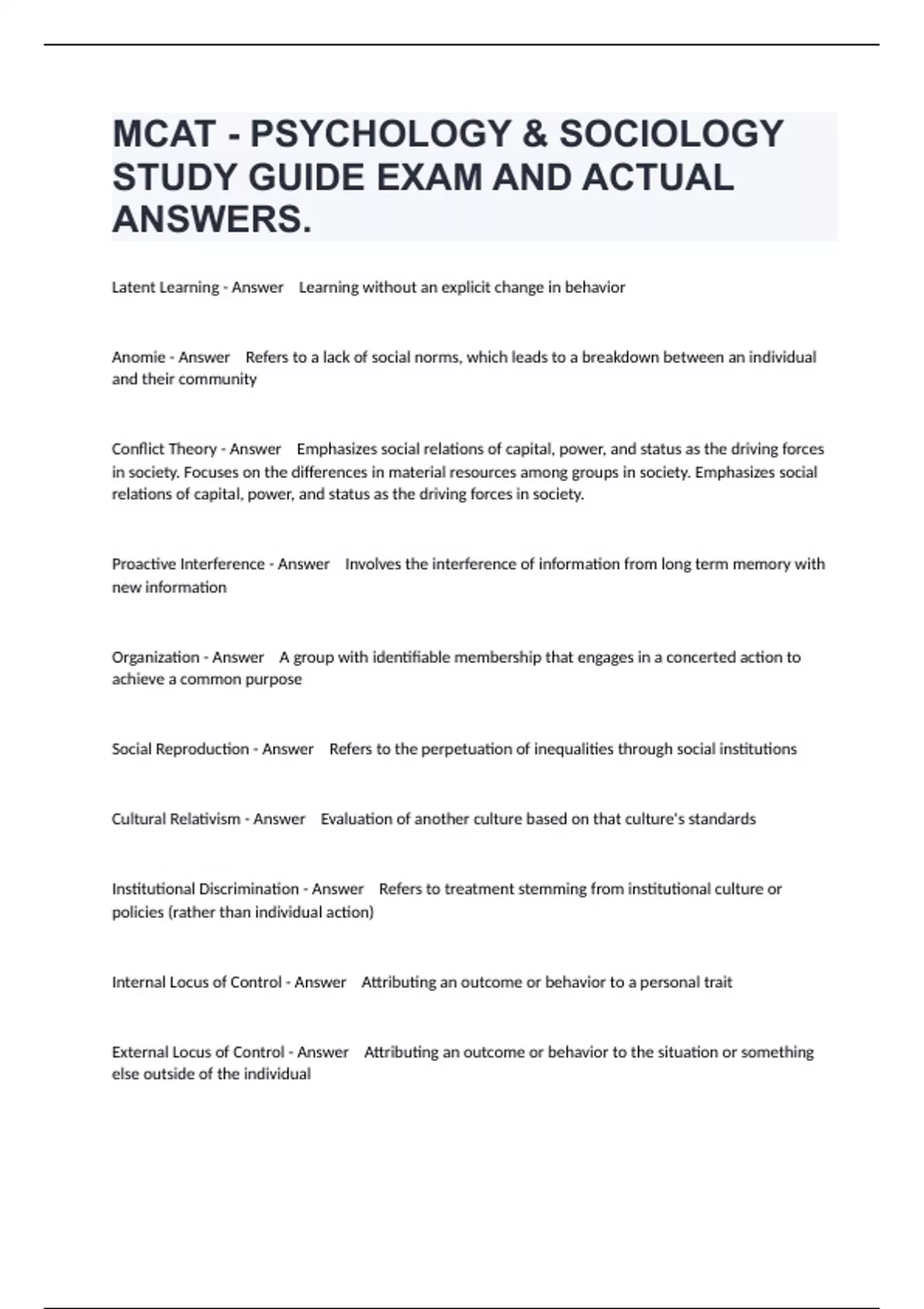
The "300 page psych soc MCAT PDF" is a widely utilized, comprehensive student-compiled review document covering the Psychological, Social, and Biological Foundations of Behavior section of the Medical College Admission Test (MCAT). Derived primarily from the Khan Academy MCAT collection, this resource serves as a core textbook replacement for mastering high-yield sociological and psychological concepts required for medical school admissions.
Preparing for the Medical College Admission Test requires navigating an immense breadth of scientific, behavioral, and critical thinking concepts. Among the various sections of the exam, the Psychological, Social, and Biological Foundations of Behavior—commonly referred to as the Psychology and Sociology (Psych/Soc) section—frequently offers the highest return on investment for students willing to memorize foundational terminology and master experimental design. Over the years, the student community on platforms like Reddit has curated, refined, and distributed several comprehensive review documents to streamline this preparation. The most famous and heavily utilized of these documents is the comprehensive notes collection colloquially known as the 300-page psych soc MCAT PDF.
Understanding how to source, integrate, and review this document effectively can mean the difference between a mediocre score and a competitive percentile on test day. This guide explores the exact origins of this document, its structural anatomy, strategies for active integration, alternative study materials, and common pitfalls to avoid during your preparation.
Origins and Structure of the 300-Page Document
To understand the value of the 300-page psych soc MCAT PDF, one must examine its origins within the premed community. When the Association of American Medical Colleges (AAMC) redesigned the MCAT in 2015 to include a dedicated behavioral sciences section, official study materials were sparse. In response, Khan Academy partnered with the AAMC to release a massive library of free video tutorials covering every single content category outlined in the official AAMC content outline.
While the videos are thorough, watching over 100 hours of content is inefficient for many prospective medical students. To solve this bottleneck, dedicated students transcribed and organized the transcripts alongside the accompanying diagrams into comprehensive PDF documents. The resulting 300-page document is essentially a verbatim, text-and-image distillation of the Khan Academy behavioral sciences video library.
The document is organized in strict alignment with the AAMC MCAT content outline, typically broken down into chapters covering:
- Individual influences on behavior (sensation, perception, motivation, emotion, attitudes, and personality theories).
- Social processes, attitudes, and behavior (social psychology, group dynamics, and prejudice).
- Social inequality (demographics, social class, global inequality, and healthcare disparities).
- Self-identity, the social self, and the development of the mind.
- Psychological disorders, including biomedical and biopsychosocial approaches, anxiety disorders, mood disorders, and schizophrenia.
- Sociological perspectives on health, illness, and healthcare delivery systems.
Key Content Categories and High-Yield Focus Areas
The Psych/Soc section of the MCAT tests more than simple memorization; it evaluates a student's ability to interpret psychological experiments, understand sociological theories, and apply these concepts to novel clinical scenarios. The 300-page document addresses this by dedicating substantial space to core theoretical frameworks and research methods.
Psychological Theories and Personality
The document covers major schools of thought in psychology, contrasting structuralism and functionalism with psychoanalytic perspectives (Sigmund Freud, Erik Erikson), humanistic perspectives (Carl Rogers, Abraham Maslow), and behavioral perspectives (B.F. Skinner, Ivan Pavlov). Students must not only memorize the definitions of defense mechanisms or stages of psychosocial development but also recognize how these concepts manifest in case studies.
Sociological Paradigms
Sociology often trips up science-heavy majors who are more accustomed to molecular pathways than abstract societal structures. The 300-page PDF provides deep dives into:
- Functionalism (Emile Durkheim): Viewing society as a complex system striving for equilibrium.
- Conflict Theory (Karl Marx, Max Weber): Focusing on social competition for scarce resources and power dynamics.
- Symbolic Interactionism (George Herbert Mead): Micro-level analysis of everyday social interactions and meaning-making through symbols.
- Social Constructionism: Examining how individuals and groups shape reality through collaborative social activity.
Biological Bases of Behavior
Because the section is officially titled "Psychological, Social, and Biological Foundations of Behavior," the document bridges the gap between neurology and psychology. It reviews the anatomy and function of the central and peripheral nervous systems, neurochemical pathways (dopamine, serotonin, endorphins), endocrine signaling, and the physiological basis of sensation and perception.
Comparison of MCAT Psych/Soc Review Resources
Choosing the right study material is critical for time management during MCAT preparation. Students often debate whether to use the full-length notes, condensed versions, or video modules directly.
| Resource Name | Average Length | Depth of Content | Best Suited For | Primary Limitation |
|---|---|---|---|---|
| 300-Page Document | ~300 Pages | Comprehensive, verbatim transcription | Content phase, deep initial learning | Time-consuming to read linearly |
| 100-Page Document | ~100 Pages | Highly condensed bullet points | Quick review, content refresh, or second pass | Lacks contextual explanations for complex theories |
| Official AAMC Outline | Variable | Outline format only | Final checklist verification | No explanatory text or definitions |
| Khan Academy Videos | 100+ Hours | Visual and auditory explanation | Visual/auditory learners | Extremely time-inefficient |
Actionable Strategies for Studying the PDF
Reading 300 pages of dense academic text passively will yield poor retention. To maximize the utility of this resource, students should adopt an active, multi-phase study plan.
Phase 1: The Content Review Pass
Begin by pairing the PDF with either the corresponding Khan Academy videos or an active spaced-repetition deck, such as the Anki decks built specifically around the 300-page document (commonly referred to as the MilesDown or Pankow decks). Read one chapter of the PDF at a time, taking concise handwritten or digital margin notes. Focus heavily on distinguishing between similarly sounding terms, such as the difference between proactive and retroactive interference, or ethnocentrism and cultural relativism.
Phase 2: Experimental Design Integration
Recent iterations of the MCAT place heavy emphasis on scientific reasoning and research methods. As you move through the PDF, pay meticulous attention to the sections detailing research design, experimental bias, independent versus dependent variables, and statistical significance. When the text describes a classic psychological experiment (such as the Zimbardo prison experiment or the Asch conformity experiments), do not just memorize the outcome; analyze why the experiment was structured that way and what potential confounding variables were present.
Phase 3: Spaced Repetition and Active Recall
Because the volume of terminology in sociology and psychology is immense—often exceeding 1,000 distinct terms and concepts—relying solely on reading is ineffective. Convert definitions from the PDF into flashcards. Review these flashcards daily. If a term is frequently missed, cross-reference it back to its specific section in the 300-page PDF to re-read the contextual explanation.
Alternative and Complementary Resources
While the 300-page PDF is legendary, it should rarely be used in isolation. To build a robust preparation strategy, students frequently combine it with:
- Official AAMC Materials: Nothing replaces the AAMC Section Bank, Question Packs, and official practice exams. These materials reveal how the test writers frame questions and test psychological constructs.
- Third-Party Prep Books: Publishers such as Kaplan, Princeton Review, and Examkrackers offer comprehensive psych/soc books that provide alternative explanations for difficult sociological theories.
- Anki Flashcard Decks: Pre-made decks mapped directly to the 300-page document bridge the gap between passive reading and long-term memory consolidation.
Common Pitfalls and Troubleshooting
Many students encounter specific hurdles when relying on student-compiled review documents. Awareness of these issues can prevent wasted study time.
- Information Overload: Attempting to memorize every single footnote or minor psychological study mentioned in the text can lead to burnout. Focus your energy on high-yield concepts that appear repeatedly on AAMC practice exams.
- Passive Reading Trap: Scrolling through the PDF while listening to music creates an illusion of competence. If you cannot explain a concept like cognitive dissonance or social loafing in your own words without looking at the page, you have not mastered it.
- Outdated Formatting or Broken Links: Because the PDF is a community-sourced document hosted on various student forums (such as Reddit's r/Mcat), ensure you are downloading the most recently updated version, which corrects typographical errors from earlier transcriptions.
Conclusion and Next Steps
The 300-page psych soc MCAT PDF remains one of the most powerful, cost-effective tools available for mastering the behavioral sciences section of the MCAT. By treating the document as an active reference guide rather than a passive novel, pairing its definitions with robust flashcard systems, and anchoring your progress with official AAMC practice materials, you can systematically eliminate content gaps and build the analytical skills required to excel on test day. Download a verified copy from a reputable academic community forum, pair it with a dedicated Anki deck, and begin your systematic review of behavioral science fundamentals today.