An FHA 203(k) loan—officially designated as the Section 203(k) Rehabilitation Mortgage Insurance program—is a government-backed mortgage that allows home buyers and homeowners to finance both the purchase (or refinancing) of a residential property and the cost of its rehabilitation through a single loan with a minimum 3.5% down payment.
What Is an FHA 203(k) Loan?
Administered by the Federal Housing Administration (FHA) under the Department of Housing and Urban Development (U.S. Department of Housing and Urban Development), the Section 203(k) loan program addresses a critical gap in traditional real estate financing. Standard mortgages generally require a home to meet strict minimum property standards before funding, making distressed properties, fixer-uppers, or homes in need of major modernization ineligible for financing. Conversely, conventional ground-up construction loans require separate closings, higher down payments, and short-term high-interest rate structures.
The FHA 203(k) loan combines the property acquisition (or existing mortgage payoff) and the construction/renovation costs into a single long-term, fixed-rate or adjustable-rate mortgage. The loan amount is calculated based on the project’s estimated "as-completed" value—the projected market value of the property after all planned improvements are finished—rather than its current condition.
Funds designated for construction are placed into an interest-bearing rehabilitation escrow account at closing and disbursed to contractors in phased payments as work is completed and verified by independent inspections.
The Two Main FHA 203(k) Loan Types: Limited vs. Standard
The FHA categorizes 203(k) projects into two distinct pathways based on the scope, cost, and structural complexity of the intended renovations: the Limited 203(k) and the Standard 203(k). Selecting the correct loan type determines the documentation required, whether a certified consultant must manage the project, and how repair funds are disbursed.
- FHA 203(k) Rehabilitation Pathways
- Limited 203(k)
- Non-structural, minor repairs only
- Maximum repair cost: $35,000 (no minimum limit)
- No mandatory HUD Consultant requirement
- Standard 203(k)
- Structural alterations, additions, and major overhauls
- Minimum repair cost: $5,000 (up to FHA area loan limit)
- Mandatory HUD 203(k) Consultant oversight
- Limited 203(k)
Limited 203(k) Loan (Minor, Non-Structural Improvements)
Formerly referred to as the Streamline 203(k), the Limited 203(k) is designed for minor cosmetic updates and non-structural repairs.
- Financial Limits: Repairs under the Limited 203(k) are subject to a maximum cap of $35,000 in total project costs. This ceiling includes contractor fees, inspection costs, and required contingency reserves, meaning the direct cost of materials and labor must fit beneath this threshold.
- Eligible Scope: Eligible work includes painting, roof repair or replacement, HVAC system upgrades, kitchen cabinet replacements, updating flooring, installing new appliances, and accessibility enhancements.
- Key Restriction: Work must not involve structural repairs, load-bearing wall alterations, room additions, or major land grading. Additionally, the project cannot prevent the occupants from residing in the home for more than 30 days during construction.
Standard 203(k) Loan (Major Structural & Comprehensive Renovations)
The Standard 203(k) is designed for extensive rehabilitation, structural alterations, and full-scale home transformations.
- Financial Limits: The minimum repair cost for a Standard 203(k) is $5,000. The maximum total loan amount (purchase price plus renovation costs plus eligible fees) is capped by the maximum FHA loan limit for the specific county or metropolitan statistical area.
- Eligible Scope: Structural repairs, moving load-bearing walls, constructing additions, replacing entire plumbing or electrical systems, complete foundation rebuilding, and resolving severe structural safety issues are permitted under this program.
- HUD Consultant Requirement: A Standard 203(k) loan strictly requires the participation of an independent HUD 203(k) Consultant. The consultant conducts an initial feasibility study, prepares the formal detailed Work Write-Up and cost estimate, conducts draw inspections, and authorizes contractor payouts.
Borrower and Property Eligibility Requirements
Qualifying for an FHA 203(k) loan requires meeting both standard FHA underwriting guidelines for borrower creditworthiness and specific FHA criteria for the property's configuration and intended occupancy.
Credit Score, Down Payment, and Financial Qualification
- Minimum Credit Score: Under basic FHA guidelines, borrowers with a FICO score of 580 or higher qualify for the minimum down payment requirement of 3.5%. Borrowers with scores between 500 and 579 are technically eligible with a 10% down payment, though individual FHA-approved lenders often set "lender overlays" requiring a minimum score of 620 to 640 for 203(k) products.
- Down Payment Calculation: The 3.5% down payment is calculated from the total project base cost—the purchase price of the home plus the estimated repair costs and eligible fees—not just the initial purchase price of the property.
- Debt-to-Income (DTI) Ratios: Standard FHA DTI ratio guidelines cap housing expenses at 31% of gross monthly income and total debt obligations at 43%. However, automated underwriting approval (using HUD's TOTAL Mortgage Scorecard) can accept total DTIs up to 45%–50% with strong compensating factors, such as high cash reserves or verified residual income.
- Occupancy: The property must serve as the primary residence of the borrower. FHA 203(k) loans cannot be used by real estate investors, real estate speculators, or buyers purchasing secondary homes or vacation properties.
Property Eligibility and Structure Types
To qualify for 203(k) financing, the property must fall into one of the following structural classifications:
- One- to Four-Unit Residential Properties: Single-family homes, duplexes, triplexes, and four-unit multiplexes are eligible, provided the owner occupies one of the units as their primary residence.
- Condominiums: Condominium units qualify primarily for interior renovations under the Limited 203(k) program or non-structural Standard projects. Repairs are restricted to the interior space of the specific unit; exterior structural work on common elements managed by a Homeowners Association (HOA) is generally excluded.
- Mixed-Use Properties: Properties with both residential and commercial spaces are eligible, provided the commercial use does not exceed 25% of the total floor area for a one-story building, 35% for a two-story building, or 50% for a three-story building, and the loan proceeds are strictly applied to the residential portion.
- Existing Structures: The dwelling must have been completed for at least one year prior to the application. Completely new construction on vacant land is ineligible under Section 203(k) (which is instead served by separate FHA construction-to-permanent financing programs). However, an existing structure can be demolished down to its existing foundation, provided the original foundation remains structurally intact and usable.
Approved vs. Unapproved Renovation Work
FHA guidelines explicitly differentiate between improvements that enhance health, safety, structural integrity, or functionality versus luxury additions.
| Renovation Category | Eligible Scope / Approved Work | Ineligible Scope / Prohibited Work |
|---|---|---|
| Structural Improvements | Foundation repair, load-bearing wall alterations, room additions, roof structural replacement. | Total demolition where the original foundation is removed. |
| Mechanical Systems | HVAC replacement, electrical upgrades, plumbing re-piping, sewer connection installation. | Commercial-grade utility systems exceeding residential needs. |
| Interior Modernization | Kitchen updates, bathroom remodels, flooring, paint, dry-rot repair. | High-end luxury custom features (e.g., specialized wine cellars). |
| Exterior & Grounds | Siding replacement, roofing, gutters, storm doors, necessary site grading. | Luxury outdoor features: swimming pools, hot tubs, tennis courts, outdoor fire pits, gazebos. |
| Accessibility & Energy | Ramps, widened doorways, lower countertops, insulation, solar integration. | Standalone commercial structures detached from primary dwelling. |
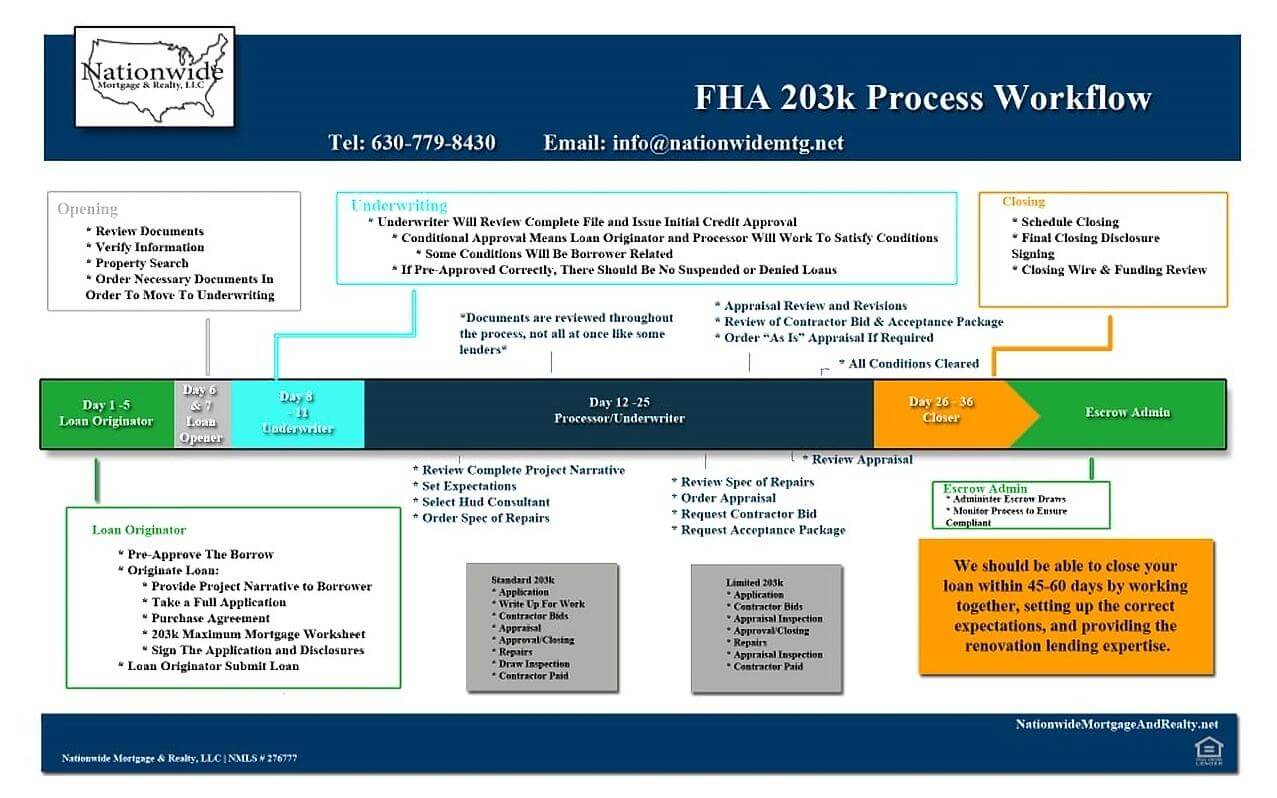
The Step-by-Step FHA 203(k) Application and Execution Process
Navigating an FHA 203(k) mortgage involves extra coordination compared to standard home purchases because renovation planning happens alongside loan underwriting.
- Phase 1: Pre-Approval
- Phase 2: Property Purchase & Contingency Contract
- Phase 3: Work Write-Up & Contractor Bids
- Phase 4: Appraisal & Underwriting
- Phase 5: Closing & Escrow Setup
- Phase 6: Construction, Inspections & Draws
Phase 1: Lender Prequalification
Borrowers must secure pre-approval with an FHA-approved lender experienced in 203(k) administration. Because 203(k) paperwork involves strict escrow management and draw schedules, working with an experienced loan officer reduces closing delays.
Phase 2: Property Identification and Contract Negotiation
Once a suitable property is identified, the buyer submits a purchase contract containing a specific FHA 203(k) sales contract addendum. This addendum specifies that the purchase is contingent on loan approval based on an "as-completed" appraisal and allows adequate time (typically 45 to 60 days) for closing.
Phase 3: Engaging the HUD 203(k) Consultant and Selection of Contractors
For Standard 203(k) loans, the borrower engages a certified HUD 203(k) Consultant. The consultant conducts an initial site inspection, performs a feasibility study, and creates a formal Work Write-Up detailing required repairs, safety code items, materials, and labor estimates.
Simultaneously, the borrower selects licensed, insured, and bonded general contractors. The contractor submits itemized proposals matching the Work Write-Up. The contractor must provide proof of liability insurance, worker’s compensation, credentials, and references to pass lender vetting.
Phase 4: Appraisal and Underwriting Approval
An FHA-approved appraiser evaluates the property using the architectural plans, contractor bids, and the HUD Consultant’s Work Write-Up to determine the "as-completed" market value. The lender’s underwriter verifies both borrower qualifications (income, assets, credit) and construction documentation (contractor bids, write-ups, contingency accounts) to issue clear-to-close status.
Phase 5: Closing and Escrow Setup
At closing, the home seller receives the agreed purchase price, and the remaining loan proceeds designated for construction are deposited into an escrow account. If the home is uninhabitable during construction, up to six months of mortgage payments can be financed directly into the loan to cover housing costs while work proceeds.
Phase 6: Construction, Draw Inspections, and Project Sign-Off
Construction must begin within 30 days of closing and must be completed within 6 months. As milestones are reached:
- The contractor requests a draw payment.
- The HUD Consultant conducts a progress inspection to confirm the work complies with local building codes and original estimates.
- Upon approval, the lender releases draw funds from escrow to the contractor (less a 10% retainage fee held until final completion).
- After final inspection, a certificate of completion is issued, lien waivers are recorded, the retainage is released, and any unused contingency funds are applied as a principal reduction on the mortgage balance.
Technical Comparison: FHA 203(k) vs. Alternative Renovation Mortgages
Borrowers seeking to finance repairs alongside home purchases can choose from several loan options. The table below compares the FHA 203(k) with alternative rehabilitation products regulated by Fannie Mae, Freddie Mac, and conventional construction lending standards.
| Feature / Metric | FHA 203(k) Limited | FHA 203(k) Standard | Fannie Mae HomeStyle® | Freddie Mac CHOICERenovate® | Conventional Construction-to-Perm |
|---|---|---|---|---|---|
| Minimum FICO Score | 580 (3.5% down) | 580 (3.5% down) | 620 | 620 | 680–720 |
| Minimum Down Payment | 3.5% | 3.5% | 3% (First-time buyers) / 5% | 3% (First-time buyers) / 5% | 10%–20% |
| Structural Repairs Allowed? | No | Yes | Yes | Yes | Yes (Full Ground-Up) |
| Max Repair Amount | $35,000 Total | Up to FHA Loan Limit | Up to 75% of "As-Completed" Value | Up to 75% of "As-Completed" Value | Up to 80%-90% of Completed Value |
| Mandatory Consultant | No | Yes (HUD Consultant) | No (Architect/Engineer based on scope) | No (Architect/Engineer based on scope) | Project Manager / Inspection Team |
| Mortgage Insurance | Upfront MIP (1.75%) + Annual MIP | Upfront MIP (1.75%) + Annual MIP | PMI (Can be canceled at 80% LTV) | PMI (Can be canceled at 80% LTV) | Standard PMI (Post-conversion) |
| Eligible Property Types | Owner-Occupied (1–4 units), Condos | Owner-Occupied (1–4 units), Condos | Primary, Second Homes, Single-unit Investors | Primary, Second Homes, Single-unit Investors | Primary & Secondary Residences |
Financial Considerations: Fees, Contingencies, and Mortgage Insurance
Understanding the complete cost structure of an FHA 203(k) loan requires accounting for financing costs beyond standard mortgage principal and interest.
Mandatory Contingency Reserves
To cover unexpected cost overruns, material price shifts, or hidden structural defects uncovered during renovation, FHA rules require a contingency reserve of 10% to 20% of the total repair bid to be set aside in escrow.
- A 10% reserve is standard if utilities are connected and operational at inspection.
- A 15% to 20% reserve is triggered if utilities are shut off, structural components are hidden, or structural hazards are identified.
If contingency funds remain unused at the end of the project, they cannot be disbursed as cash back to the borrower; instead, they are applied directly as a principal prepay reduction on the total mortgage balance.
Fee Structure for 203(k) Loans
FHA 203(k) transactions incur administrative fees specific to managing renovation escrows:
- HUD Consultant Fee: Standardized by HUD based on the total cost of repairs (typically ranging from $400 for smaller projects to $1,000+ for large projects over $100,000).
- Architectural/Engineering Fees: Billable if structural modifications require stamped blueprint documentation.
- Title Update Fees: Title checks are required before each draw release to clear mechanic's liens.
- Supplemental Origination Fee: Lenders may charge the greater of $350 or 1.5% of the renovation portion of the loan to compensate for processing escrow setup.
Mortgage Insurance Premiums (MIP)
All FHA 203(k) loans require two forms of mortgage insurance, enforced by federal FHA policy:
- Upfront Mortgage Insurance Premium (UMIP): A fee equal to 1.75% of the total base loan amount, payable at closing (and typically financed directly into the mortgage balance).
- Annual Mortgage Insurance Premium (Annual MIP): Paid monthly as part of the total mortgage payment. For standard 30-year terms with a 3.5% down payment, this rate is typically 0.55% annually of the remaining base principal balance. Unlike conventional private mortgage insurance (PMI), FHA annual MIP generally remains for the full life of the mortgage if the initial down payment is less than 10%.
Common Pitfalls and Risk Mitigation Strategies
Because 203(k) loans involve strict regulatory and construction timelines, borrowers often face structural delays if risks are not proactively addressed.
- Common 203(k) Risk Points
- Pitfall 1: Contractor Inexperience
- Risk: Rejected paperwork, slow draw releases, missed deadlines
- Pitfall 2: Strict Timeline Violations
- Risk: Exceeding 30-day start or 6-month completion rules
- Pitfall 3: Low "As-Completed" Appraisals
- Risk: Budget shortfall between repair costs and actual home value
- Pitfall 1: Contractor Inexperience
1. Inexperienced General Contractors
The most common cause of 203(k) project delays is hiring contractors unfamiliar with federal draw procedures, lien waiver releases, and standardized line-item bidding formats. If a contractor expects large upfront cash deposits for materials prior to commencing work, the project can stall because FHA rules prohibit advance disbursements of escrow funds before materials are installed or work is physically verified on-site.
- Mitigation Strategy: Engage contractors who have previously completed FHA 203(k) or conventional renovation projects, possess sufficient credit lines to purchase initial materials, and agree in writing to the draw disbursement timetable.
2. Failure to Account for Permit Timelines
FHA regulations strictly dictate that work must commence within 30 days of loan closing and reach completion within 6 months. Municipal delays in issuing building permits can cause borrowers to breach these loan covenants, requiring formal extension requests from the lender.
- Mitigation Strategy: Work with local contractors and your HUD Consultant during the underwriting phase to submit architectural plans to local building departments before closing, ensuring permits are ready for issuance immediately upon recordation of the deed.
3. Miscalculating the "As-Completed" Appraisal Limit
The maximum allowable mortgage balance is bounded by the lesser of:
- The original property purchase price plus repair costs.
- 110% of the appraiser's projected "as-completed" market value (or 100% for certain multi-unit properties).
If planned renovation costs exceed local comparable home values, the appraisal may come in lower than the combined cost of acquisition and repair.
- Mitigation Strategy: Avoid over-improving a home beyond the upper ceiling of local neighborhood market values. Adjust the renovation scope during the Work Write-Up phase if preliminary appraisal estimates indicate a valuation shortfall.
Frequently Asked Questions
Can you complete the work yourself on an FHA 203(k) loan (DIY)?
Do-it-yourself (DIY) labor is generally prohibited under FHA 203(k) guidelines. HUD regulations mandate that repairs must be executed by licensed, bonded, and insured general contractors. Limited exceptions for self-performed work exist only if the borrower is a certified contractor by trade, can document appropriate professional expertise, and receives explicit written authorization from the lender's underwriting department. In all approved DIY scenarios, financing can cover material costs, but labor costs cannot be rolled into the loan balance or paid out to the borrower.
How does the lender release payments to the contractor?
Lender payments are released through a series of formal escrow disbursements called "draws." The contractor submits a draw request upon completing a designated phase of work. A HUD 203(k) Consultant or designated FHA inspector performs a physical site inspection to confirm the work meets local codes and matches the Work Write-Up. Once approved, the lender issues a joint check payable to both the borrower and contractor. A standard 10% retainage fee is withheld from each progress draw and released only after final project sign-off and title lien clearance.
Can an FHA 203(k) loan be used to purchase a teardown home?
An FHA 203(k) loan can be used on a structure that requires near-total demolition, provided the existing foundation remains intact and is reused. Complete destruction of the entire structure—including the removal of the original foundation—disqualifies the property from Section 203(k) financing. For complete ground-up teardowns where no portion of the original structure or foundation is retained, borrowers must use a specialized single-close FHA One-Time Close Construction Loan or a conventional construction mortgage.
What happens if construction costs exceed the initial budget estimate?
Cost overruns must first be absorbed by the mandatory contingency reserve (10% to 20%) established at closing within the escrow account. If changes in work scope exceed the total contingency reserve balance, the borrower must fund the remaining cost difference out-of-pocket, or submit formal Change Orders to scale back non-essential cosmetic work items. FHA rules do not permit increasing the overall mortgage principal balance after the loan has officially closed.
How long does it take to close an FHA 203(k) loan compared to a standard mortgage?
While standard FHA home loans typically close within 30 to 45 days, an FHA 203(k) loan typically takes 45 to 60 days (and occasionally up to 75 days) to close. The extended timeline accounts for hiring a HUD Consultant, finalizing contractor estimates, conducting specialized architectural plan reviews, and finalizing the mandatory "as-completed" appraisal.
Strategic Next Steps for Homebuyers and Homeowners
Navigating an FHA 203(k) construction loan requires balancing financial qualifications, regulatory compliance, and contractor management. To position a project for success, execute the following actions:
- Obtain FHA 203(k) Lender Pre-Approval: Contact mortgage lenders specifically authorized by HUD to originate 203(k) products. Confirm their experience with processing rehabilitation escrow draws.
- Identify a HUD 203(k) Consultant: Access the official HUD 203(k) Consultant Roster online to locate qualified consultants operating within your municipal area. Engage a consultant early to evaluate prospective properties before submitting offers.
- Prequalify General Contractors: Begin interviewing licensed contractors who can demonstrate sufficient working capital and experience navigating government draw schedules. Ensure contractors can provide comprehensive itemized bids detailing labor, material quantities, and brand specifications.
- Build a Time-Sensitive Strategy: Include explicit 203(k) financing contingencies and extended closing deadlines (at least 60 days) in purchase agreements to protect earnest money deposits during detailed underwriting reviews.
Disclaimer: This article provides regulatory context, financial education, and general legal framework descriptions regarding FHA mortgage programs current as of 2026. Mortgage underwriting guidelines, local FHA loan limits, HUD program directives, and jurisdictional policies remain subject to federal regulatory update. Borrowers should consult a certified HUD-approved housing counseling agency, a qualified mortgage loan originator, or a licensed real estate professional to verify eligibility for specific financial circumstances.