Veterans life insurance programs are designed to provide financial security to former service members and their families. These government-sponsored policies, administered by the Department of Veterans Affairs (VA), offer varying levels of coverage, including specialized options for those with service-connected disabilities, ensuring that veterans have access to essential life protection regardless of their medical history.
Understanding the Landscape of Veterans Life Insurance
Navigating life insurance as a veteran requires a clear distinction between the policies provided during active duty and those available to veterans transitioning into civilian life. While active-duty service members are covered by Servicemembers' Group Life Insurance (SGLI), this coverage typically expires 120 days after separation from the military.
For many veterans, the primary challenge is determining which post-service policy best fits their financial needs. The VA maintains several distinct programs, each with specific eligibility criteria, application windows, and coverage limits. Understanding these nuances is critical because some programs are time-sensitive, meaning that failing to act within a specific period after separation can result in the loss of eligibility for certain premium rates or coverage amounts.
The two most prominent programs for veterans are Veterans’ Group Life Insurance (VGLI) and Veterans’ Mortgage Life Insurance (VMLI), though other options like Service-Disabled Veterans Life Insurance (S-DVI)—which has transitioned to Veterans Affairs Life Insurance (VALife)—serve specific populations.
Veterans’ Group Life Insurance (VGLI)
VGLI is the most common transition policy for veterans. It allows former service members to convert their SGLI coverage into a lifetime renewable group term policy.
Eligibility and Enrollment Windows
To qualify for VGLI, you must have had SGLI coverage at the time of your separation. There is a critical enrollment deadline: you have one year and 120 days from your date of separation to apply. If you apply within the first 240 days, you are guaranteed coverage regardless of your current health status. If you apply after this period but before the final deadline, you will be required to provide evidence of insurability (a medical examination).
Coverage and Costs
VGLI coverage is issued in increments of $10,000, up to a maximum of $500,000 as of 2026. The premiums are based on the veteran's age at the time of enrollment and are adjusted every five years. Because it is a term policy, it does not build cash value over time. It is essentially a renewable contract that remains in effect as long as the premiums are paid on time.
Veterans Affairs Life Insurance (VALife)
In recent years, the VA introduced VALife to replace the older S-DVI program. This program is specifically designed to be more accessible for veterans with service-connected disabilities.
Key Features of VALife
Unlike many private insurance plans, VALife is a "guaranteed acceptance" policy. This means that if you are a veteran aged 80 or younger with a service-connected disability, you are automatically eligible for coverage regardless of your health.
- Coverage Amount: Veterans can choose coverage in increments of $10,000 up to a total of $40,000.
- Cash Value: Unlike VGLI, VALife is a whole life insurance policy. It accrues cash value after the policy has been in force for two years, providing a potential financial asset in addition to the death benefit.
- Premiums: Premium rates are fixed for the life of the policy, meaning they do not increase as you get older, providing long-term budget stability for fixed-income households.
The Two-Year Waiting Period
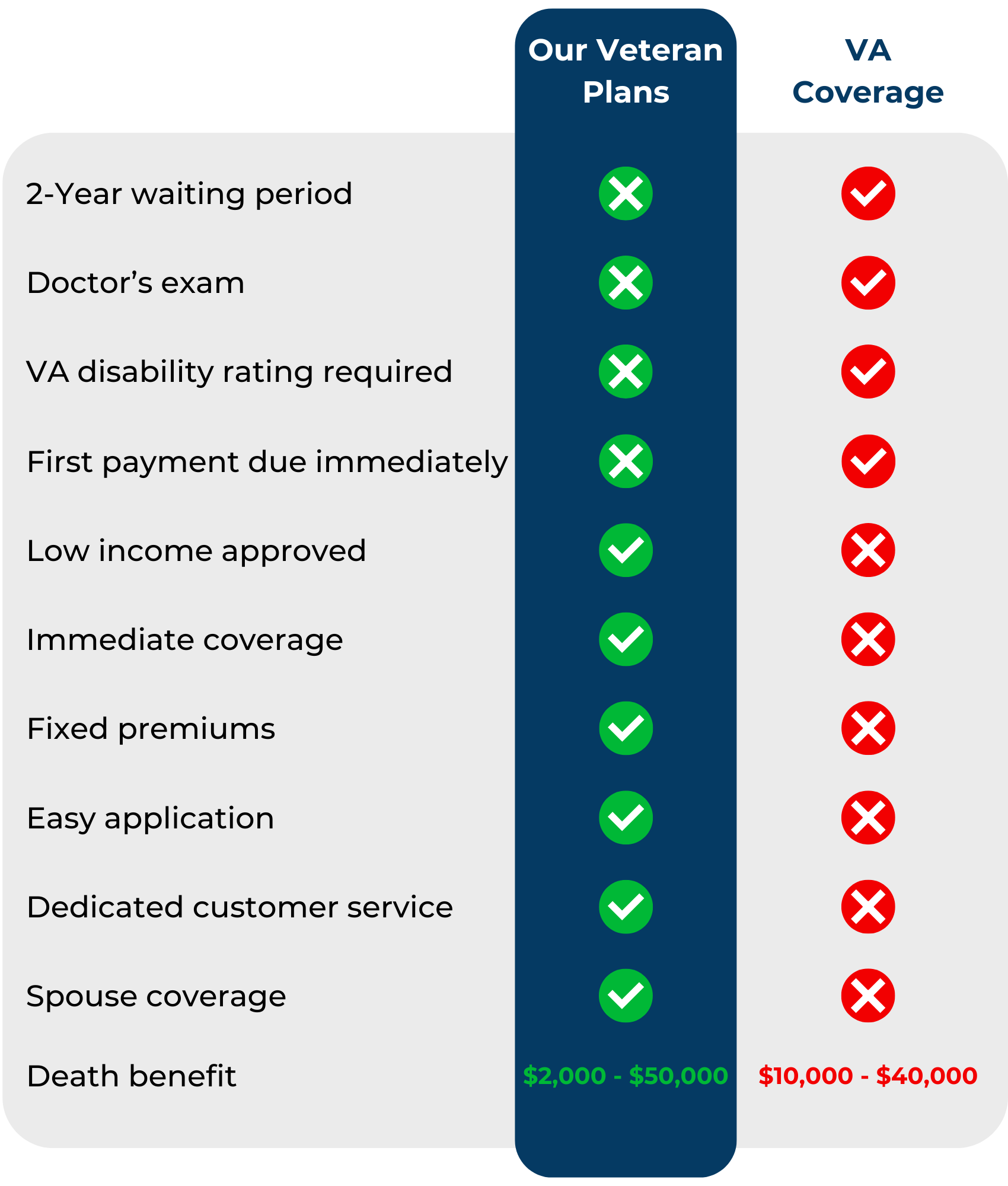
It is essential to note that for the full death benefit to be payable, the insured must complete a two-year waiting period. If the insured passes away during these first two years, the beneficiary receives a refund of all premiums paid plus interest, rather than the full face value of the policy.
Comparison of VA Life Insurance Options
Choosing the right policy depends on your current age, financial goals, and health status. The following table highlights the primary differences between the most common government-managed policies.
| Feature | Veterans’ Group Life Insurance (VGLI) | Veterans Affairs Life Insurance (VALife) |
|---|---|---|
| Policy Type | Term Insurance | Whole Life Insurance |
| Max Coverage | $500,000 | $40,000 |
| Cash Value | No | Yes (after 2 years) |
| Premium Structure | Increases with age | Fixed for life |
| Health Exam | Required if applying after 240 days | Never required |
| Primary Goal | High-limit income replacement | Final expenses/burial coverage |
Veterans’ Mortgage Life Insurance (VMLI)
For veterans who have received a Specially Adapted Housing (SAH) grant from the VA, VMLI is a specialized product. This is a decreasing term life insurance policy designed to pay off the mortgage on a veteran's home in the event of their death. The benefit is paid directly to the mortgage lender, ensuring that surviving family members are not burdened by home loan debt.
Eligibility for VMLI is strictly limited to veterans who:
- Have a service-connected disability that qualifies them for an SAH grant.
- Have title to the home and are obligated on the mortgage.
- Are under the age of 70.
Navigating the Application Process
Applying for VA life insurance is a structured process that requires specific documentation. Whether you are applying for VGLI or VALife, the primary portal for these applications is the VA’s online platform or through the use of designated forms submitted via mail.
Step-by-Step Procedure
- Verify Eligibility: Use your VA account to confirm your service-connected disability rating or your SGLI history.
- Gather Records: Ensure your DD Form 214 (Certificate of Release or Discharge from Active Duty) is available, as it is the foundational document for proving veteran status.
- Choose Coverage Amount: Evaluate your financial obligations—such as remaining mortgage, children's education, and funeral costs—to determine if you need the maximum allowable coverage.
- Complete the Application: If applying online, you will be guided through a series of secure prompts. If mailing a form, ensure all signatures are notarized if required by the specific instructions for that form.
- Await Confirmation: Once submitted, the VA will process the application. For guaranteed programs, approval is typically straightforward, while programs requiring health underwriting may take several weeks for review.
Common Considerations and Potential Pitfalls
One of the most frequent mistakes veterans make is failing to convert their SGLI to VGLI within the one-year-and-120-day window. Once this window closes, obtaining government-backed life insurance becomes significantly more difficult, often forcing veterans to rely on more expensive private-market policies.
Furthermore, many veterans overlook the importance of beneficiary designations. It is recommended that you review your beneficiary information every time there is a major life event, such as marriage, divorce, or the birth of a child. If a beneficiary is not properly updated, the death benefit may be distributed according to the order of precedence defined by federal law, which might not align with your personal wishes.
Financial Planning and Professional Advice
While VA insurance provides a strong foundation, it should not be viewed as the sole component of a comprehensive financial plan. Depending on your net worth and dependents, you may require additional coverage from private insurers. Before purchasing supplemental private policies, ensure you have maximized your VA benefits, as the group rates provided by the government are often lower than those available on the open market, particularly for individuals with pre-existing conditions.
Disclaimer: This information is for educational purposes and does not constitute formal financial, legal, or medical advice. Always consult with a qualified professional or an accredited Veterans Service Officer (VSO) when making decisions regarding insurance, estate planning, or VA benefits.
Frequently Asked Questions
Can I hold both VGLI and VALife policies simultaneously?
Yes, you can carry both policies if you meet the eligibility criteria for each. VGLI is a conversion of your SGLI, while VALife is a standalone program for service-connected disabled veterans. Many veterans choose to hold both to maximize their total death benefit coverage.
What happens if I miss a premium payment?
Missing a payment can lead to policy cancellation. VGLI and VALife policies generally have a grace period. If you miss a payment, you should contact the VA’s insurance center immediately to inquire about reinstatement. In some cases, you may be required to pay back-premiums and interest to restore coverage.
Is the death benefit from VA life insurance taxable?
Generally, the death benefit paid to a beneficiary from a government life insurance policy is considered tax-exempt. It is not usually treated as income for the beneficiary, though you should verify this with a tax professional regarding your specific financial situation and local laws.
Can I change my coverage amount after I am enrolled?
For VGLI, you can decrease your coverage at any time. Increasing your coverage is only possible up to the current maximum limit of $500,000, and you may be required to provide evidence of insurability if you are increasing your coverage after your initial enrollment period.
How do I designate a new beneficiary?
Beneficiary changes can be made through your online VA account. Keeping this information current is vital to ensuring that your assets are distributed according to your intentions. If you do not have online access, you can request the appropriate form (typically VA Form 29-336) from the VA website.
Taking the Next Action
The most immediate step for any veteran is to determine their current insurance standing. Log into your VA.gov account to view your active policies and confirm your eligibility windows. If you have recently separated from the military, prioritize reviewing your transition checklist to ensure you do not miss the enrollment deadline for VGLI. If you are a veteran with a service-connected disability, consider reviewing the VALife program as a cost-effective way to secure lifetime coverage for your loved ones.