In the 2026 ICD-10-CM coding system, a rib contusion is primarily classified under the S20.2 category, which identifies a contusion of the thorax. Specificity is required for accurate billing, meaning a complete code must specify the location (front or back wall), the laterality (right, left, or bilateral), and the encounter type (initial, subsequent, or sequela), such as S20.211A for a right-sided chest wall contusion.
Understanding the nuances of medical coding for thoracic injuries is essential for healthcare providers, medical billers, and insurance adjusters. While "rib contusion" is a common clinical term, the International Classification of Diseases, 10th Revision, Clinical Modification (ICD-10-CM) uses slightly more technical language to categorize these injuries. In 2026, the emphasis remains on high-level specificity to ensure that the severity and exact nature of the injury are documented for both clinical tracking and financial reimbursement.
The Fundamentals of ICD-10-CM Coding for Rib Injuries
ICD-10-CM is a standardized system used in the United States to track epidemiology and manage billing. For injuries like a rib contusion, the codes are found in Chapter 19: "Injury, poisoning and certain other consequences of external causes (S00-T88)." Specifically, injuries to the thorax fall within the S20 to S29 range.
A contusion, commonly known as a bruise, occurs when capillaries are damaged under the skin, usually due to blunt force trauma. When this occurs over the ribs, it is coded as a thoracic wall contusion. It is important to distinguish this from more severe injuries, such as rib fractures (S22 category) or internal organ injuries (S27 category).
Why "1 ICD 10 Code" Is Often a Category, Not a Final Code
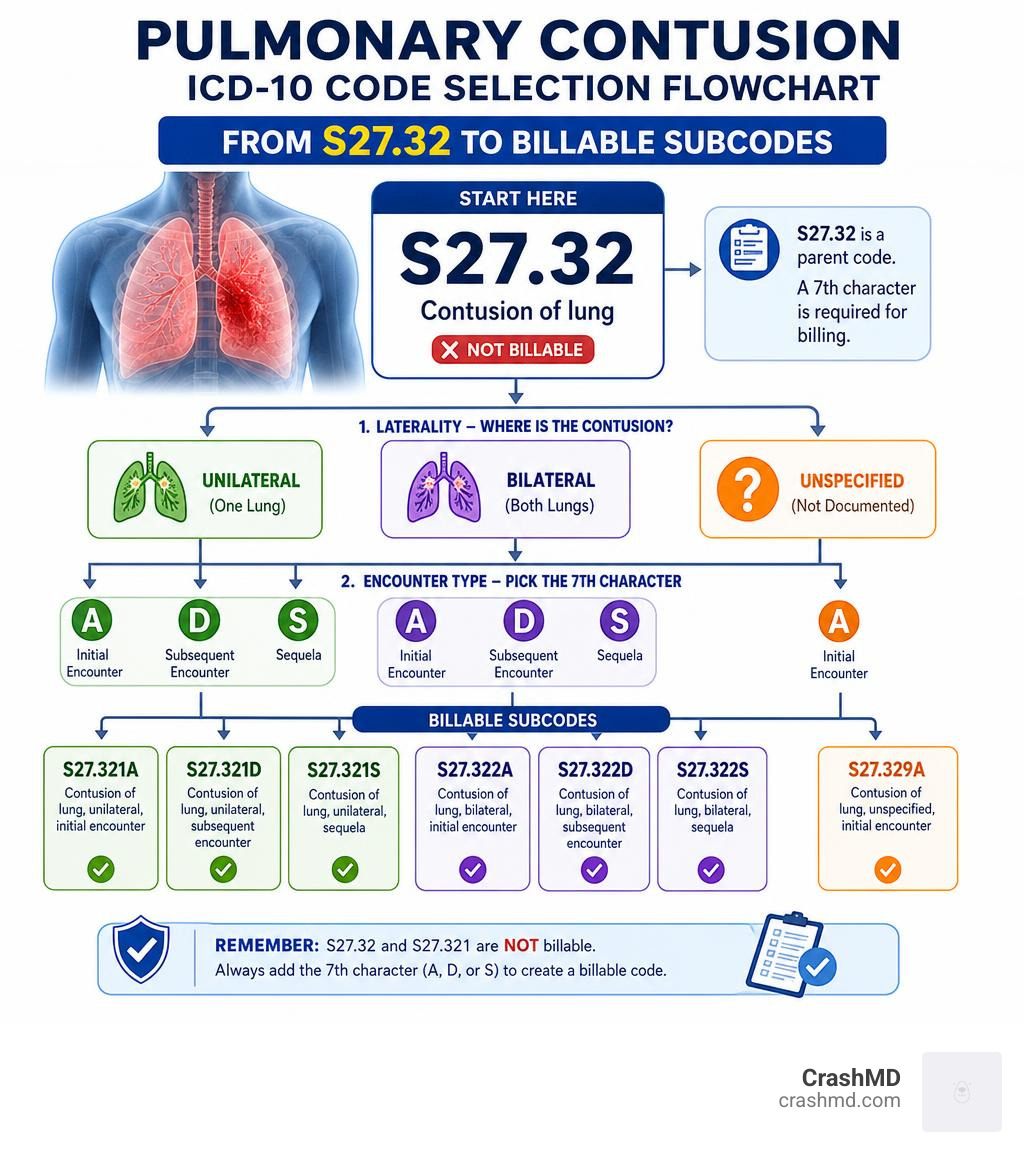
Many people search for a single code for a rib contusion, but the ICD-10 system is hierarchical. The "code" S20.2 is actually a category. You cannot bill or document a patient's chart using only S20.2; doing so would result in a claim rejection for "lack of specificity." To reach a valid, billable code in 2026, you must navigate through several sub-layers of the coding tree.
Breaking Down the S20.2 Subcategories
To accurately code a rib contusion, a provider must determine where on the thoracic wall the impact occurred. The ICD-10-CM splits the thorax into the "front wall" and the "back wall."
Contusion of the Front Wall of the Thorax (S20.21)
This subcategory is used when the injury is located on the anterior portion of the ribs or the sternal area. In clinical practice, this often results from steering wheel impacts in motor vehicle accidents or direct blows during contact sports.
- S20.211: Contusion of the right front wall of the thorax.
- S20.212: Contusion of the left front wall of the thorax.
- S20.219: Contusion of an unspecified front wall of the thorax.
Contusion of the Back Wall of the Thorax (S20.22)
This refers to the posterior aspect of the rib cage. These injuries are common in falls where the patient lands on their back or in "rear-end" collision scenarios.
- S20.221: Contusion of the right back wall of the thorax.
- S20.222: Contusion of the left back wall of the thorax.
- S20.229: Contusion of an unspecified back wall of the thorax.
The Essential Seventh Character: Encounter Types
In 2026, as in previous years, all codes in the S20.2 family require a seventh character to define the "encounter." This is perhaps the most frequent area of error for medical coders.
- A – Initial Encounter: This character is used while the patient is receiving active treatment for the injury. This includes the first visit to an emergency room, a primary care physician, or even a surgical consultation if the contusion is part of a larger trauma.
- D – Subsequent Encounter: This is used for visits occurring after the active phase of treatment has ended. Examples include follow-up visits for medication adjustments, physical therapy, or routine checks on the healing process.
- S – Sequela: This character is used for complications or conditions that arise as a direct result of the injury (e.g., chronic pain or scar tissue formation at the site of the original contusion). When using "S," you must also code the specific nature of the sequela itself.
For example, a complete code for a patient's first visit for a bruised left front rib would be S20.212A.
Comprehensive ICD-10 Reference Table for Rib Contusions
The following table summarizes the most common 2026 ICD-10-CM codes for rib-related contusions. Note that the seventh character [A, D, or S] must be added to complete each code.
| Location | Side | ICD-10 Base Code | Full Example (Initial Encounter) |
|---|---|---|---|
| Front Wall (Anterior) | Right | S20.211 | S20.211A |
| Front Wall (Anterior) | Left | S20.212 | S20.212A |
| Front Wall (Anterior) | Unspecified | S20.219 | S20.219A |
| Back Wall (Posterior) | Right | S20.221 | S20.221A |
| Back Wall (Posterior) | Left | S20.222 | S20.222A |
| Back Wall (Posterior) | Unspecified | S20.229 | S20.229A |
| Unspecified Wall | Right | S20.20X | S20.20XA |
| Unspecified Wall | Left | S20.20X | S20.20XB (Note: Format varies) |
Note: For "Unspecified Thorax Wall" (S20.20), a placeholder "X" is often required to maintain the 7-character structure.
Clinical Documentation Requirements for Accurate Coding
To ensure that the 2026 coding standards are met, the medical record must be sufficiently detailed. If a coder receives a note that simply says "bruised ribs," they may be forced to use the less specific S20.20 code, which can sometimes lead to lower reimbursement or inquiries from insurance carriers.
Required Elements in the Physician’s Note:
- Exact Location: Specify front (anterior), back (posterior), or lateral. If lateral, it is often grouped with the closest wall or coded as unspecified thorax.
- Laterality: Clearly state "right" or "left." Bilateral injuries should be coded with two separate codes (one for each side) unless a specific combination code is available.
- Mechanism of Injury: While not part of the S20 code itself, including an external cause code (e.g., W10.9XXA for a fall from stairs) is standard practice in 2026 to provide a complete picture of the accident.
- Exclusion of Fractures: The documentation should ideally mention that imaging was performed or that clinical suspicion of fracture is low. If a rib fracture is present, the contusion is typically considered "inherent" to the fracture and is not coded separately.
Differential Diagnosis and Coding Conflicts
A common challenge in thoracic coding is distinguishing between a contusion and related injuries. In 2026, the "Excludes1" and "Excludes2" notes in the ICD-10-CM manual provide guidance on which codes can be used together.
Contusion vs. Fracture (S22)
If a patient has both a rib contusion and a rib fracture on the same side, the fracture code (S22.---) takes precedence. According to coding conventions, you should not report a contusion code for the same site as a fracture, as a bruise is a logical consequence of a broken bone.
Contusion vs. Muscle Strain (S29.3)
A strain involves the muscles or tendons (such as the intercostal muscles), whereas a contusion involves the soft tissue and skin. If the patient has both, and they are distinct injuries, both may be coded. However, the primary reason for the visit (usually the more severe pain source) should be listed first.
Internal Injuries
If the blunt force trauma was severe enough to cause a lung contusion (S27.3) or a pneumothorax (S27.0), these internal injury codes must be sequenced before the rib contusion code. Internal injuries carry a much higher risk and complexity level.
The Financial Impact of Coding Specificity in 2026
Accurate coding is not merely an administrative task; it has significant financial implications for healthcare facilities. Under the Centers for Medicare & Medicaid Services (CMS) guidelines, "unspecified" codes are increasingly scrutinized.
In 2026, many private insurers have adopted AI-driven auditing tools that automatically flag codes ending in "9" (unspecified). For a provider, using S20.211A (Right front wall) instead of S20.20XA (Unspecified wall) can mean the difference between an immediate payout and a delayed "Request for Information" (RFI).
For patients, accurate codes are equally important. If a rib contusion is the result of a workplace accident or a motor vehicle collision, the specific ICD-10 code helps the Worker's Compensation board or the auto insurance carrier determine the validity of the claim and the necessity of follow-up treatments like physical therapy.
Common Mistakes to Avoid
- Missing the 7th Character: A code like S20.211 is invalid. It must have "A," "D," or "S" at the end.
- Confusing Ribs with the Chest Wall: While clinical language uses them interchangeably, ensure the documentation supports "thoracic wall" involvement for the S20 series.
- Double Coding with Fractures: As mentioned, if the rib is broken, the bruise is included in the fracture code.
- Inaccurate Lateralization: Ensure the "right" or "left" in the code matches the physical exam and any imaging reports (X-ray or CT scan).
Frequently Asked Questions
What is the most common ICD-10 code used for a simple bruised rib?
The most frequently used code for a single-sided bruised rib is S20.211A (right) or S20.212A (left). These represent a contusion of the front wall of the thorax during the initial encounter. If the bruise is on the back, the code changes to the S20.22 series.
Is there a specific code for "Multiple Rib Contusions"?
ICD-10-CM does not provide a single "multiple" code for contusions in the same way it does for fractures. Instead, you should use the code that best describes the area (e.g., front wall) and the laterality. If both the front and back walls are bruised, or if both sides of the body are affected, you may report multiple codes to represent the full extent of the injuries.
Can I use the rib contusion code if the patient has a "chest wall pain" diagnosis?
If the physician specifies that the pain is due to a contusion, use the S20.2 code. However, if the cause of the pain is unknown or not yet diagnosed as a contusion, the coder might use R07.89 (Other chest pain). Once the contusion is confirmed via physical exam or history of trauma, the S20.2 code is more appropriate and specific.
How do I code a rib contusion from a motor vehicle accident?
You would use the appropriate S20.2 code for the contusion itself. Additionally, you should append an "External Cause" code from the V00-Y99 range to describe the accident. For example, V43.52XA might be used to indicate a passenger injured in a collision with another car.
Does the code change if the contusion is on the sternum instead of the ribs?
No, the ICD-10-CM groups the sternum and the ribs under the same "thoracic wall" codes. A contusion of the sternum is coded as a contusion of the front wall of the thorax (S20.21-).
What if the patient returns for a follow-up visit after 2 weeks?
At the follow-up visit, the 7th character changes from "A" to "D." For example, if the initial injury was a left front rib contusion (S20.212A), the follow-up code would be S20.212D. This signals to the insurance company that the patient is in the healing phase and not experiencing a new injury.
Final Recommendation for Providers and Coders
To ensure clinical accuracy and seamless billing in 2026, healthcare professionals should prioritize anatomical specificity. Documentation should clearly state the side of the body and the specific aspect of the thorax involved. For medical coders, the "Gold Standard" is to avoid unspecified codes whenever the medical record allows for a more detailed selection. By correctly applying the S20.2 category and the necessary seventh-character encounter tags, you can maintain compliance with the latest World Health Organization (WHO) and CMS standards, ensuring that patient data is high-quality and reimbursement is processed without delay.