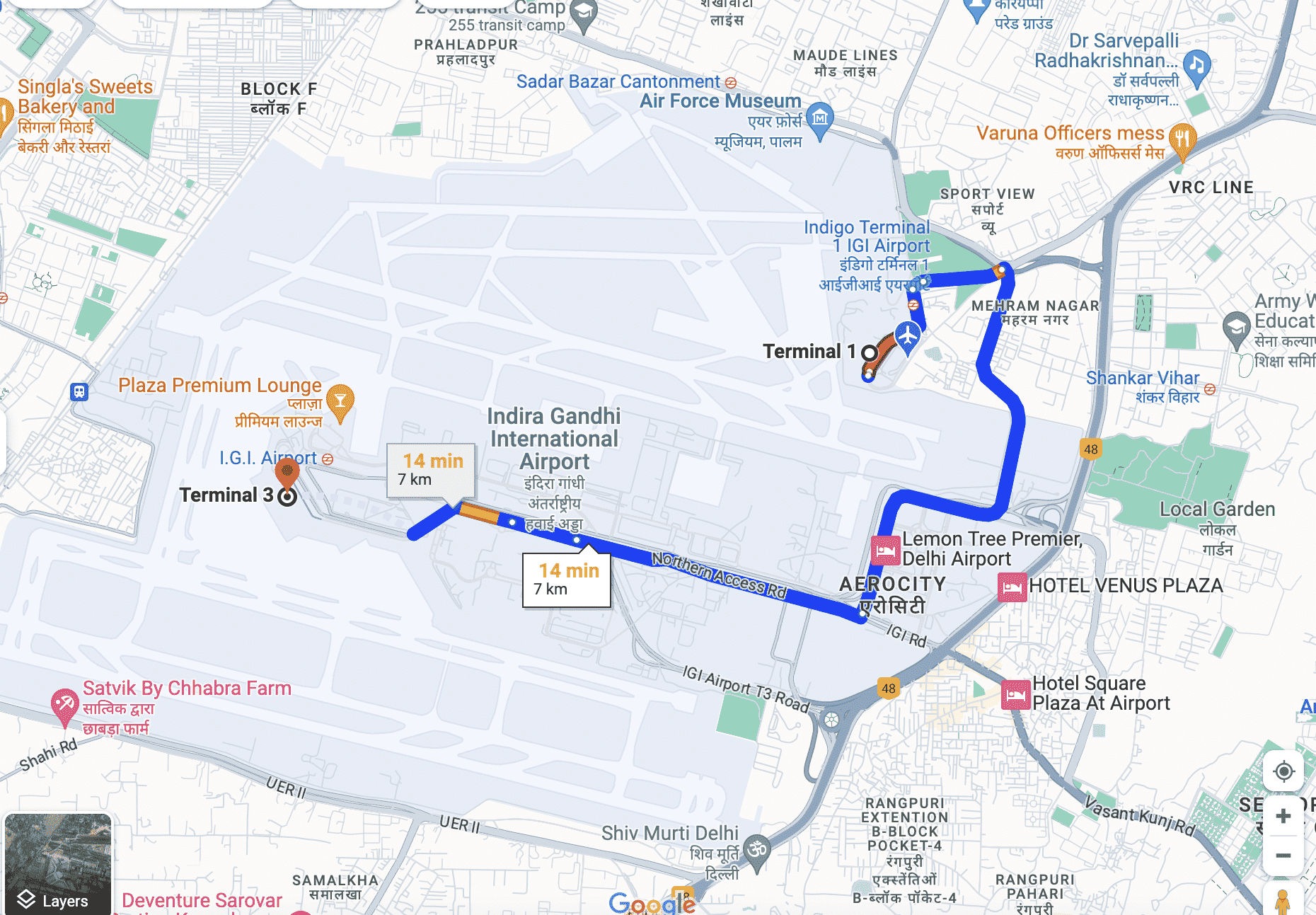
Navigating an airport transfer between Indira Gandhi International Airport's Terminal 3 (T3) and Terminal 1 (T1) in New Delhi requires careful planning, as these facilities serve different operational networks, accommodate distinct airline carriers, and sit miles apart on the airfield perimeter.
Successfully managing a Delhi T3 to T1 transfer requires understanding the physical distance between terminals, identifying available transportation options, accounting for immigration and baggage claim procedures, and building adequate buffer time into your itinerary to prevent missed connections.
Understanding Delhi Airport Terminal Layouts
Indira Gandhi International Airport (DEL) is one of the busiest aviation hubs in South Asia, handling tens of millions of passengers annually across multiple terminals. Terminal 3 and Terminal 1 operate as entirely separate physical structures on opposite sides of the airfield, meaning a transfer between them is not a simple walk down a concourse.
Terminal 3 is the massive, integrated international and domestic mega-terminal. It handles almost all international arrivals and departures, alongside domestic flights operated by full-service carriers like Vistara and Air India.
Terminal 1, conversely, is dedicated exclusively to domestic low-cost carriers, primarily IndiGo. Understanding this structural division is critical because passengers arriving on international flights at T3 who need to catch a domestic connection on a low-cost carrier at T1 must exit the secure airside zone entirely, clear customs and immigration, collect their checked bags, and physically travel across airport roads to reach T1.
Key Terminal Characteristics
- Terminal 3 (T3): Multi-level integrated terminal, primary hub for international travel, domestic full-service carriers, premium lounges, and extensive retail facilities. Operates airside and landside zones.
- Terminal 1 (T1): Newly expanded domestic-only terminal facility handling low-cost carrier operations. Features modern boarding gates, automated baggage handling systems, and dedicated arrival/departure forecourts.
The Transfer Process: Step-by-Step
When executing a Delhi T3 to T1 transfer, travelers must navigate a sequence of landside procedures. Because there is no airside airside transit bus or direct airside train connecting T3 international arrivals to T1 domestic departures, every transferring passenger must enter India (or process through transit formalities if eligible) and re-enter the landside environment.
Step 1: Disembarkation and Immigration Clearance
Upon landing at Terminal 3 from an international flight, follow the overhead signage toward the immigration hall. All foreign nationals must present a valid passport, visa (or eVisa confirmation), and a completed arrival card. Indian passport holders proceed to dedicated lanes. Processing times vary depending on arrival banks, so travelers should allocate 30 to 60 minutes for this phase alone.
Step 2: Baggage Retrieval and Customs
After clearing immigration, descend to the baggage claim carousels in the T3 arrivals hall. Locate your specific flight carousel, collect all checked luggage, and proceed through the customs green or red channels. Passengers carrying goods to declare must use the red channel; otherwise, the green channel serves those with duty-free allowances only.
Step 3: Exiting to the Landside Concourse
Once past customs, you will exit into the main T3 meet-and-greet arrivals hall. At this point, you are fully outside the secure terminal zone and must arrange ground transportation to travel to Terminal 1.
Transportation Options from T3 to T1
Because T3 and T1 are separated by several kilometers of active airfield and perimeter roadways, walking between them is impossible. Travelers must choose from several reliable ground transport methods to bridge the distance.
| Transport Mode | Average Travel Time | Cost Indicator | Operating Hours | Best Suited For |
|---|---|---|---|---|
| Inter-Terminal Shuttle Bus | 20 to 30 minutes | Free (conditions apply) | 24 Hours | Budget-conscious transit passengers with valid tickets |
| App-Based Cabs (Uber/Ola) | 15 to 25 minutes | Moderate (surge dependent) | 24 Hours | Passengers with heavy luggage or time constraints |
| Pre-Paid Airport Taxi | 15 to 25 minutes | Fixed official tariff | 24 Hours | Travelers preferring cash payments or official counters |
| Delhi Metro (Transit Route) | 45 to 60 minutes | Low | 05:00 AM to 11:30 PM | Solo travelers avoiding road traffic (requires a interchange) |
Inter-Terminal Shuttle Service
The airport operator provides inter-terminal shuttle buses connecting T3, T2, and T1. To board the shuttle, passengers typically need to present a valid flight ticket or boarding pass for the connecting flight departing from T1. While this service is cost-effective, frequencies can vary, and road traffic can occasionally extend the journey time.
App-Based and Pre-Paid Taxis
Using licensed ride-sharing apps like Uber and Ola—or booking a pre-paid taxi at the official airport counters inside the T3 arrivals hall—provides direct, door-to-door transit. Passengers should follow airport signage to the designated cab pickup zones outside T3. Traffic congestion along the outer approach roads can impact travel times during peak morning and evening rush hours.
The Delhi Metro Alternative
While Delhi's rapid transit system does not feature a direct rail link between T3 and T1, passengers can take the Airport Express Line (Orange Line) from T3 station to Dwarka Sector 21, interchange to the Blue Line, and travel to Delhi Aero City or further, though this route is generally inefficient for a direct terminal transfer compared to road transport. Alternatively, feeder buses connect metro stations to the terminals. Most transit passengers favor road transport due to luggage constraints.
Minimum Connection Time (MCT) Requirements
Calculating an appropriate Minimum Connection Time is the single most important factor in preventing travel disruptions during a Delhi T3 to T1 transfer.
For international-to-domestic transfers involving a terminal change from T3 to T1, airlines and travel authorities strongly recommend a minimum buffer of at least 4 hours. This generous window accounts for:
- Potential delays in flight arrival and gate allocation at T3.
- Peak queue times at international immigration and biometric verification counters.
- Waiting for checked baggage to appear on the carousel.
- Ground transit time through Delhi traffic from T3 to T1.
- Terminal 1 check-in and baggage drop deadlines (typically 60 minutes before domestic departure).
- Secondary security screening queues at Terminal 1 departures.
Attempting a T3 to T1 transfer with less than 3 hours exposes the traveler to extreme risk of missing their onward domestic flight, especially given that low-cost carriers at T1 strictly enforce baggage drop and boarding gate closure times.
Frequently Asked Questions
Do I need an Indian visa to transfer from T3 to T1?
Yes. Because a transfer from T3 to T1 requires exiting the secure airside terminal, clearing immigration, and entering the country to change terminals, all foreign nationals must hold a valid Indian visa, eVisa, or relevant travel authorization to complete this transfer. International transit without entering India is only possible if your entire journey remains airside within the same terminal.
Are checked bags automatically transferred from T3 to T1?
No. Unless you are flying on a single-ticket interline itinerary with specific airline transfer arrangements that cover terminal changes (which are rare between T3 full-service airlines and T1 low-cost carriers), you must collect your checked baggage at T3, clear customs, and re-check your bags at the T1 departure counter for your domestic flight.
Is there a free shuttle between Delhi Airport terminals?
Yes, complimentary inter-terminal shuttle buses operate between T3 and T1 for passengers holding valid flight tickets. However, verify current boarding pass verification requirements at the shuttle pick-up bay, as operational policies are subject to periodic updates by airport management.
What should I do if my international flight into T3 is delayed?
If a delay cuts into your buffer time, notify your T1 airline ground staff as soon as possible. Because T1 is dominated by low-cost carriers operating strict schedules, missed check-in windows often result in ticket forfeiture and the need to purchase a new fare. Purchasing travel insurance that covers missed connections due to carrier delays is highly recommended for multi-ticket itineraries through Delhi.
Final Recommendations and Next Actions
Executing a seamless Delhi T3 to T1 transfer demands meticulous preparation. Prior to departure, verify whether your domestic flight departs from Terminal 1 or Terminal 3, as airline terminal assignments can occasionally shift. Double-check your visa eligibility well in advance of travel, pack essential medications and documents in your carry-on luggage, and book your connecting flight with a minimum of 4 to 5 hours of transit time to absorb immigration queues and roadway traffic delays.