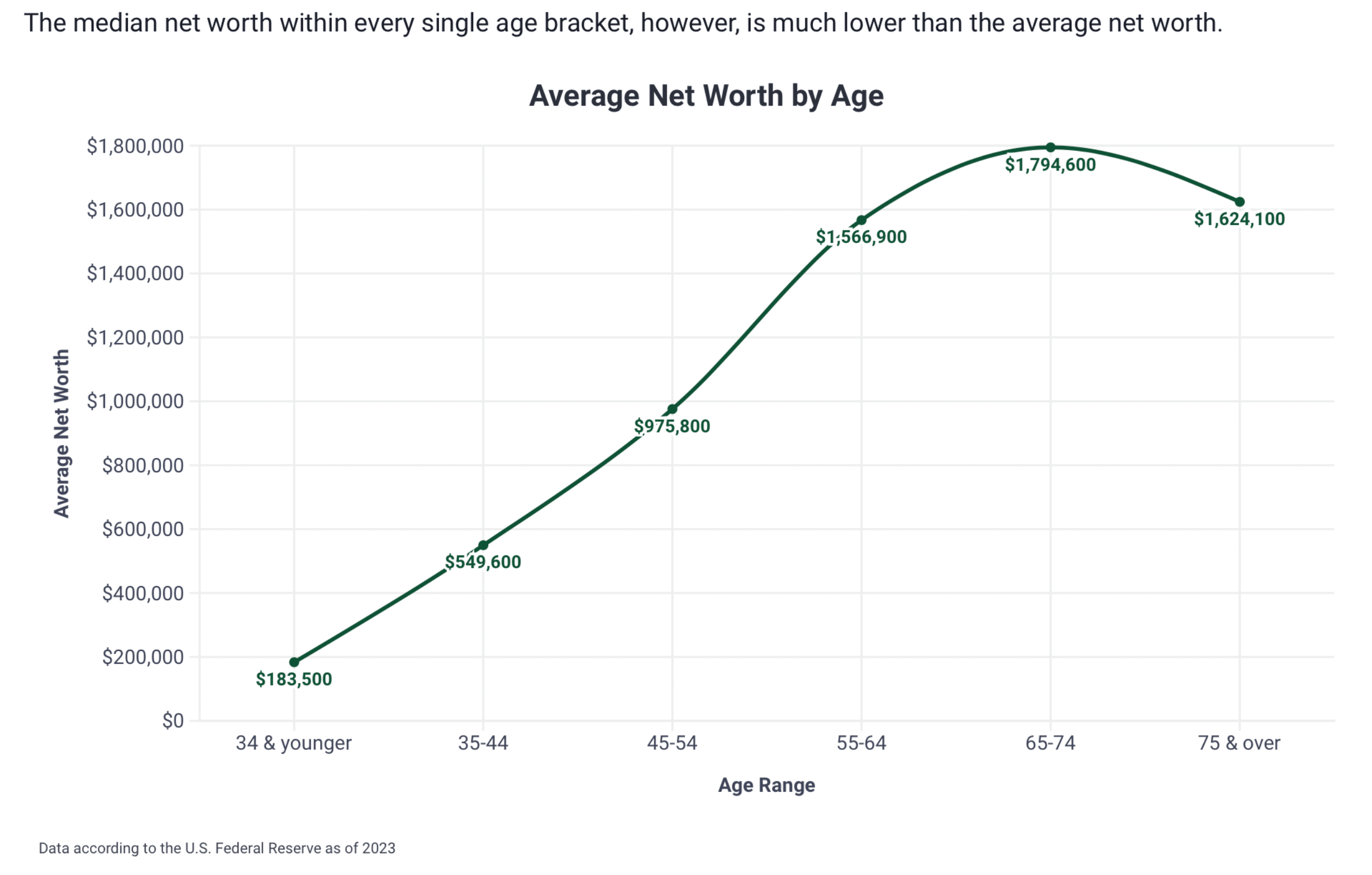
Individuals retiring at age 62 with a $1.6 million net worth sit well above the national median, though this figure often represents the mathematical mean skewed by high-net-worth outliers. In 2026, a $1.6 million net worth provides a stable foundation for early retirement, provided the assets are balanced between liquid investments and home equity, and the retiree has a strategy for healthcare costs before Medicare eligibility at 65.
Understanding the $1.6 Million Benchmark: Mean vs. Median
When discussing the "average" net worth of retirees, it is vital to distinguish between the mean and the median. According to the most recent longitudinal data from the Federal Reserve’s Survey of Consumer Finances, the mean net worth for households in the 55–64 age bracket has hovered near the $1.5 to $1.6 million range. However, the median net worth—the midpoint where half of households have more and half have less—is typically much lower, often sitting between $350,000 and $450,000.
The $1.6 million figure is a significant milestone because it aligns with what many financial planners in 2026 call the "comfortable" threshold for early retirement. At age 62, a retiree is eligible for Social Security but faces a permanent reduction in monthly benefits compared to waiting until full retirement age (FRA). Consequently, the net worth must work harder to bridge the gap.
A $1.6 million net worth at 62 usually consists of three primary pillars:
- Home Equity: Often accounting for 25% to 40% of total net worth.
- Tax-Advantaged Retirement Accounts: 401(k)s, 403(b)s, and IRAs.
- Taxable Brokerage Accounts and Cash: Liquid assets used to fund lifestyle before tapping into age-restricted or tax-heavy accounts.
Is $1.6 Million Enough to Retire at 62 in 2026?
Determining if $1.6 million is "enough" depends heavily on the distinction between total net worth and investable assets. If $600,000 of that net worth is tied up in a primary residence, the retiree is left with $1 million in investable assets.
Applying the traditional 4% rule—a guideline suggesting you can withdraw 4% of your portfolio in the first year of retirement and adjust for inflation thereafter—a $1 million portfolio generates $40,000 in annual pre-tax income. When combined with Social Security benefits, which for a high-earner retiring at 62 in 2026 might range from $24,000 to $30,000 annually, the total gross income settles around $64,000 to $70,000.
The Cost of Early Retirement
Retiring at 62 introduces specific financial pressures that those retiring at 65 or 67 do not face:
- Social Security Reduction: Claiming at 62 results in a benefit reduction of approximately 30% compared to claiming at age 67. This reduction is permanent and affects cost-of-living adjustments (COLA) for the remainder of the retiree's life.
- The Healthcare Gap: Medicare eligibility does not begin until age 65. A 62-year-old must fund private health insurance for three years. In 2026, unsubsidized silver-level plans for a couple in their early 60s can easily exceed $2,000 per month, significantly impacting the withdrawal rate of a $1.6 million portfolio.
- Sequence of Returns Risk: If the stock market experiences a downturn in the first few years of retirement (2026–2028), withdrawing funds from a diminished portfolio can permanently impair the longevity of the assets.
Asset Allocation for the Age 62 Retiree
A $1.6 million net worth requires a sophisticated allocation strategy to ensure it lasts 30 or more years. By age 62, the aggressive growth stance of one's 40s usually shifts toward capital preservation and income generation.
| Asset Category | Purpose | Typical Allocation Range |
|---|---|---|
| Equities (Stocks) | Long-term growth and inflation protection | 45% – 60% |
| Fixed Income (Bonds/CDs) | Income stability and volatility dampening | 30% – 45% |
| Cash Equivalents | Immediate liquidity (1-2 years of expenses) | 5% – 10% |
| Real Estate (Primary) | Housing security (Not an income source) | 20% – 35% of total Net Worth |
In 2026, with interest rates having stabilized after the volatility of the early 2020s, many retirees are utilizing "bond ladders" or high-yield fixed-income instruments to secure the first five years of their retirement distributions. This allows the equity portion of their $1.6 million net worth to remain invested through market cycles.
The Impact of Taxes on Net Worth Calculations
A $1.6 million net worth is not "spendable" in its entirety. The tax treatment of the components significantly alters the actual purchasing power.
Traditional vs. Roth Assets
If the majority of the $1.6 million is held in a Traditional 401(k) or IRA, every dollar withdrawn is taxed as ordinary income. In 2026, federal tax brackets and potential state taxes could claim 15% to 25% of those distributions. Conversely, assets held in a Roth IRA are tax-free, making a $1.6 million Roth-heavy net worth much more valuable than a Traditional-heavy one.
Capital Gains in Brokerage Accounts
For retirees with significant holdings in taxable brokerage accounts, the long-term capital gains tax rates (0%, 15%, or 20%) are generally more favorable than ordinary income rates. Strategically selling appreciated assets while in a lower income bracket is a hallmark of successful early retirement at 62.
Geographic Variability and Lifestyle Maintenance
The adequacy of a $1.6 million net worth is highly dependent on the retiree's location. In high-cost-of-living (HCOL) areas like San Francisco, New York, or Seattle, $1.6 million may feel restrictive, especially if a large portion is tied up in expensive real estate with high property taxes.
In contrast, in low-cost-of-living (LCOL) regions, $1.6 million can support a luxurious lifestyle. Many retirees in 2026 are engaging in "geographic arbitrage"—selling a high-value home in a HCOL area and moving to a region with lower taxes and cheaper housing. This move often converts "dead" home equity into "active" investable cash, effectively increasing the spendable portion of their net worth without changing the total $1.6 million figure.
Potential Pitfalls for the $1.6 Million Retiree
Even with a seemingly robust net worth, several "wealth eroders" can jeopardize a 62-year-old’s financial security.
- Inflation Persistence: While the hyper-inflation of previous years has cooled by 2026, even a modest 2.5% inflation rate will double the cost of living over a 30-year retirement. A $1.6 million portfolio must grow to maintain its purchasing power.
- Supporting Adult Children: A growing trend in 2026 is the "sandwich generation" phenomenon, where 62-year-olds are still providing financial assistance to adult children or aging parents. This "leakage" can deviate from the 4% withdrawal rule.
- Underestimating Longevity: With advances in healthcare and biotechnology in 2026, a 62-year-old should plan for a 35-year retirement horizon. Spreading $1.6 million over three and a half decades requires disciplined spending.
Strategic Checklist for Retiring at 62 with $1.6 Million
To maximize the utility of a $1.6 million net worth, retirees should consider the following steps:
- Audit Liquid Assets: Ensure that at least $1 million of the $1.6 million is in investable assets (stocks, bonds, cash) rather than just home equity.
- Establish a Bridge Strategy: Secure a dedicated fund to cover health insurance premiums until Medicare begins at age 65.
- Run a Social Security Optimization: Use tools provided by the Social Security Administration to compare the lifetime value of claiming at 62 versus waiting until 67 or 70.
- Review Estate Plans: Ensure that wills, trusts, and beneficiary designations are updated for 2026 tax laws.
- Tax-Bracket Management: Plan withdrawals to stay within the lowest possible tax bracket, utilizing a mix of taxable, tax-deferred, and tax-free accounts.
Frequently Asked Questions
Is $1.6 million considered "rich" for a 62-year-old?
In 2026, a $1.6 million net worth places an individual in the top 15% to 20% of American households in that age group. While it is significantly higher than the median, it is often viewed as "upper-middle class" rather than "wealthy" in major metropolitan areas, particularly when accounting for the costs of a 30-year retirement.
Can I retire at 62 with $1.6 million if I still have a mortgage?
Retiring with debt is possible but increases the required withdrawal rate from your portfolio. Many financial advisors recommend paying off the mortgage before 62 to reduce fixed monthly expenses, which allows for greater flexibility in managing the $1.6 million portfolio during market downturns.
How does the 2026 tax landscape affect a $1.6 million net worth?
With the expiration or adjustment of various tax provisions from the late 2010s, 2026 is a pivotal year for tax planning. Retirees should consult the Internal Revenue Service (IRS) guidelines regarding standard deductions and bracket adjustments to ensure their withdrawal strategy remains tax-efficient.
What is the biggest risk to a $1.6 million retirement at 62?
The "healthcare gap" is the most significant immediate risk. Without employer-sponsored insurance, the three years between age 62 and 65 can cost a couple upwards of $75,000 to $100,000 in premiums and out-of-pocket costs, which can significantly deplete cash reserves early in retirement.
Should I sell my home to increase my investable assets?
If your $1.6 million net worth is dominated by home equity (e.g., $900,000 in home value and $700,000 in savings), downsizing may be necessary to generate enough monthly income. Converting home equity into investable assets can lower the withdrawal pressure on your retirement accounts.
Final Recommendation
If you have achieved a $1.6 million net worth by age 62, you are in a strong position to retire, but caution is warranted regarding the "liquidity" of that wealth. Your next action should be a detailed cash-flow analysis that separates your primary residence value from your spendable assets. Prioritize a healthcare funding plan for the next three years and consider delaying Social Security claims if your portfolio can support you, as this will provide a higher "guaranteed" inflation-adjusted income later in life.