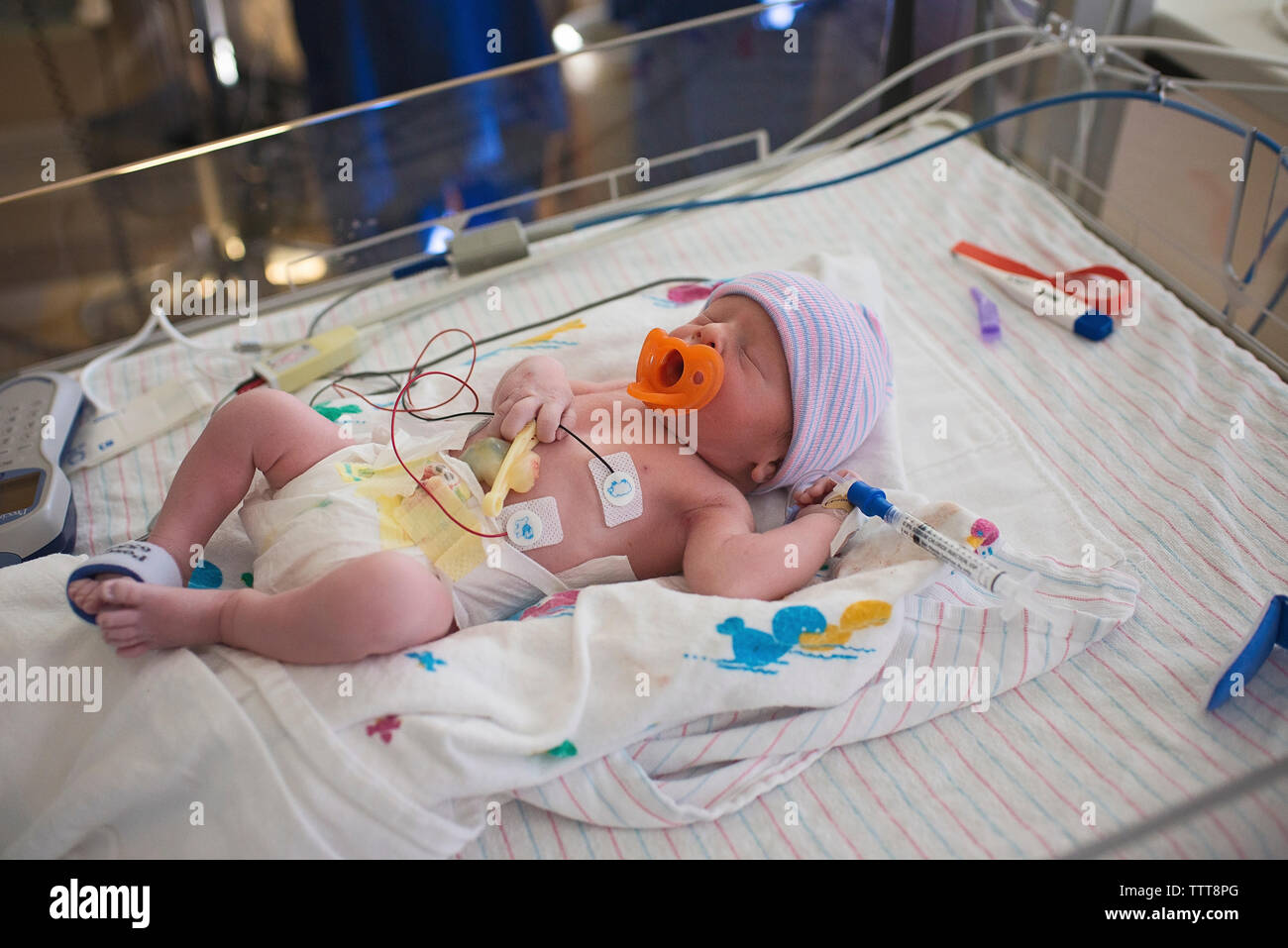
During a hospital stay following delivery, a newborn undergoes a structured series of clinical evaluations, preventive treatments, and health screenings designed to ensure a safe transition to extrauterine life. From immediate post-birth assessments like the Apgar score to mandatory blood spot tests, hearing evaluations, and jaundice monitoring, hospital medical teams systematically verify the infant's health before discharge, typically within 24 to 72 hours after birth.
Medical Disclaimer
This guide is for informational and educational purposes only and does not constitute medical advice. Healthcare practices and hospital protocols may vary by location, clinical situation, and regulatory framework. Always consult qualified healthcare professionals, such as a pediatrician or neonatologist, regarding specific medical concerns or decisions about infant care.
The First Hour After Delivery: The "Golden Hour"
The initial sixty minutes following birth, often called the "Golden Hour," represent a critical transition period for a newborn. Inside the womb, the fetus relies on the placenta for oxygen, nutrient delivery, and waste removal. At birth, the baby’s respiratory and circulatory systems undergo rapid, radical adjustments.
During an uncomplicated vaginal or cesarean delivery, clinical guidelines recommended by the World Health Organization (WHO) emphasize immediate, uninterrupted skin-to-skin contact between the mother and the newborn. Skin-to-skin contact helps regulate the baby’s body temperature, stabilizes heart rate and breathing, reduces stress hormones, and encourages the early onset of breastfeeding.
- Delivery
- Skin-to-Skin Contact: Regulates temperature & heart rate
- Delayed Cord Clamping: Increases iron stores & blood volume
- Apgar Assessment: Evaluates physical status (1 & 5 mins)
Delayed Umbilical Cord Clamping
Current obstetrical and neonatal guidelines recommend delaying umbilical cord clamping for at least 30 to 60 seconds after birth for term and preterm infants who do not require immediate resuscitation. This delay allows placental transfusion—a process that transfers vital blood volume, red blood cells, and iron stores from the placenta to the baby. Studies show that delayed cord clamping improves iron status in infants during the first six months of life and reduces the risk of intraventricular hemorrhage in premature infants.
The Apgar Score Evaluation
At 1 minute and 5 minutes after birth, a clinical professional evaluates the newborn using the Apgar scoring system. Devised by Dr. Virginia Apgar in 1952, this rapid assessment evaluates five objective physical criteria:
- Appearance (Skin Color): Assessing whether the skin is completely pink or exhibits cyanosis (bluish tint).
- Pulse (Heart Rate): Target rate is above 100 beats per minute.
- Grimace (Reflex Irritability): Response to mild stimulation, such as suctioning or tactile prompt.
- Activity (Muscle Tone): Presence of active motion and flexed limbs versus limpness.
- Respiration (Breathing Effort): Vigorous crying and strong respiratory effort.
Each category receives a score from 0 to 2, yielding a total possible score of 10. A score of 7 or higher indicates that the baby is making a healthy adjustment to life outside the womb. A score below 7 signals that the infant may require brief clinical support, such as oxygen administration, airway clearing, or tactile stimulation. The Apgar score is designed to gauge immediate resuscitation needs rather than predict long-term health outcomes.
Standard Preventive Treatments in the Delivery Room
Once the immediate transition is complete and skin-to-skin bonding is underway, healthcare staff administer several standard preventive health interventions. These procedures are routinely performed in hospital settings to protect the newborn from serious, preventable complications.
Erythromycin Ophthalmic Ointment
Shortly after birth, a thin ribbon of 0.5% erythromycin antibiotic ointment is applied to the newborn's lower eyelids. This routine prophylactic treatment protects against ophthalmia neonatorum, a severe form of neonatal conjunctivitis caused by maternal exposure to bacteria such as Neisseria gonorrhoeae or Chlamydia trachomatis during passage through the birth canal. Without preventive eye medication, neonatal gonococcal infections can lead to corneal scarring and permanent blindness.
Vitamin K Prophylaxis
Human infants are born with low stores of Vitamin K because only minimal amounts cross the placenta, and gut flora that produce Vitamin K are not yet established. This deficiency leaves newborns vulnerable to Vitamin K Deficiency Bleeding (VKDB), a potentially fatal condition that can cause spontaneous internal bleeding into the brain or gastrointestinal tract.
The American Academy of Pediatrics (AAP) recommends a single intramuscular injection of Vitamin K1 (phytonadione), typically administered in the baby's thigh within 1 to 6 hours after birth. This single dose effectively prevents both early and late forms of VKDB until the infant begins consuming solid foods and developing natural intestinal microbiota.
Hepatitis B Vaccination
The Centers for Disease Control and Prevention (CDC) and the Advisory Committee on Immunization Practices (ACIP) recommend that all medically stable infants weighing at least 2,000 grams receive their first dose of the Hepatitis B (HepB) vaccine within 24 hours of birth. The birth dose acts as a safety net, protecting the infant against horizontal transmission from household contacts or unknown maternal infection status. If the mother tests positive for Hepatitis B surface antigen (HBsAg), the newborn receives both the vaccine and Hepatitis B Immune Globulin (HBIG) within 12 hours of birth to confer immediate protection.
Mandatory Newborn Screenings Before Discharge
Before a newborn is discharged from the hospital—typically between 24 and 48 hours after delivery—a suite of non-invasive and minimally invasive screening tests is performed. These universal screenings are designed to identify rare, severe medical conditions before symptoms appear, allowing for prompt clinical intervention.
| Screening | Details |
|---|---|
| Blood Spot Screen (Heel) | Tests for 30+ metabolic disorders |
| Pulse Oximetry (CCHD) | Detects critical heart defects |
| Hearing Screen (OAE/ABR) | Identifies congenital hearing loss |
| Bilirubin Check | Monitors risk of hyperbilirubinemia |
The Universal Newborn Blood Spot Screen
Often referred to as the "heel prick test," this screening involves collecting a few drops of blood from the baby's heel onto a specialized filter paper card. To achieve accurate results, this test must occur after the baby has begun feeding and is at least 24 hours old.
The sample is sent to a public health laboratory to test for dozens of genetic, metabolic, endocrine, and hematologic disorders. Conditions evaluated under the Recommended Uniform Screening Panel (RUSP) include:
- Phenylketonuria (PKU): An inability to process the amino acid phenylalanine, which can cause intellectual disability if unmanaged.
- Congenital Hypothyroidism: Thyroid hormone deficiency that impairs brain development and growth.
- Sickle Cell Disease: Red blood cell disorders that affect oxygen transport.
- Cystic Fibrosis: A genetic disorder affecting mucus production in the lungs and digestive system.
- Severe Combined Immunodeficiency (SCID): An inherited immune system disorder leaving infants vulnerable to severe infections.
Critical Congenital Heart Disease (CCHD) Screening
Critical Congenital Heart Disease (CCHD) refers to a group of structural heart defects that require surgical or catheter intervention during the first year of life. Screening is performed using pulse oximetry, a painless sensor placed on the infant's right hand and either foot after 24 hours of age.
The test measures oxygen saturation levels in the blood. A significant discrepancy between hand and foot saturation, or an overall saturation reading below 95%, warrants a pediatric cardiology evaluation and an echocardiogram to rule out underlying cardiac anomalies before discharge.
Universal Newborn Hearing Screening
Congenital hearing loss affects roughly 1 to 3 per 1,000 live births. Because early detection is vital for language development, hospitals conduct hearing assessments prior to discharge using one of two methods:
- Otoacoustic Emissions (OAE): A tiny probe placed in the baby's ear canal plays soft tones and measures the echo response produced by the inner ear hair cells.
- Automated Auditory Brainstem Response (AABR): Sensors placed on the baby's scalp measure how the auditory nerve and brainstem respond to soft clicking sounds played through miniature earphones.
If an infant does not pass the initial screening, a follow-up diagnostic evaluation with an audiologist is scheduled within a few weeks. A failed screening does not confirm permanent hearing loss, as fluid or vernix in the ear canal often causes temporary non-passage.
Jaundice and Bilirubin Monitoring
Neonatal jaundice—a yellowing of the skin and eyes caused by elevated levels of bilirubin—is common in infants as their immature livers process broken-down red blood cells. However, severe hyperbilirubinemia can cross the blood-brain barrier and cause acute bilirubin encephalopathy or kernicterus, a form of permanent brain damage.
Hospitals systematically assess bilirubin levels in all newborns before discharge using a non-invasive transcutaneous bilirubinometer (a light device pressed against the sternum or forehead) or a serum blood test. Results are plotted on a hour-specific nomogram to determine the risk level. Infants with high bilirubin levels may receive phototherapy—exposure to specific blue light spectrums that break down bilirubin so it can be excreted through urine and stool.
Daily In-Hospital Monitoring and Pediatric Care
Throughout the hospital stay, nursing staff and pediatricians perform routine health checks to ensure normal development and physiological stability.
Daily Monitoring Cycle:
- Vital Signs: Temp, HR, Resp
- Weight: % Loss Log
- Excretion: Meconium Count
Vital Signs and Thermoregulation
Nurses regularly measure the newborn's vital signs, including heart rate (normally 110 to 160 beats per minute), respiratory rate (normally 30 to 60 breaths per minute), and axillary body temperature (36.5°C to 37.5°C / 97.7°F to 99.5°F). Newborns have a high body surface area to mass ratio and easily lose heat through evaporation, conduction, radiation, and convection. Rooming-in and wearing appropriate layers or swaddling help maintain warm body temperatures.
Weight Tracking and Feedings
It is normal for newborns to lose weight during their first few days of life as they shed excess body fluid and clear meconium. A weight loss of up to 7% to 10% of birth weight is considered typical for breastfed infants, while formula-fed infants typically lose up to 5% to 7%. Pediatric teams track daily weight loss; a loss exceeding 10% prompts a clinical assessment of feeding efficiency, hydration, and maternal milk supply.
In addition, staff track intake and output. Newborns pass dark, tar-like meconium stools during their first 24 to 48 hours. As feeding establishes, stool transitions to a greenish-brown color and eventually to yellow-seedy stools (for breastfed infants) or firmer yellow-tan stools (for formula-fed infants). Nursing logs record wet and dirty diapers to verify adequate hydration and gastrointestinal function.
When a Newborn Requires Higher-Level Care: SCN and NICU
While most infants transition smoothly in mother-baby units, some require admission to a Special Care Nursery (SCN) or a Neonatal Intensive Care Unit (NICU). Hospital units are classified into distinct levels of care based on their clinical capabilities:
- Level I (Basic Newborn Care): Standard nursery care for healthy, full-term infants.
- Level II (Special Care Nursery): Care for infants born at 32 weeks gestation or later, or those recovering from illness who require intermediate monitoring, low-flow oxygen, or intravenous fluids.
- Level III (Neonatal Intensive Care Unit): Advanced care for critically ill, premature (under 32 weeks), or low birth weight infants requiring complex respiratory support, pediatric surgical subspecialties, and advanced imaging.
- Level IV (Regional NICU): Highest level of care equipped for complex congenital conditions and emergency surgical interventions.
| Level | Unit | Description |
|---|---|---|
| Level I | Well Baby Nursery | Healthy, term infants |
| Level II | Special Care (SCN) | ≥32 weeks, mild distress/IVs |
| Level III | NICU | <32 weeks, advanced vent support |
| Level IV | Regional NICU | Complex surgical & ECMO support |
Common triggers for NICU evaluation include prematurity, respiratory distress syndrome (RDS), neonatal hypoglycemia (low blood sugar), suspected neonatal sepsis, or severe birth asphyxia.
Standard Hospital Procedures Timeline
The following table summarizes the typical care timeline for a full-term newborn during an uncomplicated hospital stay.
| Timing | Procedure / Assessment | Clinical Purpose | Expected Outcome |
|---|---|---|---|
| 0–1 Minute | Apgar Score (First Assessment) | Evaluate immediate transition & breathing effort | Score of 7–10 indicates stable adjustment |
| 0–60 Minutes | Skin-to-skin & Delayed Cord Clamping | Boost iron stores, stabilize temperature & heart rate | Improved physiological stability, early feeding |
| 5 Minutes | Apgar Score (Second Assessment) | Confirm continued stabilization or response to intervention | Score of 7–10 confirms stability |
| 1–6 Hours | Vitamin K Shot & Erythromycin Ointment | Prevent Vitamin K Deficiency Bleeding & eye infections | Prophylactic protection established |
| First 24 Hours | Hepatitis B Vaccine & First Physical Exam | Provide early immunity; evaluate anatomy and reflexes | Vaccine recorded; complete head-to-toe baseline |
| 24–48 Hours | Universal Newborn Screening (Heel Prick) | Identify 30+ metabolic and genetic conditions | Blood sample sent to laboratory for analysis |
| 24–48 Hours | CCHD Pulse Oximetry Screening | Screen for critical congenital heart defects | Oxygen saturation ≥95% with <3% hand/foot variance |
| 24–48 Hours | Hearing Screen & Bilirubin Check | Detect congenital hearing loss and monitor jaundice | Clear hearing response; normal bilirubin levels |
| Discharge Day | Final Weight Check & Car Seat Inspection | Ensure safe discharge weight and proper car seat fit | Stable weight; verified rear-facing car seat installation |
Preparing for Hospital Discharge
Before a newborn is cleared for discharge, the medical team verifies that several safety and clinical criteria have been satisfied.
Discharge Checklist:
- Clinical Stability (Vitals, Feeding, Elimination)
- Universal Screenings Completed (Blood, CCHD, Hearing)
- Bilirubin Nomogram within Safe Zone
- Rear-Facing Car Seat Installed Correctly
- Outpatient Pediatric Appointment Confirmed (24–48 hours)
Essential Discharge Checklist
- Vital Signs Stability: Body temperature must remain normal in an open crib without artificial heating sources.
- Feeding and Elimination: The baby must demonstrate successful breast or bottle feeding and have passed both urine and meconium.
- Screening Completion: Mandatory blood, hearing, and CCHD screenings must be complete with documented results.
- Bilirubin Assessment: Bilirubin levels must fall within a safe zone on the risk nomogram.
- Car Seat Check: Parents must possess an approved, unexpired, rear-facing infant car seat. Many hospitals require parents to demonstrate proper installation or carry the infant out in the harness.
- Follow-Up Appointment: A primary pediatrician visit must be scheduled within 24 to 72 hours of discharge to recheck weight, skin color, and overall transition.
Frequently Asked Questions
Why does a newborn lose weight during the first few days in the hospital?
Newborns are born with extra body fluids that they naturally shed through urination and respiration during their first few days. Additionally, mothers producing colostrum yield small volumes of high-nutrient milk before full milk production begins. A weight loss of 5% to 10% is typical and usually resolves once regular feeding is established, with most infants regaining their birth weight within 10 to 14 days.
What is the purpose of the heel prick test?
The heel prick test (Newborn Blood Spot Screening) collects blood drops to screen for rare, serious metabolic, endocrine, and genetic conditions such as Phenylketonuria (PKU), Congenital Hypothyroidism, and Sickle Cell Disease. Detecting these disorders early allows for prompt medical treatment, preventing long-term physical or intellectual disabilities.
Can parents decline standard treatments like Vitamin K or eye ointment?
While parents have legal rights regarding medical decisions, public health laws and hospital protocols regulate these prophylactic treatments. Some states mandate specific treatments by law, while others allow formal written refusal. Medical guidelines strongly advise against declining Vitamin K, as refusal increases the risk of severe, life-threatening internal bleeding in infants. Parents considering refusal should discuss risks, benefits, and local legal requirements with their healthcare provider.
How long do a newborn and mother stay in the hospital after delivery?
For an uncomplicated vaginal delivery, the average hospital stay ranges from 24 to 48 hours. Following a cesarean delivery, the typical stay ranges from 72 to 96 hours to allow for maternal surgical recovery and continued infant monitoring. The exact duration depends on clinical stability, screening completion, and medical insurance coverage rules.
What happens if a baby fails the initial hearing screening?
Failing the initial hearing screening does not mean a baby has permanent hearing loss. Amniotic fluid, vernix, or mild swelling in the ear canal frequently causes temporary non-passage. If an infant does not pass, the hospital schedules a follow-up outpatient rescreening or diagnostic evaluation with an audiologist within two to four weeks.
Recommended Next Steps
- Choose a Pediatrician Prior to Delivery: Select and contact a pediatrician or family physician during the third trimester. Ensure they accept your health insurance and have admitting privileges or hospital affiliations for newborn visits.
- Assemble Hospital Documentation: Pack pediatrician contact details, identification, insurance cards, and any maternal medical records into your hospital bag.
- Install the Infant Car Seat: Ensure your rear-facing infant car seat is properly installed in your vehicle several weeks before your due date. Review the manufacturer’s manual or visit a certified Child Passenger Safety Technician (CPST) for inspection.
- Clarify Hospital Protocols: Discuss birth preferences and routine newborn procedures with your OB/GYN or midwife during prenatal visits to understand specific hospital practices for skin-to-skin contact, rooming-in, and routine vaccinations.