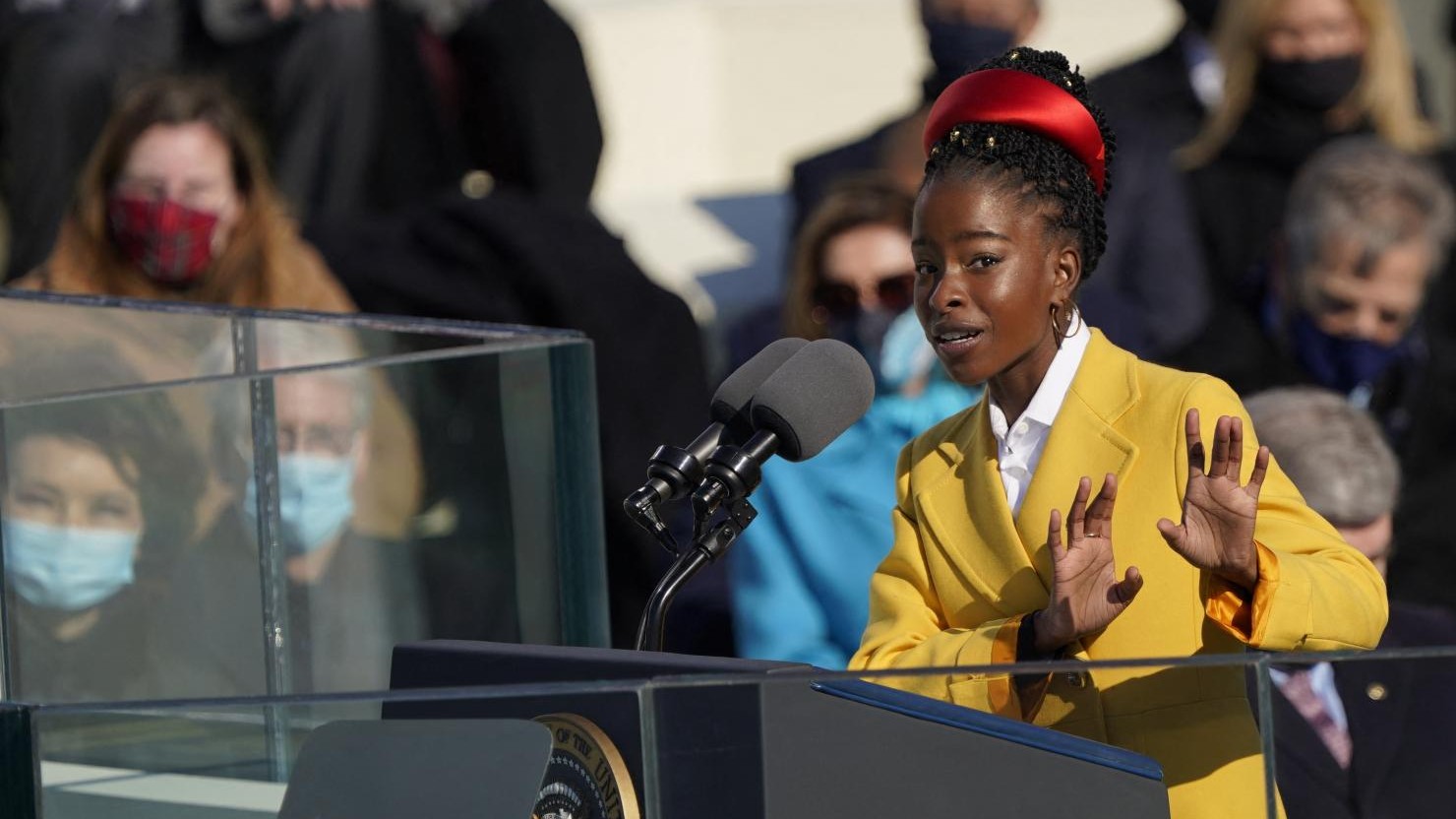
Amanda Gorman’s speeches and poetry center on themes of national unity, the intersection of history and hope, the resilience of the human spirit, and the imperative of democratic participation. Her work consistently balances an acknowledgment of past traumas with an optimistic call for collective progress, using lyrical structure to address complex sociopolitical issues.
The Intersection of Memory and Aspirations
At the heart of Amanda Gorman’s rhetorical strategy is the tension between the "unfinished" state of American history and the aspiration for a more perfect union. Her breakout performance at the 2021 Presidential Inauguration, "The Hill We Climb," established this thematic framework. Rather than ignoring the fractures in the national fabric, Gorman positions the poet as a witness to both the scars of the past and the potential for a transformative future.
This theme is not merely stylistic; it is a pedagogical tool. By juxtaposing images of "bruised" history with the "courage to create" a better reality, she frames social justice as an active, ongoing creative process. Her speeches often suggest that to ignore history is to forfeit the ability to shape the future. Consequently, her audience is invited to move from passive observation to active, civic participation. She challenges the listener to view their role in democracy not as a static birthright, but as a commitment that requires continuous maintenance, critique, and revision.
The Power of Youth and Collective Agency
A recurring motif in Gorman’s work is the unique agency of the younger generation. As the first-ever National Youth Poet Laureate, her thematic focus often elevates youth from the status of passive recipients of policy to active, essential architects of change. She frequently contrasts the perceived "quietness" or vulnerability of youth with the weight of their responsibility in addressing crises like climate change, systemic racism, and political polarization.
Her message to young audiences is consistently one of empowerment through articulation. She posits that the act of naming a problem is the first step toward dismantling it. Through the use of rhythmic, often percussive language, she emphasizes that voice is a fundamental democratic instrument. By positioning youth as the "light" that bridges the gap between historical darkness and future progress, she creates a narrative of urgency that seeks to mobilize rather than alienate. This theme of collective agency serves as a bridge between individual self-expression and broad, systemic political movement.
Linguistic Resilience and the Rhythm of Democracy
Gorman’s approach to public speaking is deeply rooted in the rhythmic traditions of spoken-word poetry. She uses alliteration, repetition, and cadence to imbue political discourse with emotional resonance. This is a deliberate thematic choice: she argues that the language of policy and politics has often become sterile, alienated from the lived experiences of the people it governs. By reintroducing high-art poetic structure into high-stakes political arenas, she aims to re-humanize the discourse.
This thematic commitment to language as a tool for reconciliation is evident in how she navigates sensitive topics. She avoids inflammatory, divisive rhetoric in favor of what might be termed "inclusive confrontation." This involves naming specific injustices without dehumanizing the entities involved, thereby maintaining a focus on the possibility of repair. Her work implies that if we change the way we speak about our neighbors and our institutions, we necessarily change the way we interact with them. In this sense, her poetry acts as a form of social technology—an attempt to upgrade the linguistic standards of the national conversation.
Comparative Themes Across Major Works
Gorman’s repertoire extends beyond her inauguration speech, touching upon environmental stewardship, gender equality, and the celebration of diversity. The following table summarizes the primary thematic pillars across her prominent public contributions:
| Work/Appearance | Primary Theme | Supporting Motif |
|---|---|---|
| "The Hill We Climb" | Democratic Restoration | Weaving together past scars and future light. |
| "Earthrise" | Environmental Accountability | The fragility of the planet as a shared inheritance. |
| "The Miracle of Morning" | Collective Resilience | Finding continuity in the wake of global crisis. |
| "Call Us More Than Carry" | Inclusive Solidarity | Redefining strength as the capacity to support others. |
Each of these pieces maintains a consistent internal logic: the belief that the status quo is never the final word. While the subject matter shifts from climate to pandemic-era survival, the underlying belief remains that the act of collective acknowledgment is the prerequisite for systemic change.
The Requirement of Civic Participation
A persistent, practical theme in Gorman’s rhetoric is the necessity of consistent civic engagement. She moves beyond abstract idealism by grounding her calls to action in the reality of voting, community organizing, and public discourse. She avoids the trap of "hope as a bystander," instead promoting a version of hope that is indistinguishable from work.
For the reader or listener, this shift in focus is critical. Gorman’s speeches often function as a prompt for the audience to examine their own sphere of influence. She suggests that if one is not part of the active, messy process of democracy, they are not merely "neutral"—they are allowing the worst aspects of history to repeat. This is a call for a high-intensity commitment to public life, emphasizing that the burden of democracy is shared, but the power to move it forward is individual.
Navigating Modern Challenges Through Poetry
In the current landscape of 2026, where digital echo chambers often fragment discourse, Gorman’s themes offer a counter-narrative. Her focus on "common ground" is often misconstrued as a call for superficial compromise. However, a deeper analysis of her work shows that she advocates for "common ground" as a space of shared accountability.
To engage with Gorman’s work as a viewer or researcher, one must understand that her poetry is intended to perform specific social functions:
- Validation: Acknowledging the exhaustion and frustration of marginalized communities.
- Standard-Setting: Defining what an ideal, inclusive democracy looks like in practical, sensory terms.
- Invitation: Providing the audience with the vocabulary to address their own political frustrations productively.
Frequently Asked Questions
What are the main influences behind Amanda Gorman's themes?
Gorman is deeply influenced by the intersection of the Black American literary tradition, the history of oratory, and the specific sociopolitical climate of the early 2020s. Her work draws upon the cadences of leaders like Dr. Martin Luther King Jr. and the lyrical density of poets like Maya Angelou, modernized to address contemporary issues such as digital activism and environmental change.
Does Amanda Gorman’s poetry focus only on American politics?
While her most famous works are tied to American civic moments, her themes are universally applicable. She often addresses human rights, the climate crisis, and the general necessity of empathy in global discourse. Her work is concerned with the nature of human systems and how those systems can be re-engineered for equity and sustainability.
How does her use of repetition help deliver her themes?
Gorman uses anaphora and rhythmic repetition to create a sense of momentum. In themes of social progress, this structural repetition acts as a "beat," mirroring the steady, repetitive effort required for social change. It elevates the importance of her words, making them feel like a collective chant or a shared commitment rather than an isolated opinion.
How can a reader best interpret the "hope" in her work?
Hope in Gorman’s writing should not be interpreted as passive optimism or a belief that things will work out on their own. Instead, it is a form of "radical action." She presents hope as an intellectual choice—a tool used to persist through difficulty. It is the fuel for the "work" she constantly references in her speeches.
Why is youth identity such a prominent theme in her work?
Gorman’s focus on youth serves to emphasize that democracy is a forward-facing project. By highlighting the perspective of those who will inherit the current political system, she injects a sense of urgency and intergenerational accountability into the conversation. She challenges older generations to protect the future, while encouraging the young to claim their seat at the table.
Recommendations for Further Study
To fully grasp the evolution of these themes, it is recommended that you read her anthologies alongside the transcripts of her live speeches. Observing the text on the page highlights her technical mastery of meter, while viewing the live performances demonstrates the rhetorical weight of her delivery. Focus specifically on the progression of her imagery—how her metaphors for "darkness" and "light" shift as her career matures—to understand how she refines her message for different audiences. Her commitment to the idea that "hope is an act" remains the most vital entry point for anyone wishing to understand her work in the present day.