Alkenes react primarily through electrophilic addition mechanisms because the high electron density of their carbon-carbon pi bonds makes them susceptible to attack by electron-deficient species (electrophiles). This process typically involves the pi electrons breaking to form a new sigma bond with an electrophile, followed by the addition of a nucleophile to the resulting carbocation intermediate.
The Fundamental Nature of the Alkene Double Bond
To understand the alkenes mechanism, one must first analyze the electronic structure of the carbon-carbon double bond. In an alkene, each carbon atom is $sp^2$ hybridized, resulting in a planar geometry with bond angles of approximately 120 degrees. The double bond consists of one strong sigma ($\sigma$) bond and one weaker pi ($\pi$) bond.
The $\pi$ bond is formed by the sideways overlap of unhybridized $p$ orbitals. Because the electrons in the $\pi$ orbital are located above and below the plane of the nuclei, they are less tightly held than the electrons in the $\sigma$ bond. This creates a region of high electron density that is highly accessible to reagents. In chemical terms, the alkene acts as a nucleophile—a species that "seeks" a positive charge or an electron-deficient center.
As of 2026, computational chemistry models have further refined our view of these electron clouds, allowing chemists to visualize how the "softness" of the $\pi$ electron density dictates the trajectory of incoming electrophiles. This reactivity is the cornerstone of synthetic organic chemistry, enabling the conversion of simple hydrocarbons into complex alcohols, halides, and polymers.
The Electrophilic Addition Paradigm: Step-by-Step
The most common alkenes mechanism is electrophilic addition. While specific reagents lead to different products, the underlying two-step framework remains remarkably consistent.
Step 1: The Rate-Determining Electrophilic Attack
The mechanism begins when an electrophile ($E^+$) approaches the $\pi$ bond. The $\pi$ electrons are drawn toward the electrophile, eventually breaking the double bond to form a new $C-E$ sigma bond. This step is usually the slow, rate-determining step because it involves the disruption of the stable $\pi$ system and the formation of a high-energy intermediate.
When the double bond breaks, one carbon atom gains the electrophile, while the other carbon atom is left with only six valence electrons and a formal positive charge. This reactive species is known as a carbocation. The stability of this carbocation is the primary factor in determining the speed and outcome of the reaction.
Step 2: Nucleophilic Capture
The carbocation is a powerful electrophile. In the second step, a nucleophile ($Nu^-$) present in the reaction medium—such as a halide ion or a water molecule—quickly attacks the positively charged carbon. This results in the formation of a second sigma bond, completing the addition across the original double bond. The overall enthalpy of the reaction is typically exothermic, as two relatively weak bonds (one $\pi$ and one $\sigma$ bond in the reagents) are replaced by two strong $\sigma$ bonds in the product.
Carbocation Stability and Markovnikov’s Rule
A critical aspect of the alkenes mechanism is regioselectivity, which refers to the preference for one direction of chemical bond making or breaking over all other possible directions. This is most famously described by Markovnikov’s Rule.
Markovnikov’s Rule states that in the addition of a protic acid ($H-X$) to an asymmetric alkene, the hydrogen atom attaches to the carbon with the greater number of hydrogen atoms, while the $X$ group attaches to the carbon with fewer hydrogen atoms.
The Electronic Basis for Stability
The rule is not merely an observation but a consequence of carbocation stability. Carbocations are stabilized by two main effects:
- Inductive Effect: Alkyl groups are electron-donating. They push electron density toward the positive carbon, helping to disperse the charge.
- Hyperconjugation: This involves the overlap of the empty $p$ orbital of the carbocation with the $\sigma$ bonds of adjacent $C-H$ or $C-C$ bonds.
In the context of 2026 laboratory standards, tertiary carbocations ($R_3C^+$) are recognized as significantly more stable than secondary ($R_2CH^+$) or primary ($RCH_2^+$) ones. Therefore, the mechanism will always proceed through the most stable possible intermediate. If a more stable carbocation can be formed via a hydride or methyl shift (rearrangement), the mechanism will often involve that transition to reach a lower-energy state.
Halogenation: The Cyclic Halonium Ion Path
While the addition of $H-X$ involves a "naked" carbocation, the addition of halogens like bromine ($Br_2$) or chlorine ($Cl_2$) follows a slightly different alkenes mechanism. This is a classic example of anti-addition and stereospecificity.
When $Br_2$ approaches an alkene, the $\pi$ electrons polarize the $Br-Br$ bond, inducing a dipole. The alkene attacks the "near" bromine, but instead of forming a simple carbocation, the bromine’s lone pairs stabilize the positive charge by forming a three-membered ring called a bromonium ion.
This cyclic intermediate is crucial for two reasons:
- No Rearrangement: Because the charge is shared within a ring rather than sitting on a single carbon, carbocation rearrangements are generally avoided.
- Anti-Stereochemistry: The second bromide ion must attack from the opposite face of the bromonium ring due to steric hindrance. This results in a trans or anti configuration in the final vicinal dihalide product.
Hydration and Alcohols: Acid-Catalyzed Mechanisms
The industrial production of alcohols often relies on the acid-catalyzed hydration of alkenes. In this mechanism, the electrophile is a hydronium ion ($H_3O^+$).
- Protonation: The alkene is protonated by the acid to form the more stable carbocation.
- Nucleophilic Attack by Water: Since water is the solvent and acts as a nucleophile, it attacks the carbocation to form a protonated alcohol (alkyloxonium ion).
- Deprotonation: A second water molecule removes the excess proton, regenerating the acid catalyst and yielding the final alcohol.
This mechanism follows Markovnikov’s rule. However, because it involves a free carbocation, it is prone to rearrangements. In 2026, many industrial processes favor Oxymercuration-Demercuration when they need Markovnikov hydration without the risk of skeletal rearrangements, as the mercurinium ion intermediate prevents the carbon skeleton from shifting.
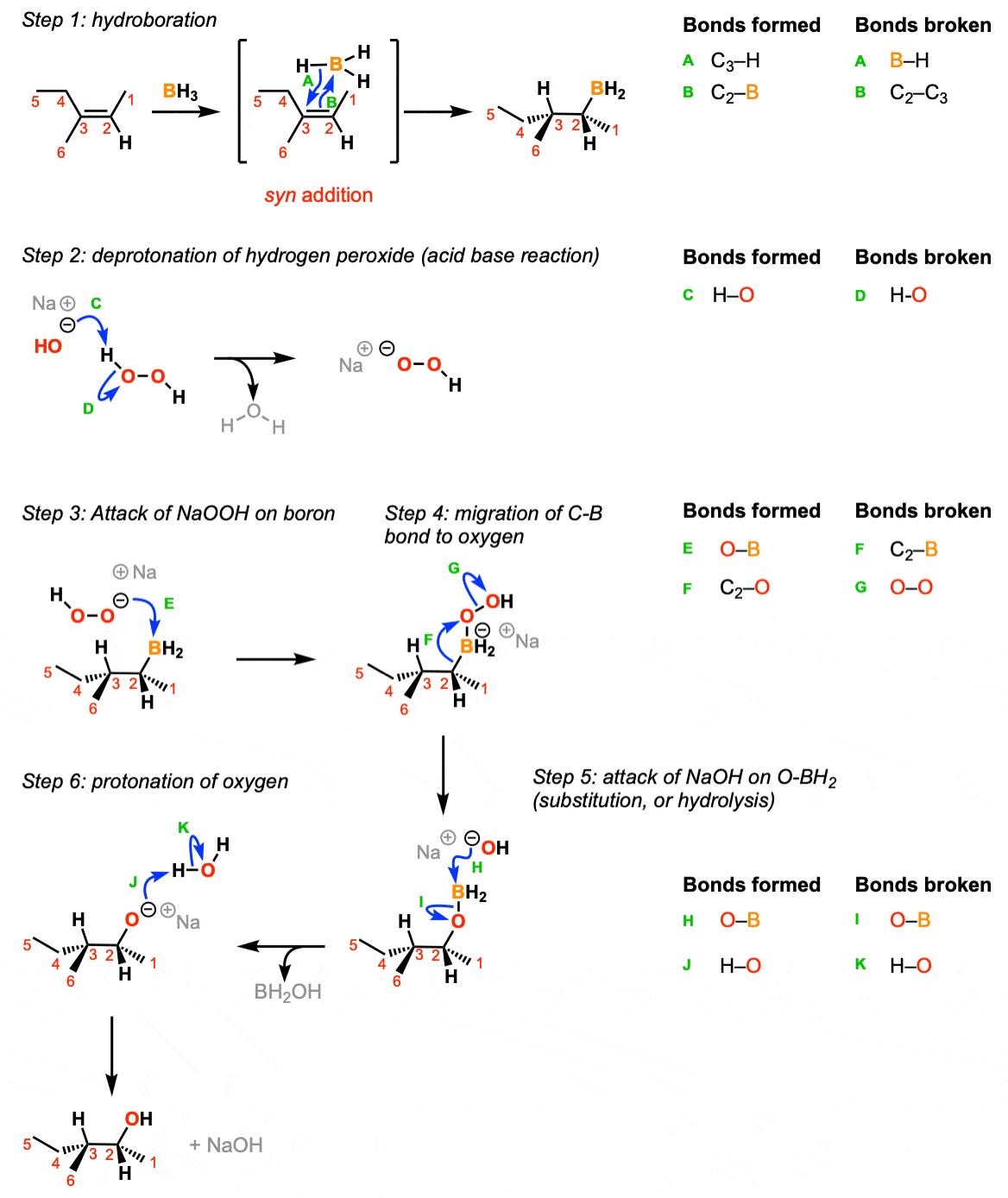
Hydroboration-Oxidation: The Anti-Markovnikov Exception
For students and professionals, the hydroboration-oxidation reaction represents a unique "work-around" in alkene chemistry. It results in anti-Markovnikov hydration, where the $-OH$ group ends up on the less substituted carbon.
The mechanism is a concerted process. Borane ($BH_3$) adds to the double bond in a single step. The boron atom, being larger and less electronegative than hydrogen, attaches to the less hindered, less substituted carbon. Simultaneously, the hydrogen attaches to the more substituted carbon. This is a syn-addition, meaning both components add to the same face of the alkene.
In the subsequent oxidation step, the boron is replaced by a hydroxyl group with complete retention of configuration. This mechanism is essential for synthesizing specific primary alcohols that cannot be made via standard acid-catalyzed hydration.
Comparison of Common Alkene Addition Mechanisms
The following table summarizes the key characteristics of the most common mechanisms encountered in organic chemistry as of 2026.
| Reaction | Reagents | Intermediate | Regioselectivity | Stereochemistry |
|---|---|---|---|---|
| Hydrohalogenation | $H-X$ | Carbocation | Markovnikov | Mixed (Syn/Anti) |
| Halogenation | $X_2$ in $CCl_4$ | Halonium Ion | N/A | Anti-addition |
| Hydration | $H_2O, H^+$ | Carbocation | Markovnikov | Mixed (Syn/Anti) |
| Hydroboration | $BH_3 \cdot THF$ | Transition State | Anti-Markovnikov | Syn-addition |
| Oxymercuration | $Hg(OAc)_2, H_2O$ | Mercurinium Ion | Markovnikov | Anti-addition |
| Hydrogenation | $H_2, Pd/C$ | Metal-surface complex | N/A | Syn-addition |
Catalytic Hydrogenation: Surface Chemistry
Not all alkenes mechanisms occur in a homogeneous solution. Catalytic hydrogenation is a heterogeneous process occurring on the surface of a metal catalyst such as palladium, platinum, or nickel.
The mechanism begins with the adsorption of hydrogen molecules onto the metal surface, where the $H-H$ bond breaks, leaving individual hydrogen atoms bonded to the metal. The alkene then coordinates with the metal surface through its $\pi$ system. The hydrogen atoms are transferred one at a time to the same face of the double bond. Because the alkene is "pinned" to the flat surface of the catalyst, the hydrogens must add to the same side, resulting in syn-addition. This is a foundational reaction in the food industry (hydrogenation of fats) and fuel production.
Computational Insights and Green Chemistry in 2026
Modern chemistry in 2026 has moved toward "Green Mechanism" design. Researchers now use high-level density functional theory (DFT) to predict the activation energy of these mechanisms before entering the lab. This minimizes chemical waste by ensuring that the chosen reaction conditions (temperature, solvent, and catalyst) are optimized for the specific alkene's electronic profile.
Furthermore, the study of organocatalysis has provided new mechanisms for alkene functionalization that avoid toxic heavy metals like mercury or osmium. By using small organic molecules to activate the electrophile or the alkene, chemists can achieve high levels of enantioselectivity—creating "left-handed" or "right-handed" molecules—which is vital for the pharmaceutical industry.
Frequently Asked Questions
Why do alkenes undergo addition rather than substitution?
Alkenes undergo addition because the $\pi$ bond is relatively weak and its electrons are highly accessible. Addition allows the molecule to trade a $\pi$ bond for two stronger $\sigma$ bonds, which is thermodynamically favorable. Substitution would require breaking a stronger $C-H$ $\sigma$ bond and would not resolve the "unsaturation" of the double bond.
How does the Hammond Postulate apply to the alkenes mechanism?
The Hammond Postulate suggests that the transition state of a reaction resembles the species (reactant, intermediate, or product) to which it is closest in energy. In electrophilic addition, the transition state for the rate-determining step resembles the carbocation intermediate. This explains why the more stable carbocation forms faster: its corresponding transition state is lower in energy.
Can alkenes react with nucleophiles directly?
Generally, no. Alkenes are electron-rich and will repel other electron-rich species (nucleophiles). However, if the alkene is conjugated with a strong electron-withdrawing group (like a carbonyl group), it can undergo nucleophilic conjugate addition (Michael addition). In the absence of such groups, an electrophile must attack first.
What is the role of the peroxide effect in alkene reactions?
When $HBr$ is added to an alkene in the presence of peroxides, the mechanism shifts from electrophilic addition to radical addition. This results in anti-Markovnikov regiochemistry because the bromine radical attacks the less substituted carbon to form the more stable carbon radical.
Are there any alkenes that do not follow Markovnikov's rule?
Yes, any mechanism that does not proceed through a free carbocation or that involves steric control (like hydroboration) can bypass Markovnikov's rule. Additionally, if the alkene is substituted with strongly electron-withdrawing groups (like $-CF_3$), the inductive effect can destabilize a carbocation at the more substituted position, reversing the typical regioselectivity.
Practical Recommendation for Mastering Mechanisms
To master the alkenes mechanism, focus on "arrow pushing"—the formal notation used to track the movement of electron pairs. Always start your arrow at the center of the $\pi$ bond and point it toward the electrophile. This habit reinforces the understanding that the alkene is the electron donor. Additionally, always draw out the intermediate carbocation to check for potential rearrangements before adding the final nucleophile. Using 2026 digital modeling software can also provide a 3D perspective on steric hindrance, which is often the deciding factor in complex additions.
For further technical specifications on reagent properties and safety data, refer to the IUPAC Gold Book or PubChem. Comprehensive mechanistic studies are also available via ChemLibreTexts.