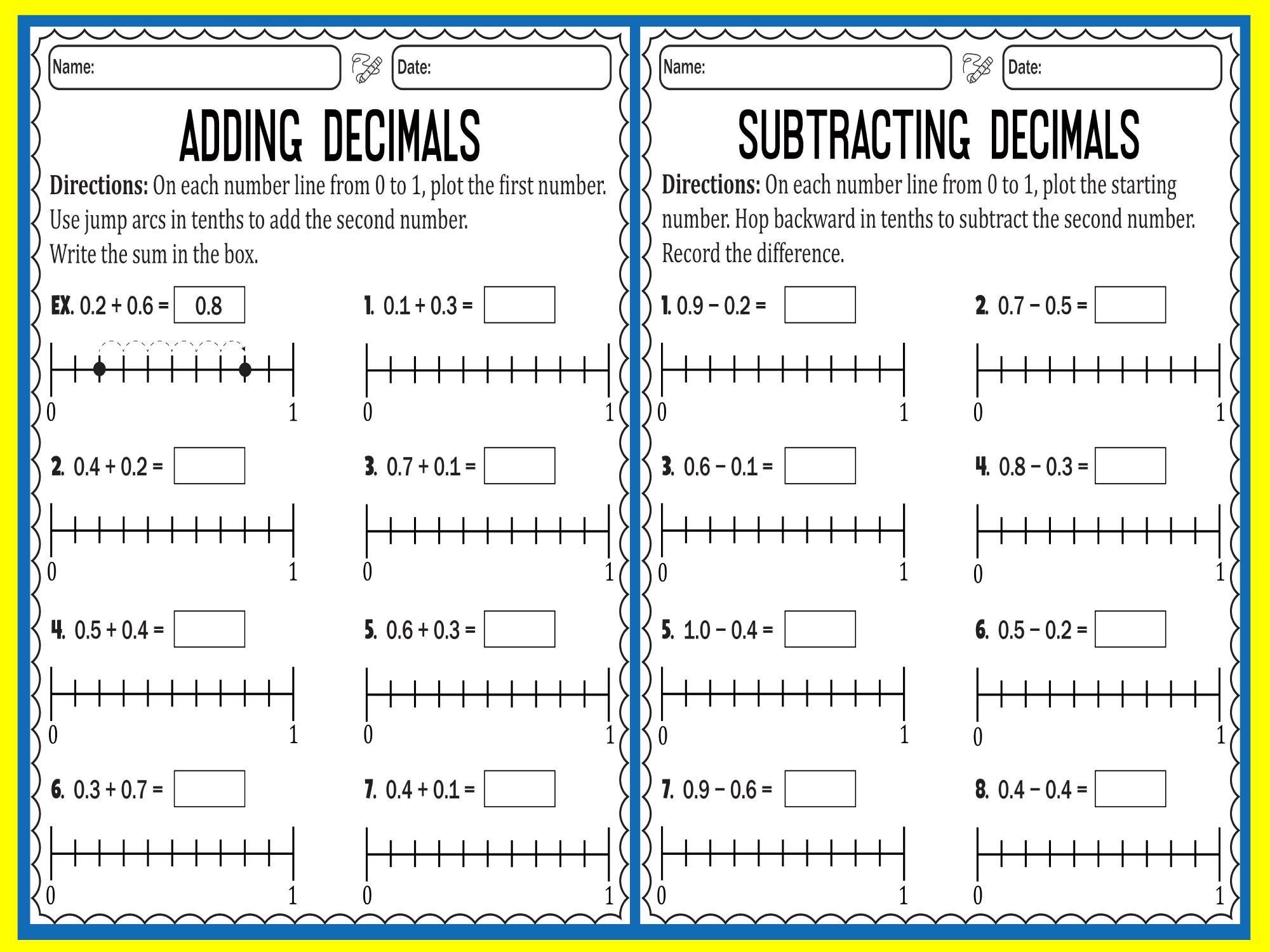
Adding and subtracting decimals is a foundational mathematical skill that requires aligning decimal points to ensure digits of the same place value are operated upon together. By treating the decimal point as a fixed anchor, learners can utilize standard column addition and subtraction methods, filling empty spaces with placeholder zeros to maintain precision and avoid common alignment errors.
The Importance of Decimal Alignment
The core challenge when performing arithmetic with decimals lies not in the operations themselves, but in the positioning of the digits. Unlike whole numbers, where the "ones" column is always at the far right, the decimal point acts as the structural pivot for a number. When adding or subtracting, the columns must represent identical fractional or whole powers of ten.
If you align numbers by their left-most digit rather than the decimal point, you are effectively comparing apples to oranges. For example, adding 2.5 and 0.12 by aligning the digits on the left would result in an incorrect calculation because the 2 (in the tenths place) would be added to the 1 (in the tenths place) while the 5 (in the tenths place) would be incorrectly compared against the 2 (in the hundredths place). Always aligning the decimal points ensures that tenths are added to tenths, hundredths to hundredths, and so on.
Step-by-Step Methodology for Decimal Operations
To ensure accuracy, follow a consistent procedure whenever you encounter a worksheet or calculation involving decimals.
1. Vertical Alignment
Rewrite your equation vertically. Place one number above the other, ensuring that every decimal point falls into the exact same vertical column. If the numbers have different amounts of digits, the decimal points are your primary reference—ignore the length of the number itself.
2. Placeholder Zeros
After alignment, you will often find that some numbers have fewer decimal places than others. To prevent confusion and errors during subtraction (especially when "borrowing" or "regrouping"), fill all empty columns with placeholder zeros. For instance, if you are subtracting 1.2 from 4.75, rewrite the problem so that 1.2 becomes 1.20. This makes the math visual and intuitive.
3. The Operation
Perform the addition or subtraction as you would with whole numbers, moving from right to left. Carry over or borrow as necessary, ignoring the decimal point while you work through the digits.
4. Placing the Decimal
Once the calculation is complete, drop the decimal point straight down into the answer row, maintaining the same vertical line you established in Step 1.
Common Pitfalls and Troubleshooting
Even advanced students often fall into traps when working with decimal arithmetic. Recognizing these common errors is the first step toward avoiding them in your practice sessions.
- The "Whole Number" Misconception: When adding a whole number to a decimal, such as 5 + 2.34, many learners mistakenly add the 5 to the 2. Always remember that 5 is the same as 5.00. Writing it this way avoids the error of adding the 5 to the hundredths or tenths place.
- Borrowing Errors: During subtraction, if the top number has fewer decimal places than the bottom number, learners often treat the empty space as a zero but fail to "borrow" correctly from the adjacent columns. Using placeholder zeros helps visualize the necessity of regrouping across decimal boundaries.
- Decimal Drift: Sometimes, students become confused about where to place the decimal point at the end of the calculation. Remember that in addition and subtraction, the decimal point does not move; it stays in its original column. It only moves in multiplication and division, a common point of confusion for those transitioning between operations.
Comparison of Methods
Choosing the right approach depends on whether you are working with simple problems or more complex, multi-step equations.
| Method | Best For | Benefit |
|---|---|---|
| Vertical Column Method | Homework/Worksheets | Highly accurate; reduces alignment errors. |
| Expanded Form | Understanding place value | Great for visualizing why decimals work. |
| Mental Math (Rounding) | Estimation/Checking | Helps verify if your final answer is reasonable. |
| Number Line Mapping | Visual learners | Useful for conceptualizing distance between decimals. |
Integrating Estimation to Verify Results
Before finalizing your answer on an adding and subtracting decimals worksheet, perform a quick mental check using estimation. Round each decimal to the nearest whole number and compute the operation.
If you are adding 12.85 and 4.12, round them to 13 and 4. Your estimated sum is 17. If your calculated answer is 16.97, you are likely correct. However, if your calculated answer is 5.39, you know instantly that the decimal point was placed incorrectly or an alignment error occurred. Estimation is the most effective tool for catching "decimal drift" before you submit your work.
Practical Applications Beyond the Worksheet
The mechanics of decimal arithmetic are not limited to classroom exercises. They are essential for:
- Financial Literacy: Balancing a budget, calculating tax, or managing a bank account requires precise addition and subtraction of currency, which is essentially decimal math.
- Measurement: Cooking, carpentry, and science experiments often involve measurements like 2.5 cups or 10.75 centimeters. Precise decimal arithmetic prevents ruined recipes or structural errors in projects.
- Time Tracking: When calculating hours worked for payroll, decimals are used to represent fractions of an hour. A quarter-hour is expressed as 0.25, and understanding how to add these decimals is vital for accurate timekeeping.
Supporting Success Through Consistent Practice
Worksheets are effective because they provide repetitive, low-stakes environments to practice these rules until they become automatic. When selecting or creating practice materials, look for a progression of difficulty. Start with decimals that have the same number of places, then progress to decimals with different place values, and finally incorporate word problems. Word problems are particularly important because they force the learner to translate real-world language into mathematical operations, bridging the gap between abstract numbers and tangible reality.
If you find that a student is struggling, return to the basics of place value. Ensure they understand that the first digit to the right of the decimal point is the "tenths" place, the next is "hundredths," and so on. Without a solid grasp of place value, no amount of practice on a worksheet will resolve the underlying conceptual disconnect.
Frequently Asked Questions
Why must I align decimal points for adding and subtracting?
Alignment ensures that you are adding and subtracting the same units. You cannot add tenths to hundredths. By aligning the points, you guarantee that each digit is in its correct place-value column.
How do I add a whole number to a decimal?
Treat the whole number as if it has a decimal point to its right, followed by as many zeros as needed. For example, change 7 to 7.00 so it can be easily aligned with a number like 4.25.
What do I do if my answer has trailing zeros?
Trailing zeros at the end of a decimal (e.g., 5.500) are mathematically equivalent to the shorter form (5.5). While they are not "wrong," it is standard practice in most academic settings to simplify the answer by removing unnecessary trailing zeros.
Can I use a calculator for these problems?
Calculators are useful for verification, but they should not be the primary way to learn the mechanics. Using a worksheet allows you to develop the "math sense" required to spot calculator errors or input mistakes.
Why is subtraction harder than addition for most students?
Subtraction requires the additional step of regrouping or "borrowing" across the decimal point, which students often find visually confusing. Consistent use of placeholder zeros usually alleviates this difficulty.
How many decimal places should I keep in my final answer?
Unless the worksheet specifies a level of rounding, you should keep all digits that result from the calculation. If you are solving a word problem regarding money, you should typically round to two decimal places, as currency is measured in cents.
Recommendation for Continued Learning
To master this skill, consistency is more effective than intensity. Instead of completing one massive worksheet, aim for ten minutes of targeted practice four times a week. Focus on "problem solving" rather than just "calculating"—look for word problems that require you to identify which numbers to add or subtract in a real-life scenario. By internalizing the alignment rule and verifying every answer with an estimate, you will gain the confidence to handle any decimal-based operation you encounter.