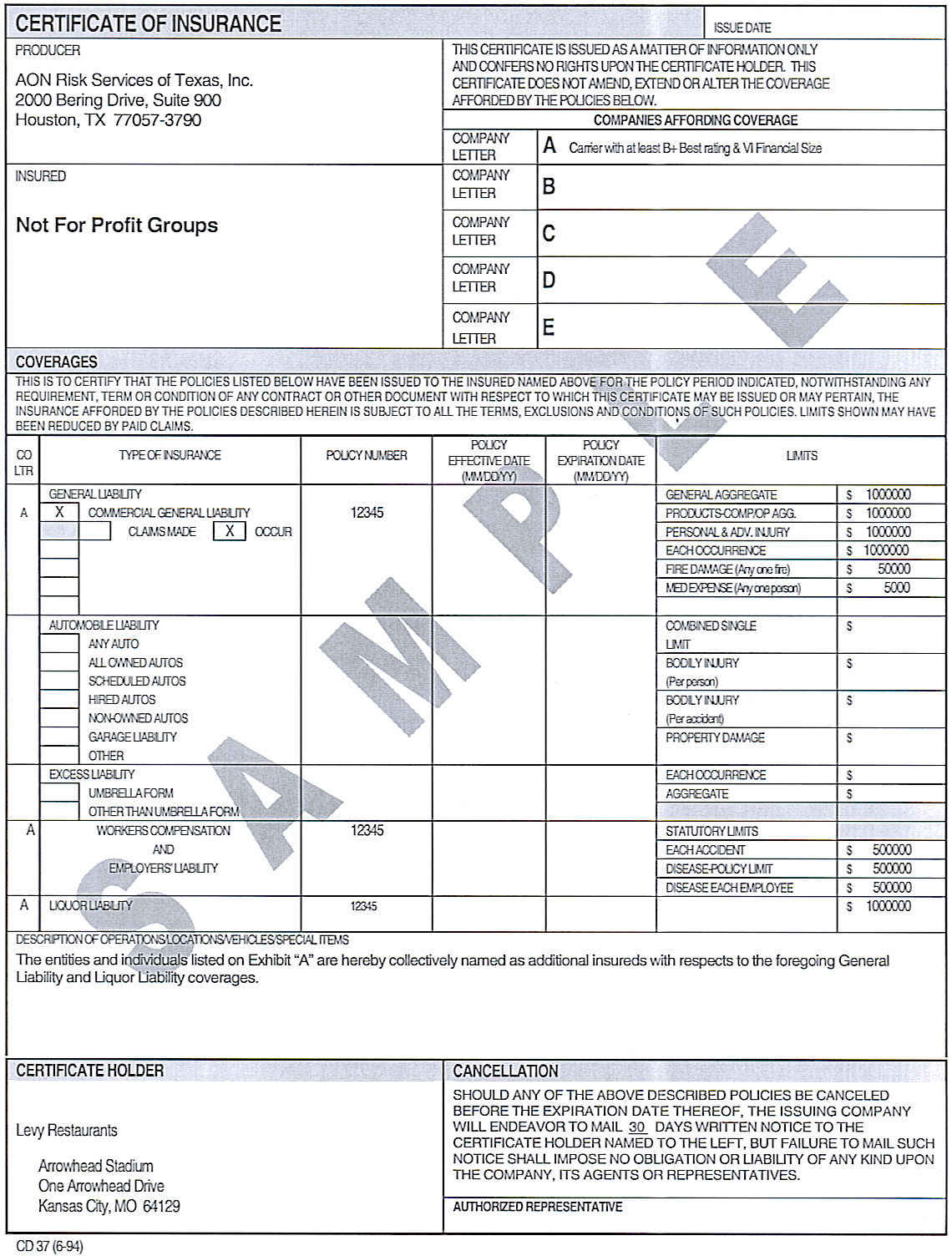
An ACORD certificate of insurance for Workers' Compensation—most commonly rendered on the ACORD 25 (Certificate of Liability Insurance) form—is a standardized summary document issued by a licensed insurance broker or carrier. It provides written evidence that a business maintains active Workers' Compensation and Employers' Liability coverage, outlining policy numbers, effective dates, coverage limits, and certificate holder details.
Legal Disclaimer: Insurance regulations and workers' compensation enforcement vary significantly across state jurisdictions. This guide provides general commercial insurance education. For legal compliance, policy drafting, or dispute resolution, consult a qualified commercial insurance broker or legal counsel licensed in your state.
What Is an ACORD Certificate of Insurance for Workers' Compensation?
An ACORD certificate of insurance (COI) is an industry-standard informational document developed by the Association for Cooperative Operations Research and Development (ACORD). ACORD is a non-profit insurance industry organization that creates standardized forms to streamline reporting and verification across insurers, brokers, and insured businesses.
While commercial insurance policies themselves are multi-page legal contracts containing detailed schedules, endorsements, conditions, and exclusions, an ACORD certificate serves as a concise, one- to two-page snapshot. It allows third parties—such as general contractors, commercial landlords, government bodies, or project owners—to verify that a vendor or contractor carries mandatory workers' compensation insurance before allowing work to begin on a site.
- ACORD 25 FORM (Standard Certificate of Liability Insurance)
- General Liability / Automobile / Umbrella
- Workers' Compensation & Employers' Liability
- Statutory Limits
- EL Limits
- Officer Status
Certificate of Insurance vs. Actual Insurance Policy
It is crucial to understand that an ACORD certificate is not an insurance policy and does not confer legal coverage rights to the certificate holder. The standard text at the top of the ACORD 25 explicitly states that the certificate is issued as a matter of information only and confers no rights upon the certificate holder. It does not affirmatively or negatively amend, extend, or alter the coverage afforded by the policies listed.
If a conflict arises between the text on an ACORD 25 certificate and the actual workers' compensation policy contract issued by the insurer, the terms of the policy contract always prevail.
Key Sections and Fields on the ACORD 25 for Workers' Compensation
To properly evaluate risk, contract compliance, and regulatory adherence, risk managers and business owners must know how to read the specific fields dedicated to Workers' Compensation on the ACORD 25 form.
| Section | Details / Provisions |
|---|---|
| WORKERS COMPENSATION AND EMPLOYERS' LIABILITY | ANY PROPRIETOR/PARTNER/EXECUTIVE OFFICER/MEMBER EXCLUDED? (Mandatory in NH)[ ] YES [ ] NO [ ] N/A (If yes, describe under SPECIAL PROVISIONS below) |
| SPECIAL PROVISIONS / DESCRIPTION OF OPERATIONS / VEHICLES / EXCLUSIONS / WAIVERS | Statutory Workers' Compensation Limits Apply. Employers' Liability Limits:E.L. EACH ACCIDENT: $1,000,000E.L. DISEASE - POLICY LIMIT: $1,000,000E.L. DISEASE - EACH EMPLOYEE: $1,000,000Waiver of Subrogation applies in favor of Certificate Holder where required by written contract. |
1. Producer and Insured Information
- Producer: The licensed insurance agency or broker issuing the certificate. This block includes the agent's name, address, contact phone number, and email address.
- Insured: The legal business name and primary mailing address of the contractor or business being certified. The legal name must match corporate registration documents exactly (including legal identifiers like "LLC" or "Inc.").
2. Insurers Affording Coverage
The top-right box lists insurance companies with corresponding letter codes (Insurer A, Insurer B, Insurer C, etc.) along with their NAIC (National Association of Insurance Commissioners) number. The NAIC number allows you to verify that the insurance company is authorized and solvent within your jurisdiction.
3. Workers' Compensation and Employers' Liability Grid
The lower portion of the ACORD 25 grid specifically addresses Workers' Compensation. Key fields include:
- INSR LTR (Insurer Letter): Maps back to the carrier listed in the Insurers Affording Coverage section.
- ADDL INSR (Additional Insured): Generally unchecked for Workers' Compensation (see explanation below regarding structural legal limits).
- SUBR WVD (Subrogation Waived): A checkbox marked "Y" if the insurer has issued a formal Waiver of Subrogation endorsement in favor of the certificate holder.
- Policy Number: The unique policy tracking identifier issued by the carrier.
- Policy Effective Date (MM/DD/YYYY): The start date of coverage.
- Policy Expiration Date (MM/DD/YYYY): The date coverage terminates.
- Statutory Limits Checkbox (PER STR / OTH):
- Per Statute (PER STR): Checked when the policy provides statutory benefits required by state law (which typically provides unlimited coverage for reasonable and necessary medical care and state-mandated wage reimbursement).
- Other (OTH): Checked when special statutory circumstances apply or when coverage operates under federal jurisdiction (e.g., Longshore and Harbor Workers' Compensation Act or Jones Act).
4. Employers' Liability (EL) Limits
While Workers' Compensation covers statutory benefits for injured workers, Employers' Liability (Part Two of a standard workers' compensation policy) protects the employer against common-law lawsuits brought by employees for work-related injuries not fully covered by statutory provisions. The standard policy limits displayed on the ACORD 25 include:
- E.L. EACH ACCIDENT: Maximum limit paid for bodily injury by accident for any single accident. Standard baseline limit is $100,000 or $500,000, though commercial contracts frequently mandate $1,000,000.
- E.L. DISEASE - POLICY LIMIT: Aggregate limit paid for bodily injury by disease across all claims during the policy period. Typically $500,000 or $1,000,000.
- E.L. DISEASE - EACH EMPLOYEE: Maximum limit paid for bodily injury by disease to any individual employee. Typically $100,000, $500,000, or $1,000,000.
5. Officer, Partner, and Member Exclusions (Y/N Box)
A critical feature of the ACORD 25 form is the field marked:
"ANY PROPRIETOR/PARTNER/EXECUTIVE OFFICER/MEMBER EXCLUDED? (Mandatory in NH)"
Because sole proprietors, partners, corporate officers, and LLC members are often permitted by state law to opt out of workers' compensation coverage to reduce costs, this box must be marked "Yes" or "No". If officers are excluded, their names or positions must be detailed in the Description of Operations section.
If a sole proprietor or working officer is excluded from their policy and suffers an injury on your job site, they are not covered under their own policy—exposing general contractors and project owners to secondary liability and premium audit penalties.
6. Certificate Holder and Cancellation Notice
- Certificate Holder: Displays the legal entity requesting proof of insurance.
- Cancellation Provision: Specifies that if the policy is canceled before the expiration date, notice will be delivered in accordance with policy terms. Standard administrative provisions generally provide 30 days' advance notice (or 10 days for non-payment of premium), provided a direct cancellation endorsement is attached to the policy.
State-Specific Certificate Variations and Exceptions
While the ACORD 25 form is accepted across most commercial settings, multiple state-level regulations restrict or completely prohibit its use as proof of Workers' Compensation compliance.
- WORKERS' COMP CERTIFICATE PATHWAYS
- STANDARD COMMERCIAL JURIS.
- Standard ACORD 25 Accepted
- Private Market Issuance
- Multi-State Endorsements
- SPECIALTY / MONOPOLISTIC
- Monopolistic State Funds
- NY C-105.2 / DB-120.1
- Mandatory State Exemption
- STANDARD COMMERCIAL JURIS.
1. Monopolistic State Insurance Funds
In four US states—Ohio, Washington, North Dakota, and Wyoming—employers are required by law to obtain Workers' Compensation coverage directly through state-administered monopolistic insurance funds rather than private commercial insurers.
- In these monopolistic jurisdictions, standard private insurers cannot write statutory Workers' Compensation insurance.
- Proof of coverage is provided via official state fund certificates issued directly by state agencies (such as the Ohio Bureau of Workers' Compensation or the Washington State Department of Labor & Industries), rather than an ACORD 25 form.
- Stop Gap Employers' Liability coverage in monopolistic states is often added via endorsement to the business's General Liability policy and noted separately on an ACORD 25.
2. New York State Mandates (Form C-105.2 and U-26.3)
Under Section 57 of the New York Workers' Compensation Law, state agencies, local municipalities, and building departments cannot accept the ACORD 25 form as proof of workers' compensation compliance for permit issuance or public licensing.
New York law requires one of the following official state forms issued directly by the insurer or authorized state board:
- Form C-105.2: Certificate of Workers' Compensation Insurance (issued by private insurance carriers).
- Form U-26.3: Certificate of Workers' Compensation Insurance issued by the New York State Insurance Fund (NYSIF).
- Form CE-200: Certificate of Attestation of Exemption from NYS Workers' Compensation and/or Disability Benefits.
- Form DB-120.1: Certificate of Disability Benefits Insurance.
Risk managers doing business in New York must request these exact forms directly from vendors; accepting a standard ACORD 25 for municipal work in NY creates legal non-compliance risks.
Key Endorsements: Waiver of Subrogation and Additional Insured Realities
Understanding how endorsements interact with an ACORD Workers' Compensation certificate prevents critical gaps in legal protection.
Can You Add an "Additional Insured" to Workers' Compensation?
A widespread compliance error among project managers is requiring subcontractors to add the General Contractor or Project Owner as an "Additional Insured" on a Workers' Compensation policy.
- Fact: Standard Workers' Compensation policies do not permit Additional Insured endorsements.
- Reasoning: Workers' Compensation covers statutory benefits exclusively for the named employer’s legal employees. An external third party cannot be added as an insured party to receive employee statutory benefits.
- Alternative: When commercial contracts require indemnification or liability protection, project owners must instead request a Waiver of Subrogation or an Alternate Employer Endorsement.
Waiver of Subrogation (Form WC 00 03 13)
Subrogation is the legal right of an insurance carrier to sue a negligent third party to recover claim payments made to an injured worker.
When an insurer issues a Waiver of Subrogation endorsement (such as National Council on Compensation Insurance form NCCI WC 00 03 13):
- The insurer agrees not to pursue recovery against the specified certificate holder (e.g., the general contractor) if a worker is injured on the job due to partial third-party negligence.
- The ACORD 25 form records this endorsement by placing a "Y" in the
SUBR WVDcolumn next to Workers' Compensation and documenting the endorsement details in the Description of Operations box.
Alternate Employer Endorsement (Form WC 00 03 01 A)
Used frequently in temporary staffing or joint-venture setups, the Alternate Employer Endorsement extends workers' compensation protection to a secondary business (the temporary client) as if they were the primary employer, preventing direct injury lawsuits against the client while maintaining sole policy administration under the staffing firm.
Comparison Table: Certificates and Forms by Risk Profile
The table below outlines key distinctions between standard certificates, state-specific forms, and specialized endorsements.
| Form / Certificate Type | Primary Issuer | Target Use Case | Accepts ACORD 25? | Key Coverage / Statutory Feature |
|---|---|---|---|---|
| ACORD 25 | Licensed Insurance Broker / Agent | General Commercial Projects, Vendor Verification | N/A (Standard Form) | Snapshot of GL, Auto, Umbrella, and Statutory Workers' Comp. |
| Monopolistic State Certs | State Bureau (OH, WA, ND, WY) | Operations within Monopolistic States | No (For WC Statutory portion) | Issued directly by state funds; private carriers cannot issue statutory WC. |
| NYS Form C-105.2 | Private Insurance Carrier | New York State Building Permits & Govt Contracts | No (ACORD 25 prohibited by NY Section 57) | Official proof of compliance under NY Workers' Comp Law. |
| NYS Form U-26.3 | New York State Insurance Fund (NYSIF) | Entities insured via NYSIF | No | Specific to state fund policyholders in New York. |
| Form CE-200 | NYS Workers' Comp Board | Sole Proprietors / Out-of-State Exempt Business | No | Legal attestation that business is legally exempt from NY WC laws. |
| Waiver of Subrogation (WC 00 03 13) | Carrier via Endorsement | High-risk Construction / Subcontracting | Documented on ACORD 25 | Prevents insurer from seeking reimbursement from Certificate Holder. |
Step-by-Step Guide: Requesting, Reviewing, and Verifying an ACORD COI
To prevent premium audit penalties, costly lawsuits, and unverified contractor exposure, risk managers must follow a systematic process when collecting ACORD certificates.
COI VERIFICATION WORKFLOW
- REQUEST: Broker issues ACORD 25 directly to Certificate Holder
- AUDIT FIELDS: Verify Legal Name, Expiration Dates, Statutory Checkboxes
- CHECK EXCLUSIONS: Confirm Executive Officers / Sole Proprietors are INCLUDED
- CARRIER VERIFY: Cross-reference Policy Number & Status via NCCI or State Board
- ARCHIVE & TRACK: Log Policy Expiration Date; set automatic 30-day renewal alert
Step 1: Issue Detailed Written Contract Requirements
Before work commences, send clear insurance specifications to your vendor or subcontractor. Specify:
- Statutory Workers' Compensation limits ("Per Statute").
- Minimum Employers' Liability limits (e.g., $1,000,000 / $1,000,000 / $1,000,000).
- Requirement for a Waiver of Subrogation in favor of your legal entity.
- Requirement that all officers, partners, and owners actively working on-site be included under coverage.
Step 2: Receive Certificate Directly from the Agent
Always request that the ACORD 25 form be transmitted directly from the contractor's licensed insurance broker or carrier. Never accept hand-edited or self-submitted PDF certificates directly from an unverified vendor without independent validation, as fraudulent certificate modification remains a common compliance breakdown.
Step 3: Perform Line-by-Line Audit of the Certificate
Review the incoming ACORD 25 against these criteria:
- Legal Entity Name: Confirm the exact legal entity name matches the contract.
- Effective Dates: Ensure the policy effective date is current and covers the entire anticipated project timeline.
- Statutory Checkbox: Verify the
PER STR(Per Statute) box is checked. - Employers' Liability Limits: Confirm the limits equal or exceed contractual thresholds.
- Exclusions Box: Check whether officers/members are excluded. If an officer is excluded and active on-site, require an endorsement bringing them under coverage or request a secondary policy.
- Certificate Holder Box: Confirm your company's full legal name and primary business address are accurately printed in the lower-left box.
Step 4: Verify Policy Active Status with Rating Bureaus
Do not rely solely on the physical document. Verify policy active status directly:
- Use state regulatory databases or rating bureau lookup engines such as the National Council on Compensation Insurance (NCCI) Proof of Coverage database or state-specific portals like the New York State Workers' Compensation Board online verification tool.
- Cross-reference the policy number listed on the ACORD 25 with the carrier’s active status in the database.
Step 5: Implement Expiration Tracking
Record the expiration dates in a centralized risk management tracking program. Automate renewal requests 30 days prior to policy expiration to prevent compliance gaps during ongoing project lifecycles.
Common Pitfalls, Red Flags, and Legal Liabilities
Failure to properly scrutinize an ACORD certificate for Workers' Compensation exposes businesses to substantial legal and financial damage.
1. The Excluded Sole Proprietor Risk
In many jurisdictions, sole proprietors and single-member LLCs are automatically excluded from Workers' Compensation coverage unless they file an explicit election form to include themselves.
- The Trap: A general contractor hires an independent subcontractor who provides an ACORD 25 showing an active policy. However, the owner is the sole worker on-site, and the
EXCLUDEDbox is checked "Yes". - The Outcome: If that owner is injured on-site, their insurance policy will deny the claim. State workers' compensation boards will routinely reclassify the owner as a statutory employee of the general contractor—forcing the general contractor's insurance policy to pay medical and indemnity claims, followed by severe audit penalties.
2. Unauthorized Alterations of Limits
Because ACORD forms are distributed in fillable PDF formats, unscrupulous vendors occasionally edit policy limits, effective dates, or policy numbers using desktop software.
- Red Flag: Misaligned fonts, blurry corporate logos, missing NAIC codes, or certificate dates that precede the policy effective date.
- Prevention: Always verify certificate validity directly with the issuing broker or through official state proof-of-coverage databases.
3. Relying on General Liability for Worker Injuries
General Liability (GL) policies systematically exclude coverage for bodily injury to employees arising out of and in the course of employment. Relying on a vendor's ACORD certificate showing high General Liability limits without confirming statutory Workers' Compensation creates an absolute coverage void for workplace injuries.
Frequently Asked Questions
Is an ACORD 25 certificate of insurance proof of an active policy?
An ACORD 25 is an informational summary, not conclusive legal proof of active coverage. Policies can be canceled for non-payment or underwriting changes shortly after a certificate is issued. To confirm an active policy, cross-reference the policy details on state rating bureau databases (such as NCCI) or contact the issuing broker directly.
Can an ACORD certificate grant Additional Insured status for Workers' Compensation?
No. Workers' Compensation policies do not permit Additional Insured endorsements because benefits are governed strictly by state labor statutes for an employer's direct staff. To obtain legal protection against subrogation claims, business entities should request a Waiver of Subrogation endorsement instead.
What does "WC Statutory Limits" mean on an ACORD form?
When "PER STR" (Per Statute) is checked on an ACORD 25 form, it means the policy provides full medical, disability, and vocational rehabilitation benefits as mandated by the workers' compensation laws of the state(s) listed in the policy. Statutory medical benefits under Part One of the policy typically have no dollar cap.
Why will a government agency reject my ACORD 25 form for Workers' Compensation?
Certain states—most notably New York—prohibit municipal building departments and government agencies from accepting ACORD 25 forms for permits or public licensing. State laws often mandate official state agency forms (such as NY Form C-105.2, NYSIF Form U-26.3, or Exemption Form CE-200) to ensure direct carrier notification of cancellations.
Who is authorized to issue an ACORD Workers' Compensation certificate?
Only a licensed commercial insurance agent, broker, or authorized representative of the insurance carrier has legal authorization to complete and issue an ACORD certificate. Policyholders cannot create, modify, or issue ACORD certificates for their own businesses.
How much does it cost to get an ACORD certificate of insurance for Workers' Compensation?
Licensed insurance brokers routinely issue ACORD certificates to policyholders free of charge. However, if a client or commercial contract requires specific policy endorsements—such as a Waiver of Subrogation or higher Employers' Liability limits—the insurance carrier may charge an additional premium fee to add those endorsements to the policy.
Practical Action Plan for Compliance Risk Managers
To protect your organization against non-compliance penalties, premium audit back-charges, and third-party injury liabilities:
- Standardize Contract Language: Mandate statutory Workers' Compensation, minimum $1,000,000 Employers' Liability limits, and a Waiver of Subrogation on all vendor contracts.
- Audit the ACORD 25 Box by Box: Inspect the Insurer NAIC code, the statutory limits checkbox, and specifically ensure executive officers and working owners are not excluded.
- Reject ACORD Forms Where Prohibited: Demand state-specific forms (e.g., NY Form C-105.2) or state fund documents when operating in restricted state jurisdictions or monopolistic states (OH, WA, ND, WY).
- Enforce Direct Transmission: Establish a strict policy of accepting certificates sent directly from licensed insurance agents or verifying policies online through regulatory proof-of-coverage tools.
EDITORIAL CATEGORY METADATA:
TOPIC METADATA: