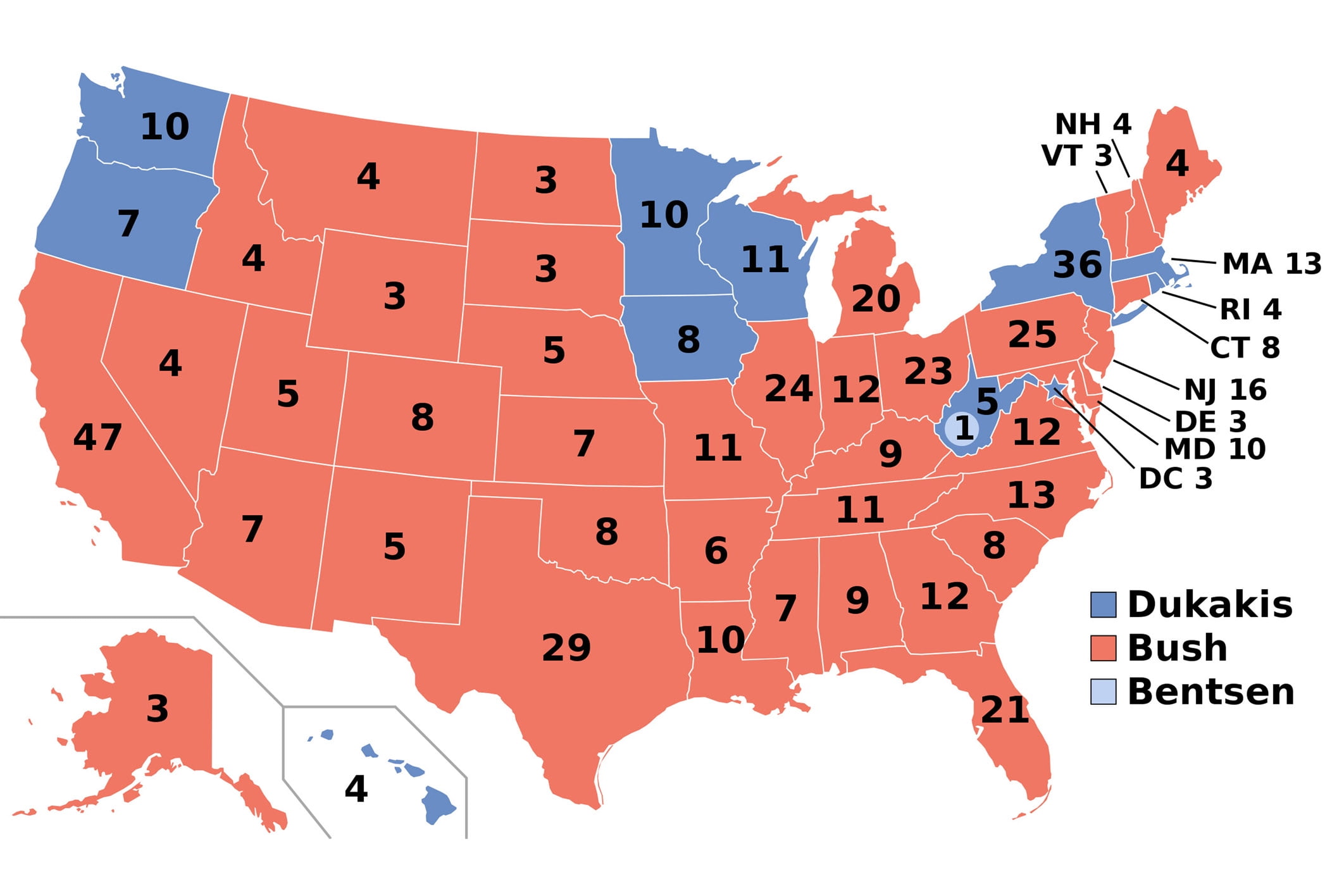
The 1988 presidential election resulted in a decisive victory for Republican George H.W. Bush, who defeated Democrat Michael Dukakis by capturing 426 electoral votes to 111. Beyond the numbers, this election fundamentally transformed American political campaigning by institutionalizing high-stakes negative advertising and reshaping the electoral map for decades to come.
The 1988 contest remains a watershed moment in American history. It served as the final confirmation of the "Reagan Revolution" while simultaneously planting the seeds for the hyper-partisan, media-saturated political environment that defines the landscape in 2026. To understand the current state of American governance, one must analyze how the strategies, mistakes, and policy shifts of 1988 created a blueprint for modern executive power and campaign warfare.
Detailed Breakdown of the 1988 Election Results
The 1988 election was, in many ways, a referendum on the preceding eight years of the Reagan administration. Vice President George H.W. Bush ran essentially as a "third term" for Ronald Reagan, promising a "kinder, gentler nation" while maintaining the core tenets of Reaganomics and a strong national defense.
Michael Dukakis, the Governor of Massachusetts, initially held a double-digit lead in the polls following the Democratic National Convention. However, the Republican apparatus, led by strategist Lee Atwater, executed a surgical strike on Dukakis’s record that eroded his lead by November.
The Electoral College and Popular Vote
The final tally reflected a country that was not yet as deeply divided as it is today, but was beginning to show the first signs of regional realignment.
| Category | George H.W. Bush (Republican) | Michael Dukakis (Democrat) |
|---|---|---|
| Electoral Votes | 426 | 111 |
| Popular Vote | 48,886,097 (53.4%) | 41,809,074 (45.6%) |
| States Carried | 40 | 10 + D.C. |
| Key States Won | CA, TX, FL, IL, PA, OH | NY, MA, RI, MN, WI |
The National Archives records show that Bush's victory was broad-based, winning states that are now considered "Deep Blue," such as California, Illinois, and New Jersey. This underscores how much the American electoral map has hardened in the intervening decades. Dukakis managed to hold onto traditional Democratic strongholds in the Northeast and parts of the Upper Midwest, but failed to make inroads into the "Sun Belt," which was then rapidly becoming a Republican fortress.
The Atwater Revolution: The Birth of Modern Negative Campaigning
The most significant lasting impact of the 1988 election was the professionalization of the "attack ad." While negative campaigning had existed since the dawn of the Republic, the Bush campaign’s use of the "Willie Horton" ad and the "Tank" ad set a new standard for efficiency and ruthlessness.
The Willie Horton Ad and Racial Coding
The Willie Horton advertisement, technically produced by a political action committee (National Security PAC) but closely associated with the Bush campaign’s messaging, focused on a weekend furlough program in Massachusetts. Horton, a convicted murderer, committed a violent assault while on furlough.
The ad was devastatingly effective because it framed Dukakis as "soft on crime," a label that would haunt the Democratic Party for the next two decades. This tactic established a blueprint for using specific, emotionally charged criminal justice issues to appeal to "suburban" and "Reagan Democrat" voters. In the years that followed, this led to a bipartisan "tough on crime" arms race, culminating in the 1994 Crime Bill.
The "Tank" Ad and Visual Messaging
The Bush campaign also capitalized on a massive visual blunder by the Dukakis team. Attempting to project strength on national defense, Dukakis rode in an M1 Abrams tank wearing a helmet that appeared oversized and awkward. The Bush campaign quickly cut an ad featuring the footage, accompanied by a list of Dukakis's perceived weaknesses in military policy.
This taught future campaigns a vital lesson: in the television and digital age, the visual image often overrides the policy argument. From 1988 onward, every presidential candidate’s movements have been meticulously choreographed to avoid "tank moments."
The "No New Taxes" Pledge and Fiscal Orthodoxy
During the 1988 Republican National Convention, George H.W. Bush uttered what would become the most famous—and eventually most politically damaging—line of the campaign: "Read my lips: no new taxes."
Establishing the Conservative Litmus Test
This pledge was designed to appease the conservative wing of the GOP, which was skeptical of Bush’s "Eastern Establishment" roots. By making this promise, Bush cemented tax opposition as the primary litmus test for Republican identity.
However, the lasting impact was the eventual fallout. In 1990, facing a massive budget deficit and a Democrat-controlled Congress, Bush agreed to a budget deal that included tax increases. This "betrayal" of the 1988 pledge led to a primary challenge from Pat Buchanan in 1992 and alienated a significant portion of the base, contributing to his eventual defeat by Bill Clinton.
For modern politics, the 1988 pledge created the era of "The Pledge" (such as the Americans for Tax Reform pledge), where candidates are often forced into rigid fiscal positions years before they take office, limiting their ability to navigate economic crises with flexibility.
The Transformation of the Democratic Party: Learning from 1988
The scale of the 1988 defeat forced the Democratic Party into a period of deep soul-searching. Michael Dukakis was seen as a technocrat who failed to connect emotionally with voters and failed to respond quickly to Republican attacks.
The Rise of the "New Democrats"
Following 1988, the Democratic Leadership Council (DLC) gained significant influence. Figures like Bill Clinton and Al Gore argued that for Democrats to win again, they had to move to the center on issues like crime, welfare, and defense. This shift—essentially a direct response to the 1988 results—led to the "New Democrat" movement.
The 1992 Clinton campaign’s "War Room" was a direct structural response to the Bush campaign of 1988. The mantra "The war room" and the philosophy of "no attack goes unanswered" were born from the realization that Dukakis’s silence in the face of the Willie Horton and Tank ads had been fatal. This rapid-response culture is now a standard feature of every political organization in 2026.
Geopolitical Shifts: From Cold War to New World Order
The 1988 election occurred during a period of monumental global change. George H.W. Bush was perhaps the best-prepared candidate in history for foreign policy, having served as CIA Director and Ambassador to the United Nations.
Managing the End of the Cold War
The 1988 results ensured that the transition from a bipolar world (US vs. USSR) to a unipolar one was managed by a traditionalist internationalist. Bush’s victory meant that the U.S. response to the fall of the Berlin Wall (1989) and the dissolution of the Soviet Union (1991) was characterized by "prudent" diplomacy rather than triumphalism.
This had a lasting impact on American foreign policy, establishing a "New World Order" based on international coalitions. This doctrine was successfully tested in the 1991 Gulf War, but the reliance on these international structures would later become a point of contention within the Republican Party, leading to the rise of the isolationist "America First" movements seen in the early 21st century.
The Changing Electoral Map: 1988 vs. Today
One of the most fascinating aspects of the 1988 results is how they illustrate the total transformation of American regional politics. In 1988, many states that are now reliably "Blue" or "Red" were the opposite.
- California: Bush won California by over 350,000 votes. Today, California is the cornerstone of the Democratic electoral strategy.
- Vermont: A state that now elects socialist-leaning independents like Bernie Sanders was won by Bush in 1988.
- The South: While Bush won the South, it was still a region with many Democratic governors and congressmen. The 1988 election accelerated the "Solid South" becoming Republican at the presidential level, which eventually trickled down to state legislatures by the early 2000s.
This shift underscores the "Great Sort" of the American electorate. The 1988 election was one of the last where a candidate could win a broad national mandate across vastly different geographic and cultural regions.
The Bork Effect and the Judicial Wars
While the Robert Bork Supreme Court nomination occurred in 1987, it was a central theme of the 1988 campaign season. The rejection of Bork by the Senate led to the term "Borking"—the systematic political attack on a judicial nominee’s character and philosophy.
Bush’s subsequent appointments, specifically Clarence Thomas in 1991, were shaped by the scorched-earth tactics developed during and immediately after the 1988 campaign. This era marked the end of the "consensus" judicial appointment process and the beginning of the Supreme Court becoming a primary motivator for base voters on both sides—a trend that has only intensified by 2026.
FAQs: Understanding the 1988 Election Impact
Why did Michael Dukakis lose despite having a large early lead?
Dukakis’s loss is attributed to several factors: his failure to respond to negative advertising, a perceived lack of charisma or "warmth," and his focus on "competence" rather than "ideology." The Bush campaign successfully painted him as an out-of-touch liberal from the "Bolshevik Republic of Massachusetts," a label he did not effectively counter until it was too late.
How did the 1988 election change political ads?
Before 1988, ads were often more positive or focused on broad policy themes. 1988 introduced the "wedge issue" ad—taking a specific, often controversial, local issue (like the Massachusetts furlough program) and using it as a symbol for a candidate’s entire worldview. This led to the modern era of high-frequency, high-impact negative spots.
What was the "New World Order" mentioned by Bush?
Following his 1988 victory, Bush used this term to describe a post-Cold War world where the United Nations and international law would play a larger role in settling disputes, backed by American leadership. This was a shift from the more unilateral rhetoric of the early Reagan years and defined U.S. foreign policy until the post-9/11 era.
Was the 1988 election the last "landslide" in U.S. history?
While 1988 was a significant victory, 1984 (Reagan) was a larger landslide. However, 1988 is often considered the last time a candidate won 40 or more states. Since then, the country has become more evenly divided, and electoral victories have become much narrower in terms of state counts.
How did the 1988 election influence the 1992 election?
The 1988 election directly led to the 1992 result in two ways. First, Bush’s "no new taxes" pledge became a liability when he eventually raised taxes, opening the door for Ross Perot and Bill Clinton. Second, the Democratic Party's "New Democrat" strategy was specifically designed to avoid the "Dukakis trap" by being more aggressive and centrist.
Expert Guidance: Lessons for Future Political Analysis
When analyzing the 1988 election from the perspective of 2026, it is essential to view it not just as a historical event, but as the "Year Zero" of the current political era. The tactical innovations of the Bush campaign—opposition research, rapid response, and the use of cultural wedge issues—are now the baseline for any campaign.
For students of politics and voters alike, the primary takeaway is the importance of narrative over data. Michael Dukakis ran a campaign based on the "competent management" of government, while George H.W. Bush ran a campaign based on "values" and "national identity." In the American system, identity and values almost always defeat technical competence in the court of public opinion.
Final Recommendation: To truly understand the lasting impact of 1988, one should study the transition of the Republican Party from the internationalist "Bush-Baker" wing to the more populist movements of the 21st century. The 1988 election was the high-water mark for the traditional GOP establishment, and its subsequent struggles to maintain the "Reagan Coalition" explain much of the volatility in modern American governance.