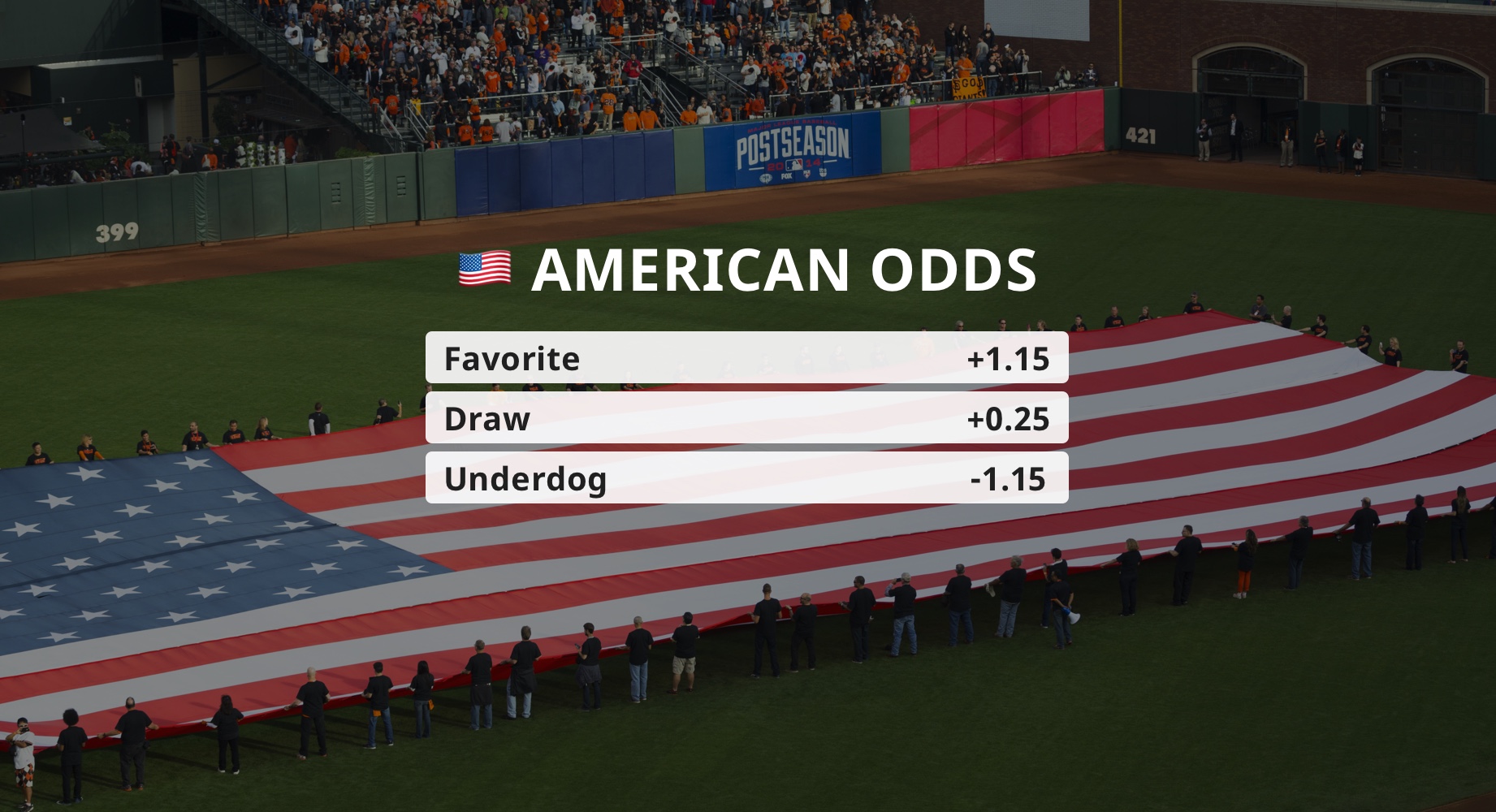
American betting odds, also known as Moneyline odds, are centered around a $100 baseline to indicate how much a bettor must risk to win $100 or how much a $100 bet will pay out in profit. Positive numbers (+) represent underdogs, while negative numbers (-) represent the favorites.
Understanding how to read and calculate American betting odds is the fundamental first step for any sports bettor in North America. While international markets often prefer decimal or fractional formats, the American system is the standard for the NFL, NBA, MLB, and NHL. In 2026, as legal sports wagering continues to expand across jurisdictions, mastering this specific numerical language is essential for evaluating risk, calculating potential returns, and identifying value in a competitive market.
The Core Logic of American Odds
The American odds system is unique because it uses a fixed pivot point of $100 to describe the relationship between the stake and the profit. It does not mean you are required to bet exactly $100; rather, the $100 figure serves as a mathematical ratio. This system allows bettors to quickly identify which side the sportsbook considers the "favorite" (expected to win) and which side is the "underdog" (expected to lose).
The most important distinction in American odds is the prefix: the plus (+) or minus (-) sign. These symbols change the entire direction of the calculation. Without understanding this distinction, a bettor cannot accurately assess their potential payout or the level of risk they are assuming.
Decoding the Symbols: Plus (+) vs. Minus (-)
To navigate a sportsbook interface in 2026, you must immediately recognize what the plus and minus signs signify. They act as a shorthand for the cost of the bet relative to the reward.
The Favorites: The Minus (-) Sign
When you see a minus sign preceding a number, such as -150 or -240, you are looking at the favorite. The number tells you exactly how much money you must wager in order to make a $100 profit.
For example, if a team is listed at -150, you must bet $150 to win $100. If your bet is successful, the sportsbook returns your $150 stake plus your $100 profit, totaling $250. Negative odds signify that the event is more likely to happen, according to the bookmaker, and therefore the "cost" of winning is higher than the reward.
The Underdogs: The Plus (+) Sign
A plus sign, such as +120 or +300, indicates the underdog. In this scenario, the number represents the profit you will make on a $100 wager.
If you bet $100 on an underdog at +150, a winning bet would net you $150 in profit. Your total payout would be $250 (your $100 original stake returned plus the $150 profit). Positive odds reflect an outcome that the bookmaker deems less likely to occur, offering a higher reward for the increased risk.
Step-by-Step Payout Calculations
While the $100 baseline is the standard for explanation, most bettors wager different amounts. Calculating payouts for odd totals requires two distinct formulas depending on whether the odds are positive or negative.
Calculating Profit for Negative Odds (Favorites)
To calculate your potential profit when betting on a favorite, use the following formula: Profit = (Stake / |Odds|) × 100
Suppose you want to wager $50 on a favorite with odds of -200.
- Take your stake ($50).
- Divide it by the absolute value of the odds (200).
- Multiply by 100.
- $50 / 200 = 0.25.
- 0.25 × 100 = $25. Your profit on a $50 bet at -200 is $25, for a total return of $75.
Calculating Profit for Positive Odds (Underdogs)
To calculate your profit when betting on an underdog, use this formula: Profit = Stake × (Odds / 100)
Suppose you want to wager $50 on an underdog with odds of +160.
- Take your stake ($50).
- Divide the odds by 100 (160 / 100 = 1.6).
- Multiply your stake by that result.
- $50 × 1.6 = $80. Your profit on a $50 bet at +160 is $80, for a total return of $130.
The Role of Implied Probability
One of the most critical aspects of professional sports betting is converting odds into implied probability. Implied probability is the likelihood of an outcome occurring as suggested by the odds. By converting American odds into a percentage, a bettor can decide if the "true" chance of an event happening is higher than what the bookmaker suggests. If the bettor believes the probability is higher, they have found "value."
Formulas for Implied Probability
For negative odds (favorites): Probability = |Odds| / (|Odds| + 100)
For positive odds (underdogs): Probability = 100 / (Odds + 100)
For example, if a team has odds of -150: 150 / (150 + 100) = 150 / 250 = 0.60 or 60%.
If a team has odds of +150: 100 / (150 + 100) = 100 / 250 = 0.40 or 40%.
In an ideal world without a house edge, the implied probabilities of all outcomes in a game would add up to exactly 100%. However, in the real world, they always add up to more (e.g., 105%), which leads us to the concept of the "vig."
Understanding the "Vig" or Juice
The "vig" (short for vigorish) or "juice" is the commission the sportsbook charges for taking your bet. It is built directly into the American odds. This is why you will often see both sides of a balanced bet, such as a Point Spread, listed at -110 rather than even money (+100).
When both sides are -110, the implied probability for each side is 52.38%. Added together, they equal 104.76%. The extra 4.76% is the sportsbook's margin. This explains why a bettor must win approximately 52.4% of their bets at -110 odds just to break even over the long term. Understanding the vig is essential for bankroll management and long-term sustainability in sports betting.
Comparing Odds Formats
While American odds are dominant in the United States, you may encounter Decimal (common in Europe and Australia) or Fractional odds (common in the UK and horse racing). Knowing how to convert between them allows you to use international tools and resources.
| American Odds | Decimal Odds | Fractional Odds | Implied Probability |
|---|---|---|---|
| -400 | 1.25 | 1/4 | 80.0% |
| -200 | 1.50 | 1/2 | 66.7% |
| -110 | 1.91 | 10/11 | 52.4% |
| +100 (Even) | 2.00 | 1/1 | 50.0% |
| +150 | 2.50 | 3/2 | 40.0% |
| +200 | 3.00 | 2/1 | 33.3% |
| +500 | 6.00 | 5/1 | 16.7% |
Note: Decimal odds represent the total payout (stake + profit) for every $1 wagered, whereas American and Fractional odds primarily highlight the profit relative to the stake.
Practical Examples Across Major Sports
To see these numbers in action, consider how they appear on a standard 2026 sportsbook betting board.
NFL Moneyline Example
Imagine the Kansas City Chiefs are playing the Las Vegas Raiders. The odds might look like this:
- Chiefs: -220
- Raiders: +180
If you believe the Chiefs will win and wager $220, you would profit $100. If you believe the Raiders will pull off an upset and wager $100, you would profit $180.
MLB Moneyline Example
Baseball is almost exclusively a Moneyline sport. Because games are often lower scoring, the odds fluctuate frequently based on starting pitchers.
- New York Yankees: -115
- Boston Red Sox: -105
Here, both teams have negative signs. This occurs when a game is very close to a "Pick'em" (even odds). The Yankees are a slight favorite; you must bet $115 to win $100. The Red Sox are a very slight underdog, but because of the vig, they are also listed with a minus sign. You would need to bet $105 to win $100.
Common Mistakes to Avoid
Even experienced bettors can make errors when calculating or interpreting American odds. Avoiding these pitfalls is vital for preserving your bankroll.
- Confusing Odds with the Spread: American odds describe the payout for a straight win (Moneyline). The Point Spread describes the margin of victory. While both use American-style numbers (like -110) to show the payout, they are different types of bets.
- Ignoring the Minus Sign on Small Underdogs: As seen in the MLB example, sometimes "underdogs" have a minus sign if the game is nearly even. Always look at the specific number, not just the sign, to determine which team is the actual favorite.
- Chasing High Positive Odds: It is tempting to bet on a +5000 longshot because the payout is massive. However, the implied probability of a +5000 bet is only 1.96%. Without a statistical reason to believe the actual chance is higher, these bets are generally losing propositions in the long run.
- Miscalculating Total Return: Remember that your total return includes your original stake. If you win $100 on a $110 bet at -110, you receive $210 back. New bettors often forget to account for the return of the risk capital when calculating their net worth or daily P&L.
Expert Guidance for 2026
As of 2026, the landscape of sports betting involves highly sophisticated algorithms used by sportsbooks to set these odds. For the individual bettor, the best course of action is line shopping. Since different sportsbooks might list the same game with slightly different American odds (e.g., -110 at one book and -105 at another), consistently finding the best "price" is the most effective way to reduce the impact of the vig.
Disclaimer: Sports betting involves significant financial risk. Only wager money you can afford to lose. If you or someone you know has a gambling problem, please contact a national or local helpline, such as 1-800-GAMBLER, for support. Laws regarding sports betting vary by jurisdiction; ensure you are complying with local regulations.
Frequently Asked Questions
What does "Even Money" mean in American odds?
Even money is expressed as +100 or -100. It means that the potential profit is exactly equal to the amount wagered. If you bet $10, you win $10 profit (totaling $20 return). In many sportsbook displays, "Even" or "EV" will replace the numerical value.
Why do both teams sometimes have minus (-) odds?
This happens when the teams are very evenly matched. Because the sportsbook takes a commission (the vig), they might set both teams at -110 or -105. This ensures the bookmaker makes a profit regardless of which team wins, provided the betting volume is balanced on both sides.
How do I convert American odds to a percentage?
To convert positive odds, divide 100 by the odds plus 100 (100 / (Odds + 100)). To convert negative odds, divide the odds by the odds plus 100 (Odds / (Odds + 100)). Multiply the result by 100 to get the implied probability percentage.
What are "Pick'em" odds?
A "Pick'em" (often abbreviated as "pk") is a game where neither team is favored. The odds are usually -110 for both sides. In this scenario, you simply choose the winner of the game, and the point spread is zero.
Is it better to bet on favorites or underdogs?
Neither is inherently "better." Betting on favorites requires a higher win rate to be profitable because you are risking more than you win. Betting on underdogs allows for a lower win rate because the payouts are larger. The goal is to find "value," where the true probability of the outcome is higher than the implied probability of the odds.
Final Recommendation
To master American betting odds, stop thinking in terms of the total amount you want to win and start thinking in terms of percentages and value. Begin by practicing conversions to implied probability for every bet you consider. Use a calculator to ensure you understand the exact risk-to-reward ratio before placing a wager. Over time, your ability to read these numbers will become second nature, allowing you to focus on the more complex aspects of sports analysis.