The Emirates Airbus A380-800 fleet features four primary seating configurations: the Four-Class (with Premium Economy), the Three-Class Long-Haul, the Three-Class Ultra-Long-Haul, and the Two-Class layout. Most configurations feature First and Business Class on the upper deck, while Economy and Premium Economy occupy the main deck, offering a range of comfort levels and amenities.
Navigating the seat map of the world’s largest passenger aircraft requires an understanding of how Emirates utilizes the massive double-deck space of the Airbus A380-800. As of 2026, Emirates has completed a significant portion of its massive retrofit program, ensuring that a large percentage of its 116-strong A380 fleet features the highly sought-after Premium Economy cabin. Whether you are traveling for business or leisure, choosing the right seat involves balancing proximity to on-board lounges, galley noise, and the specific technical layout of the deck you are assigned to.
Understanding the Four Primary Emirates A380 Configurations
Emirates does not have a "one size fits all" layout for its A380-800s. The airline assigns specific tail numbers to different routes based on demand and flight duration. Identifying which seat map applies to your flight is the first step in ensuring a comfortable journey.
1. The Four-Class Ultra-Long-Haul (Retrofitted)
This is the modern flagship configuration. It features 14 First Class Private Suites, 76 Business Class seats, 56 Premium Economy seats, and 338 Economy Class seats. This layout is increasingly common on premium routes to London, New York, Sydney, and Paris. The introduction of Premium Economy changed the dynamics of the main deck, moving the front section from standard Economy to a more exclusive 2-4-2 setup.
2. The Three-Class Long-Haul
The traditional backbone of the fleet, this version lacks Premium Economy. It consists of 14 First Class Suites, 76 Business Class seats, and 399 to 427 Economy seats depending on the specific series. The upper deck remains exclusively for premium passengers, while the entire main deck is dedicated to Economy.
3. The Three-Class Ultra-Long-Haul (Non-Retrofitted)
Similar to the long-haul version but optimized for flights exceeding 12 hours. The seat counts are nearly identical, but the crew rest areas are positioned differently to accommodate the legal requirements for secondary flight crews on longer rotations.
4. The Two-Class Configuration
Designed for high-density, medium-haul routes (such as regional Middle East or specific European destinations), this layout removes First Class entirely. The upper deck is shared between Business Class and a section of Economy, while the main deck remains entirely Economy. This version can carry over 600 passengers.
The Upper Deck: First Class and Business Class Dynamics
The upper deck of the Emirates A380-800 is legendary for its luxury. In almost all premium configurations, the upper deck is accessed via the grand staircase at the front (First Class) or the rear staircase (Lounge/Business Class).
First Class Private Suites (Rows 1-4)
Emirates offers 14 Private Suites in a 1-2-1 configuration. These suites feature floor-to-ceiling sliding doors, a personal mini-bar, and a vanity table.
- The Seat: A fully flat bed with a length of 78 inches.
- The Shower Spa: Located at the very front of the upper deck, two Shower Spas are available for First Class passengers. When selecting a seat, rows 1 and 2 offer the fastest access to the spas, but they are also closer to the front galley where crew activity is highest.
- Best Seats: Seats 2A and 2K are widely considered the "sweet spots" as they are far enough from the front lavatories and the mid-cabin galley to minimize light and noise pollution.
Business Class (Rows 7-26)
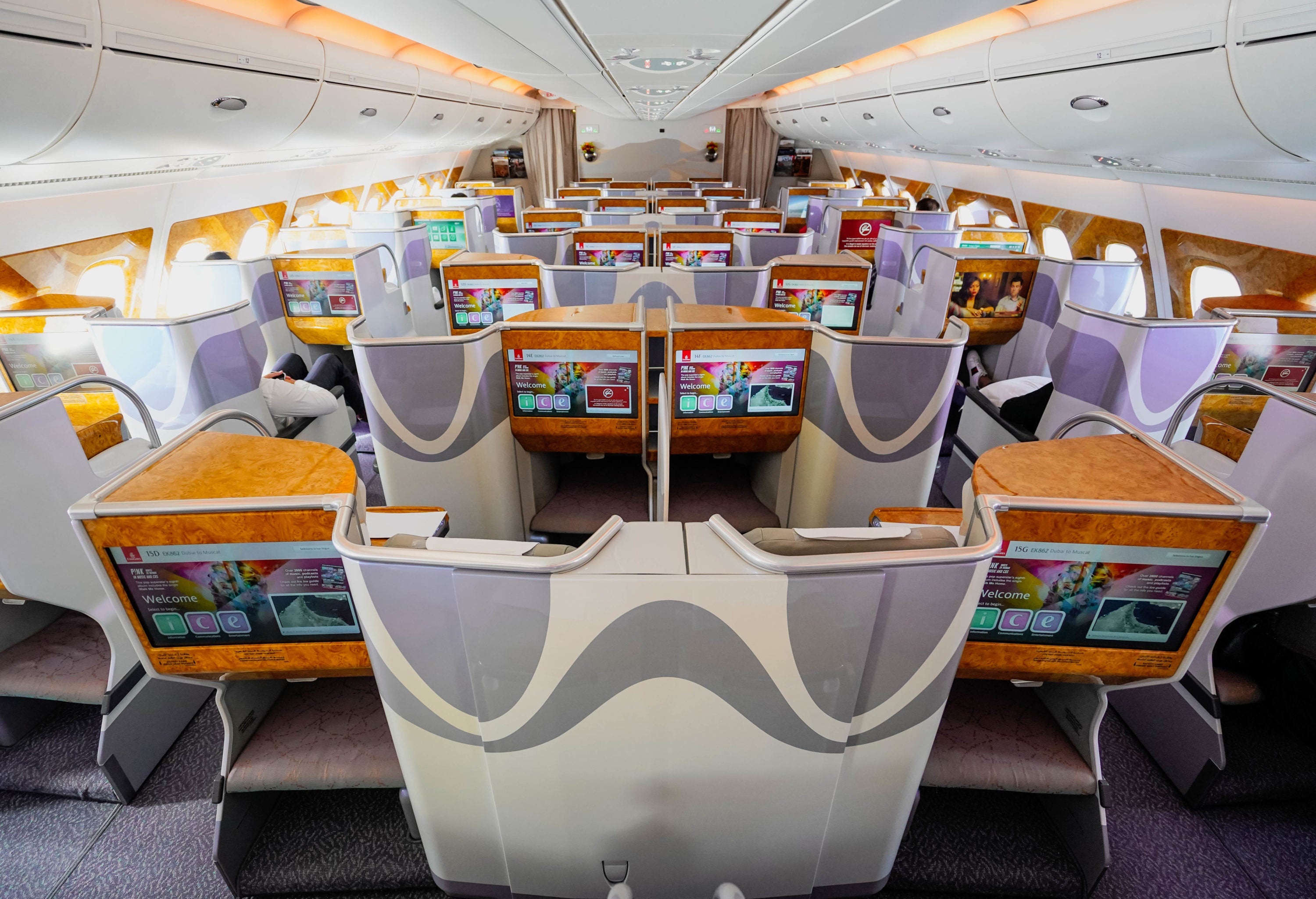
Emirates uses a staggered 1-2-1 configuration in Business Class, ensuring every passenger has direct aisle access. However, because of the staggered design, not all seats are created equal.
- Window Seats (A and K): These are the most private. The seat is positioned directly against the window, with the console table acting as a buffer from the aisle.
- Aisle-Adjacent Window Seats (B and J): In these rows, the seat is next to the aisle, and the console is against the window. These feel less private than the A and K seats.
- Center "Honeymoon" Seats (E and F): Located in the center section, these seats are right next to each other. They are ideal for couples but have a motorized privacy divider for solo travelers.
- Center Aisle Seats (D and G): Like the B and J seats, these are positioned next to the aisle with the console in the middle.
Technical Note on Business Class Noise: Rows 25 and 26 are closest to the Onboard Lounge (the bar). While this is a major perk for social travelers, the noise from the lounge and the rear galley can be disruptive for those trying to sleep on overnight flights.
The Onboard Lounge and Social Area
Unique to the Emirates A380 is the horseshoe-shaped bar located at the rear of the upper deck. Accessible to First and Business Class passengers, it provides a space to stretch, socialize, and enjoy hors d'oeuvres. When viewing the seat map, the lounge occupies the space behind row 26. Passengers prioritizing rest should aim for seats between rows 10 and 20 to stay clear of both the front and rear social zones.
The Main Deck: Premium Economy and Economy
The main deck is where the bulk of the passengers reside. With the 2026 retrofit standards, the front of the main deck has undergone a significant transformation.
Premium Economy (Rows 33-40)
Located at the front of the main deck in the 4-class configuration, Premium Economy offers 56 seats in a 2-4-2 layout. This is a significant upgrade over Economy’s 3-4-3 layout.
- Specifications: A 40-inch pitch (legroom) and a 19.5-inch seat width.
- Legrests: Every seat features a calf rest and a 6-way adjustable headrest.
- Privacy: This cabin is separated from Economy by a bulkhead and has its own dedicated lavatories in some configurations. Seats in row 33 (bulkhead) offer the most knee room but have fixed armrests containing the tray tables.
Economy Class (Rows 43-88)
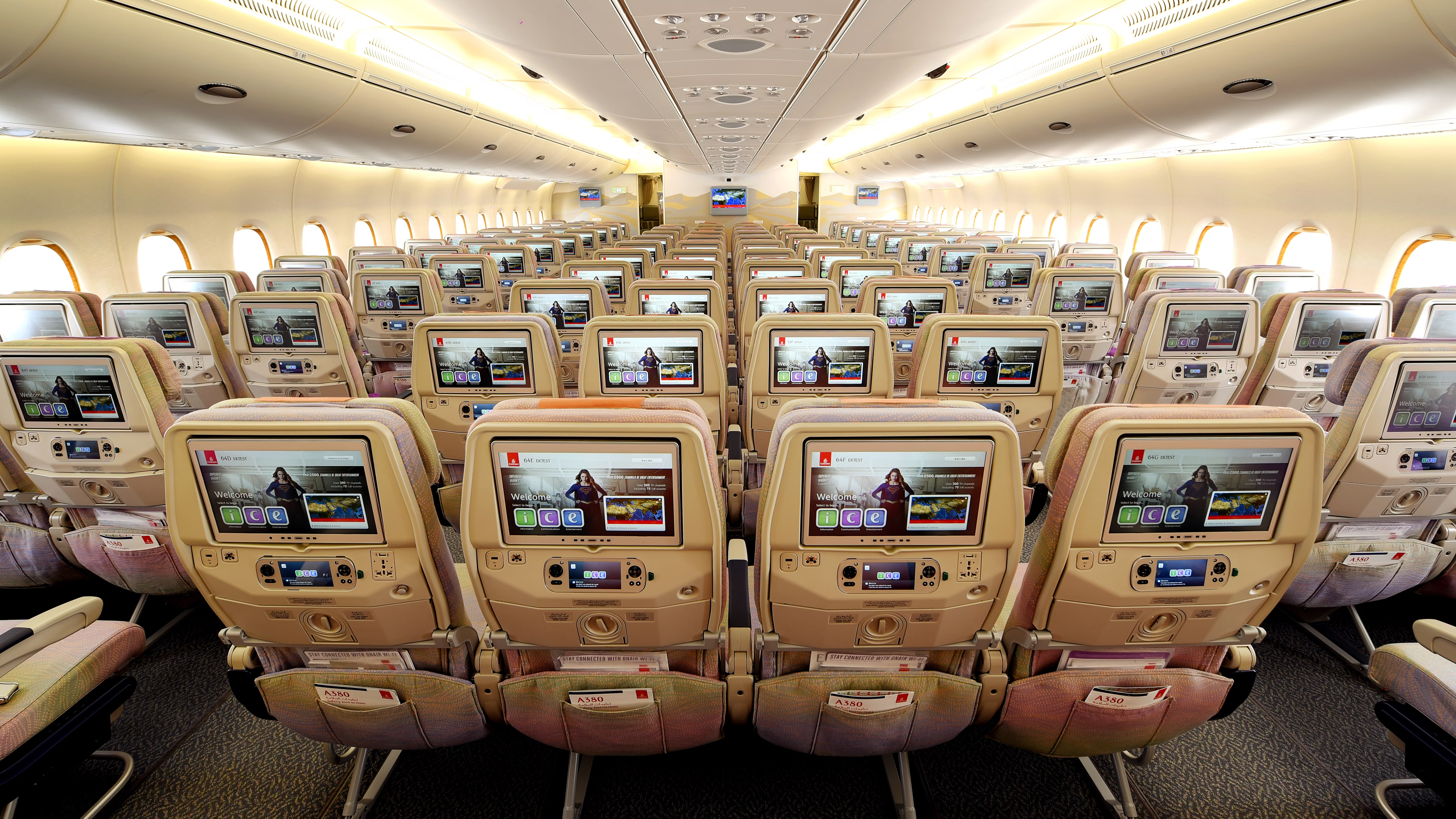
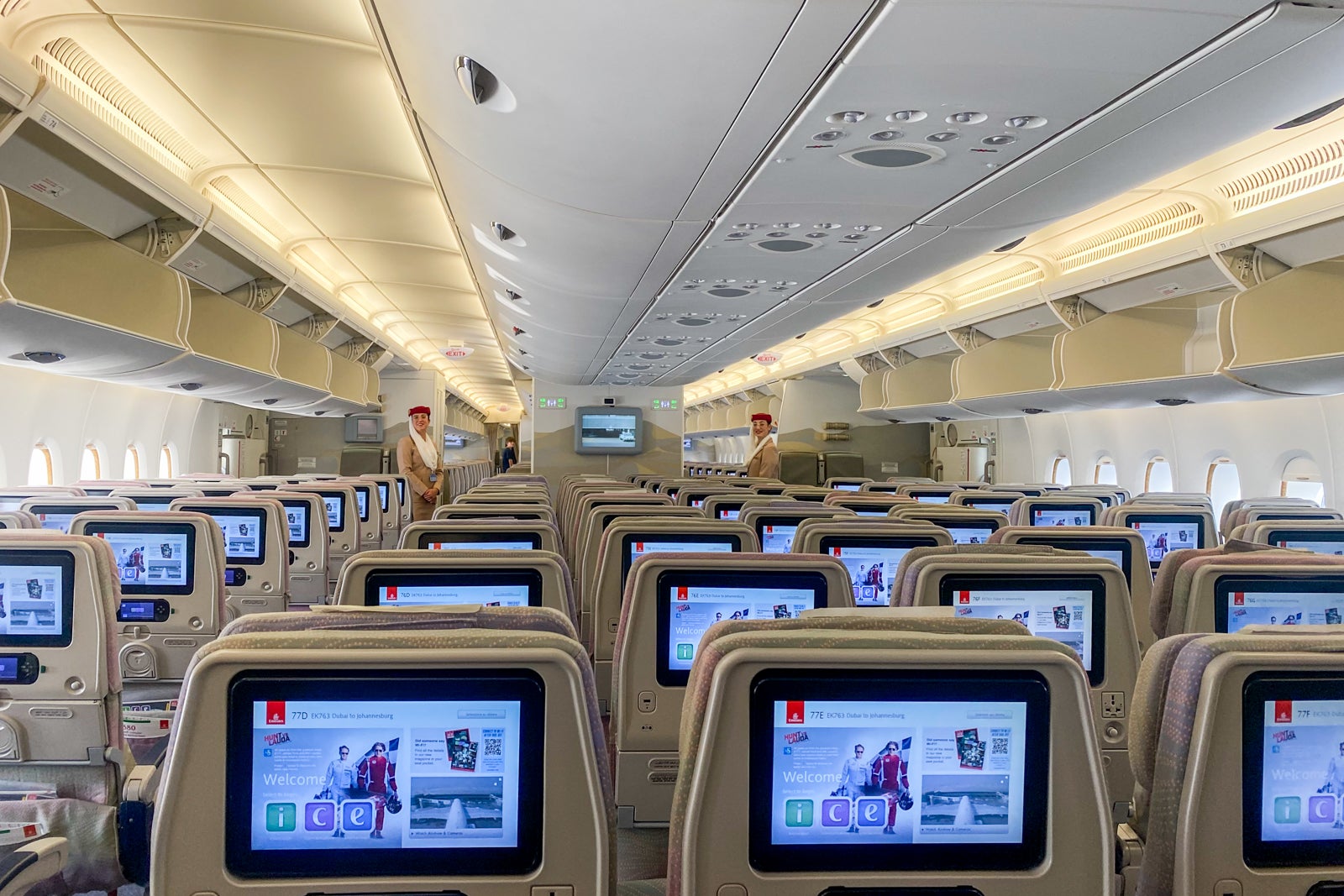
Economy Class on the Emirates A380 is generally praised for its 18-inch seat width and 32-34 inch pitch. However, the sheer size of the cabin means some zones are better than others.
- The 3-4-3 Layout: Most of the cabin follows this standard.
- The "Two-Seaters": At the very rear of the aircraft (usually rows 80-88), the fuselage tapers. In these rows, the window groups of three often become groups of two. These are highly coveted by couples as they offer extra storage space between the seat and the window wall.
- Exit Row Seats (Rows 43, 52, 67, 80): These offer virtually limitless legroom. However, they are often located near lavatories or galleys, leading to "passenger congregating" noise. Row 67 is particularly popular as it is a dedicated exit row with no seats directly in front of the window positions in some layouts.
Technical Seat Map Comparison Table
The following table compares the physical dimensions and features of the different classes on the Emirates A380-800 as of 2026.
| Feature | First Class | Business Class | Premium Economy | Economy Class |
|---|---|---|---|---|
| Seat Configuration | 1-2-1 | 1-2-1 (Staggered) | 2-4-2 | 3-4-3 |
| Bed Length/Pitch | 78" (Flat) | 70" - 78" (Flat) | 40" Pitch | 32" - 34" Pitch |
| Seat Width | 23" | 18.5" - 20" | 19.5" | 18" |
| Screen Size | 32" HD | 20" - 23" HD | 13.3" HD | 13.3" HD |
| Aisle Access | Direct | Direct | Shared | Shared |
| Onboard Shower | Yes (2) | No | No | No |
| Onboard Lounge | Yes | Yes | No | No |
Strategic Seat Selection: Tips from Frequent Flyers
When viewing the Emirates Seat Map during the booking process or online check-in, consider these factors to optimize your flight experience:
- Avoid the "Dreaded" Rows: In Economy, rows directly in front of a lavatory or galley (often the last row of a section) may have restricted recline. Check the map for row 51, 66, and 79, which are frequently positioned against bulkheads.
- Wing Views vs. Ground Views: The A380 has a massive wing. If you are in Economy between rows 50 and 75, your view of the ground will be largely obstructed by the wing and the massive Engine Alliance GP7200 engines. For a clear view, choose seats in the very front (Premium Economy) or the very back (Row 80+).
- Engine Noise: The A380 is famously quiet, but the quietest part of the plane is forward of the engines. This means First Class, Premium Economy, and the front Business Class cabin (Rows 7-15) offer the most silent environment.
- The "Basin" Effect: In the center 4-seat sections of Economy, the middle two seats (E and F) are often the last to be assigned. If you are traveling as a duo, picking an aisle and a middle seat in the side blocks is usually safer than the center.
- Galley Light: On long-haul night flights, the light from the galleys can be intrusive. Avoid the first and last rows of any cabin section to minimize this.
Power and Connectivity Across the Map
Emirates has equipped all A380-800 seats with universal power outlets and USB ports. However, the location varies.
- First and Business: Outlets are located on the console or near the floor.
- Premium Economy and Economy: Ports are usually located on the back of the seat in front of you or under your own seat.
- Wi-Fi: The A380 features OnAir Wi-Fi. While available throughout the aircraft, signal strength can occasionally vary depending on your proximity to the internal routers, which are typically located near the galleys.
FAQ: Emirates A380-800 Seat Map
Which Emirates A380 has Premium Economy?
As of 2026, the Four-Class configuration features Premium Economy. You can identify these flights during booking by looking for the "Premium Economy" cabin option. On the seat map, these are located on the main deck in rows 33 through 40.
What are the best seats for solo travelers in Business Class?
The best seats for solo travelers are the "true" window seats: 7A, 7K, 9A, 9K, and so on. These seats have the side console on the aisle side, providing a physical barrier and maximum privacy.
Are there any "hidden" seats in the Economy cabin?
Row 67 (on some configurations) and row 80 often feature seats with extra legroom because they are positioned behind exit doors. Additionally, the pairs of seats at the very rear (Rows 81-88, seats A/C and H/K) are highly recommended for pairs because there is no middle seat.
Is First Class always on the upper deck?
Yes, on all Emirates A380-800 configurations that include a First Class cabin, it is located at the front of the upper deck. The only configuration where the upper deck is not premium-only is the high-density Two-Class version, where the rear of the upper deck contains Economy seats.
How do I know which configuration I am flying before I book?
You can use the "Manage Booking" tool on the official Emirates website or check third-party sites like SeatGuru or AeroLOPA by entering your flight number. Emirates also displays the seat map during the seat selection phase of the booking process.
Final Recommendations for Your Flight
For the best experience on the Emirates Airbus A380-800, prioritize your needs based on the duration of the flight. If you are on an overnight journey and traveling in Business Class, avoid the rear rows (24-26) to stay away from the lounge noise. If you are in Economy, look for the "twin seats" at the rear of the aircraft for extra personal space.
With the 2026 fleet updates, the Premium Economy cabin represents the best value for many travelers, offering a significant jump in comfort without the price tag of Business Class. Regardless of your class, always check your specific tail number's map 48 hours before departure, as aircraft swaps can occasionally occur due to operational requirements.