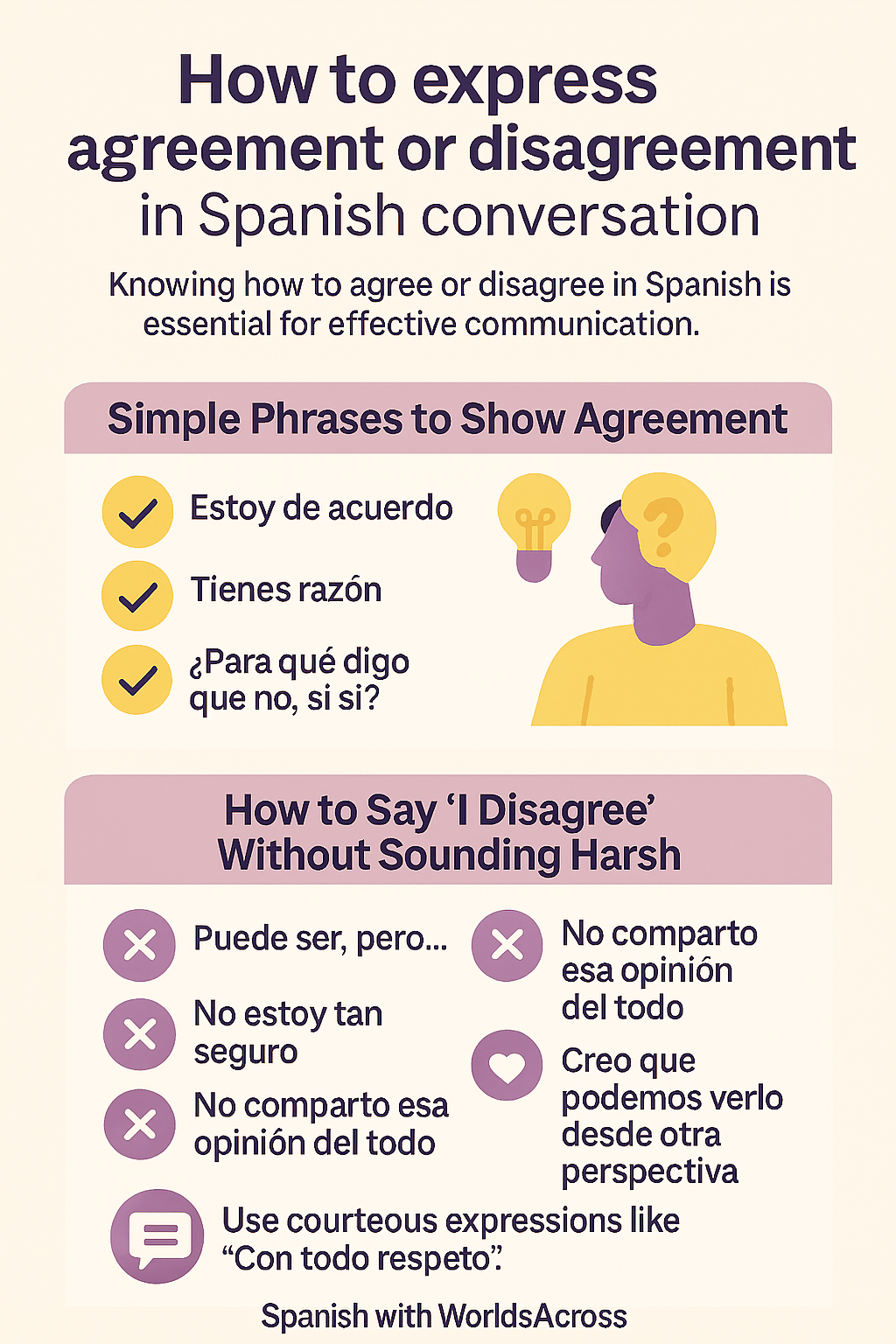
Effective agreement and disagreement involve using specific linguistic markers and psychological strategies to maintain rapport while expressing a stance. By mastering "softeners," active listening, and interest-based negotiation, individuals can navigate complex professional and personal social dynamics, ensuring that differing opinions lead to constructive outcomes rather than interpersonal conflict or stagnation.
The Social and Psychological Importance of Nuance
In the landscape of 2026, where hybrid work and AI-augmented communication are the norms, the ability to navigate the spectrum of agreement and disagreement has never been more critical. We often view agreement and disagreement as a simple binary—a "yes" or "no" choice. However, in sophisticated communication, these actions function as a nuanced spectrum that defines the quality of our professional and personal relationships.
Agreeing isn't just about compliance; it is about building consensus and validating the perspectives of others to foster a collaborative environment. Conversely, disagreement is not merely an act of opposition; it is the fundamental engine of innovation and critical thinking. When managed correctly, disagreement prevents "groupthink," a psychological phenomenon where the desire for harmony results in irrational or dysfunctional decision-making. To master these interactions, one must understand the linguistic tools and psychological frameworks that allow for the expression of a stance without damaging the "social fabric" of the conversation.
The Linguistic Spectrum of Agreement
Agreement can range from enthusiastic, total support to cautious, conditional acceptance. Using the right level of intensity is vital for clarity and for managing the expectations of your interlocutors.
Strong and Total Agreement
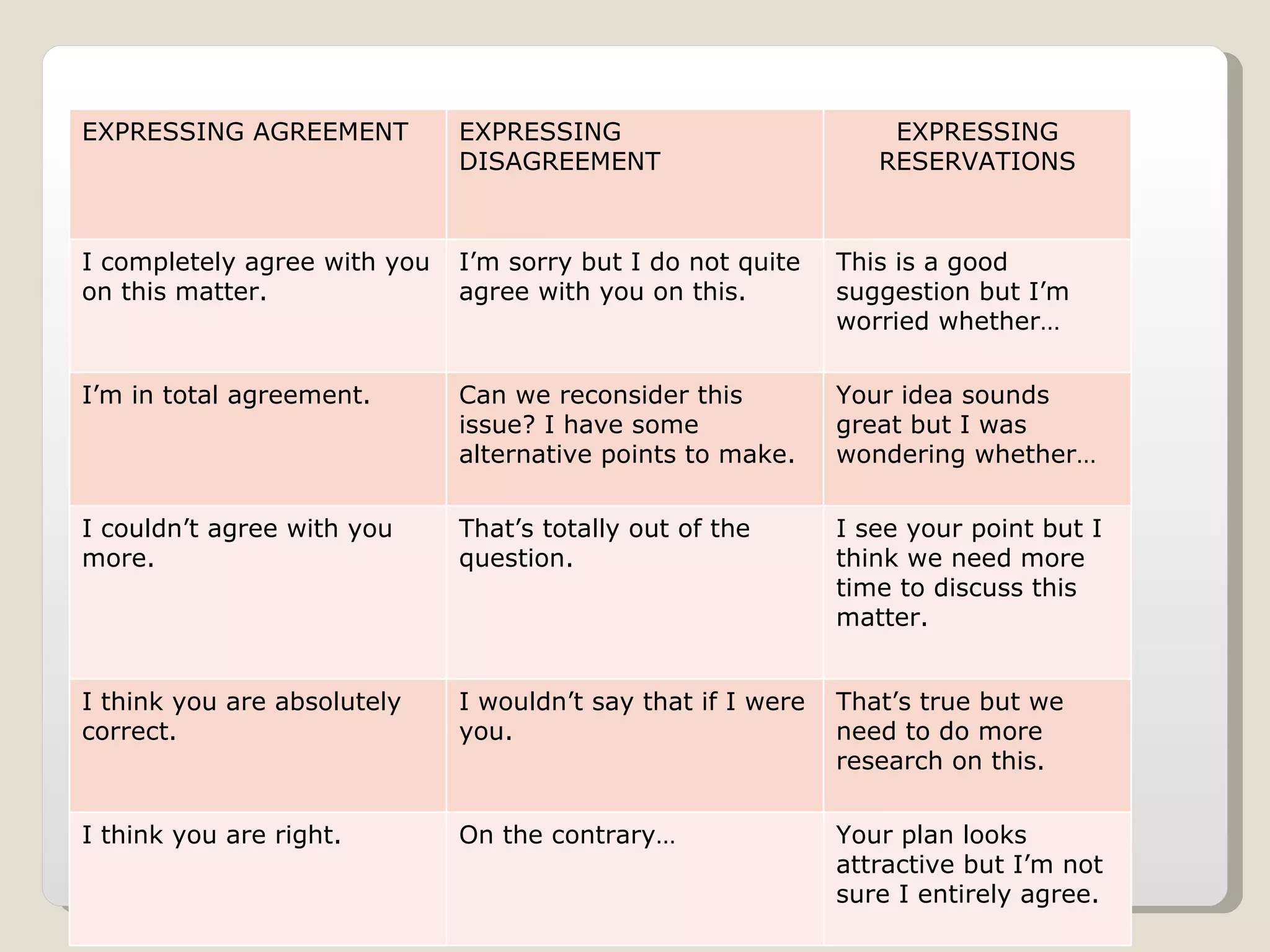
Strong agreement is used when you are fully aligned with a proposal or statement. This is essential for building momentum in projects or affirming a core value. In professional settings, this often sounds like:
- "I completely concur with that assessment."
- "That is exactly the approach we need to take."
- "You’ve hit the nail on the head."
The goal here is to provide a "green light." By using absolute adverbs like "completely," "entirely," or "absolutely," you remove any ambiguity regarding your position. This transparency allows the group to move forward with confidence.
Neutral and Partial Agreement
Partial agreement is a sophisticated tool used to acknowledge the validity of a point while maintaining a reservation. It is the hallmark of a critical thinker who avoids blind following. This is often phrased as:
- "I see where you are coming from, though I have some thoughts on the implementation."
- "That makes sense in principle, but we need to look at the data."
- "I agree with the first part of your proposal, but I'm less sure about the second."
This technique, often referred to as "hedging" in linguistics, protects the speaker's credibility. It signals that you are listening and validating the other person's input, which keeps the lines of communication open even if you eventually move toward a different conclusion.
The Art of Disagreeing Without Being Disagreeable
Disagreeing is inherently risky because it can be perceived as a personal attack or a challenge to someone’s status. To mitigate this, expert communicators use "softening" techniques to separate the person from the idea.
The Power of "Softeners" and Pre-sequences
A "softener" is a phrase used to reduce the impact of a negative statement. Instead of a blunt "I disagree," which can trigger a defensive biological response in the listener, a softener prepares the ground. Common examples include:
- "With all due respect..."
- "I hear what you're saying, but..."
- "I’m not sure I see it quite the same way."
In 2026, communication experts emphasize the use of "I" statements rather than "You" statements. Saying "I have a different perspective on this" is significantly less confrontational than "You are wrong about this." The former describes your internal state; the latter makes an objective (and often offensive) claim about the other person's competence.
The "Yes, And" Technique
Borrowed from improvisational theater, the "Yes, And" technique is a powerful method for disagreeing constructively. Instead of saying "No" or "But"—which acts as a linguistic stop sign—you use "And" to build upon or pivot the conversation.
- Initial Statement: "We should spend the entire budget on social media ads."
- Reframing with 'Yes, And': "Yes, social media has a high reach, and we also need to consider our long-term SEO strategy to ensure sustainable growth."
By replacing "but" with "and," you acknowledge the previous point as a valid contribution while introducing your own conflicting or supplementary idea. This keeps the conversation additive rather than subtractive.
Strategic Frameworks for Conflict Resolution
Beyond individual phrases, managing agreement and disagreement requires an understanding of broader conflict resolution frameworks. One of the most effective is interest-based negotiation, popularized by the Harvard Negotiation Project.
Interest-Based vs. Position-Based Disagreement
When people disagree, they often dig into "positions"—fixed demands like "I want a 10% discount." When communication focuses on positions, it becomes a win-lose battle. Interest-based communication focuses on the why behind the position.
- Position: "We shouldn't use this vendor."
- Interest-based Inquiry: "What specific concerns do you have regarding their delivery timeline or quality?"
By focusing on interests, you can often find a "third way" that satisfies both parties, turning a disagreement into a collaborative problem-solving session. This approach is essential in 2026’s complex global supply chains and cross-functional team environments.
Cultural Nuances in Agreement Styles
Agreement and disagreement are not universal; they are deeply influenced by cultural context. Understanding these differences is vital for anyone working in international business or diverse communities.
High-Context vs. Low-Context Cultures
In "low-context" cultures (such as the United States, Germany, or the Netherlands), communication is expected to be direct and explicit. Disagreement is often viewed as a sign of honesty and engagement.
In "high-context" cultures (such as Japan, Korea, or many Middle Eastern nations), communication is more indirect. A direct "no" may be considered extremely rude or a cause for "loss of face." In these cultures, disagreement might be expressed through silence, a change of subject, or a phrase like "That would be very difficult," which essentially means "No." Failing to read these subtle cues can lead to major misunderstandings and damaged relationships.
| Communication Style | Typical Characteristics | Approach to Disagreement |
|---|---|---|
| Direct (Low-Context) | Explicit, logic-driven, task-oriented. | Open, honest, and seen as constructive. |
| Indirect (High-Context) | Implicit, relationship-oriented, nuanced. | Avoided or expressed through non-verbal cues. |
| Diplomatic | Balanced, use of softeners, consensus-seeking. | Aimed at preserving the relationship while pivoting. |
| Assertive | Firm, clear, but respectful of boundaries. | Direct but focused on the issue, not the person. |
Communication in the Digital and AI Era (2026)
As of 2026, a significant portion of our agreement and disagreement happens via text-based platforms (Slack, Teams) or through AI-mediated summaries. This introduces a "tone gap." Without facial expressions and vocal inflection, a simple "I don't agree" can sound much harsher than intended.
Managing the "Tone Gap"
To counteract this, digital communicators should:
- Use Explicit Emotional Markers: Phrases like "I'm saying this with the best intentions for the project" help clarify intent.
- Avoid Sarcasm: Sarcasm relies on vocal tone and is easily misinterpreted in digital formats, often escalating a minor disagreement into a major conflict.
- Leverage Video for High-Stakes Disagreement: If a disagreement is becoming circular or heated in text, move to a video call immediately. Seeing a human face fosters empathy and reduces aggression.
Agreement and Disagreement in Academic and Formal Writing
In academic settings, expressing agreement and disagreement requires a high level of formality and the use of evidence-based language. This is not just about opinion; it is about "positioning" your work within the existing body of knowledge.
Critiquing Existing Literature
When disagreeing with a published study or theory, scholars use phrases like:
- "While Smith (2024) argues X, the current data suggests Y."
- "This theory appears to overlook the impact of Z."
- "The findings of Jones et al. are limited by their small sample size."
Note how the focus is entirely on the methodology or the data, never the person. This objective distance is what allows academic discourse to remain productive over decades. The University of North Carolina Writing Center provides excellent resources on how to construct these arguments without alienating your peers.
Common Mistakes to Avoid
- The "Pseudo-Agreement": Saying "I agree" just to end a conversation while actually harboring resentment. This leads to "passive-aggressive" behavior later on.
- The "Ad Hominem" Attack: Attacking the person's character rather than their argument. Even if you win the argument, you lose the relationship.
- Over-Softeners: Using so many softeners that your actual point is lost. "I might be wrong, and maybe it's just me, but perhaps we could possibly think about..." This undermines your authority.
- Interrupting: Disagreeing before the other person has finished their sentence. This signals that you aren't listening, only waiting to speak.
FAQs
How can I disagree with my boss without risking my job?
The key to disagreeing with a superior is to frame your disagreement as a form of "risk management." Instead of saying "Your idea won't work," say "I'm concerned about how this might impact our Q3 targets; can we walk through the contingencies?" This shows you are aligned with their goals (the company's success) even if you disagree with their methods.
What is the "7-38-55 Rule" and how does it apply here?
Developed by Albert Mehrabian, this rule suggests that communication is 7% verbal (words), 38% vocal (tone), and 55% facial/body language. When agreeing or disagreeing, your tone and body language must match your words. If you say "I agree" while crossing your arms and frowning, the listener will believe your body language over your words.
Is it ever okay to just say "No"?
Yes. In matters of safety, ethics, or personal boundaries, a direct "No" is often the most responsible and clear form of communication. Nuance is for collaborative problem-solving; directness is for setting non-negotiable boundaries.
How do I handle someone who refuses to agree to disagree?
In some cases, a stalemate is inevitable. If the other party continues to push, use a "meta-communication" strategy: "It seems we have a fundamental difference of opinion on this specific point. Perhaps we should move on to other items where we can find common ground and revisit this later." This shifts the focus from the conflict to the communication process itself.
Can AI help in resolving disagreements?
In 2026, many organizations use AI tools to analyze meeting transcripts for "hidden friction." AI can identify when a team is in "violent agreement" (agreeing in words but not in understanding) or when a specific voice is being suppressed. These tools provide data-driven insights that help human mediators intervene effectively.
Next Steps for Improving Your Communication
To enhance your ability to navigate agreement and disagreement, start by practicing "Active Listening." Before you express your stance, summarize the other person’s position to their satisfaction. Phrases like "So, if I understand you correctly, your main concern is..." are invaluable. Once they feel heard, they are psychologically much more open to hearing your agreement or your respectful disagreement.
For further study on the psychology of influence and consensus, the American Psychological Association (APA) offers extensive resources on group dynamics and interpersonal communication that remain foundational for professional development in 2026.