Agentic AI enables managed services to move beyond simple automation toward autonomous problem-solving. By integrating agents that reason and execute across AIOps, security, and data workflows, providers achieve faster Mean Time to Recovery (MTTR), proactive security posture management, and self-healing data pipelines with minimal manual intervention, significantly reducing operational overhead in complex 2026 cloud environments.
Defining Agentic AI in the 2026 Managed Services Ecosystem
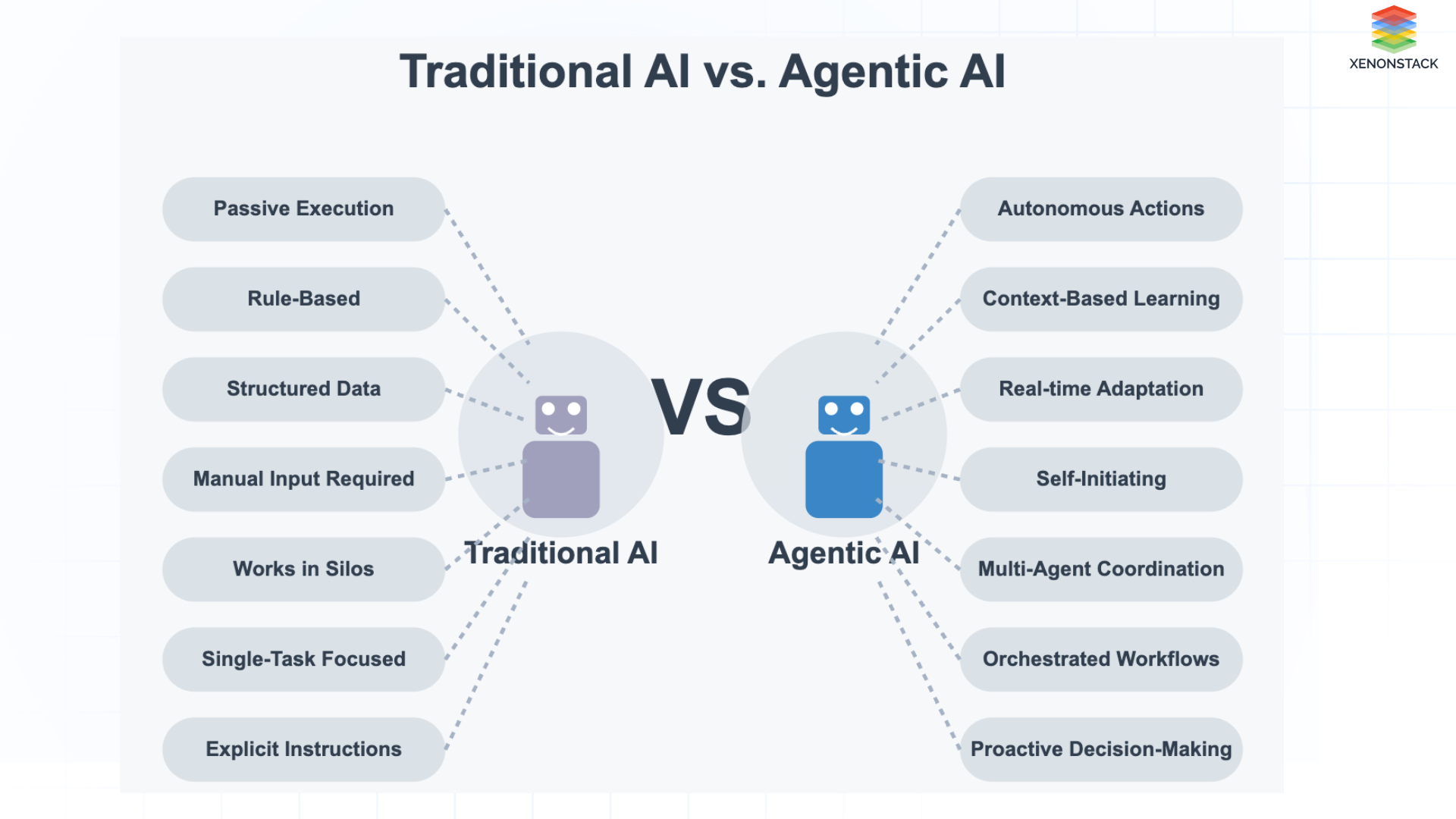
In 2026, the distinction between traditional automation and Agentic AI has become the primary differentiator for Managed Service Providers (MSPs). While traditional automation follows a rigid "if-this-then-that" logic, Agentic AI employs autonomous agents capable of reasoning, planning, and tool-use to achieve high-level objectives. These agents are not merely chatbots; they are functional software entities that can interact with APIs, execute CLI commands, and navigate complex cloud architectures to resolve issues without waiting for human approval at every step.
The shift toward agent-led managed services is driven by the sheer scale of modern ephemeral infrastructure. With the ubiquity of multi-cloud environments and microservices, the volume of telemetry data has surpassed human cognitive limits. Agentic AI addresses this by acting as a "Reasoning Layer" atop the IT stack. This layer interprets intent, decomposes a goal (e.g., "Optimize this Kubernetes cluster for cost without sacrificing latency") into sub-tasks, and executes them using specialized tools.
For MSPs, this means a transition from "hands-on-keyboard" support to "Human-on-the-loop" orchestration. Managed services now focus on defining the guardrails, policies, and desired outcomes, while the AI agents handle the tactical execution across AIOps, security, and data operations. This evolution allows for a level of scalability and speed that was previously impossible, transforming managed services into a proactive, outcome-oriented partnership rather than a reactive utility.
Transformational Impacts on AIOps: From Correlation to Autonomous Resolution
Artificial Intelligence for IT Operations (AIOps) has evolved from simple alert grouping to a fully agentic lifecycle. In 2026, the primary challenge is no longer identifying that something is wrong, but resolving it before it impacts the end-user. Agentic AI excels here by closing the gap between observation and action.
The Autonomous OODA Loop in AIOps
Agentic systems operate on an Observe-Orient-Decide-Act (OODA) loop. In a managed service context, the agent "Observes" by ingesting logs, metrics, and traces across the stack. It "Orients" by cross-referencing this data with historical patterns and the current architectural topology. The "Decide" phase is where agentic reasoning shines; the AI evaluates multiple remediation paths—such as restarting a pod, scaling a database, or rolling back a deployment—based on risk and efficacy. Finally, it "Acts" by executing the necessary commands through the provider's management plane.
Incident Remediation and Noise Reduction
Traditional AIOps platforms often suffer from "alert fatigue," where the system generates thousands of notifications, many of them false positives. Agentic AI solves this by acting as a primary triager. When an anomaly is detected, an agent is dispatched to investigate. The agent can run diagnostic scripts, check recent code commits, and verify network connectivity autonomously. If the agent determines the alert is a transient flicker, it suppresses it. If it identifies a genuine leak or failure, it can apply a temporary patch and notify the human operator with a detailed report of what was found and what was already done to mitigate the issue.
According to research from the IEEE Xplore Digital Library, multi-agent systems in IT operations have demonstrated the ability to reduce MTTR by up to 60% compared to non-agentic automated systems. This is because the agent does not wait for a human to interpret a dashboard; it interprets the underlying data in real-time.
Cloud Security: The Rise of Autonomous SOC Agents
The security landscape in 2026 is characterized by hyper-speed attacks that leverage AI to find vulnerabilities. Managed Security Service Providers (MSSPs) are countering this by deploying Agentic AI for continuous threat hunting and automated incident response. The goal is to create a "Self-Defending Cloud."
Agentic Threat Hunting and Posture Management
Unlike static scanners that run on a schedule, security agents are persistent entities that monitor the environment for behavioral deviations. An agentic security system can identify a suspicious lateral movement across VPCs (Virtual Private Clouds) and immediately take action to isolate the affected segment. This is significantly more advanced than traditional Security Orchestration, Automation, and Response (SOAR). While SOAR requires predefined playbooks, agentic systems can improvise a response based on the specific nature of the threat.
In cloud security posture management (CSPM), agents don't just flag a misconfigured S3 bucket; they analyze the context. If the bucket contains sensitive PII (Personally Identifiable Information) and is public, the agent can automatically apply the correct IAM (Identity and Access Management) policy, log the change, and then initiate an investigation into how the misconfiguration occurred in the first place.
Continuous Compliance and Governance
Compliance is no longer a "point-in-time" check. With Agentic AI, managed services offer continuous compliance as a core feature. Agents are programmed with the rules of frameworks like SOC2, GDPR, or HIPAA. They continuously audit the infrastructure and data flows. If a developer launches a resource that violates a compliance rule, the agent can intercept the deployment, explain the violation to the developer via Slack or Teams, and suggest the necessary code changes. This "security-as-code" approach, powered by agents, ensures that the environment remains compliant even as it changes hundreds of times a day.
The NIST AI Risk Management Framework provides the foundational guidelines that these agents follow to ensure their actions are safe, secure, and explainable, which is crucial for regulated industries.
Data Operations (DataOps): Ensuring Integrity through AI Agents
Data operations in 2026 involve massive distributed pipelines that feed both business intelligence and real-time AI models. Agentic AI in managed DataOps ensures that these pipelines are robust, performant, and reliable.
Self-Healing Data Pipelines
Data pipelines are notorious for breaking due to schema changes, upstream data quality issues, or API failures. An agentic DataOps service uses agents to monitor the "health" of the data. If a pipeline fails, an agent analyzes the error logs. If it’s a schema mismatch, the agent can attempt to map the new schema to the target destination or quarantine the problematic records while allowing the rest of the pipeline to continue. This prevents a single error from halting the entire data supply chain.
Automated Metadata Management and Data Quality
Maintaining a data catalog is a labor-intensive task that often falls behind. AI agents can autonomously scan new data sources, infer metadata, classify the sensitivity of the data, and update the catalog. Furthermore, they can implement active data quality monitoring. For example, an agent can observe that the "average order value" in a stream has dropped to zero—a statistical impossibility—and trigger a data quality alert while simultaneously tracing the issue back to a faulty sensor or a bug in a transformation script.
Managed services focusing on DataOps leverage these agents to provide a "Data Contract" guarantee. The agents act as the enforcers of these contracts, ensuring that the data delivered to downstream consumers meets all predefined specifications for freshness, accuracy, and completeness.
Comparative Analysis: Traditional Managed Services vs. Agent-Led Services
The transition to agentic models represents a fundamental change in the service level agreements (SLAs) and operational models of IT providers.
| Feature | Traditional Managed Services | Agentic Managed Services (2026) |
|---|---|---|
| Response Model | Reactive: Triggered by alerts and tickets. | Proactive: Agents identify and resolve issues before alerts trigger. |
| Automation Type | Static Playbooks: Fixed logic, limited flexibility. | Dynamic Reasoning: Agents adapt to context and specific scenarios. |
| Human Involvement | High: Humans perform most complex troubleshooting. | Low: Humans act as supervisors and policy-makers. |
| Scalability | Linear: More resources require more staff. | Exponential: Agents can scale infinitely across infrastructure. |
| Remediation Speed | Minutes to Hours: Limited by human availability. | Seconds to Minutes: Limited by processing and API latency. |
| Data Handling | Manual Audits: Periodic checks for data quality. | Continuous Monitoring: Real-time agentic data validation. |
| Security Approach | Perimeter & Signature: Looking for known threats. | Behavioral & Agentic: Hunting for unknown anomalies. |
Implementing Agentic AI: Prerequisites and Technical Infrastructure
Successfully integrating Agentic AI into managed services requires a robust foundation. Organizations cannot simply "turn on" AI agents; they must build the environment in which agents can operate safely and effectively.
1. Unified Telemetry and Data Fabric
Agents are only as good as the data they can access. A prerequisite for agentic AIOps and security is a unified telemetry layer that aggregates logs, metrics, events, and traces from across the multi-cloud environment. This "Data Fabric" must be accessible via standardized APIs so that agents can query the state of the system in real-time.
2. Tooling and API Accessibility
For an agent to be "agentic," it must have "tools." In the context of IT operations, tools are APIs that allow the agent to interact with the environment. This includes cloud provider APIs (AWS, Azure, GCP), CI/CD pipelines (GitHub Actions, GitLab), and communication platforms. Managed services must ensure that agents have the appropriate, scoped permissions to use these tools—often referred to as "Function Calling" in the context of Large Language Models (LLMs).
3. Reasoning Frameworks and Small Language Models (SLMs)
While early agents relied on massive, centralized LLMs, the 2026 landscape has shifted toward specialized Small Language Models (SLMs). These models are fine-tuned for specific domains like Python scripting, SQL generation, or network configuration. They are faster, cheaper to run, and can be deployed closer to the data (at the edge or within a private VPC), addressing both latency and data sovereignty concerns.
4. Human-in-the-loop (HITL) and Guardrails
Safety is paramount. Managed services must implement "Guardrail Layers" that intercept agent actions. For example, an agent might propose a solution that involves deleting a production database. A robust system will have a policy-based guardrail that flags this for human approval, regardless of how "confident" the agent is. Frameworks like the Cloud Native Computing Foundation (CNCF) observability standards help in creating these structured feedback loops.
Risk Management and Governance in an Agentic World
The delegation of authority to AI agents introduces new risks that must be managed through rigorous governance. Managed Service Providers are responsible for the "actions" of their agents, making transparency and auditability non-negotiable.
Addressing Hallucination and Unintended Actions
AI agents, particularly those based on probabilistic models, can "hallucinate" or propose illogical solutions. In a managed services context, this is mitigated through "Multi-Agent Consensus." Instead of one agent making a decision, a system might use three different agents to analyze a problem. If they all agree on the solution, it proceeds; if they disagree, the issue is escalated to a human. This redundancy significantly reduces the risk of an agent taking a destructive action.
Ethical AI and Bias Mitigation
In DataOps especially, agents must be monitored for bias. If an agent is tasked with optimizing a data pipeline for a marketing firm, it must not inadvertently introduce or amplify biases present in the source data. MSPs now use "Audit Agents"—separate AI entities whose only job is to monitor the primary agents for compliance with ethical guidelines and corporate policies.
The "Black Box" Problem: Explainability
When an agent resolves a critical security breach at 3:00 AM, the IT team needs to know exactly why it took certain actions. Modern agentic systems produce "Thought Logs"—a step-by-step breakdown of the agent's reasoning process, the data it consulted, and the tools it used. This transparency is vital for post-mortem analysis and for building trust between the MSP and the client.
Frequently Asked Questions
What is the difference between a bot and an AI agent in managed services?
A bot is typically programmed to follow a specific, linear script or respond to specific keywords. It cannot handle unexpected scenarios or deviate from its path. An AI agent, however, uses a reasoning engine (like an LLM or SLM) to understand a high-level goal. It can plan its own steps, choose which tools to use, and adapt its strategy based on the results of its previous actions. In managed services, this means an agent can solve problems that weren't specifically programmed into it.
How much does it cost to transition to agentic managed services?
The cost varies based on the scale of the infrastructure, but while there is an initial investment in the data fabric and reasoning infrastructure, the long-term operational costs are often lower. By reducing the reliance on human labor for routine tasks, MSPs can offer more competitive pricing or higher levels of service for the same price. Most organizations see a return on investment through reduced downtime and fewer security breaches within 12 to 18 months.
Can AI agents replace my entire IT and Security team?
No. AI agents are designed to augment teams, not replace them. They handle the "toil"—the repetitive, high-volume tasks that lead to burnout. This allows human experts to focus on high-level strategy, architectural design, and complex problem-solving that requires deep contextual understanding and institutional knowledge. Humans move from being "operators" to being "orchestrators."
Are AI agents safe to use in highly regulated environments like finance or healthcare?
Yes, provided they are implemented with strict guardrails and human-in-the-loop triggers. In 2026, agentic systems are built with "Zero Trust" principles for the agents themselves. Every action an agent takes is authenticated, authorized, and logged. Furthermore, specialized "Compliance Agents" ensure that all actions adhere to the specific regulatory requirements of the industry, often providing better audit trails than human operators could.
What happens if an agent makes a mistake that causes an outage?
Managed Service Providers typically include "Agentic Liability" clauses in their contracts. To prevent such incidents, systems use "pre-execution simulation." Before an agent applies a change to a production environment, it tests the change in a digital twin or a staging environment. If the simulation shows a negative impact, the action is blocked and reported. This layer of safety is a standard feature of enterprise-grade agentic platforms in 2026.
Strategic Recommendation for Implementation
To leverage Agentic AI effectively, organizations should begin by identifying the "toil" in their current operations—the repetitive tasks that consume the most time in AIOps, security, or data management. Rather than a "big bang" rollout, start with a "pilot agent" focused on a narrow domain, such as automated incident triage or data quality monitoring.
Ensure that your telemetry data is clean and accessible via API, as this is the fuel for agentic reasoning. Partner with a Managed Service Provider that demonstrates a clear commitment to "Explainable AI" and has robust guardrail frameworks in place. The transition to agentic services is not just a technical upgrade; it is a cultural shift toward trusting autonomous systems to handle the complexity of the modern cloud, allowing your human talent to focus on innovation and business value.