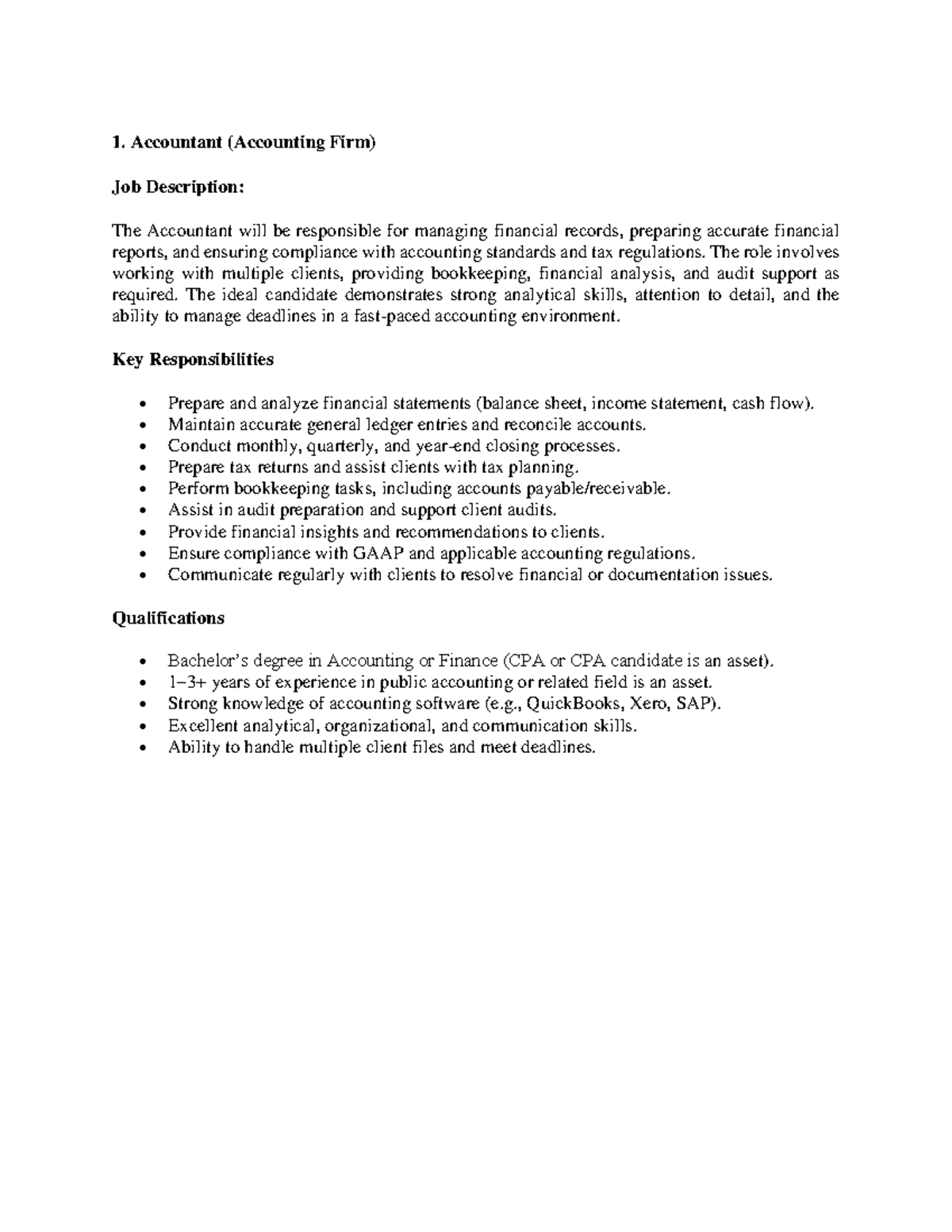
Defining precise accounting job descriptions and titles is essential for organizational structure, talent acquisition, and long-term career pathing. A well-structured hierarchy clarifies expectations for internal staff while ensuring that external candidates clearly understand the technical competencies, reporting lines, and level of responsibility associated with each role. By aligning internal titles with industry standards, companies can improve recruitment efficiency, facilitate accurate compensation benchmarking, and support professional development cycles.
Understanding the Accounting Organizational Hierarchy
Accounting roles generally follow a vertical progression based on the complexity of financial analysis, the level of regulatory oversight, and the degree of strategic involvement. While titles can vary depending on company size—ranging from small sole proprietorships to multinational corporations—most organizations divide the function into distinct operational tiers.
At the foundational level, roles focus on transactional accuracy and data entry. Moving toward the middle and senior management tiers, the focus shifts toward internal control, technical reporting, compliance, and departmental strategy. Finally, executive-level roles are primarily concerned with high-level financial planning, capital structure, and overarching risk management.
The Foundation: Entry-Level and Staff Roles
Entry-level positions form the bedrock of the accounting department. In these roles, the primary objectives are data integrity, documentation, and the timely execution of routine financial tasks.
- Accounts Payable/Receivable Clerk: These roles are highly specialized and focused on the cash flow cycle. AP clerks manage outgoing payments, verify invoices, and reconcile vendor statements. AR clerks handle incoming receipts, manage customer accounts, and monitor outstanding balances.
- Bookkeeper: A broader role that encompasses the recording of all financial transactions into the general ledger. A bookkeeper ensures that the trial balance is accurate and maintains detailed records of bank statements and expense reports.
- Staff Accountant: This is the entry-to-mid-level professional role. A Staff Accountant typically handles month-end close procedures, prepares journal entries, and reconciles balance sheet accounts. They require a foundational understanding of Generally Accepted Accounting Principles (GAAP).
The Middle Management Tier: Technical and Supervisory
As a professional gains experience, they transition into roles that require deeper analytical capabilities and the ability to supervise others or manage complex project workflows.
- Senior Accountant: This role handles high-level reconciliations and serves as a technical resource for the team. They are responsible for reviewing the work of Staff Accountants and ensuring that complex transactions are recorded in compliance with accounting standards.
- Accounting Manager: The bridge between operational accounting and financial strategy. The Accounting Manager oversees the monthly, quarterly, and annual closing processes. They are responsible for the performance of the accounting team, internal control maintenance, and primary communication with external auditors.
- Cost Accountant: A specialized role within manufacturing or production-heavy organizations. These individuals analyze production costs, variances between standard and actual costs, and inventory valuation to help leadership understand the profitability of specific product lines.
The Strategic Tier: Executive Leadership
At the executive level, the scope shifts from "how to record" to "what the numbers mean for the future of the firm."
- Controller: Often the top accounting position in mid-sized firms. The Controller manages the entire accounting department, oversees financial reporting, and is responsible for the integrity of the company’s internal financial controls.
- Chief Financial Officer (CFO): The highest executive role in finance. The CFO is a strategic partner to the CEO. They focus on capital allocation, financial planning and analysis (FP&A), investor relations, and high-level risk management.
Key Components of an Effective Accounting Job Description
A high-quality job description does more than list requirements; it serves as a roadmap for the employee and a vetting tool for the hiring manager. To be effective, every description should include the following core components:
- Summary of the Role: A 3–5 sentence overview of how the position fits into the accounting team and the value the role provides to the organization.
- Core Responsibilities: A breakdown of daily, weekly, and monthly tasks. Avoid overly generic terms like "general accounting duties." Instead, specify "Perform monthly bank reconciliations for five operating accounts" or "Execute semi-monthly payroll processing for 200 employees."
- Technical Requirements: List specific software proficiencies (e.g., SAP, NetSuite, Oracle, or Advanced Excel) and technical knowledge (e.g., knowledge of GAAP or IFRS).
- Qualifications and Experience: Clearly state the required educational background, such as a Bachelor’s degree in Accounting, and professional certifications, such as a Certified Public Accountant (CPA) or Certified Management Accountant (CMA) credential.
- Soft Skills: Identify the necessary interpersonal skills, such as cross-departmental communication, attention to detail under tight deadlines, and the ability to explain financial data to non-finance stakeholders.
Comparative Overview of Accounting Roles
The following table provides a high-level comparison of the typical educational requirements, primary focus areas, and technical skill sets for common accounting roles as of 2026.
| Title | Core Focus | Typical Education | Technical Priority |
|---|---|---|---|
| Bookkeeper | Transactional Recording | Associate degree / Certificate | Ledger software / Data Entry |
| Staff Accountant | Month-end close & Reconciliations | Bachelor’s degree | GAAP / ERP proficiency |
| Senior Accountant | Technical reporting & Review | Bachelor’s + CPA candidate | Complex variance analysis |
| Accounting Manager | Departmental operations | Bachelor’s + CPA/CMA | Team leadership / Internal control |
| Controller | Financial compliance & Strategy | Master’s degree / CPA | Risk management / Oversight |
| CFO | Strategic capital allocation | MBA / CPA | Financial modeling / Strategy |
Standardizing Titles for Internal Equity
One common mistake organizations make is inflating job titles, such as labeling a basic bookkeeper as a "Financial Analyst." This creates confusion during the recruitment process and leads to salary compression or equity issues when market benchmarking occurs.
To maintain organizational clarity, companies should follow these three rules for titling:
- Consistency: If the title contains "Manager," the role must include direct reports or budgetary authority. If the role is an individual contributor, avoid using management-level nomenclature.
- Scope Definition: Use the prefix to define the level (e.g., Junior, Staff, Senior). This creates a clear career ladder that employees can visualize, which is a powerful retention tool.
- Market Alignment: Regularly review job titles against industry compensation surveys. If a job title deviates significantly from the industry norm, candidates may undervalue the role or assume the responsibilities are vastly different than they actually are.
Navigating Certification Requirements
In 2026, the demand for certified professionals continues to rise. When drafting job descriptions, identifying the need for a license or certification is a critical step in setting the technical depth of the role.
- CPA (Certified Public Accountant): Generally required for roles that involve signing off on financial statements, regulatory reporting, or high-level tax strategy.
- CMA (Certified Management Accountant): Highly relevant for roles focused on internal financial planning, cost accounting, and operational strategy.
- CIA (Certified Internal Auditor): Essential for roles that focus on risk assessment, internal controls, and corporate governance.
When writing a job description, explicitly state whether a certification is "required," "preferred," or "highly desirable." For instance, a "Senior Accountant" role might state: "CPA license preferred; if not currently licensed, candidate must be on the path toward certification."
Common Pitfalls in Job Description Writing
Many companies fall into the trap of using "boilerplate" text that fails to differentiate their brand or their specific needs. To ensure your job descriptions perform well, avoid the following mistakes:
- Ignoring the Tech Stack: Accounting is increasingly automated. If the role requires proficiency in specific cloud-based accounting platforms or automated reconciliation tools, state this clearly. Omitting the tech stack often leads to candidates applying who do not have the necessary technical foundation to hit the ground running.
- Overloading the Requirements: Avoid a "wish list" approach where you list every possible skill. This often discourages qualified candidates who may possess 80% of the skills but feel intimidated by a list of 25 requirements. Focus on the core competencies necessary for the first 90 days.
- Vague Success Metrics: Instead of asking for "an analytical mind," ask for "the ability to identify and resolve discrepancies in large data sets through the use of Pivot Tables and VLOOKUPs." Concrete examples of success help candidates visualize the work.
Frequently Asked Questions
How do I differentiate between a Staff Accountant and a Senior Accountant in a job description?
A Staff Accountant primarily focuses on executing day-to-day tasks like journal entries and basic reconciliations under supervision. A Senior Accountant is expected to handle complex issues with minimal supervision, perform advanced financial analysis, and review the work of staff-level employees to ensure accuracy and compliance.
Is a CPA certification always necessary for an Accounting Manager role?
While not universally required, it is strongly preferred in many industries. A CPA demonstrates a high level of technical competency and ethical standard. For companies that are publicly traded or highly regulated, the CPA is often a non-negotiable requirement for anyone in a management position overseeing financial reporting.
Should I include soft skills in an accounting job description?
Yes. Accounting is an increasingly collaborative function. Skills such as cross-functional communication, adaptability to new software, and the ability to explain technical financial results to non-financial executives are critical for long-term success.
How often should job descriptions be updated?
Job descriptions should be reviewed annually or whenever the department undergoes a restructuring. With the rapid evolution of financial technology and accounting standards, a role that was accurate three years ago may be obsolete today.
What is the most important section of an accounting job description?
The most important section is the "Responsibilities" section. Candidates need to know exactly what the daily work entails. If the responsibilities are well-defined, the candidate can accurately self-assess their fit for the role, saving your team significant time in the interview process.
Next Steps for Talent Acquisition
When you are ready to publish, begin by auditing your current team’s output to see which tasks are currently taking up the most time. Map these tasks to the corresponding levels outlined in this guide. If your current "Staff Accountant" is performing "Senior Accountant" duties, you are likely underpaying the role or creating a retention risk. Use the hierarchy provided here to align your titles with the reality of the work performed. Finally, work with your HR or talent acquisition team to ensure that your salary bands for these titles align with current 2026 regional market data for the accounting profession.