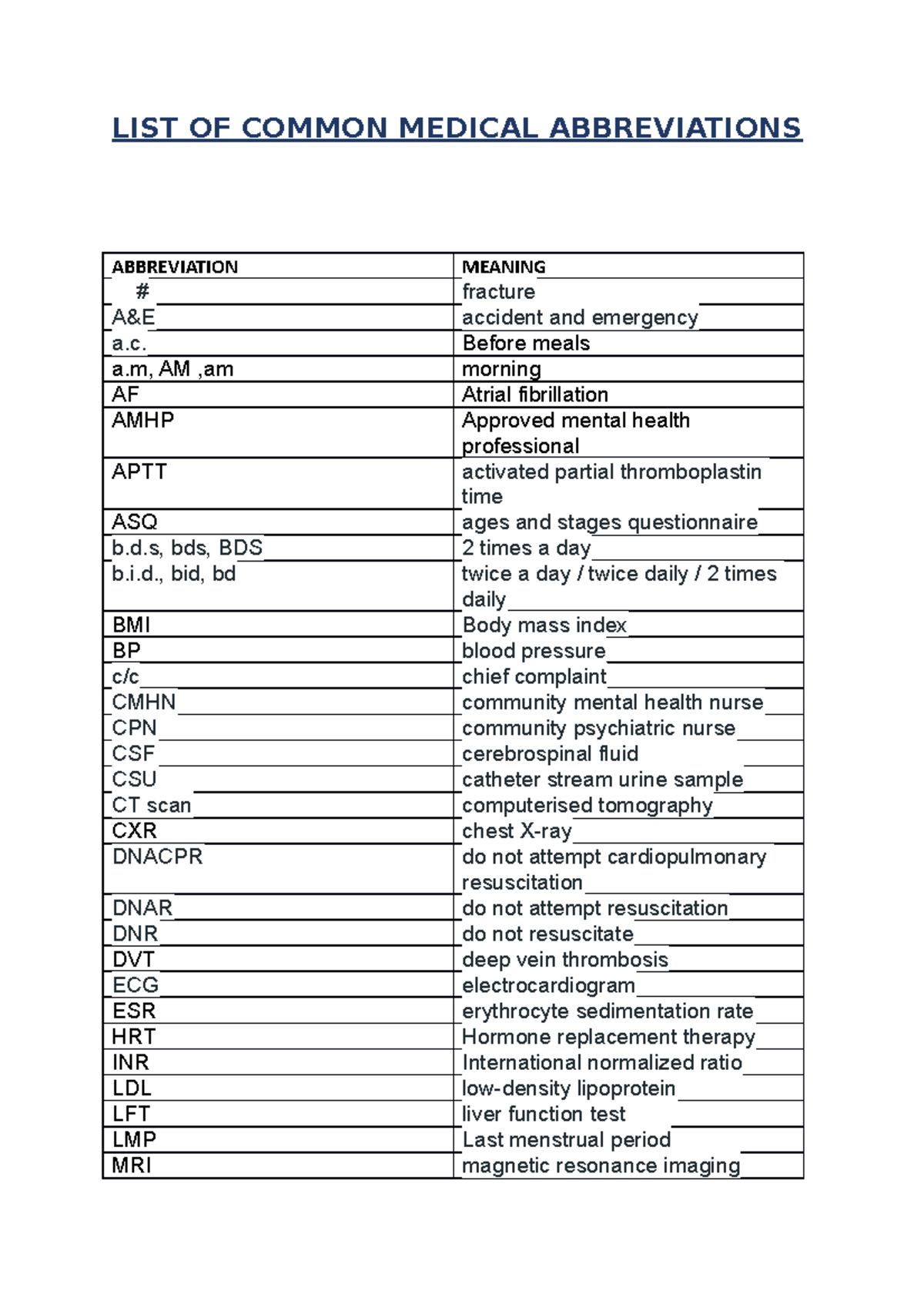
The most common general abbreviation for an orthopedic surgeon is Ortho or Orthop. in spoken medical dialogue and clinical shorthand. On official credentials, an orthopedic surgeon is designated by their medical degree—MD (Doctor of Medicine) or DO (Doctor of Osteopathic Medicine)—often followed by specialty board fellowship acronyms such as FAAOS (Fellow of the American Academy of Orthopaedic Surgeons).
Understanding these medical abbreviations helps patients, administrative staff, and healthcare professionals quickly identify a surgeon's scope of practice, board certification level, and subspecialty focus. Medical shorthand varies depending on whether it is used in electronic health record (EHR) systems, formal prescription signatures, academic publishing, or international medical registers.
Primary Abbreviations for Orthopedic Surgeons
Abbreviations for orthopedic surgeons fall into three main categories: informal clinical shorthand, formal medical degrees, and post-nominal board certifications.
| Category | Abbreviations |
|---|---|
| Clinical Shorthand | Ortho / Orthop. / ORTH |
| Medical Degrees | MD / DO / MBBS |
| US Credentials | FAAOS / FAOA |
| UK/Intl Credentials | FRCS (Tr & Orth) / FRCSC / FRACS |
1. Clinical Shorthand and Medical Charting
In hospitals, surgical consultations, and shift handover reports, clinical staff use concise terms to refer to the orthopedic surgery department or duty attending physician:
- Ortho: The most widely recognized informal abbreviation used by physicians, nurses, and allied health staff. It refers interchangeably to the specialty, the department, or the surgeon on call.
- Orthop.: A standard written abbreviation used in clinical notes, progress reports, and bibliographies.
- ORTH: The standard four-letter department code utilized in hospital computerized physician order entry (CPOE) systems, operating room (OR) scheduling software, and health information management (HIM) databases.
- Surg Orth / Surg Ortho: Used in multidisciplinary medical charts to distinguish surgical orthopedists from non-surgical musculoskeletal specialists or rheumatologists.
2. Primary Medical Degrees (Post-Nominal Degrees)
Every qualified orthopedic surgeon first completes medical school before undertaking a specialized residency in orthopedic surgery. Their initial post-nominal letters represent their earned medical degree:
- MD (Doctor of Medicine): Earned by graduates of allopathic medical schools.
- DO (Doctor of Osteopathic Medicine): Earned by graduates of osteopathic medical schools in the United States, who complete equivalent surgical residency training and national licensing examinations.
- MBBS / MBChB (Bachelor of Medicine, Bachelor of Surgery): The primary medical degree awarded in the United Kingdom, Australia, India, and many Commonwealth nations before postgraduate surgical training.
3. Board Certifications and Professional Fellowships
After medical degree completion and five to six years of specialized orthopedic residency training, surgeons complete board exams and join professional organizations. These credentials appear directly after the medical degree:
- FAAOS: Fellow of the American Academy of Orthopaedic Surgeons. This designation confirms that the physician is board-certified by the American Board of Orthopaedic Surgery (ABOS) or the American Osteopathic Board of Orthopedic Surgery (AOBOS) and maintains active peer-reviewed fellowship status.
- FAOA: Fellow of the American Orthopaedic Association. Reserved for orthopedic surgeons recognized for exceptional leadership, academic contributions, and surgical innovation.
- FRCS (Tr & Orth): Fellow of the Royal College of Surgeons (Trauma and Orthopaedics). The formal designation for fully qualified orthopedic surgeons in the United Kingdom and Ireland.
- FRCSC: Fellow of the Royal College of Physicians and Surgeons of Canada (Orthopedic Surgery division).
- FRACS: Fellow of the Royal Australasian College of Surgeons (Orthopaedic Surgery division).
Reference Guide: Orthopedic Titles and Credentials
The following reference table outlines the acronyms, full titles, contexts, and regional applications associated with orthopedic surgeons and related musculoskeletal specialists.
| Abbreviation | Full Term / Title | Primary Context | Region / Application |
|---|---|---|---|
| Ortho / Orthop. | Orthopedics / Orthopedist | Conversational / Clinical Notes | Global (English-speaking) |
| ORTH | Orthopedic Surgery Department | Hospital EHR & CPOE Systems | International |
| MD | Doctor of Medicine | Primary Professional Degree | US, Canada, International |
| DO | Doctor of Osteopathic Medicine | Primary Professional Degree | United States |
| MBBS | Bachelor of Medicine, Bachelor of Surgery | Primary Medical Qualification | UK, Commonwealth, Asia |
| FAAOS | Fellow of the American Academy of Orthopaedic Surgeons | Board-Certified Specialty Status | United States |
| ABOS | American Board of Orthopaedic Surgery | Certifying Board Body | United States |
| AOBOS | American Osteopathic Board of Orthopedic Surgery | Osteopathic Certifying Board | United States |
| FRCS (Tr & Orth) | Fellow of the Royal College of Surgeons (Trauma & Orthopaedics) | Specialist Surgical Registry | United Kingdom & Ireland |
| FRCSC | Fellow of the Royal College of Physicians and Surgeons of Canada | Specialist Surgical Registry | Canada |
| FRACS | Fellow of the Royal Australasian College of Surgeons | Specialist Surgical Registry | Australia & New Zealand |
| TJA | Total Joint Arthroplasty (Surgeon) | Subspecialty Designation | Global |
| OPA-C | Orthopaedic Physician Assistant - Certified | Allied Health Professional | United States |
Deep Dive into Professional Designations
What FAAOS Signifies on a Physician's ID
When reviewing a physician’s business card, hospital badge, or clinical profile, seeing FAAOS after an MD or DO title carries specific regulatory and clinical weight.
To earn and maintain the FAAOS credential, a surgeon must:
- Graduate from an accredited allopathic or osteopathic medical school.
- Complete an accredited five-year orthopedic surgery residency program.
- Pass rigorous written and oral examinations administered by the American Board of Orthopaedic Surgery (ABOS) or the American Osteopathic Board of Orthopedic Surgery.
- Maintain an active, unencumbered license to practice medicine.
- Undergo periodic peer review and complete ongoing Maintenance of Certification (MOC) requirements.
Seeing MD, FAAOS or DO, FAAOS confirms that the practitioner is not merely a general practitioner performing musculoskeletal care, but a fully certified orthopedic surgeon operating within national practice standards.
- Earn Medical Degree (MD or DO): 4 Years
- Complete Orthopedic Residency: 5 Years
- Complete Subspecialty Fellowship: 1 Year (Optional)
- Pass ABOS / AOBOS Board Exams: Board Certification
- Peer Review & AAOS Election: FAAOS Designation
International Variations: FRCS, FRCSC, and FRACS
In nations outside North America, surgical credentialing relies on historical collegiate fellowships rather than academy board designations:
- United Kingdom & Ireland: A surgeon who completes Higher Specialist Training in orthopedic surgery passes the Intercollegiate Fellowship Examination to earn the title FRCS (Tr & Orth). In British medical tradition, surgeons who earn the FRCS historically drop the title "Doctor" (Dr.) and revert to "Mr.", "Ms.", "Mrs.", or "Miss" as a sign of distinction dating back to the historical separation between barber-surgeons and academic physicians.
- Canada: Canadian orthopedic surgeons obtain certification through the Royal College of Physicians and Surgeons of Canada, appending FRCSC to their medical degree.
- Australia & New Zealand: Surgeons complete fellowship pathways through the Royal Australasian College of Surgeons, utilizing FRACS (Orth) to denote specialization.
Subspecialty Abbreviations in Orthopedic Surgery
Orthopedic surgery encompasses numerous distinct anatomical and clinical domains. Surgeons who complete an additional 12 to 24 months of fellowship training after residency often list subspecialty acronyms in their clinical documentation or professional profiles.
- Sports Med: Arthroscopy & Athletic Injuries
- TJA / Joint: Hip & Knee Replacements (Arthroplasty)
- Trauma: Complex Fractures & Reconstruction
- Peds Ortho: Pediatric Deformities & Congenital Conditions
- Hand / UE: Hand, Wrist, & Upper Extremity Surgery
- Spine: Vertebral & Spinal Cord Decompressions / Fusions
- Foot & Ankle: Reconstructive Podiatric Orthopedics
Common Subspecialty Designations
- Sports Med (Sports Medicine): Focuses on arthroscopic surgery of the knee, shoulder, hip, and ankle, as well as ligament reconstruction (such as ACL and UCL repairs).
- TJA (Total Joint Arthroplasty): Specialists in primary and complex revision joint replacements, focusing predominantly on total hip replacements (THA) and total knee replacements (TKA).
- Ortho Trauma / Trauma Surg: Specialists who manage complex open fractures, non-unions, malunions, and multi-trauma skeletal injuries in emergency trauma centers.
- Peds Ortho (Pediatric Orthopedics): Surgeons specializing in congenital limb deformities, scoliosis, cerebral palsy manifestations, and pediatric fractures.
- Spine / Spine Surg: Orthopedic surgeons focused on surgical interventions for the cervical, thoracic, and lumbar spine, including discectomies, laminectomies, and spinal fusions.
- Hand Surg / UE (Hand and Upper Extremity): Surgeons focusing on complex nerve, tendon, microvascular, and bone structures from the shoulder down to the fingertips.
- Foot & Ankle: Specialists treating complex reconstructive foot conditions, Achilles tendon ruptures, and severe ankle arthritis.
Distinguishing Orthopedic Surgeons from Related Professionals
Patients and administrative staff frequently encounter acronyms for non-surgeon healthcare providers working in musculoskeletal medicine. It is vital to distinguish board-certified surgeons from allied health practitioners.
| Role | Abbreviation | Surgical Authority |
|---|---|---|
| Orthopedic Surgeon | MD / DO | Full Surgical Scope |
| Orthopedic Physician Assist. | PA-C / OPA-C | Assists in Surgery |
| Physical Therapist | PT / DPT | Non-Surgical Rehab |
| Rheumatologist | MD / DO | Medical / Non-Surg |
| Certified Orthotist | CO / CPO | Bracing / Devices |
1. Orthopedic Physician Assistants (PA-C / OPA-C)
- PA-C (Physician Assistant - Certified): Advanced practice providers who diagnose musculoskeletal conditions, order imaging, perform joint injections, and first-assist during surgical procedures under surgeon supervision.
- OPA-C (Orthopaedic Physician Assistant - Certified): A physician assistant specializing exclusively in orthopedics, holding certification from the National Board for Certification of Orthopaedic Physician Assistants (NBCOPA).
2. Non-Surgical Musculoskeletal Specialists
- Rheumatologists (MD/DO): Internal medicine or pediatric physicians who specialize in systemic autoimmune and inflammatory disorders affecting joints (such as rheumatoid arthritis or lupus). They do not perform surgery.
- PMR / Physiatrists (MD/DO): Specialists in Physical Medicine and Rehabilitation (PM&R) who treat nerve, muscle, and bone injuries non-surgically using physical therapy, nerve blocks, and medication management.
- DPT / PT (Doctor of Physical Therapy / Physical Therapist): Rehabilitation experts who guide post-operative recovery, strength restoration, and mobility training.
- CPO / CO (Certified Prosthetist-Orthotist / Certified Orthotist): Healthcare professionals who design, fit, and construct custom medical braces, splints, and artificial limbs.
Spelling Variations: Orthopedic vs. Orthopaedic
When reading medical abbreviations and organization names, both orthopedic and orthopaedic appear frequently.
Historical Origins
The term was coined in 1741 by French physician Nicolas Andry in his publication Orthopédie, derived from the Greek words orthos ("straight" or "correct") and paedion ("child"). The original discipline focused on correcting spinal and skeletal deformities in children.
Modern Usage Standards
- Orthopaedic (with the ligature "ae"): Preserved primarily by academic institutions, historical societies, and professional certifying bodies. Examples include the American Academy of Orthopaedic Surgeons (AAOS), the Journal of Bone and Joint Surgery, and university academic departments.
- Orthopedic (standard American English "e"): The dominant spelling used in general journalism, modern hospital system branding, patient education portals, and lay conversations across North America.
Both spellings are correct. In terms of medical abbreviations, Ortho serves as the universal shorthand regardless of whether an institution prefers the classical or modern spelling.
Frequently Asked Questions
What does FAAOS stand for after a doctor's name?
FAAOS stands for Fellow of the American Academy of Orthopaedic Surgeons. It indicates that the physician is an active member of the academy, holds current board certification from the American Board of Orthopaedic Surgery (ABOS) or the American Osteopathic Board of Orthopedic Surgery (AOBOS), and adheres to strict professional and ethical standards in orthopedic practice.
What is the difference between an MD and a DO orthopedic surgeon?
Both MD (Doctor of Medicine) and DO (Doctor of Osteopathic Medicine) orthopedic surgeons complete identical orthopedic surgical residencies, take equivalent board certification examinations, and possess full, unrestricted surgical privileges. The main difference lies in their initial medical school training: MD programs emphasize allopathic medicine, while DO programs incorporate additional training in the musculoskeletal system and holistic osteopathic manipulative treatment (OMT).
Is "Ortho" an official medical abbreviation?
While Ortho is universally understood across healthcare settings, it is technically an informal clinical shorthand. In formal medical documentation, legal records, and academic publishing, standardized abbreviations such as Orthop., ORTH, or specific post-nominal degree titles (MD, DO, FAAOS) are preferred for clarity and legal precision.
What is the abbreviation for an Orthopedic Physician Assistant?
An Orthopedic Physician Assistant is typically designated as PA-C (Physician Assistant - Certified) or OPA-C (Orthopaedic Physician Assistant - Certified). They work under the direct supervision of an orthopedic surgeon to perform physical exams, order diagnostic tests, manage fracture care, and assist during surgical procedures.
How is a British orthopedic surgeon's title abbreviated?
In the United Kingdom, a fully qualified orthopedic surgeon typically holds the post-nominal credential FRCS (Tr & Orth), standing for Fellow of the Royal College of Surgeons (Trauma and Orthopaedics). By historical tradition, surgeons in the UK adopt the title Mr., Ms., Mrs., or Miss instead of Dr. after earning their fellowship credential.
Verifying an Orthopedic Surgeon's Credentials
When evaluating an orthopedic specialist for care, understanding medical abbreviations allows patients to verify credentials independently through recognized official databases:
- Check Board Certification: In the United States, patients can search the American Board of Medical Specialties (ABMS) or the American Board of Orthopaedic Surgery (ABOS) directory to confirm whether a physician listing MD, FAAOS or DO, FAAOS maintains active board certification.
- Verify State Medical Licensing: Consult the state medical board database to ensure the surgeon holds an unencumbered medical license without active disciplinary actions.
- Confirm Subspecialty Fellowship Training: If undergoing a specialized procedure—such as a complex revision joint replacement or spine surgery—verify that the surgeon's profile indicates formal fellowship completion in that specific area (e.g., TJA, Sports Medicine, or Spine).
Disclaimer: This guide is provided for educational and informational purposes only and does not constitute medical or legal advice. Patients should consult licensed healthcare providers and official state medical boards to verify specific practitioner qualifications and treatment recommendations.