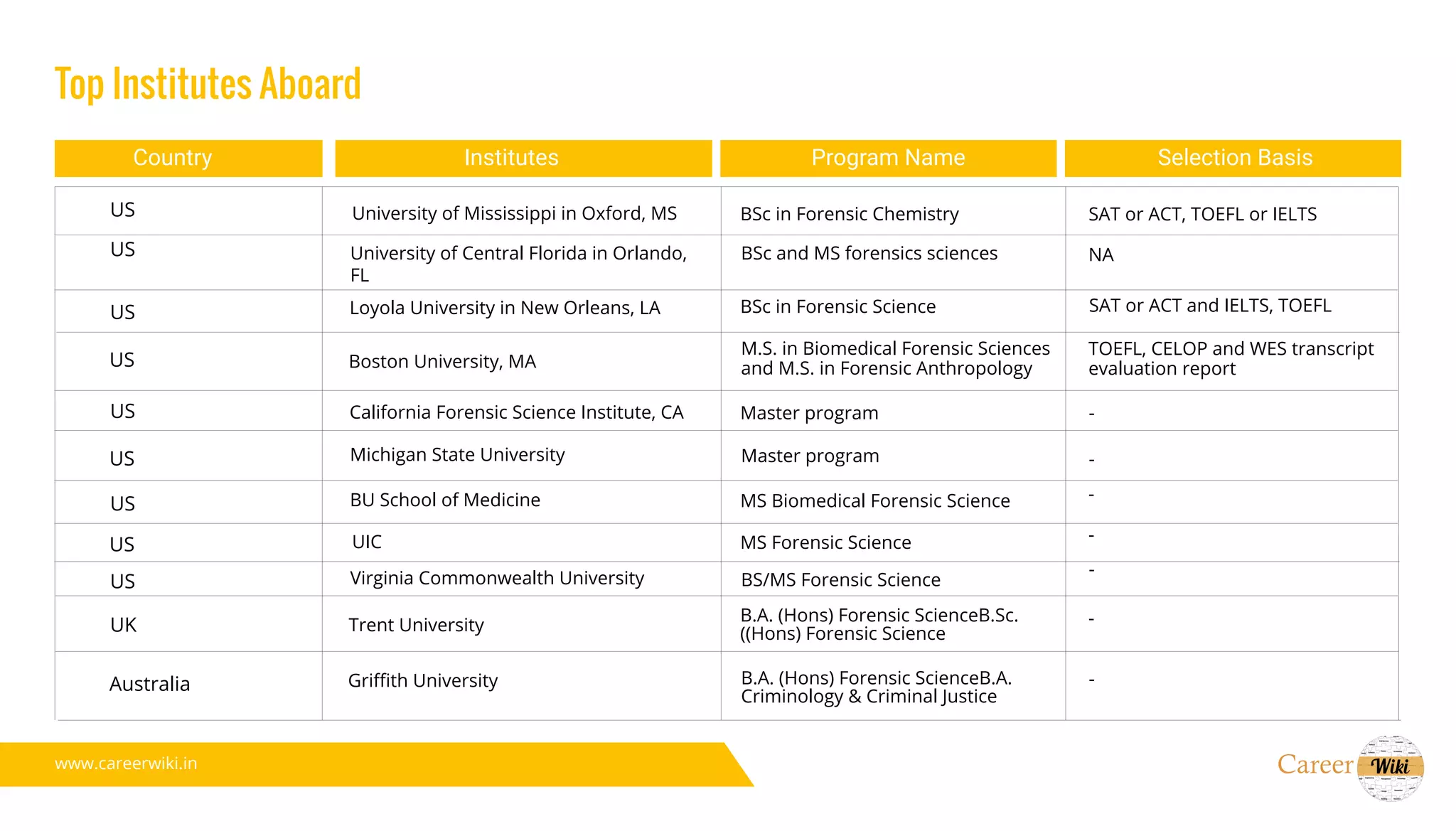
Choosing the right institution for a forensic science degree requires evaluating FEPAC accreditation, laboratory resources, and proximity to federal or state investigative agencies. In 2026, the premier programs are those that integrate rigorous natural science foundations with hands-on investigative technology, specifically at Pennsylvania State University, West Virginia University, and Texas A&M.
The Critical Importance of FEPAC Accreditation
Before selecting a college, students must understand the role of the Forensic Science Education Programs Accreditation Commission (FEPAC). This body ensures that a university’s curriculum, faculty, and facilities meet the rigorous standards required by the forensic community. Graduating from a FEPAC-accredited program is often a prerequisite for employment in high-level state and federal laboratories.
FEPAC accreditation signifies that the program does not just teach "criminal justice" with a science veneer. Instead, it confirms the curriculum is rooted in hard sciences—organic chemistry, molecular biology, and physics—which are the tools used to analyze evidence. In 2026, as DNA sequencing and digital forensics become more complex, the distinction between an accredited science degree and a general criminal justice degree has never been more vital for career placement.
1. Pennsylvania State University (University Park, PA)
Pennsylvania State University remains a gold standard for forensic science education. The program is distinguished by its heavy emphasis on the physical sciences and its state-of-the-art facilities. Penn State offers both undergraduate and graduate tracks that are FEPAC-accredited, ensuring a seamless transition for those pursuing advanced research.
The program’s centerpiece is its Crime Scene Training Station, a dedicated facility where students process simulated crime scenes using professional-grade equipment. Unlike many programs that rely on classroom theory, Penn State requires students to engage in rigorous laboratory work that mimics the daily operations of a forensic lab.
Students can specialize in Forensic Biology or Forensic Chemistry. The Forensic Biology track focuses on DNA analysis and serology, utilizing modern sequencing technology. The Forensic Chemistry track delves into toxicology and trace evidence analysis. Faculty members often include active researchers and former practitioners from agencies like the FBI, providing students with direct links to the professional world.
2. West Virginia University (Morgantown, WV)
West Virginia University (WVU) hosts one of the oldest and largest forensic science programs in the United States. Its reputation is built on its massive infrastructure, including four dedicated "crime scene houses" where students practice evidence recovery in realistic residential settings.
WVU is unique because of its partnership with the Federal Bureau of Investigation (FBI), specifically the Criminal Justice Information Services (CJIS) Division located nearby. This proximity facilitates internships and recruitment opportunities that are difficult to find elsewhere. The Department of Forensic and Investigative Science at WVU offers specialized tracks in:
- Forensic Examiner: Focused on the collection and preservation of evidence.
- Forensic Biology: Focused on the laboratory analysis of biological samples.
- Forensic Chemistry: Focused on controlled substances and toxicology.
In 2026, WVU continues to lead in research regarding ballistics and toolmark analysis, utilizing advanced scanning electron microscopy to provide students with a technical edge in the job market.
3. Texas A&M University (College Station, TX)
Texas A&M University offers a highly specialized Forensic and Investigative Sciences program. While many programs are housed within chemistry or biology departments, Texas A&M provides a multidisciplinary approach that includes a strong focus on Forensic Entomology.
The university’s program is designed to meet the requirements of the Texas Forensic Science Commission, which is known for having some of the strictest standards in the nation. This makes Texas A&M graduates highly competitive not only in Texas but across the country.
The curriculum is divided into two main paths: the Pre-Law track and the Science track. For those looking to work in a laboratory setting, the Science track is FEPAC-accredited and requires extensive coursework in genetics, biochemistry, and quantitative analysis. The university's "Body Farm" (Forensic Anthropology Center) nearby also provides unique insights into decomposition and time-since-death estimations, a critical area of forensic study.
4. University of Central Florida (Orlando, FL)
The University of Central Florida (UCF) is home to the National Center for Forensic Science (NCFS), a major research hub funded by federal grants. This connection allows undergraduate students to participate in cutting-edge research that most other institutions reserve for doctoral candidates.
UCF’s program is particularly strong in Digital Forensics and Forensic Chemistry. As cybercrime and digital evidence become central to modern investigations in 2026, UCF has expanded its curriculum to include advanced mobile device forensics and cloud-based evidence recovery.
The Forensic Chemistry track at UCF is renowned for its focus on arson and explosives analysis. Students work in laboratories equipped with gas chromatography-mass spectrometry (GC-MS) and infrared spectroscopy to identify chemical signatures in fire debris. This specialization is highly valued by agencies such as the ATF (Bureau of Alcohol, Tobacco, Firearms and Explosives).
5. Loyola University Chicago (Chicago, IL)
Loyola University Chicago offers a premier forensic science education in an urban environment, providing students with unique access to the Cook County Medical Examiner’s Office and various Chicago-based private forensic labs.
Loyola’s program is strictly laboratory-based. It emphasizes the "Chain of Custody" and the legal implications of scientific findings. Students are trained to act as expert witnesses, participating in mock trials where they must defend their scientific methodologies against aggressive cross-examination. This focus on the legal-scientific interface prepares graduates for the realities of the courtroom.
The curriculum is heavily weighted toward chemistry and biology, with a significant amount of time spent on microscopy and pattern evidence. For students interested in working in metropolitan crime labs, Loyola’s location and professional networking circles are significant advantages.
6. University of Mississippi (Oxford, MS)
The University of Mississippi, commonly known as Ole Miss, offers a Bachelor of Science in Forensic Chemistry that is consistently ranked among the top in the nation. The program is specifically designed to prepare students for careers in toxicology and drug analysis.
Ole Miss is home to the National Center for Natural Products Research, which works closely with the DEA and FDA. Students in the forensic chemistry program benefit from this relationship, gaining exposure to the analysis of controlled substances and the development of new testing methodologies.
The program is notoriously rigorous, with a high attrition rate that ensures only the most capable scientists graduate. By 2026, the program has integrated more spectroscopic techniques and automated liquid handling systems into its undergraduate labs, mirroring the equipment found in the world’s most advanced government laboratories.
7. George Washington University (Washington, D.C.)
George Washington University (GWU) offers an unparalleled location for forensic science students. Situated in the heart of the nation’s capital, students are minutes away from the FBI, the DEA, and the Department of Justice.
While GWU is famous for its graduate-level forensic programs, its undergraduate opportunities are highly integrated with the federal forensic community. The program focuses on Forensic Molecular Biology and Forensic Chemistry. The faculty consists largely of working professionals from federal agencies, meaning the curriculum is updated in real-time to reflect changing federal protocols and technologies.
GWU’s strength lies in its internship placements. Students often secure positions at federal labs during their junior and senior years, frequently leading to full-time employment offers upon graduation. The university’s emphasis on ethics and professional responsibility is also a key component of the curriculum, ensuring graduates understand the weight of their roles in the justice system.
Comparison of Top Forensic Science Programs
The following table compares key metrics for these top-tier institutions to assist in the decision-making process.
| University | FEPAC Accredited | Primary Specialization | Notable Facility |
|---|---|---|---|
| Penn State | Yes | Forensic Biology/Chemistry | Crime Scene Training Station |
| West Virginia University | Yes | Evidence Recovery | Four Crime Scene Houses |
| Texas A&M | Yes | Entomology/Hard Sciences | Forensic Anthropology Center |
| UCF | Yes | Digital/Arson Analysis | National Center for Forensic Science |
| Loyola Chicago | Yes | Laboratory Standards | Mock Courtroom Facilities |
| Ole Miss | Yes | Toxicology/Drug Chem | Natural Products Research Center |
| GWU | Yes | Federal Lab Prep | D.C. Federal Agency Network |
Career Paths and Salary Expectations in 2026
Graduating from a top forensic science college opens doors to various specialized roles. In 2026, the demand for forensic scientists is projected to grow, particularly in the private sector and specialized government units.
- Forensic Toxicologist: These professionals analyze bodily fluids and tissues to determine the presence of drugs, alcohol, or poisons. Starting salaries for graduates from top programs typically range from $65,000 to $80,000.
- DNA Analyst: Focused on biological evidence, DNA analysts work in state and federal crime labs. Due to the high level of technical expertise required, salaries can exceed $90,000 with a few years of experience.
- Digital Forensic Examiner: This is the fastest-growing sector. Examiners recover data from encrypted devices and investigate cybercrimes. Salaries in the private sector for digital forensics can start at $85,000.
- Trace Evidence Examiner: Analyzing hairs, fibers, and soil requires specialized microscopy skills. These roles are typically found in larger state or federal laboratories.
How to Choose the Right Program for Your Goals
When selecting a program from this list, consider your ultimate career goal. If you want to work for a federal agency like the FBI, George Washington University or West Virginia University offer the best geographic and professional pipelines. If your interest lies in the chemical analysis of drugs or toxins, the University of Mississippi provides the most focused chemistry curriculum.
Prospective students should also evaluate the research opportunities available. If you intend to pursue a Ph.D. or work in forensic research, choosing a school with a dedicated research center, like the University of Central Florida, is essential.
Finally, verify the specific lab equipment available to undergraduates. A top-tier program in 2026 should provide access to:
- Gas Chromatography-Mass Spectrometry (GC-MS)
- High-Performance Liquid Chromatography (HPLC)
- Genetic Analyzers (for DNA profiling)
- Comparison Microscopes (for ballistics and hair analysis)
Frequently Asked Questions
Is a forensic science degree better than a biology or chemistry degree?
For those certain they want to work in a crime lab, a FEPAC-accredited forensic science degree is superior because it includes specific training in chain of custody, legal testimony, and forensic-specific analytical techniques. However, a pure science degree with a forensic minor is also a viable path.
Can I get a forensic science job with an online degree?
In 2026, most accredited crime labs require significant hands-on laboratory hours that online programs cannot provide. While some digital forensics roles accept online degrees, traditional "wet lab" forensic roles (biology/chemistry) almost exclusively hire graduates from in-person, accredited programs.
How much math is required for a forensic science degree?
Top-tier programs typically require at least two semesters of Calculus and one semester of Statistics. Forensic chemistry tracks may require additional math, such as Physical Chemistry, which relies heavily on advanced calculus.
Do these colleges help with internship placements?
Yes, the best colleges have dedicated career counselors and partnerships with local and federal law enforcement. For example, WVU and GWU have formal pipelines to federal agencies, while Loyola Chicago leverages its proximity to the Cook County systems.
What is the most difficult part of a forensic science major?
Most students find Organic Chemistry and Quantitative Analysis to be the most challenging courses. These "gatekeeper" courses ensure that graduates have the chemical foundation necessary to handle complex evidentiary samples without error.
Final Recommendation
If you are seeking the most comprehensive, well-rounded forensic education with the strongest reputation in 2026, Pennsylvania State University and West Virginia University are the top choices. For students specifically interested in the intersection of federal policy and science, George Washington University remains the best strategic option. Regardless of your choice, ensure the program currently maintains its FEPAC accreditation to protect your future career eligibility.