The race riots of 1967, which erupted in American cities like Newark, New Jersey, and Detroit, Michigan, exposed deep-seated systemic inequalities, institutional discrimination, and strained police-community relations. Analyzing these historical events reveals five core lessons: the dangers of chronic economic neglect, the consequences of aggressive and unaccountable policing, the critical need for transparent local governance, the failure of reactionary rather than proactive policymaking, and the enduring importance of addressing root social causes rather than merely suppressing civil unrest.
Historical Context and Scope of the 1967 Civil Unrest
The summer of 1967 marked one of the most turbulent periods in modern American history. Often referred to by historians as part of the "Long Hot Summer of 1967," the United States experienced urban uprisings in over 150 cities. The most devastating of these occurred in Newark, beginning on July 12, and in Detroit, beginning on July 23.
While these events are frequently categorized simply as riots, subsequent governmental investigations—most notably the Report of the National Advisory Commission on Civil Disorders, commonly known as the Kerner Commission—framed them as civil disorders rooted in racial discrimination, residential segregation, and economic deprivation. Understanding the 1967 riots requires examining structural failures that accumulated over decades, rather than treating the outbreaks as isolated incidents of lawlessness.
- The Path to Urban Unrest in 1967
- Chronic Economic Disadvantage & Systematic Job Barriers
- Severe Housing Segregation & Deteriorating Infrastructure
- Hostile Police-Community Relations & Lack of Oversight
- Immediate Spark (e.g., Police Encounter or Arrest)
- Widespread Civil Disorder & Mobilization of Guard Forces
The Spark vs. The Underlying Fire
In Newark, the immediate catalyst for the unrest was the arrest and alleged beating of a Black taxi driver, John Smith, by white police officers. In Detroit, the catalyst was a police raid on an unlicensed after-hours club on West Twelfth Street. However, historians and sociologists emphasize that these incidents were merely sparks. The underlying tinderbox consisted of profound socio-economic disparities that left urban minority communities vulnerable and alienated.
Lesson 1: Economic Deprivation and Joblessness Fuel Civil Instability
One of the most profound takeaways from the 1967 urban uprisings is the direct correlation between economic exclusion and civil unrest. In both Newark and Detroit, African American residents faced severe barriers to stable employment, despite the post-World War II economic boom.
Deindustrialization and the Dual Labor Market
During the mid-20th century, manufacturing jobs that had historically sustained urban working-class families began to relocate to the suburbs or non-unionized southern states. This deindustrialization disproportionately affected urban centers. Black workers were largely restricted to low-wage, menial, or insecure positions within a dual labor market.
- Lack of Mobility: Educational disparities, reinforced by segregated schooling, limited upward mobility.
- Discriminatory Hiring: Private sector employers frequently practiced overt racial discrimination in hiring and promotion.
- Underemployment: Even when formal unemployment rates appeared manageable, underemployment and lack of career pathways created pervasive financial insecurity.
Addressing economic deprivation requires more than temporary job training programs. It demands intentional investment in urban job creation, anti-discrimination enforcement in hiring, and targeted economic development that benefits local residents directly.
Lesson 2: Police-Community Relations Require Accountability and Reform
Tense, hostile relationships between urban police departments and minority communities served as a primary accelerant for the 1967 riots. In the decades preceding the unrest, major city police forces—including the Newark Police Department and the Detroit Police Department—were overwhelmingly white, while the populations they patrolled were increasingly Black.
The Dynamics of Occupational Policing
Police forces often operated in urban minority neighborhoods with an occupational mindset, viewing residents with suspicion rather than treating them as citizens entitled to protection and respect.
- Brutality and Harassment: Frequent allegations of physical abuse, verbal harassment, and arbitrary stops created an atmosphere of fear and resentment.
- Absence of Civilian Oversight: Internal affairs divisions rarely held officers accountable for misconduct, fostering a culture of impunity.
- Lack of Representation: Minimal minority representation within command ranks and patrol divisions exacerbated the cultural and racial disconnect.
The Kerner Commission explicitly identified aggressive police practices as a primary grievance among rioters. The lesson remains vital: sustainable public safety depends on community policing, rigorous accountability mechanisms, demographic representation, and de-escalation training.
Lesson 3: Housing Segregation and Urban Decay Create Pressure Cookers
Residential segregation was not accidental; it was institutionalized through federal housing policies, municipal zoning laws, restrictive covenants, and real estate practices such as redlining. By 1967, cities like Detroit and Newark were sharply divided along racial lines.
The Consequences of Concentrated Poverty
As middle-class white residents and economic resources moved to the burgeoning suburbs, urban centers experienced a shrinking tax base. This fiscal depletion directly impacted municipal services:
- The Cycle of Urban Fiscal Depletion
- White Flight & Suburbanization
- Declining Municipal Tax Base
- Deteriorating Schools, Sanitation, & Infrastructure
- Concentrated Urban Poverty & Slum Conditions
- Deteriorating Schools, Sanitation, & Infrastructure
- Declining Municipal Tax Base
- White Flight & Suburbanization
- Substandard Housing: Landlords frequently neglected maintenance in urban core neighborhoods, leading to widespread slum conditions and health hazards.
- Overcrowding: Discriminatory housing markets trapped minority families in overcrowded areas with limited options for relocation.
- Inadequate Municipal Services: Trash collection, park maintenance, and public health infrastructure in minority neighborhoods fell far below the standards of white suburban areas.
Resolving these vulnerabilities requires dismantling systemic barriers to housing access, enforcing fair housing laws, and sustaining long-term investments in urban infrastructure.
Lesson 4: Government Response: Reactive Force vs. Proactive Engagement
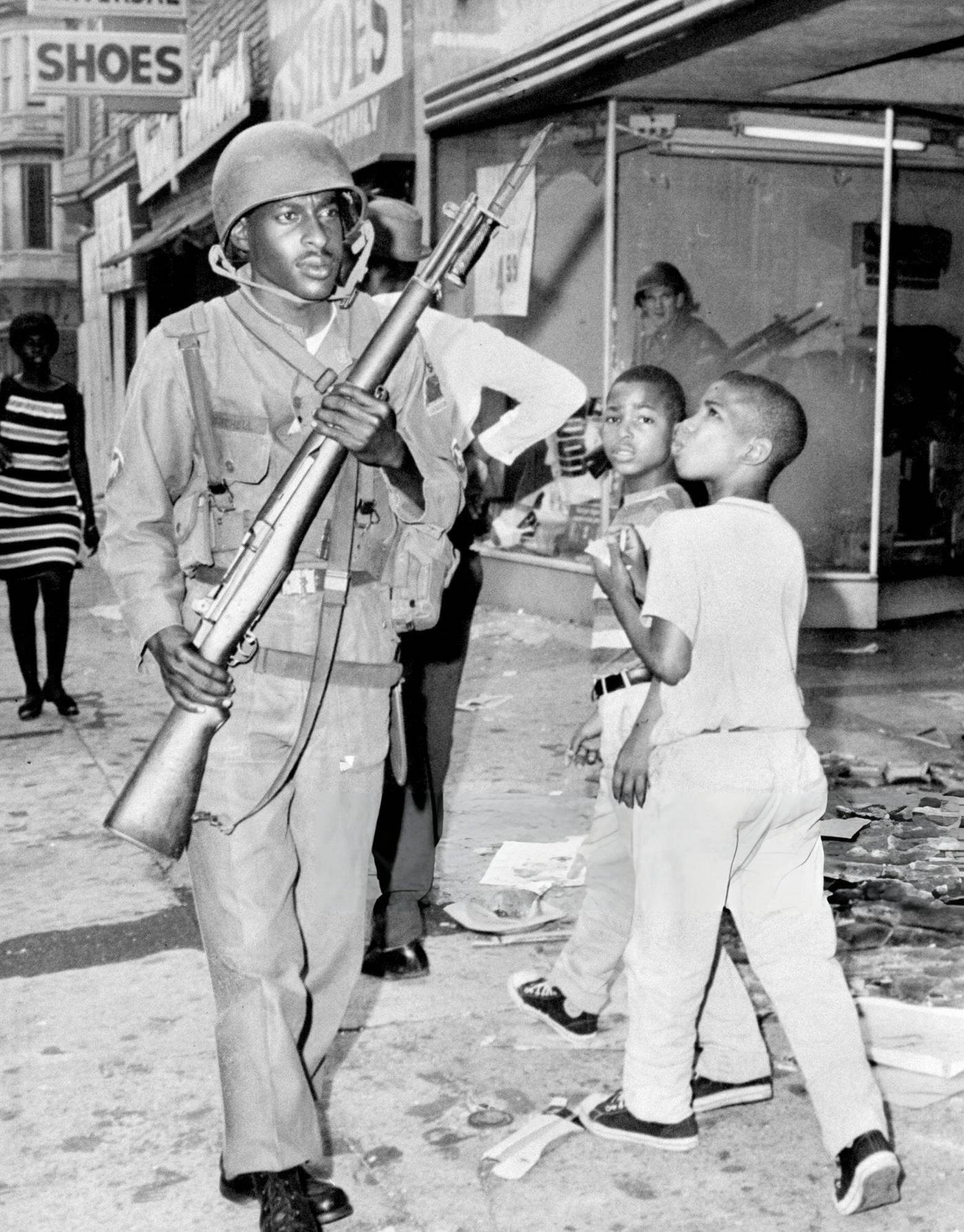
The immediate governmental response to the 1967 riots often compounded the tragedy. In Detroit, Governor George Romney deployed the Michigan National Guard, and President Lyndon B. Johnson eventually invoked the Insurrection Act to deploy federal Army paratroopers. The resulting military-style intervention involved heavy weaponry, armored vehicles, and indiscriminate firing, which contributed significantly to property damage and the loss of human life.
The Cost of Reactionary Governance
The events of 1967 demonstrated that deploying overwhelming military force without addressing underlying grievances merely suppresses symptoms while exacerbating trauma.
- Loss of Life and Property: The Newark riots resulted in 26 deaths and hundreds of injuries; the Detroit riots resulted in 43 deaths, over 1,000 injuries, and catastrophic property destruction.
- Erosion of Trust: Overly aggressive security measures alienated law-abiding residents, deepening distrust of municipal, state, and federal authorities.
- The Kerner Commission Warning: The commission famously warned that America was "moving toward two societies, one black, one white—separate and unequal," urging massive national investment over military suppression.
Proactive governance requires leaders to listen to community grievances before civil unrest erupts, establishing open communication channels and implementing structural reforms ahead of crises.
Lesson 5: The Need for Comprehensive Social Policy Over Band-Aid Solutions
Following the civil unrest of the 1960s, policymakers often turned to short-term, superficial fixes—such as increased emergency funding or temporary community outreach programs—that failed to dismantle structural inequities. Lesson five emphasizes that enduring social stability requires comprehensive, systemic policy reform.
Key Pillars of Comprehensive Social Policy
To prevent the recurrence of the conditions that sparked the 1967 uprisings, structural interventions must span multiple domains:
- Educational Equity: Eliminating funding disparities between urban and suburban school districts to ensure equal access to quality education and vocational training.
- Healthcare Access: Addressing disparities in health outcomes, life expectancy, and mental health resources within economically disadvantaged urban cores.
- Criminal Justice Reform: Implementing bail reform, eliminating mandatory minimum sentencing disparities, and establishing independent civilian review boards for law enforcement agencies.
- Economic Inclusion: Supporting minority-owned business enterprises, expanding workforce development programs aligned with modern industries, and enforcing robust anti-discrimination laws in labor markets.
Comparative Overview of the 1967 Newark and Detroit Riots
| Feature | Newark Riots (July 1967) | Detroit Riots (July 1967) |
|---|---|---|
| Duration | 6 days (July 12–17) | 5 days (July 23–28) |
| Immediate Catalyst | Arrest and beating of taxi driver John Smith | Police raid on an unlicensed after-hours club |
| Fatalities | 26 deaths | 43 deaths |
| Injuries | ~725 injuries | ~1,189 injuries |
| Property Damage | Estimated at $10 million to $15 million | Estimated at $40 million to $50 million |
| Security Forces | Newark Police, New Jersey State Police, National Guard | Detroit Police, Michigan National Guard, U.S. Army |
Frequently Asked Questions
What caused the race riots of 1967?
The 1967 riots were caused by chronic systemic issues, including widespread racial discrimination, severe housing segregation, high levels of urban unemployment, inadequate social services, and tense, hostile relations between minority communities and predominantly white police forces.
How did the Kerner Commission analyze the 1967 riots?
The Kerner Commission, established by President Lyndon B. Johnson, concluded that the riots stemmed from pervasive white racism and unequal social conditions. The commission warned that the United States was dividing into separate and unequal societies and recommended massive public investments in housing, employment, and education.
What role did police departments play in the 1967 uprisings?
Aggressive, discriminatory policing practices and a lack of accountability served as immediate catalysts and primary grievances in both Newark and Detroit. Heavy-handed tactics by law enforcement deepened community alienation and triggered the escalation of protests into widespread civil disorder.
What are the main economic takeaways from 1967?
The uprisings demonstrated that deindustrialization, lack of stable job opportunities, and barriers to upward economic mobility create fertile ground for social instability. Sustainable urban peace requires intentional economic investment, job creation, and fair labor practices.
How do the lessons of 1967 apply to modern governance?
Modern policymakers use the lessons of 1967 to emphasize proactive community engagement, police accountability, equitable resource distribution, and the dismantling of systemic discrimination. Addressing root socio-economic disparities remains essential for fostering resilient, stable communities.
Conclusion and Next Actions
Examining the race riots of 1967 provides critical historical perspective on the structural roots of urban civil unrest. To honor the lessons of this turbulent period, civic leaders, policymakers, and community members must prioritize proactive governance, dismantle economic barriers, enforce genuine police accountability, and invest equitably in urban infrastructure. Local stakeholders should review current municipal resource allocations, support independent oversight mechanisms for public safety agencies, and advocate for policies that ensure broad-based economic opportunity across all communities.