Effective NFPA 70E arc flash training must include five core components: the identification of qualified persons, comprehensive hazard risk assessments, the establishment of an electrically safe work condition (ESWC), proper selection and maintenance of Personal Protective Equipment (PPE), and rigorous emergency response and documentation procedures. These elements ensure compliance with OSHA mandates and minimize catastrophic workplace injuries.
In the high-stakes environment of electrical maintenance and operation, the National Fire Protection Association’s NFPA 70E: Standard for Electrical Safety in the Workplace serves as the definitive blueprint for protecting personnel. By 2026, the integration of these safety protocols has become more than a regulatory hurdle; it is a critical operational strategy for any organization utilizing energized equipment. An arc flash—a massive release of energy caused by an electric arc—can reach temperatures exceeding 35,000°F, vaporizing metal and causing fatal pressure waves. Consequently, training cannot be a "check-the-box" activity. It must be a deep, technical immersion into the following five essential pillars.
1. Defining and Verifying the "Qualified Person"
The distinction between a "qualified" and "unqualified" person is the bedrock of NFPA 70E. Training that fails to clearly delineate these roles puts both the employee and the employer at significant legal and physical risk. According to the standard, a qualified person is not merely someone who has attended a seminar. They must demonstrate the skills and knowledge related to the construction and operation of electrical equipment and installations and have received safety training to identify and avoid the associated hazards.
The Skills Gap and Field Verification
In 2026, industry standards emphasize that classroom or online training is only half of the equation. To be truly "qualified," an individual must undergo "employer-validated" hands-on training. This means a senior electrician or safety officer must observe the trainee performing specific tasks—such as using a digital multimeter to verify the absence of voltage—to ensure they can execute safe work practices in real-world conditions.
Training programs must teach workers how to:
- Distinguish exposed energized conductors and circuit parts from other parts of electrical equipment.
- Determine the nominal voltage of exposed energized conductors.
- Understand the specific safety-related work practices required for their assigned tasks.
Training for Unqualified Persons
It is a common mistake to assume that only electricians need arc flash training. NFPA 70E requires that unqualified persons (such as machine operators or janitorial staff working near electrical equipment) also receive training. Their curriculum focuses on recognizing when an electrical hazard exists and understanding the boundaries they must never cross. For example, an unqualified person must know that they cannot enter the "Limited Approach Boundary" unless escorted by a qualified individual.
2. Hazard Identification and Boundary Determination
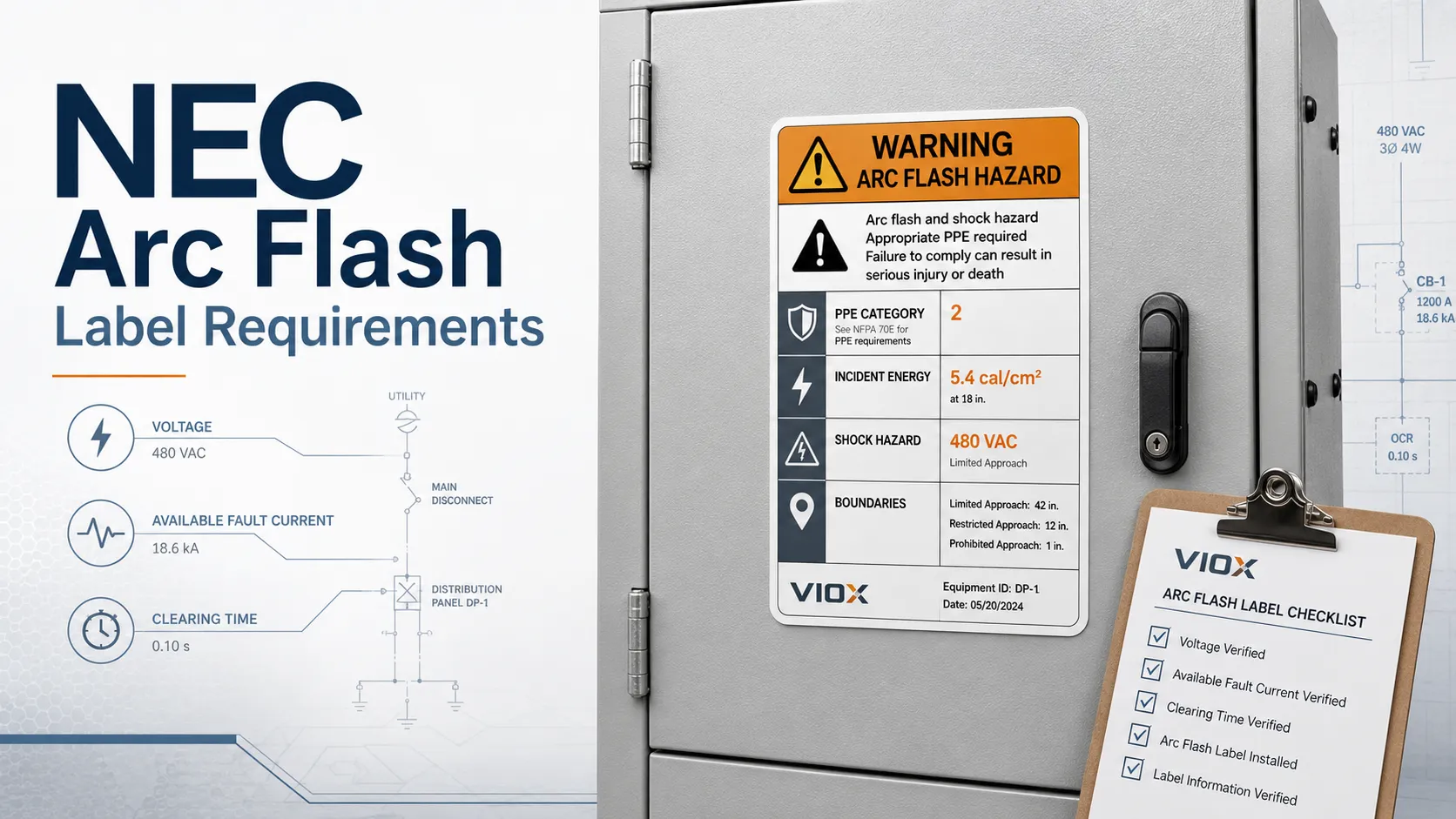
The second essential element is the ability to interpret the data found on arc flash labels and perform risk assessments. A worker who cannot read an equipment label is a worker who cannot protect themselves. Training must cover the two primary methods used to determine arc flash hazards: the Incident Energy Analysis Method and the PPE Category Method.
Understanding Incident Energy and the Arc Flash Boundary
Incident energy is the amount of thermal energy impressed on a surface, a certain distance from the source, generated during an electrical arc event. It is measured in calories per square centimeter ($cal/cm^2$). Training must teach employees that the Arc Flash Boundary is the distance at which a person could receive a second-degree burn ($1.2 cal/cm^2$) if an arc flash occurs.
Beyond the thermal boundary, training must also cover shock boundaries:
- Limited Approach Boundary: The distance from an exposed energized conductor within which a shock hazard exists.
- Restricted Approach Boundary: The distance from an exposed energized conductor where there is an increased risk of shock due to electrical arc-over combined with inadvertent movement.
Risk Assessment Procedure
The 2024 and subsequent 2027 iterations of NFPA 70E emphasize a "Risk Assessment" approach rather than just a hazard identification approach. Training must teach employees to evaluate the likelihood of an occurrence. For example, operating a circuit breaker that has been properly maintained and has all covers in place carries a lower risk than performing voltage testing on exposed busbars. Employees must be trained to recognize "abnormal conditions," such as evidence of overheating, moisture, or loose parts, which immediately elevate the risk level.
3. Establishing an Electrically Safe Work Condition (ESWC)
The safest way to work on electrical equipment is to ensure it is not energized. NFPA 70E prioritizes the establishment of an Electrically Safe Work Condition (ESWC) as the primary safety strategy. Training must provide a rigorous, step-by-step breakdown of how to achieve this state, moving beyond simple lockout/tagout (LOTO) procedures.
The 8 Steps of the ESWC
Training must drill the following sequence into every qualified worker to ensure no steps are skipped during a long shift or under pressure:
| Step | Action | Description |
|---|---|---|
| 1 | Identify Sources | Determine all possible sources of electrical energy to the specific equipment. |
| 2 | Interrupt Load | Properly interrupt the load current, then open the disconnecting device(s). |
| 3 | Visual Verify | Where possible, visually verify that all blades of the disconnecting devices are fully open. |
| 4 | Release Energy | Release stored electrical energy (e.g., discharge capacitors). |
| 5 | Block Energy | Release or block stored mechanical energy. |
| 6 | Apply LOTO | Apply lockout/tagout devices in accordance with established policy. |
| 7 | Test for Voltage | Use an adequately rated portable voltmeter to test each phase conductor. |
| 8 | Grounding | Apply temporary protective grounds where the possibility of induced voltages exists. |
The "Test-Before-Touch" Rule
The most critical part of this element is Step 7. Training must emphasize the Live-Dead-Live test method. This involves testing the voltmeter on a known energized source, then testing the de-energized equipment, and then re-testing the voltmeter on the known source to ensure the meter did not fail during the process. This specific training point saves more lives than perhaps any other technical skill.
4. PPE Selection, Care, and Maintenance
When an Electrically Safe Work Condition cannot be established (such as during troubleshooting or testing), Personal Protective Equipment (PPE) is the final line of defense. However, PPE only works if it is rated correctly for the specific incident energy available at the piece of equipment.
The Hierarchy of PPE
Training must explain that PPE is not a substitute for safe work practices; it is a mitigation strategy. The curriculum should cover:
- Arc-Rated (AR) Clothing: Understanding that "Flame Resistant" (FR) is not necessarily "Arc-Rated," and that all clothing within the arc flash boundary must be arc-rated.
- Layering: How layering non-melting undergarments (like cotton or wool) can provide additional protection, and the extreme danger of wearing synthetic materials (like polyester or nylon) that can melt into the skin.
- Head, Face, and Hand Protection: The use of arc-rated face shields, balaclavas, and insulated gloves with leather protectors.
Maintenance and Inspection
By 2026, the focus on PPE maintenance has intensified. Training must include instructions on how to inspect PPE before every use. Workers must look for holes, tears, or contamination from oil and grease, which can compromise the arc rating of the fabric. Furthermore, training should cover the "care and feeding" of PPE—how to wash it without destroying its protective properties (e.g., avoiding bleach and certain fabric softeners).
5. Emergency Response and Documentation
The final element of a comprehensive NFPA 70E training program is preparing for the worst-case scenario. If an arc flash or shock occurs, the response time of bystanders and co-workers determines the survival of the victim.
Emergency Procedures
Training must include:
- Release of Victims: How to safely remove a victim from an energized circuit without becoming a victim themselves (using a non-conductive rescue hook).
- First Aid and CPR: NFPA 70E requires that employees responsible for responding to medical emergencies be trained in First Aid, CPR, and the use of an Automated External Defibrillator (AED).
- Emergency Communication: Establishing clear protocols for who to call and what information to provide to emergency responders regarding the nature of the electrical accident.
Documentation and Compliance
From a management perspective, if it isn't documented, it didn't happen. NFPA 70E requires specific records to be maintained. Training should instruct supervisors and safety officers on:
- Training Records: Documenting the content of the training, the employee’s name, and the dates of training.
- Audit Requirements: The standard requires an audit of the electrical safety program at least every three years and an audit of field work at least annually to ensure workers are following the practices they were taught.
- Retraining Cycles: Retraining must happen at least every three years, or sooner if an audit reveals that an employee is not following safe work practices, or if the job duties change.
The Role of Technology in 2026 Training
In 2026, the delivery of these five elements often incorporates Virtual Reality (VR) and Augmented Reality (AR). These technologies allow "Qualified Persons" to practice the 8 steps of establishing an ESWC or the Live-Dead-Live test in a risk-free digital environment before touching live equipment. While technology enhances the learning experience, it remains a supplement to the core requirements of NFPA 70E.
Organizations should look for training providers that offer a blended learning approach—combining theoretical knowledge (online or classroom) with practical, hands-on demonstrations. This ensure that the five essential elements are not just heard, but mastered.
Frequently Asked Questions
How often is NFPA 70E training required?
NFPA 70E 110.6(A)(4) stipulates that retraining in safety-related work practices and applicable changes in the standard shall be performed at intervals not to exceed three years. However, employees must be retrained sooner if annual inspections indicate they are not complying with safety procedures, or if new technology and equipment are introduced to the workplace.
Can NFPA 70E training be done entirely online?
While the theoretical components (the "knowledge" part) can be effectively delivered online, the "skills" part of becoming a Qualified Person usually requires a hands-on component. The employer is ultimately responsible for verifying that the worker can perform the tasks safely in the field. Therefore, a hybrid model is generally considered the industry best practice.
What is the difference between a 10-hour OSHA card and NFPA 70E training?
The OSHA 10-hour course provides a broad overview of general construction or industry safety, including a brief section on electricity. NFPA 70E training is a deep-dive, technical standard specifically focused on electrical safety. OSHA often uses NFPA 70E as evidence of what constitutes a "safe workplace" under the General Duty Clause, but an OSHA 10 card is not a substitute for specialized arc flash training.
Does arc flash training cover DC (Direct Current) systems?
Yes. Modern NFPA 70E training must cover both AC and DC systems. With the proliferation of solar PV arrays, battery energy storage systems (BESS), and electric vehicle charging infrastructure in 2026, understanding DC arc flash hazards—which behave differently than AC arcs—is more important than ever.
What happens if an employer fails to provide this training?
Failure to provide adequate training can result in significant OSHA citations and fines, especially under OSHA 1910.332. More importantly, it leaves the employer liable in the event of a workplace injury or fatality, leading to potential multi-million dollar legal settlements and, most tragically, the loss of life.
Practical Recommendation
To ensure your facility is fully compliant in 2026, start by conducting a gap analysis of your current training records. Verify that your "Qualified Persons" have not only attended a class within the last three years but have also had their field skills documented by a supervisor. If you are unsure of your equipment’s incident energy levels, prioritize a professional Arc Flash Hazard Analysis to provide the data necessary for accurate PPE selection. Safety is a continuous cycle of training, auditing, and refining; staying current with NFPA 70E is the most effective way to protect your most valuable asset—your people.