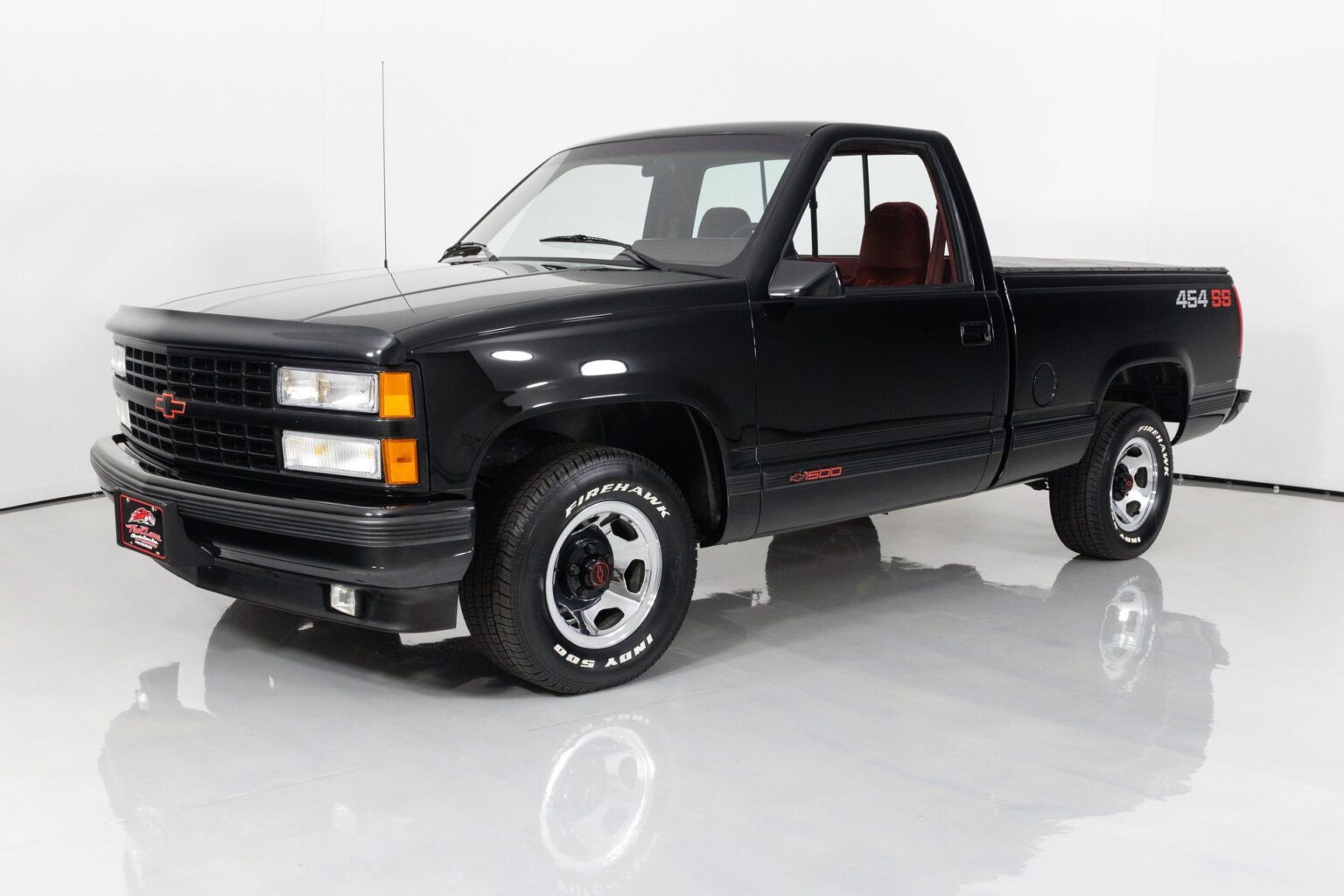
The 1990 Chevrolet 454 SS is a high-performance variant of the C/K 1500 regular-cab short-bed pickup, featuring a 7.4-liter V8 engine producing 230 horsepower and 385 lb-ft of torque. It utilizes a three-speed Turbo Hydra-Matic 400 automatic transmission, a 3.73 rear axle ratio, and specialized Bilstein gas-pressure shocks for enhanced handling.
The late 1980s and early 1990s represented a transformative period for American automotive engineering. While the muscle car era had technically ended in the mid-1970s due to emissions regulations and fuel crises, the spirit of displacement-heavy performance lived on in the truck segment. Chevrolet’s introduction of the 454 SS in 1990 was a bold statement, effectively creating the modern "sport truck" niche. By taking their lightest full-size chassis and stuffing it with their largest passenger-vehicle engine, Chevrolet provided a recipe for straight-line dominance that remains legendary in 2026.
The Foundation: The GMT400 Platform and the B4U Option
To understand the 1990 Chevrolet 454 SS, one must first look at the GMT400 platform. Introduced for the 1988 model year, the GMT400 was a massive leap forward in truck design, offering better aerodynamics, a more comfortable interior, and an independent front suspension that improved ride quality significantly over the previous "Square Body" generation.
The 454 SS was designated by the RPO code B4U. It was exclusively available as a C1500 (half-ton, two-wheel drive) regular cab with a "fleetside" short box. This configuration was chosen specifically for its weight advantages. By keeping the wheelbase short at 117.5 inches, Chevrolet ensured the truck remained agile enough to handle the massive weight of the big-block engine sitting over the front wheels.
In 1990, the 454 SS was only available in one color scheme: Onyx Black with a Garnet Red cloth interior. This monochromatic look, featuring a blacked-out grille, bumpers, and mirrors, set it apart from the chrome-laden work trucks of the era. The only exterior splashes of color were the red "454 SS" decals on the rear quarter panels and the red Chevrolet "bowtie" on the grille.
The Heart of the Beast: The 7.4L Mark IV Big Block
The defining feature of the 1990 454 SS was, of course, the engine. The L19 454 cubic inch (7.4L) V8 was a monster by 1990 standards, though its specifications might seem modest compared to modern turbocharged powerplants.
Engine Architecture and Fueling
The L19 utilized a cast-iron block and cylinder heads. In 1990, it employed Throttle Body Injection (TBI), which used two large fuel injectors sitting atop what looked like a traditional carburetor base. While TBI was more reliable and efficient than a carburetor, it was relatively restrictive, which explains why the 454 produced "only" 230 horsepower at 3,600 RPM.
However, horsepower was never the point of a big block; torque was the objective. The 1990 454 SS produced a massive 385 lb-ft of torque at just 2,400 RPM. This low-end grunt allowed the truck to accelerate from a standstill with significant urgency, making it a favorite for stoplight-to-stoplight sprints.
Cooling and Lubrication
To manage the heat generated by 7.4 liters of displacement, Chevrolet equipped the 454 SS with a heavy-duty cooling package. This included a high-capacity radiator and an external oil cooler. These features were essential, as the big-block engine occupied nearly every square inch of the engine bay, leaving little room for natural heat dissipation.
Drivetrain: The Turbo Hydra-Matic 400 and the 14-Bolt Rear End
For the inaugural 1990 model year, Chevrolet opted for durability over highway manners. The transmission selected was the TH400 (Turbo Hydra-Matic 400). This was a three-speed automatic transmission known for its nearly indestructible nature in high-torque applications.
Transmission Limitations
The primary drawback of the TH400 in 1990 was the lack of an overdrive gear. With a 1:1 final drive ratio in third gear, the engine spun at high RPMs during highway cruising. Combined with the truck’s aerodynamics, this led to an EPA fuel economy rating of approximately 10-11 MPG, though real-world figures often dipped into the single digits. (Note: The 1991-1993 models would later upgrade to the 4L80E four-speed electronic overdrive transmission).
The Heavy-Duty Rear Axle
Power was sent to the pavement via a heavy-duty 14-bolt semi-floating rear axle equipped with a 3.73:1 gear ratio. This was significantly beefier than the 10-bolt axles found in standard C1500 trucks. To ensure that the torque translated into forward motion rather than just smoke from one tire, a locking differential (often referred to as the Gov-Lock) was standard equipment. This allowed both rear wheels to grip simultaneously under heavy acceleration.
Suspension and Handling: The Performance Handling Package
While the 454 SS was primarily a drag-strip-style performer, Chevrolet did make efforts to improve its handling characteristics relative to a standard pickup.
- Bilstein Gas-Pressure Shocks: These shocks provided a firmer ride and better damping than the standard hydraulic units, reducing the "floaty" feeling typical of 90s trucks.
- Increased Spring Rates: The front coil springs and rear leaf springs were stiffened to handle the weight of the 454 engine and to reduce body roll in corners.
- Thicker Front Sway Bar: A 32mm front stabilizer bar was installed to keep the front end planted.
- Quick-Ratio Steering: The steering box was tuned for a faster response, making the truck feel more nimble than its 4,500-pound curb weight suggested.
The truck sat on 15x7-inch chrome-plated steel wheels wrapped in BFGoodrich Comp T/A P275/60R15 tires. These wide tires were essential for providing the necessary contact patch to manage the torque.
Detailed Technical Specifications Table
The following table summarizes the key technical data for the 1990 Chevrolet 454 SS.
| Specification | Detail |
|---|---|
| Engine Type | 7.4L (454 cu in) V8, OHV 16-valve |
| Fuel System | Electronic Throttle Body Injection (TBI) |
| Horsepower | 230 hp @ 3,600 RPM |
| Torque | 385 lb-ft @ 2,400 RPM |
| Compression Ratio | 7.9:1 |
| Transmission | 3-speed TH400 Automatic |
| Rear Axle | 14-bolt semi-floating, 3.73 gears |
| Differential | Locking (Positraction) |
| Front Suspension | Independent with Bilstein shocks and 32mm sway bar |
| Rear Suspension | Multi-leaf springs with Bilstein shocks |
| Brakes (F/R) | Power-assisted Disc / Drum (Rear ABS) |
| Curb Weight | Approx. 4,520 lbs |
| Wheelbase | 117.5 inches |
| Fuel Tank Capacity | 25 Gallons |
| 0-60 MPH (1990) | Approx. 7.7 seconds |
| 1/4 Mile (1990) | Approx. 15.9 seconds @ 85 MPH |
Interior Comfort and Aesthetics
The interior of the 1990 454 SS was surprisingly well-appointed for a performance truck. Because it was marketed as a premium "halo" vehicle, it came standard with the high-end Silverado trim package.
The most striking feature was the Garnet Red color scheme. The high-back bucket seats were upholstered in a soft cloth with supportive side bolsters—a rarity in trucks at the time. Between the seats sat a center console with storage and cupholders.
The dashboard featured a full set of gauges, which was a critical inclusion for a performance vehicle. Drivers could monitor oil pressure, battery voltage, and coolant temperature, alongside a tachometer. Other standard features included:
- Air conditioning
- Cruise control
- Tilt steering wheel
- Delco AM/FM stereo with cassette player and graphic equalizer
- Power windows and door locks
Performance and Real-World Driving Dynamics
In 1990, a 0-60 MPH time of 7.7 seconds was genuinely impressive for a vehicle with the aerodynamics of a brick. For context, it was competitive with several sports cars of the era and could out-accelerate many V8-powered sedans.
However, the driving experience was dominated by the engine's torque curve. The 454 SS didn't need to rev high to get moving; a light tap on the accelerator resulted in an immediate surge of power. The downside of this front-heavy bias was weight distribution. With a massive iron engine over the front wheels and very little weight over the rear, the truck was prone to losing traction on wet or loose surfaces.
The braking system utilized front discs and rear drums. While typical for the time, the 454 SS was one of the early adopters of Rear-Wheel Anti-lock Brakes (RWAL) in the truck market. This system helped prevent the rear end from washing out during hard braking, although it was not as sophisticated as modern four-wheel ABS systems found in 2026.
Collectors' Market and Rarity
Approximately 13,748 units of the 454 SS were produced for the 1990 model year. This was the highest production year for the model, as sales tapered off in 1991, 1992, and 1993.
As of 2026, the 1990 454 SS has become a highly sought-after collector's item. Collectors specifically look for "survivor" trucks—those that haven't been heavily modified or succumbed to the rust issues common to the GMT400 cab corners and rockers.
Value Factors in 2026:
- Originality: Trucks with the original TBI setup and TH400 transmission command a premium among purists.
- Mileage: Due to the poor fuel economy, many of these trucks were used sparingly, meaning low-mileage examples (under 50,000 miles) still appear on the market.
- Dashboard Condition: The plastic interiors of the early GMT400 trucks were prone to cracking and fading; a pristine Garnet Red interior is a significant value adder.
Maintenance and Common Issues
Owning a 1990 454 SS in 2026 requires an understanding of late-20th-century GM engineering. While the big-block engine is fundamentally robust, there are several areas owners should monitor.
The TBI Fuel System
The TBI units are simple but can suffer from hardened gaskets or clogged injectors over decades of use. Fuel pressure is critical on these engines; if the fuel pump (located inside the gas tank) begins to fail, the engine will stumble under load, even if it idles fine.
The "Gov-Lock" Rear End
The locking differential is effective but can be fragile if subjected to repeated "neutral drops" or extreme abuse on high-traction surfaces. If the internal weights or springs shatter, it can lead to a catastrophic failure of the rear axle assembly.
Cooling System Maintenance
Because the 454 runs hot, the cooling system must be kept in top condition. This includes regular flushing of the radiator and ensuring the fan clutch is engaging properly. Many owners in warmer climates upgrade to electric fans to help pull more air through the radiator at idle.
Frequently Asked Questions
What is the main difference between the 1990 and 1991 454 SS?
The 1990 model uses a 3-speed TH400 automatic transmission and produces 230 horsepower. The 1991-1993 models were upgraded to a 4-speed 4L80E transmission (with overdrive), a 4.10 rear axle ratio, and a slight power bump to 255 horsepower and 405 lb-ft of torque.
Was the 1990 454 SS available in other colors?
No. For the 1990 model year, Onyx Black was the only exterior color option. In 1992 and 1993, Chevrolet expanded the palette to include Summit White and Victory Red.
How much weight can the 1990 454 SS tow?
While it has a massive engine, the 454 SS was not designed primarily for towing. It has a relatively low payload capacity due to its sport-tuned suspension. However, when properly equipped, it was generally rated to tow approximately 6,000 to 7,500 lbs, though the short wheelbase makes it less stable for towing than a long-bed or 2500-series truck.
Is the 1990 Chevrolet 454 SS fuel injected?
Yes, it uses Throttle Body Injection (TBI). While it looks like a carburetor under the air cleaner, it is an electronic fuel injection system that uses two injectors and a basic Engine Control Module (ECM) to manage fuel delivery.
Why is the horsepower so low for such a large engine?
In 1990, emissions standards and the limitations of TBI technology meant that engines were not optimized for high-RPM airflow. The 454 was designed for low-end torque and durability rather than peak horsepower. The cylinder heads and intake manifold used on the L19 were designed for "swirl-port" combustion, which prioritized fuel mixing at low speeds over high-speed breathing.
Summary of Next Actions for Buyers or Owners
If you are looking to purchase a 1990 Chevrolet 454 SS in 2026, your first step should be to verify the VIN and RPO codes to ensure it is a genuine B4U truck and not a "clone" (a standard C1500 with a 454 swapped in). Authentic trucks will have the B4U code on the Service Parts Identification sticker, usually located in the glove box.
For current owners, preserving the original Garnet Red interior and Onyx Black paint is essential for maintaining the vehicle's investment value. As these trucks cross the 35-year mark, rubber components, including vacuum lines and suspension bushings, should be inspected and replaced to maintain the sharp handling characteristics that defined the 454 SS when it first rolled off the assembly line.