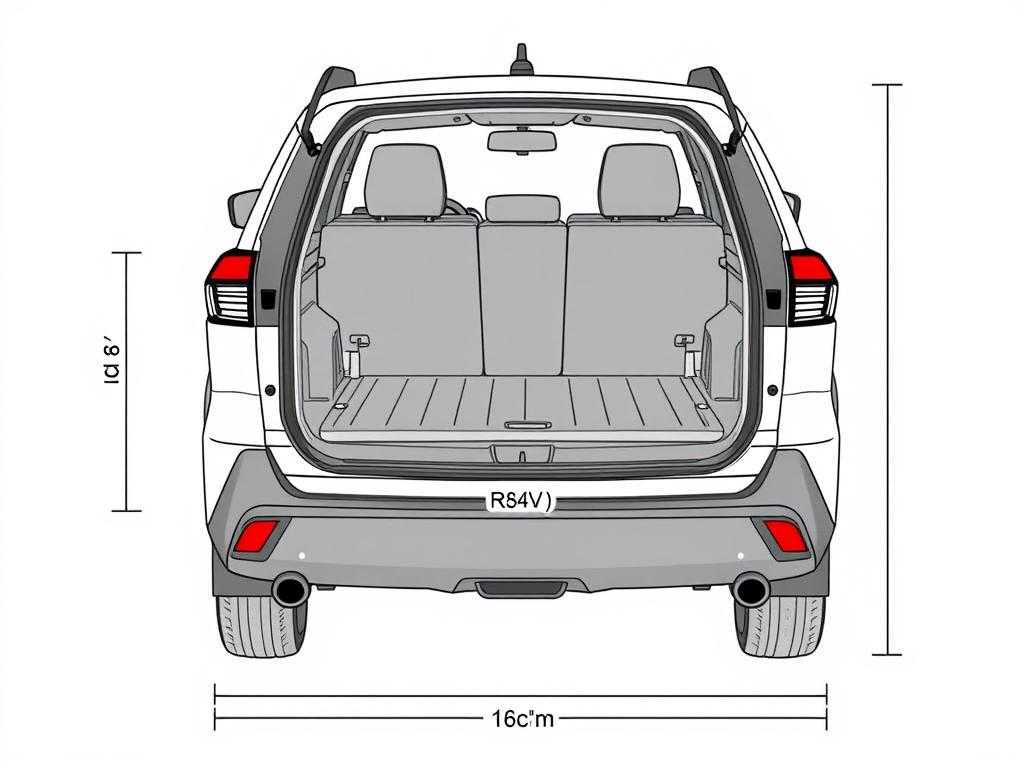
The Toyota RAV4 currently features a wheelbase of 105.9 inches (2,690 mm) for its fifth and latest generation models as of 2026. This specific measurement is a critical engineering factor that dictates the vehicle’s interior legroom, high-speed stability, ride quality, and its ability to navigate tight urban environments or off-road trails.
The wheelbase of a vehicle—the distance between the centers of the front and rear wheels—is arguably the most influential dimension in automotive design. For the Toyota RAV4, a vehicle that has transitioned from a compact "Recreational Active Vehicle with 4-wheel drive" into a sophisticated family crossover, the wheelbase serves as the foundation for its balance between utility and maneuverability. In this comprehensive analysis, we examine the exact dimensions of the RAV4's wheelbase and the multi-faceted impact these measurements have on the driving experience in 2026.
Understanding the RAV4 Wheelbase Evolution
To understand the impact of the current 105.9-inch wheelbase, one must look at how Toyota has scaled the RAV4 over the decades. The vehicle has grown significantly since its debut in the mid-1990s. The initial first-generation (XA10) two-door models had a diminutive wheelbase of just 86.6 inches, while the four-door models sat at 94.9 inches.
By the time the fifth generation launched on the Toyota New Global Architecture (TNGA-K) platform, the wheelbase had been extended to the current 105.9 inches. This evolution reflects a shift in consumer demand: modern drivers require a vehicle that can serve as a primary family car, necessitating a "longer footprint" to accommodate more safety technology, hybrid powertrains, and passenger comfort.
Current RAV4 Dimensional Specifications (2026 Model Year)
| Feature | Dimension (Inches) | Dimension (Millimeters) |
|---|---|---|
| Wheelbase | 105.9 in | 2,690 mm |
| Overall Length | 180.9 - 181.5 in | 4,595 - 4,610 mm |
| Overall Width | 73.0 in | 1,855 mm |
| Overall Height | 67.0 - 68.6 in | 1,700 - 1,740 mm |
| Front Track Width | 62.6 in | 1,590 mm |
| Rear Track Width | 63.3 in | 1,608 mm |
| Ground Clearance | 8.1 - 8.6 in | 205 - 218 mm |
The Impact on Interior Space and Rear Legroom
The primary beneficiary of a 105.9-inch wheelbase is the cabin. In automotive packaging, the "dash-to-axle" ratio and the distance between the B-pillar and the rear axle determine how much room is available for human occupants versus mechanical components.
Passenger Legroom
A longer wheelbase allows the rear seats to be positioned further back without encroaching on the rear wheel wells. In the RAV4, this results in approximately 37.8 inches of rear legroom. This measurement is crucial for families with tall teenagers or those who frequently use rear-facing child safety seats. Because the wheelbase is optimized for the TNGA-K platform, Toyota engineers have managed to keep the floor relatively flat, even in Hybrid and Plug-in Hybrid (Prime) variants, despite the presence of battery packs.
Entry and Exit Ergonomics
The wheelbase also dictates the size of the rear door apertures. A 105.9-inch span allows for wider rear doors that open to nearly 90 degrees in some trim levels. This makes it significantly easier to load cargo into the footwells or to secure children into car seats, a practical advantage that stems directly from the distance between the two axles.
Driving Dynamics: Stability vs. Agility
The "impact" of the wheelbase is most felt when the vehicle is in motion. There is a fundamental trade-off in physics between a long wheelbase and a short one, and Toyota has positioned the RAV4 in the "Goldilocks" zone for crossovers.
High-Speed Stability
The RAV4’s 105.9-inch wheelbase provides excellent longitudinal stability. When driving at highway speeds, a longer distance between the axles reduces the vehicle's tendency to "pitch"—the rocking motion felt when hitting expansion joints or dips in the road. This makes the RAV4 feel more planted and less skittish than smaller crossovers with sub-100-inch wheelbases.
Turning Radius and Maneuverability
Conversely, a longer wheelbase typically increases the turning circle. The RAV4 maintains a curb-to-curb turning diameter of approximately 36.1 to 37.4 feet, depending on wheel size (17-inch vs. 19-inch). While larger than a subcompact car, this remains highly competitive for the compact SUV segment. It allows the RAV4 to remain a viable choice for urban dwellers who must navigate tight parking garages and narrow city streets.
The TNGA-K Advantage
It is important to note that the impact of the wheelbase is augmented by the TNGA-K platform's low center of gravity. By placing the heavy mechanical components lower within that 105.9-inch span, Toyota has mitigated the "top-heavy" feel common in SUVs, resulting in a more car-like handling profile that belies the vehicle’s ride height.
Ride Quality and Suspension Geometry
The relationship between the wheelbase and ride quality is a matter of frequency and bridge-building. A longer wheelbase effectively "bridges" road imperfections. When the front tires hit a bump, the delay before the rear tires hit the same bump is longer in a vehicle with a 105.9-inch wheelbase compared to a shorter vehicle.
This delay allows the suspension system more time to settle, preventing a "bucking" sensation. In the RAV4, the wheelbase works in tandem with a multi-link rear suspension to isolate the cabin from vibrations. This is particularly noticeable on unpaved roads or poorly maintained highways where "washboard" surfaces can cause shorter vehicles to lose traction or become uncomfortable.
Off-Road Capability and the Breakover Angle
For enthusiasts looking at the RAV4 TRD Off-Road or Adventure trims, the wheelbase has a direct impact on off-road geometry, specifically the breakover angle.
The breakover angle is the maximum peak angle a vehicle can drive over without the apex of that peak touching the underside of the chassis.
- A shorter wheelbase yields a better breakover angle.
- A longer wheelbase (like the RAV4’s 105.9 inches) makes the vehicle more susceptible to "high-centering" on sharp crests.
To compensate for this, Toyota has engineered the RAV4 with a ground clearance of up to 8.6 inches in specific trims. While the wheelbase is designed primarily for on-road comfort and stability, the combination of short front/rear overhangs and the specific axle placement ensures the RAV4 remains capable for light-to-moderate trail use, such as reaching remote campsites or navigating snowy fire roads.
Comparative Analysis: RAV4 vs. Key Competitors
To fully grasp the impact of the RAV4's dimensions, we must compare them to its primary rivals in the 2026 market.
| Vehicle | Wheelbase (Inches) | Impact/Difference |
|---|---|---|
| Toyota RAV4 | 105.9 | The Segment Standard: Balanced stability and agility. |
| Honda CR-V | 106.3 | Slightly longer; prioritizes maximum rear-seat legroom. |
| Mazda CX-5 | 106.2 | Similar length, but prioritizes front-axle placement for steering feel. |
| Subaru Forester | 105.1 | Shorter; emphasizes a tighter turning radius and better breakover angle. |
| Hyundai Tucson | 108.5 | Significantly longer; focuses on mid-size-level interior volume. |
The RAV4’s wheelbase is slightly shorter than the CR-V and Tucson, which explains why those vehicles might offer a fraction more legroom or a slightly smoother highway ride, while the RAV4 feels more compact and easier to place in a parking spot.
Impact on Fuel Efficiency and Aerodynamics
While it may seem indirect, the wheelbase affects the vehicle's aerodynamic profile. A longer wheelbase allows for a more gradual "taper" of the vehicle's bodywork, which can reduce air turbulence underneath the car.
In the 2026 RAV4 Hybrid and Prime models, the 105.9-inch wheelbase allows for a large underbody tray that smooths airflow. Furthermore, the distance between the wheels provides the necessary volume to house the lithium-ion battery packs centrally. Placing the weight between the axles—rather than over or behind them—ensures that the vehicle's "polar moment of inertia" remains optimized, meaning the car doesn't feel sluggish when changing directions despite the added weight of the hybrid system.
Practical Considerations for the Modern Buyer
When evaluating the "1 wheelbase rav4 dimensions and impact," buyers should consider three practical scenarios where these measurements matter most:
- Garage Fitment: The 105.9-inch wheelbase contributes to an overall length of roughly 181 inches. This is small enough to fit into a standard "short" suburban garage while still leaving room for a workbench or storage at the front.
- Towing Stability: If you plan to tow a small trailer (up to 3,500 lbs on the Adventure/TRD trims), the 105.9-inch wheelbase is long enough to prevent the "tail wagging the dog" syndrome, providing a stable platform for towing.
- Tire Wear: A well-proportioned wheelbase ensures more even weight distribution across all four tires. In AWD models, this helps maintain the longevity of the tires and the efficiency of the rear-axle electric motor (in hybrids).
Frequently Asked Questions
Does the RAV4 wheelbase change between the Gas and Hybrid models?
No, the wheelbase remains identical at 105.9 inches across all powertrain variants, including the Gas, Hybrid, and Plug-in Hybrid (Prime) models. This consistency is due to the modular nature of the TNGA-K platform, which was designed from the outset to accommodate various battery and engine configurations without altering the chassis's hard points.
How does the wheelbase affect the RAV4's cargo space?
While the wheelbase primarily affects passenger legroom, it indirectly impacts cargo space by determining where the rear wheel wells intrude into the trunk area. The 105.9-inch wheelbase allows for a cargo floor length that can accommodate most standard suitcases and groceries, though the total volume (approx. 37.5 - 37.6 cubic feet) is also influenced by the vehicle's height and rear pillar "rake."
Is a longer wheelbase always better for an SUV?
Not necessarily. A longer wheelbase improves ride comfort and interior room but sacrifices maneuverability and off-road "breakover" clearance. The RAV4’s 105.9-inch dimension is a compromise designed to satisfy the 90% of drivers who prioritize highway comfort while maintaining enough agility for the remaining 10% of urban or light-trail driving.
Does the RAV4 have a shorter wheelbase than the Toyota Highlander?
Yes. The Toyota Highlander, which sits on a larger version of the TNGA-K platform, has a wheelbase of approximately 112.2 inches. This additional length is necessary to accommodate the Highlander’s third row of seating and provides a significantly different driving feel, prioritizing "limousine-like" stability over the RAV4’s more tossable, compact nature.
How does the wheelbase impact the safety ratings of the RAV4?
The wheelbase is a key factor in side-impact protection. The distance between the wheels allows for reinforced side sills and B-pillar structures that can better absorb and deflect energy in a collision. Furthermore, the stable footprint provided by the 105.9-inch wheelbase contributes to the vehicle's low rollover risk, a metric where the RAV4 consistently performs well in IIHS testing.
Final Recommendation: Is the RAV4's Wheelbase Right for You?
If your priority is a vehicle that feels stable on the highway, offers enough room for a growing family, and remains easy to park in a grocery store lot, the 105.9-inch wheelbase of the Toyota RAV4 is an ideal specification. It represents a mature balance of engineering priorities, providing the comfort of a larger vehicle with the footprint of a compact one.
For those who prioritize maximum off-road rock crawling, a vehicle with a shorter wheelbase (like a Jeep Wrangler 2-door) would be superior. Conversely, if you frequently transport four adults over long distances, a vehicle with a longer wheelbase (like the Toyota Crown Signia or Highlander) might offer more "stretch-out" room. However, as a versatile "do-everything" vehicle, the RAV4’s dimensions remain the benchmark for the crossover segment in 2026.