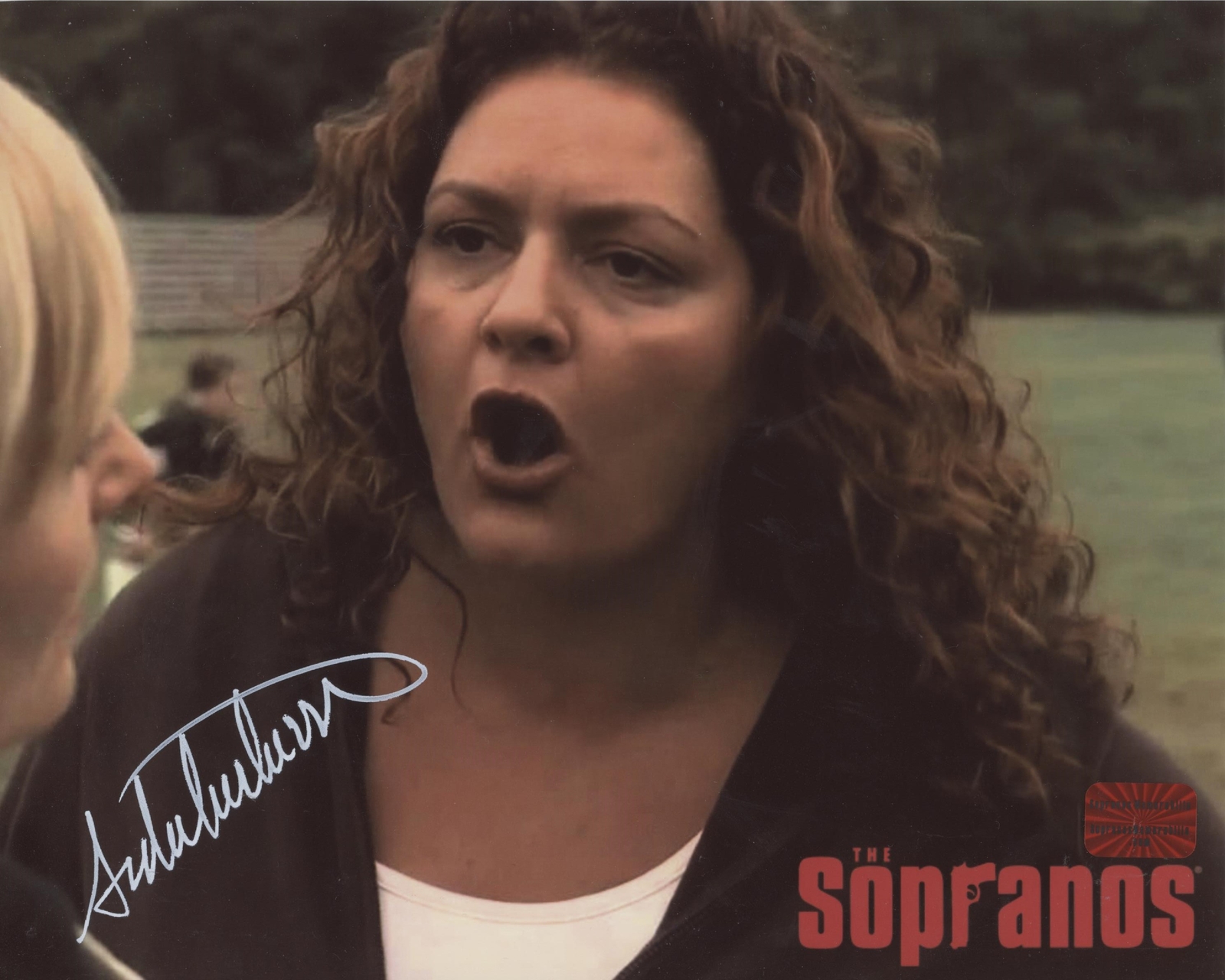
Aida Turturro’s portrayal of Janice Soprano in The Sopranos stands as one of the most complex, polarizing, and masterfully executed character studies in television history. Over the course of her tenure on the HBO series, Turturro navigated the volatile evolution of Tony Soprano’s older sister, transforming a character defined by transient bohemianism into a calculated, manipulative force that mirrored her brother's own darker tendencies.
The Character Arc of Janice Soprano
When Janice first appears in the second season, she arrives under the guise of the prodigal daughter returning to reconcile with her ailing mother, Livia. However, as the narrative unfolds, it becomes clear that Janice is motivated primarily by self-interest and the potential for financial gain from the Soprano estate.
Turturro’s performance is anchored in the duality of the character. Janice is frequently depicted as a woman who hides her toxic ambition behind a thin veneer of New Age spirituality and progressive ideals. She adopts different personas—ranging from the devoted wife to the struggling mother—to suit her immediate survival needs. This fluidity allows Aida Turturro to showcase a wide emotional range, shifting seamlessly from calculated serenity to explosive, authentic rage.
Domestic Dynamics: The Relationship with Tony Soprano
The core tension of Janice’s role in The Sopranos is her relationship with Tony. While they share a childhood defined by their volatile mother, their adult relationship is characterized by a cycle of codependency, exploitation, and resentment.
Turturro masterfully portrays the friction between the siblings. She plays Janice as someone who both envies Tony’s power and believes she is his intellectual superior. This often manifests in scenes where Janice attempts to manipulate Tony, only to retreat into a victim mentality when she is confronted. The power dynamic shifts dramatically throughout the seasons, particularly during the middle arc of the series, where Janice’s domestic life with Bobby Baccalieri forces Tony to interact with her not just as a sibling, but as a member of his "family" business environment.
Key Narrative Milestones
To understand the significance of Aida Turturro’s performance, one must look at specific narrative arcs that tested the character's limits:
- The Homecoming: Her initial return acts as a catalyst for the series' shift toward exploring the generational trauma within the Soprano household.
- The Richie Aprile Era: Her involvement with Richie Aprile serves as a bridge between the domestic and criminal worlds of the show. It highlights Janice’s capacity for violence, both verbal and physical.
- The Marriage to Bobby Baccalieri: Perhaps the most "grounded" era for the character, this period humanizes her while simultaneously exposing her ability to influence even the most loyal of Tony’s capos.
- The Final Season: Her maturation into a matriarchal figure—retaining the ruthlessness of her mother—provides a poignant mirror to Tony’s decline.
Comparison of Character Archetypes
The following table outlines how Janice Soprano fits within the broader ecosystem of the series’ central family members.
| Character | Primary Driver | Tactical Approach | Relationship to Power |
|---|---|---|---|
| Tony Soprano | Maintenance of Authority | Aggressive/Direct | The Apex Predator |
| Janice Soprano | Self-Preservation | Manipulative/Psychological | The Opportunist |
| Livia Soprano | Nihilism | Passive-Aggressive | The Architect of Trauma |
| Carmela Soprano | Security/Status | Moral Bargaining | The Enabler |
Aida Turturro’s Acting Technique
Turturro’s success in the role can be attributed to her refusal to make Janice "likable." In the era of the anti-hero, many actors might have been tempted to soften a character’s edges to maintain audience sympathy. Turturro leaned into the abrasive qualities of Janice—her insincerity, her narcissism, and her lack of accountability.
By playing Janice as fundamentally unaware of her own hypocrisy, Turturro made the character a terrifyingly realistic figure. Her performance is subtle in its physicality; her expressions often suggest a constant state of calculation, even when the character is supposedly at rest or engaged in domestic tasks. This commitment to the character’s authentic flaws ensured that Janice never felt like a caricature, even when the plot surrounding her took increasingly dramatic turns.
The Impact on Television Anti-Heroes
Janice Soprano is often cited by critics as a benchmark for the "secondary" antagonist in serialized dramas. She does not always hold a gun, and she is rarely the primary decision-maker in the criminal hierarchy, yet her influence on the emotional landscape of the show is absolute.
Turturro’s work provided a necessary contrast to the men of the series. While the male characters dealt with their struggles through violence or organized crime, Janice dealt with hers through social maneuvering. Her presence underscored the reality that in the world of The Sopranos, the "home front" was just as dangerous as the street.
Navigating the Psychological Landscape
Janice is frequently observed navigating the worlds of therapy, religion, and self-help. Throughout the series, she is seen flirting with various belief systems, from her time in the Pacific Northwest to her later domesticity. These pursuits are rarely presented as genuine spiritual journeys; instead, they serve as extensions of her personality.
Aida Turturro portrayed these phases with a satirical edge that never crossed into overt comedy. She understood that for Janice, these belief systems were tools—mechanisms used to justify her desires or to deflect criticism from her brother. This nuance is crucial, as it elevates the character from a simple villain to a deeply layered human being, symptomatic of the environment in which she was raised.
Frequently Asked Questions
Did Aida Turturro’s real-life family background influence her casting? Aida Turturro is indeed part of the prominent acting family that includes John Turturro and Nicholas Turturro. While her lineage suggests a deep immersion in the craft, her casting as Janice was the result of a rigorous audition process. Creator David Chase sought an actress who could match the specific, high-intensity energy of James Gandolfini while maintaining a distinct, separate identity within the story.
How did the writers ensure Janice remained relevant after the death of her partners? The writing staff consistently tethered Janice to the central narrative by making her a permanent fixture in Tony’s domestic life. By keeping her near the "Soprano home," they ensured that she remained a constant emotional irritant to Tony. This proximity prevented the character from becoming isolated from the main plot, allowing Turturro to react to, and influence, the show’s primary arcs through the final episodes.
What was the most challenging aspect of playing Janice Soprano? Turturro has noted in retrospective interviews that the primary challenge was maintaining the character’s unwavering self-belief. Janice rarely views herself as the villain of her own story; portraying that lack of self-awareness while the audience clearly sees the character's manipulations required a high level of discipline and character study.
How is Janice Soprano viewed in the context of the series’ legacy? Janice is regarded as a masterclass in the "supporting antagonist." Her arc—from an outsider to a central, immovable force—is considered a blueprint for how to maintain high-stakes tension within a family drama without relying exclusively on the show’s central conflict of organized crime.
Was the character of Janice always intended to be a long-term presence? The scope of Janice’s role expanded as the series progressed. Initially brought in as a recurring presence, the writers recognized the chemistry between Turturro and the rest of the cast. Her character became the primary mirror for Tony’s upbringing, making her indispensable to the show’s thematic exploration of family trauma.
A Note on Performance Analysis
When evaluating Aida Turturro’s work in The Sopranos, it is essential to view the performance through the lens of the series’ intent: to explore the banality and the brutality of the human condition. Turturro did not play Janice as a stereotype of a mob sister; she played her as an individual who survived a childhood of systemic emotional abuse and, in response, became a master of the very tools that were used against her.
For those interested in studying the intersection of character development and acting craft, revisiting the scenes between Aida Turturro and James Gandolfini offers a prime example of professional collaboration. Their ability to switch from genuine affection to visceral, underlying hatred within the span of a single conversation serves as a foundational study in dramatic tension.
Aida Turturro’s contribution to the television landscape remains fixed. Her ability to inhabit a character so thoroughly detested by the audience, while simultaneously earning their grudging admiration for her tactical survival skills, marks one of the most successful character portrayals in the history of the medium.