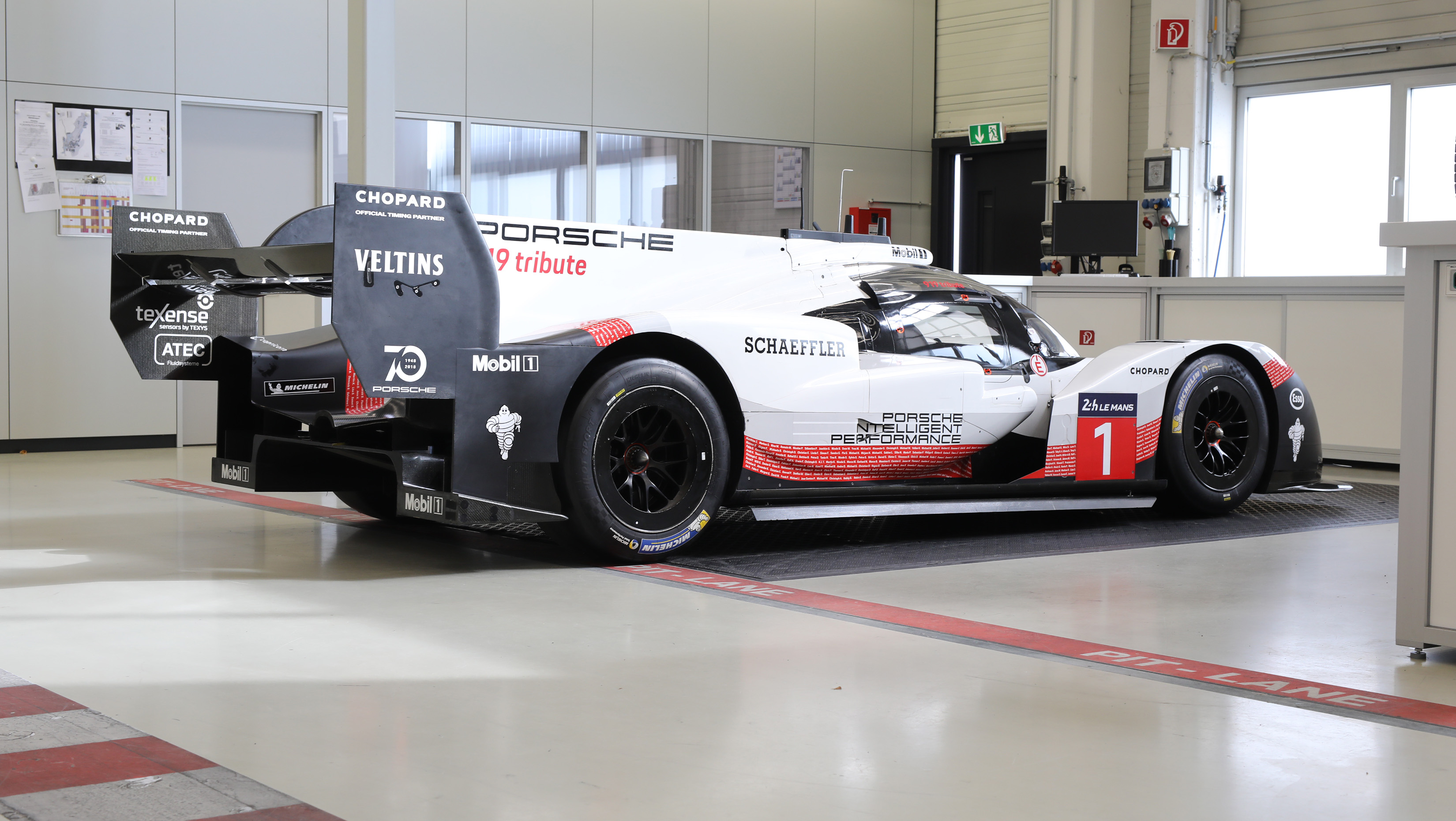
The Porsche 919 Hybrid Evo features a highly optimized 2.0-liter 90-degree V4 turbocharged engine that produces 720 horsepower. This power output was achieved by removing the FIA World Endurance Championship (WEC) fuel flow restrictors, allowing the compact internal combustion engine to reach its full mechanical potential. Combined with an unrestricted hybrid recovery system, the 919 Evo delivers a total system output of 1,160 horsepower, making it one of the most efficient and powerful racing machines ever built.
The Genesis of the Porsche 919 Hybrid Evo
To understand the 720 horsepower 2.0-liter V4 turbo in the Porsche 919 Evo engine, one must first look at its predecessor. The original Porsche 919 Hybrid was designed to compete in the Le Mans Prototype 1 (LMP1) category of the FIA WEC. Between 2014 and 2017, this car secured three consecutive overall wins at the 24 Hours of Le Mans and multiple world championships.
However, racing regulations are often designed to limit performance for safety and competitive balance. In the LMP1 class, Porsche was restricted by strict fuel flow meters and energy recovery limits. When Porsche decided to retire from the LMP1 category at the end of 2017, the engineers were given a unique "Tribute" mission: take the existing 919 Hybrid and remove every regulatory shackle to see how fast it could truly go.
The result was the 919 Hybrid Evo. By 2018, it had broken lap records at Spa-Francorchamps and the Nürburgring Nordschleife. As we look back from 2026, the 919 Evo remains a benchmark for internal combustion efficiency and hybrid integration, proving that a small-displacement engine can outperform massive naturally aspirated powerplants when paired with cutting-edge forced induction and electrification.
The Architecture of the 2.0-Liter V4 Turbo
The heart of the 919 Evo is its unique 2.0-liter V4 engine. While many manufacturers opt for V6 or V8 configurations for high-performance applications, Porsche chose a V4 for several strategic reasons related to packaging and efficiency.
Why a V4 Configuration?
The 90-degree V4 layout is inherently compact. In a mid-engine prototype, space is at a premium. The V4 is shorter than an inline-4 or a V6, allowing Porsche to position the engine lower and more centrally within the chassis. This centralizes the mass and lowers the center of gravity, which is critical for the high-speed cornering seen at circuits like the Nürburgring.
Furthermore, the V4 acts as a structural member of the chassis. The engine is bolted directly to the carbon-fiber monocoque and supports the rear suspension and gearbox. This "stressed member" design requires the engine block to be incredibly rigid. Porsche utilized high-strength aluminum alloys and advanced casting techniques to ensure the engine could handle the immense torsional loads of a car producing over 50% more downforce than a standard Formula 1 car.
Displacement and Thermal Efficiency
At only 2,000cc, the engine produces a staggering 360 horsepower per liter. This is achieved through a combination of extreme turbocharging and optimized thermal efficiency. In its unrestricted Evo state, the engine operates at thermal efficiency levels exceeding 40%. This means a larger percentage of the energy released during combustion is converted into mechanical work rather than being wasted as heat.
Unleashing 720 Horsepower: Removing the Restrictors
In the standard WEC racing version, the 919's engine was tuned to produce approximately 500 horsepower. This limit was not a mechanical failure of the engine but a result of the fuel flow meter mandated by the FIA. The meter restricted the amount of fuel the engine could consume per hour, effectively capping the horsepower to ensure parity between different hybrid systems.
The Fuel Flow Transformation
For the Evo version, Porsche engineers removed the fuel flow meter and updated the engine management software. Without the fuel restriction, the 2.0-liter V4 could take in more air and fuel, allowing the turbocharger to reach higher boost levels. By utilizing the maximum flow capacity of the fuel injectors and optimizing the ignition timing, the power output jumped from 500 hp to 720 hp.
This 44% increase in power was achieved without changing the core hardware of the engine. It serves as a testament to the "over-engineering" present in the original LMP1 design. The internal components—pistons, connecting rods, and crankshaft—were already capable of handling the increased pressure and heat generated by a 720 hp output, even though they were rarely asked to do so during 24-hour endurance races.
Turbocharging and Variable Geometry
The 919 Evo utilizes a single turbocharger located in the "V" of the engine. Unlike many road cars that use twin-turbo setups to reduce lag, Porsche utilized a sophisticated hybrid turbocharger system. The turbo is connected to an electric Motor Generator Unit (MGU-H), which can spin the turbo up instantly to eliminate lag or recover energy from exhaust gases when the wastegate would normally be open. This allows the 720 hp to be delivered with a linear power curve that feels more like a large-displacement naturally aspirated engine than a traditional small turbo.
The Role of the Hybrid Recovery Systems
While the 720 hp 2.0-liter V4 turbo is the primary driver, it does not act alone. The "Evo" designation implies a holistic approach to speed. To support the increased power of the ICE (Internal Combustion Engine), the hybrid systems were also "unleashed."
MGU-K and MGU-H
The 919 Evo utilizes two energy recovery systems:
- MGU-K (Motor Generator Unit-Kinetic): Located on the front axle, it recovers energy during braking and converts it into electricity stored in a liquid-cooled lithium-ion battery.
- MGU-H (Motor Generator Unit-Heat): Located in the exhaust stream, it recovers thermal energy from the turbocharger.
In the racing version, the amount of energy these systems could deploy was limited by "megajoule classes" (Porsche competed in the 8MJ class). For the Evo, these limits were discarded. The front-axle electric motor provides an additional 440 hp, bringing the total combined output to 1,160 hp. This massive electric boost complements the 720 hp from the V4, providing instantaneous torque out of corners while the turbo builds pressure for the high-end power delivery.
Comparative Specifications: 919 Hybrid vs. 919 Hybrid Evo
The table below highlights the technical differences that allowed the 919 Evo to achieve its legendary performance status.
| Feature | 919 Hybrid (WEC Race Spec) | 919 Hybrid Evo (Unrestricted) |
|---|---|---|
| Engine Type | 2.0L 90° V4 Turbo | 2.0L 90° V4 Turbo |
| ICE Power (HP) | ~500 hp | 720 hp |
| Electric Power (HP) | ~400 hp | 440 hp |
| Total System Power | ~900 hp | 1,160 hp |
| Fuel Flow Limit | Restricted (variable) | Unrestricted |
| Weight (Dry) | 875 kg (plus ballast) | 849 kg |
| Aerodynamics | WEC Regulated | Active DRS / Extended Diffusers |
| Top Speed | ~330 km/h (Le Mans) | 369 km/h (Spa) |
Aerodynamic and Structural Requirements for 720 Horsepower
Generating 720 horsepower from a small 2.0-liter engine creates immense heat and physical stress. To manage the output of the 919 Evo, Porsche had to redesign the cooling and aerodynamic packages.
Cooling Challenges
Because the engine was now burning significantly more fuel to produce 720 hp, the cooling requirements increased proportionally. The Evo features larger radiators and optimized ducting to ensure the V4 remains within its optimal operating temperature. High-performance racing lubricants and a sophisticated dry-sump oiling system are used to ensure that even under the 5G lateral loads seen at the Nürburgring, the engine internals remain lubricated.
Handling the Power: Active Aerodynamics
720 hp is only useful if it can be transmitted to the ground. The 919 Evo features an active Drag Reduction System (DRS). This system adjusts the angle of the rear wing and front flaps to reduce drag on straights—allowing the car to reach higher top speeds—and increases downforce in corners. When the V4 is screaming at its 720 hp peak, the car is generating so much downforce that it could theoretically drive upside down on the ceiling of a tunnel at speeds over 190 mph.
Historical Significance and Lap Records
The technical prowess of the 720 horsepower 2.0-liter V4 turbo was proven on the track. In 2018, the 919 Evo embarked on the "919 Tribute Tour," designed to showcase the car's ultimate potential.
Spa-Francorchamps
At the Spa-Francorchamps circuit in Belgium, Neel Jani drove the 919 Evo to a lap time of 1:41.770. At the time, this was faster than the reigning Formula 1 track record held by Lewis Hamilton. It was a historic moment where a "closed-wheel" prototype outpaced the pinnacle of open-wheel racing, largely due to the unrestricted 720 hp ICE and the massive hybrid boost.
The Nürburgring Nordschleife
The most famous achievement of the 919 Evo engine is the Nürburgring Nordschleife record. On June 29, 2018, Timo Bernhard lapped the "Green Hell" in 5:19.546. This shattered the previous all-time record set by Stefan Bellof in 1983 (6:11.13) by nearly a full minute. To achieve this, the 720 hp V4 had to endure sustained high-RPM operation over the 12.9-mile course, reaching a top speed of 369.4 km/h (229.5 mph) on the Döttinger Höhe straight.
Technical Legacy in 2026
As we evaluate this engine from the perspective of 2026, its influence on current automotive technology is clear. The lessons learned from the 919's 2.0-liter V4 turbo have directly informed the development of Porsche’s latest hypercars and their LMDh (Le Mans Daytona h) programs.
The high-pressure direct injection systems, the MGU-H heat recovery technology, and the use of the engine as a structural chassis member are now standard practices in high-end performance engineering. Furthermore, the 919 Evo proved that "downsizing" does not mean a loss in performance. By applying sophisticated turbocharging and hybridization, a 2.0-liter engine can dominate tracks that were once the playground of 6.0-liter V12s.
FAQ
How does a 2.0-liter engine produce 720 horsepower?
The high power output is a result of high-pressure turbocharging and the removal of fuel flow restrictions. By allowing the engine to consume more fuel per second and increasing the boost pressure from the turbocharger, the engine can complete more combustion cycles with higher energy release, resulting in 720 hp.
Is the Porsche 919 Evo engine reliable?
The engine was designed for 24-hour endurance racing, where it produced 500 hp. While the 720 hp tune increases internal stresses, the components were engineered with high safety margins. For the short "Time Attack" runs of the Evo, the engine proved to be exceptionally reliable, though it requires specialized maintenance and pre-heating before operation.
Why did Porsche use a V4 instead of a V6?
A V4 is more compact and lighter, which is essential for the weight distribution of a mid-engine racing car. It also allowed for a more efficient integration of the single turbocharger and MGU-H system within the "V" of the engine block.
Can you buy a Porsche 919 Evo?
No, the Porsche 919 Evo is a one-of-a-kind development vehicle owned by Porsche. It was created specifically for the Tribute Tour and is housed in the Porsche Museum in Stuttgart. It is not a production vehicle and is not street-legal.
What fuel does the 919 Evo use?
The 919 Evo typically uses high-performance racing fuel with a high octane rating to prevent knock under the extreme boost pressures required to reach 720 hp. In recent years, Porsche has also tested the engine with nearly carbon-neutral eFuels.
Final Recommendation
The 720 horsepower 2.0-liter V4 turbo in the Porsche 919 Evo engine represents the absolute zenith of internal combustion development. For engineers and enthusiasts, it serves as a masterclass in how to balance displacement, forced induction, and hybrid assistance. If you are looking to understand the future of performance, look no further than the efficiency-first approach of the 919 Evo. Its records may one day be broken by fully electric prototypes, but the technical sophistication of its V4 heart will remain a milestone in automotive history.