Choosing the right ceiling fan for your home improves indoor air circulation, reduces reliance on air conditioning, and complements your interior design. Top-rated models combine energy-efficient DC motors, integrated LED lighting, and smart-home integration to deliver optimal performance across different room sizes and ceiling heights.
Understanding the Role of Ceiling Fans in Modern Home Climate Control
Ceiling fans do not actually lower the ambient temperature of a room; instead, they create a wind chill effect that makes occupants feel cooler by accelerating the evaporation of moisture from the skin. When used correctly, a ceiling fan allows you to raise your thermostat setting by approximately four degrees Fahrenheit without sacrificing personal comfort. This reduction in air conditioning workload translates directly to lower energy bills during peak summer months.
Beyond cooling, ceiling fans are valuable during the heating season. By operating the fan in reverse at a low speed, you can force warm air that has naturally risen to the ceiling back down into the living space. This prevents thermal stratification and ensures a more uniform temperature throughout the room.
Selecting the right fan requires looking beyond aesthetics. Factors such as motor type, blade pitch, room dimensions, and ceiling mounting configuration dictate how effectively a fan will perform. Understanding these baseline requirements helps homeowners avoid common pitfalls, such as installing an undersized fan in a large living room or mounting a standard downrod fan on a low ceiling without adequate clearance.
Key Technical Specifications to Evaluate Before Buying
Before examining specific models, it is essential to understand the technical metrics manufacturers use to define ceiling fan capability. Evaluating these specifications ensures that the fan you choose matches the physical and electrical demands of your space.
Airflow Efficiency and CFM Ratings
Airflow is measured in cubic feet per minute (CFM), which indicates the volume of air the fan moves per minute at high speed. Higher CFM ratings signify stronger airflow, but energy efficiency is equally important. Efficiency is expressed as CFM per watt, calculated by dividing the airflow by the energy consumed at high speed. Modern DC (direct current) motor fans typically offer exceptional efficiency, often exceeding 200 CFM per watt, whereas older AC (alternating current) motor fans generally fall below 100 CFM per watt.
Motor Types: DC vs. AC
The motor is the heart of any ceiling fan. Traditional AC motors are reliable and cost-effective, but they are bulkier, offer fewer speed settings (usually three), and consume more electricity. DC motors represent a major technological advancement. They operate much more quietly, generate higher torque, offer six or more speed options, and consume up to 70 percent less electricity than standard AC motors. Many DC fans also include a reverse function accessible directly from the remote control or smart app, eliminating the need to reach up and flip a manual switch on the motor housing.
Blade Pitch and Aerodynamics
Blade pitch refers to the angle of the blades relative to the horizontal plane. A steeper pitch—typically between 12 and 16 degrees—moves more air because the blades slice through the air more aggressively. Flat or shallow blades (under 10 degrees) tend to spin quietly but move significantly less air, making them less effective for primary climate control in large spaces.
5 Top Rated Ceiling Fans for Every Home
Based on performance metrics, user reviews, build quality, and feature sets, the following five ceiling fans represent the best options available for various residential applications.
1. Hunter Fan Dempsey Low Profile Modern Ceiling Fan
- Best For: Rooms with low ceilings and transitional spaces
- Size: 52-inch span
- Motor Type: WhisperWind AC motor
- Lighting: Dimmable LED module with casing
The Hunter Dempsey Low Profile is engineered specifically for rooms with standard or low ceilings where a downrod cannot be used. Its low-profile housing sits flush against the ceiling, maintaining safety clearances while delivering robust airflow. The 52-inch blade span makes it ideal for medium to large bedrooms and living areas.
Performance-wise, the Dempsey utilizes a multi-speed WhisperWind motor that operates quietly even at maximum velocity. The included handheld remote allows for effortless speed adjustments and light dimming. While it uses an AC motor rather than a DC motor, its reliability and traditional pull-chain alternative make it a durable, user-friendly choice for everyday residential environments.
2. Minka-Aire F844-DK Light Wave
- Best For: Contemporary and modern architectural interiors
- Size: 52-inch span
- Motor Type: Energy-efficient DC motor
- Lighting: Integrated 18-watt LED array
The Minka-Aire Light Wave is a design-forward ceiling fan featuring three undulating, wave-like blades that double as functional art. Beyond its striking visual appeal, the aerodynamic curve of the blades optimizes airflow, producing high CFM output relative to its energy consumption.
Powered by a reversible DC motor, the Light Wave provides six distinct speeds and operates with virtually zero motor hum. It includes a full-function remote control and is compatible with wall-control accessories and smart-home modules. The integrated LED light kit is covered by an etched opal glass shade, diffusing soft, glare-free illumination suitable for dining rooms, great rooms, and modern master suites.
3. Casablanca Cação Modern Indoor Ceiling Fan
- Best For: Premium quality, large spaces, and smart-home integration
- Size: 54-inch span
- Motor Type: Direct Drive DC motor
- Lighting: Integrated LED light fixture
Casablanca is widely recognized for engineering premium ceiling fans, and the Cação exemplifies this reputation. Featuring a high-torque Direct Drive DC motor, this fan moves an impressive volume of air while maintaining whisper-quiet operation. Its 54-inch blade span is well-suited for spacious living rooms, master bedrooms, and open-concept floor plans.
A standout feature of the Cação is its compatibility with smart-home systems such as Amazon Alexa, Apple HomeKit, and Google Assistant via proprietary Wi-Fi connectivity. Homeowners can automate schedules, adjust fan speeds via voice commands, and integrate the fan into whole-home climate routines. The heavy-duty construction and weather-resistant materials also allow for covered outdoor installation in patios or porches.
4. Honeywell Store Xerxes Modern Ceiling Fan
- Best For: Budget-conscious buyers seeking modern styling
- Size: 52-inch span
- Motor Type: Reversible AC motor
- Lighting: Globe-style LED light kit
The Honeywell Xerxes bridges the gap between modern design and budget-friendly pricing. Featuring a brushed nickel or bronze finish paired with clean blade geometry, it adapts easily to guest bedrooms, home offices, and dens.
The Xerxes comes equipped with a multi-speed reversible motor and an integrated LED light fixture housed within a contemporary globe. While it lacks the advanced smartphone integration of more expensive DC models, its traditional handheld remote provides convenient control over lighting and airflow speeds. Installation is straightforward, supported by dual-mount capabilities that accommodate both standard downrods and angled ceilings.
5. Big Ass Fans Haiku L Series
- Best For: Maximum airflow efficiency and luxury architectural applications
- Size: 52-inch or 60-inch options
- Motor Type: Premium EC (Electronically Commutated) DC motor
- Lighting: Optional integrated LED module
For homeowners seeking uncompromising performance and cutting-edge engineering, the Big Ass Fans Haiku L Series is the industry benchmark. Hand-balanced airfoils crafted from sustainable bamboo or durable composite materials maximize aerodynamic efficiency, moving significantly more air than standard residential fans while consuming a fraction of the electricity.
The Haiku L features a sensuous, minimalist profile that has earned numerous international design awards. Its onboard computer senses ambient temperature and humidity, automatically adjusting fan speed to maintain optimal comfort without user intervention. Wi-Fi connectivity enables seamless integration with smart thermostats and home automation ecosystems. Although it commands a higher price point, its commercial-grade durability and exceptional energy savings make it a worthwhile long-term investment.
Comparative Overview of Top-Rated Ceiling Fans
| Model Name | Blade Span | Motor Type | Smart Compatible | Best Application |
|---|---|---|---|---|
| Hunter Dempsey Low Profile | 52-inch | AC | Optional (External) | Low ceilings, bedrooms |
| Minka-Aire Light Wave | 52-inch | DC | Optional (Module) | Contemporary living spaces |
| Casablanca Cação | 54-inch | DC | Yes (Built-in Wi-Fi) | Smart homes, large rooms |
| Honeywell Xerxes | 52-inch | AC | No | Budget-friendly updates |
| Big Ass Fans Haiku L | 52/60-inch | EC / DC | Yes (Built-in Wi-Fi) | Luxury installations, maximum airflow |
Room Size and Ceiling Height Sizing Guidelines
Installing a ceiling fan that is improperly sized for the room results in either inadequate airflow or overwhelming wind force. Use the following guidelines to select the correct blade span based on square footage:
- Under 75 square feet (small bathrooms, walk-in closets): Choose a 36-inch or smaller fan.
- 75 to 144 square feet (standard bedrooms, home offices): Choose a 42-inch to 48-inch fan.
- 144 to 225 square feet (large bedrooms, dining rooms): Choose a 52-inch to 54-inch fan.
- 225 to 400 square feet (great rooms, large living areas): Choose a 60-inch to 72-inch fan, or consider installing dual fans for elongated spaces.
Ceiling height is equally critical for safety and performance. Underwriters Laboratories (UL) and building safety codes require that the lowest point of the fan blades hang at least 7 feet above the finished floor. For standard 8-foot ceilings, flush-mount or low-profile fans are mandatory. For ceilings higher than 9 feet, a downrod should be added to lower the fan to the optimal working height of 8 to 9 feet above the floor, ensuring maximum air velocity in the living zone.
Installation Considerations and Safety Best Practices
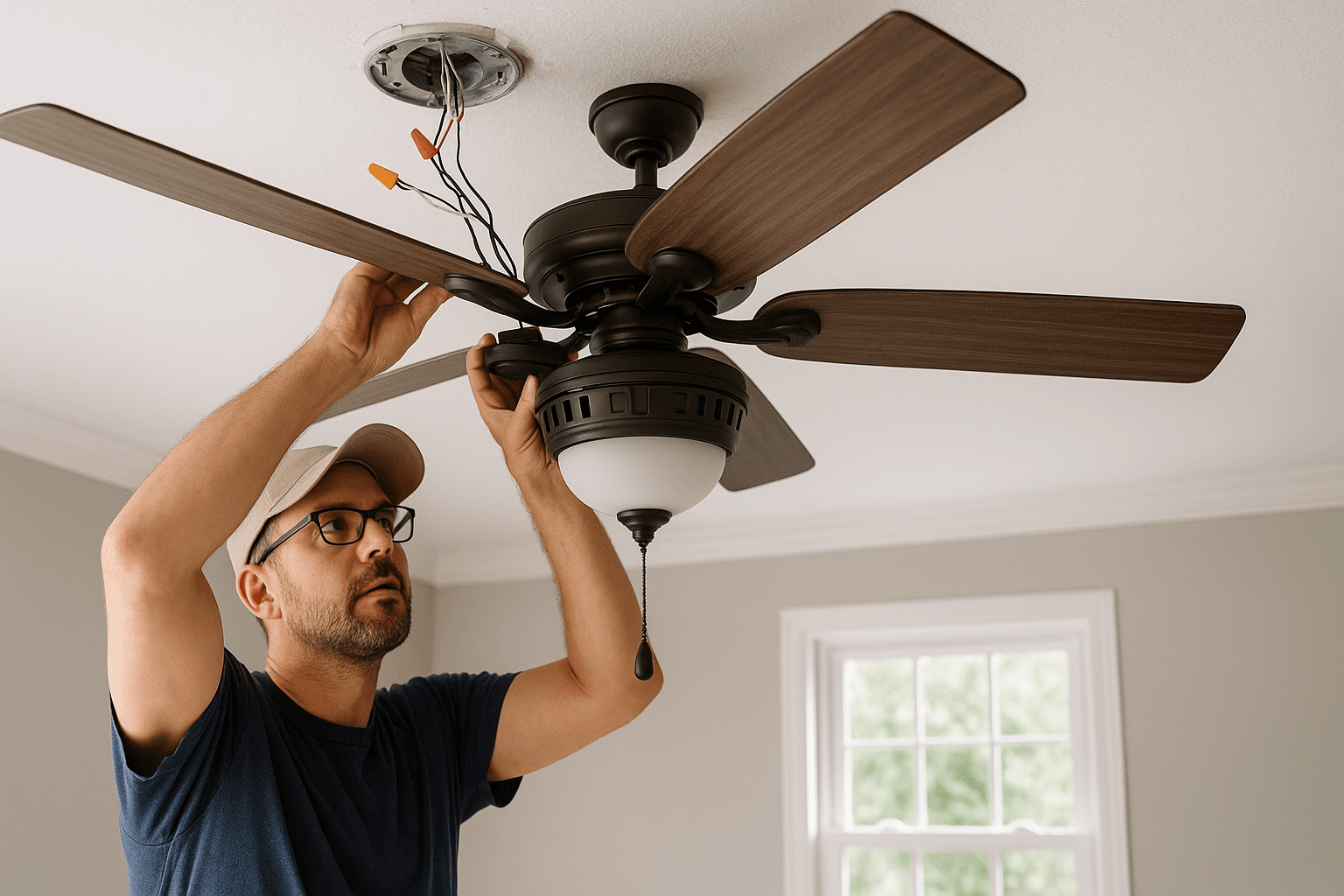
While ceiling fan installation is a common do-it-yourself project, it requires strict adherence to electrical safety protocols.
- Verify Electrical Box Support: Standard ceiling light junction boxes are not designed to support the dynamic weight and rotational vibration of a ceiling fan. You must replace existing light boxes with a UL-listed, fan-rated electrical box securely braced to the ceiling joists.
- Disconnect Power at the Breaker: Always shut off power to the circuit at the main electrical panel before beginning any wiring work. Use a non-contact voltage tester to confirm that no live current is present in the junction box.
- Balance the Blades: If a newly installed fan wobbles, check blade alignment. Use the included balancing kit to attach small adhesive weights to the top of any blade that causes vertical displacement during operation. Wobbling is most frequently caused by uneven blade weight or loose blade-iron screws.
Frequently Asked Questions
Do ceiling fans actually save money on electricity bills?
Yes, ceiling fans reduce electricity costs when used in conjunction with air conditioning. By creating a wind chill effect, a fan makes the room feel four degrees cooler than the actual temperature. This allows you to set your thermostat higher—such as raising it from 72°F to 76°F—which substantially decreases compressor run time and lowers overall energy consumption.
Can I install a standard ceiling fan on a sloped or vaulted ceiling?
Most ceiling fans can be installed on sloped or vaulted ceilings, but you must check the manufacturer's specifications. Many models accommodate slopes up to 30 degrees out of the box, while steeper angles require an adapter mounting kit and a longer downrod to ensure the blades clear the ceiling surface during rotation.
What is the difference between an AC motor and a DC motor ceiling fan?
AC (alternating current) motors are traditional, reliable, and typically less expensive, but they consume more electricity and offer fewer speed options. DC (direct current) motors are significantly more energy-efficient, whisper-quiet, produce higher torque, and usually include six speed settings with a remote-controlled reverse function.
How do I reverse my ceiling fan for winter use?
To run a ceiling fan in reverse for the heating season, the blades should rotate in a clockwise direction at low speed. On DC motor fans, this is achieved by pressing the reverse button on the handheld remote or mobile app. On older AC motor fans, you must turn off the fan, wait for the blades to stop completely, and flip the physical reverse switch located on the side of the motor housing.
Are integrated LED light kits replaceable when they burn out?
It depends on the specific manufacturer design. Some ceiling fans feature modular LED boards that can be replaced as a unit if they fail, while others utilize standard GU24 or E26 base LED bulbs that can be unscrewed and replaced like traditional light bulbs. Always check the product specifications regarding LED replacement before purchasing.
Final Recommendation
Selecting the ideal ceiling fan depends on your specific room dimensions, ceiling architecture, and preference for energy efficiency versus initial cost. For standard low ceilings, the Hunter Dempsey Low Profile delivers reliable performance without sacrificing vertical clearance. Homeowners prioritizing maximum energy savings and smart-home integration should invest in the Casablanca Cação or the high-performance Big Ass Fans Haiku L Series. Prioritize proper electrical box support during installation to ensure safe, vibration-free operation for years to come.