Modern ethical dilemmas occur when competing moral imperatives—such as personal safety versus collective autonomy, or short-term economic stability versus long-term environmental preservation—force decision-makers to choose between conflicting, imperfect outcomes. Key examples include autonomous AI navigation choices, data privacy versus law enforcement access, CRISPR gene editing, corporate whistleblowing, and climate resource allocation.
Understanding how to evaluate competing moral obligations is no longer merely an academic exercise. Modern technological capabilities, global interconnectivity, and systemic corporate choices require individuals and organizational leaders to navigate high-stakes ethical choices daily. When two fundamentally sound ethical principles clash, conventional rules offer no simple answers. Decision-makers must instead rely on structured moral frameworks to weigh risk, duty, equity, and human impact.
Theoretical Foundations of Modern Ethical Choices
An ethical dilemma arises when a scenario demands a choice between two or more options, each backed by a defensible moral justification, yet mutually exclusive or producing unavoidable harm. Unlike a moral failure—where an individual knowingly chooses a harmful path over a correct one—a true dilemma presents competing values where no single option is entirely flawless.
To analyze these complex scenarios, ethics draws on four foundational frameworks:
- Utilitarianism (Consequentialism): Originating from philosophers like Jeremy Bentham and John Stuart Mill, this approach evaluates an action based on its outcomes. The optimal decision is the one that produces the greatest overall good or minimizes net harm for the largest number of people.
- Deontology (Duty-Based Ethics): Spearheaded by Immanuel Kant, deontological ethics asserts that actions are inherently right or wrong, regardless of their consequences. Decision-makers must uphold moral duties, rights, and rules (such as honesty, autonomy, and justice) universally.
- Virtue Ethics: Tracing back to Aristotle, this framework focuses on the moral character of the agent rather than specific rules or consequences. It asks what a courageous, wise, and just person or organization would do in a given situation.
- Ethics of Care: Developed through feminist philosophy, particularly by Carol Gilligan, this framework prioritizes relational bonds, empathy, contextual nuance, and the protection of vulnerable stakeholders over abstract, universal rules.
When applied to modern dilemmas, these frameworks frequently clash, highlighting why complex decisions rarely yield universal consensus.
5 Defining Ethical Dilemma Examples
1. Autonomous Systems and the Algorithm Conflict (The AI Trolley Problem)
The emergence of autonomous systems—ranging from self-driving vehicles to algorithmic medical triage tools—has transformed theoretical philosophy into active software engineering. The classic "Trolley Problem," once a thought experiment designed to test moral intuition, is now a operational challenge for machine learning developers.
Consider an autonomous vehicle traveling along a narrow road when a child suddenly runs into the lane. The vehicle's onboard sensors compute two real-time trajectories: continue straight and collide with the pedestrian, or swerve into oncoming traffic, exposing the vehicle's passenger to severe injury or death.
- Unavoidable Obstacle / Child in Road
- Scenario A: Maintain Course
- Collision with Pedestrian
- Utilitarian Violation: Fails to minimize total loss of life (younger demographic)
- Scenario B: Swerve Lane
- Collision with Oncoming Traffic
- Deontological Violation: Breaches duty of safety owed to vehicle passenger
- Scenario A: Maintain Course
This scenario exposes a stark philosophical divide:
- The Utilitarian Approach: Software programmed under utilitarian principles might mandate that the vehicle swerve, choosing to protect the pedestrian based on demographic survival metrics or total potential life-years saved.
- The Deontological Approach: A duty-based framework argues that a manufacturer has a fundamental obligation to protect the occupant who entrusted their safety to the vehicle. Swerving intentionally uses the passenger as a passive sacrifice to solve an external hazard, violating Kantian principles of human dignity.
In response to these tensions, regulatory frameworks, such as guidelines published by the Stanford Encyclopedia of Philosophy on artificial intelligence, emphasize that algorithms must avoid discriminatory scoring systems while establishing clear liability structures for automated hardware.
2. Consumer Data Privacy vs. Public Security
The digital economy relies on mass data collection, while civil society depends on individual privacy rights. A persistent ethical conflict emerges when law enforcement agencies demand access to end-to-end encrypted consumer communications to prevent serious crimes or investigate national security threats.
A prime illustration occurs when a tech enterprise develops an unhackable operating system that protects user data from cybercriminals, identity thieves, and authoritarian surveillance. Following a severe criminal act, federal investigators secure a court order compelling the tech company to build a diagnostic tool—a "backdoor"—to decrypt the suspect's device.
The competing moral arguments create a strict deadlock:
- Public Safety Obligation: Proponents of law enforcement access argue using consequentialist logic: the immediate threat to human lives outweighs abstract digital rights. Denying access potentially enables preventable violence, placing organizational policy above public safety.
- Fundamental Right to Privacy: Proponents of absolute encryption argue from a deontological standpoint. Creating a cryptographic backdoor inherently undermines the security architecture for hundreds of millions of innocent users. Once created, such access tools can be stolen, abused by malicious actors, or weaponized by repressive regimes, compromising user autonomy on a global scale.
This dilemma pits collective security against systemic privacy, forcing organizations to determine whether rights can be selectively compromised for the greater good.
3. Germline Gene Editing and Bioethical Boundaries
The maturation of genetic engineering technologies, such as CRISPR-Cas9, presents humanity with unprecedented control over biology. While somatic gene editing targets non-heritable traits in individual patients to treat conditions like sickle cell anemia, germline editing alters the DNA of embryos, passing modified genes down to future generations.
An ethical crisis arises when deciding whether to permit germline modifications to eradicate severe hereditary disorders, such as Huntington's disease or cystic fibrosis.
- CRISPR Genetic Intervention
- Therapeutic Germline Editing
- Eradicates hereditary disease
- Prevents multi-generational suffering
- Unintended genetic mutations
- Non-Therapeutic Enhancement
- Creates physical/cognitive advantages
- Exacerbates socioeconomic divides
- Removes consent of future generations
- Therapeutic Germline Editing
The core ethical tensions include:
- Preventing Suffering vs. Unintended Consequences: From a care ethics perspective, failing to use available technology to prevent debilitating, painful conditions in future children appears indifferent to suffering. However, consequentialist analysis cautions against unknown, permanent off-target mutations introduced into the human gene pool that cannot be recalled.
- Distributive Justice and Enhancement: Allowing germline editing opens the door to non-therapeutic enhancements (e.g., height, muscle density, cognitive capacity). Because such interventions are costly, access may be restricted to affluent populations, risking a permanent biological divide between socioeconomic classes. Furthermore, altering embryonic DNA bypasses the informed consent of future generations who must live with those genetic alterations.
Global health organizations, including the World Health Organization, continue to update regulatory standards to ensure therapeutic breakthroughs do not cross into unmonitored human enhancement.
4. Corporate Loyalty vs. Public Interest Whistleblowing
In corporate environments, professionals often encounter sensitive operational information regarding product safety, environmental compliance, or financial integrity. The decision to report internal wrongdoing—frequently referred to as whistleblowing—creates an acute ethical conflict for the individual.
Imagine a senior quality assurance engineer at an aerospace manufacturing firm who discovers a structural defect in commercial aircraft components. Internal executives dismiss the warning, citing financial losses, tight delivery schedules, and the minimal statistical likelihood of component failure during standard operations. The engineer must choose whether to remain silent, respecting contractual non-disclosure agreements (NDAs) and corporate loyalty, or breach confidentiality to inform regulatory authorities and the public.
This decision forces a balance between competing duties:
- Duty to the Organization and Family: Employees owe a baseline duty of loyalty to their employer, which provides their income and stability. Breaking NDAs can lead to career ruin, financial liability, and professional ostracization.
- Duty to Public Safety and Truth: Deontological ethics posits an absolute obligation to prevent harm and uphold truth. Allowing unsafe aircraft to fly treats passengers as collateral risk for corporate profit, violating basic human rights to safety.
Whistleblowers routinely face severe personal risk to correct systemic harms, highlighting the operational friction between institutional loyalty and broad public welfare.
5. Immediate Resource Development vs. Intergenerational Climate Justice
The global effort to mitigate climate change creates a complex socio-economic dilemma, particularly when balancing immediate economic development against long-term ecological stability.
Consider a developing nation with rich natural gas reserves located in an ecologically sensitive region. Exploiting these resources could generate billions in tax revenue, fund public healthcare, build schools, and lift millions of citizens out of extreme poverty today. However, extracting and burning these fossil fuels releases significant carbon emissions, accelerating global climate change and disproportionately impacting future generations worldwide.
- Developing Nation Energy Choice
- Exploitation of Natural Gas
- Lifts millions out of poverty today
- Expands local health & education
- Increases global carbon emissions
- Resource Preservation Mandates
- Protects future global climate
- Curtails immediate economic growth
- Sustains poverty in vulnerable regions
- Exploitation of Natural Gas
This dilemma highlights deep structural equities:
- Distributive Justice (Present Generation): Developing nations argue that developed countries achieved their economic prosperity through centuries of unrestricted industrialization. Restricting developing countries from using their natural resources compromises their immediate human rights to economic survival and poverty alleviation.
- Intergenerational Equity (Future Generations): Environmental ethicists stress that the current generation holds the Earth in trust. Maximizing present-day consumption degrades the biosphere for future generations who have no vote or representation in contemporary economic choices.
Resolving this tension requires balancing immediate poverty reduction against long-term planetary viability.
Comparing Modern Ethical Dilemmas
To understand how these scenarios interact with moral philosophy, the table below compares the primary tensions, dominant frameworks, key stakeholders, and systemic consequences across all five examples.
| Dilemma Scenario | Core Moral Conflict | Dominant Ethical Frameworks | Key Stakeholders Affected | Long-Term Governance Impact |
|---|---|---|---|---|
| 1. Autonomous Systems | Passenger safety vs. Pedestrian protection | Utilitarianism vs. Deontology | Vehicle occupants, pedestrians, system engineers | AI safety standards, liability law, automated transport protocols |
| 2. Data Privacy & Security | Individual rights vs. Public safety | Rights-Based Ethics vs. Consequentialism | Digital consumers, law enforcement, tech platforms | Encryption mandates, state surveillance limits, consumer data laws |
| 3. Germline Gene Editing | Eradicating disease vs. Genetic stratification | Ethics of Care vs. Distributive Justice | Patients, future offspring, health systems | International bioethics guidelines, CRISPR usage policies |
| 4. Corporate Whistleblowing | Institutional loyalty vs. Public protection | Kantian Duty vs. Virtue Ethics | Employees, corporate executives, general public | Whistleblower protection acts, compliance architecture, corporate governance |
| 5. Climate Justice | Present economic survival vs. Future sustainability | Distributive Justice vs. Intergenerational Equity | Developing populations, future generations, global ecosystem | Carbon trade agreements, global energy policy, international aid models |
A Structured Framework for Navigating Ethical Dilemmas
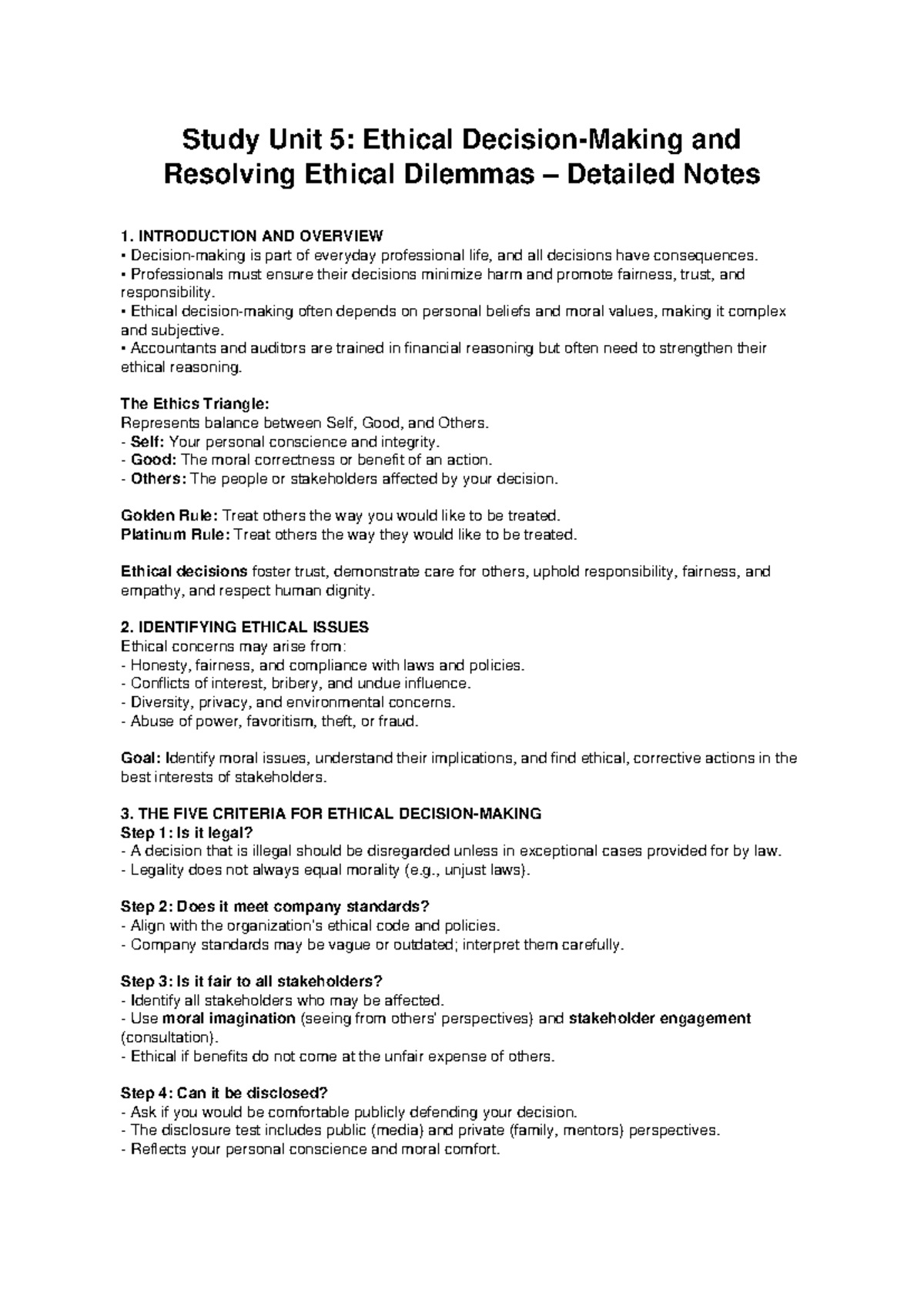
Resolving complex moral choices requires a systematic evaluation process rather than relying on gut instinct or rigid adherence to policy. Institutional leaders, technical architects, and individuals can apply a five-stage ethical decision-making model to manage competing priorities rationally.
- Step 1: Define Moral Conflicts
- Step 2: Map Stakeholders & Externalities
- Step 3: Apply Philosophical Lenses
- Step 4: Evaluate Reversibility & Compliance
- Step 5: Implement & Audit Outcomes
Step 1: Explicitly Define the Competing Obligations
Identify the specific values in conflict. Articulate why each choice carries moral weight (e.g., "Choice A protects user privacy, while Choice B prevents immediate physical harm"). If one option violates a basic human right while the other merely causes inconvenience, the choice is not a true ethical dilemma, but a matter of compliance or prioritization.
Step 2: Map Stakeholders and Downstream Externalities
Catalogue all parties affected by the decision, including primary stakeholders (those directly involved) and secondary stakeholders (those impacted indirectly). Consider long-term externalities—unintended consequences that manifest years after the initial choice is executed.
Step 3: Test Decisions Through Complementary Philosophical Lenses
Evaluate the candidate actions using multiple moral frameworks:
- The Utilitarian Lens: Which choice yields the best overall outcome with the least net harm?
- The Deontological Lens: Does this choice respect fundamental rights, or does it treat human beings merely as a means to an end?
- The Virtue Lens: What message does this choice send about the character and integrity of the decision-maker or institution?
Step 4: Evaluate Reversibility and Proportionality
Determine whether the consequences of a decision are reversible. Irreversible choices—such as releasing altered genetic traits into an ecosystem or exposing sensitive personal data—demand higher burdens of proof, stricter risk limits, and greater transparency than choices that can be adjusted dynamically over time.
Step 5: Implement, Document, and Audit Outcomes
Document the rationale behind the decision, acknowledging the trade-offs accepted. After execution, audit the real-world outcomes against initial projections. Continuous feedback loops ensure that unintended harms are identified and remediated quickly.
Frequently Asked Questions
What is the difference between a moral issue and an ethical dilemma?
A moral issue involves a scenario where the right course of action is clear based on established social norms, legal guidelines, or personal values, but individual incentives may tempt someone to do otherwise. An ethical dilemma occurs when two or more valid moral obligations directly conflict, making it impossible to satisfy one principle without violating another.
How do developers program self-driving cars to manage ethical decisions in crash scenarios?
Modern autonomous vehicle engineers avoid hardcoding specific moral choices into software. Instead, safety standards emphasize risk minimization strategies—such as slowing down to lower kinetic energy, maintaining lane boundaries, and applying equal braking force—rather than actively choosing between human targets based on demographic criteria.
Can artificial intelligence resolve ethical dilemmas objectively?
Artificial intelligence cannot resolve ethical dilemmas autonomously because AI models learn from historical human data, which contains inherent biases and competing value systems. While AI can model complex outcomes and project risks, selecting which moral value to prioritize remains a fundamental human responsibility requiring qualitative judgment.
What legal protections exist for whistleblowers facing ethical conflicts?
In many jurisdictions, specific statutory frameworks protect whistleblowers from employer retaliation. In the United States, legislation like the Whistleblower Protection Act, Sarbanes-Oxley Act, and Dodd-Frank Act provides financial incentives, job security protections, and legal remedies for individuals who report systemic corporate or governmental fraud.
How do companies build ethical frameworks into daily organizational operations?
Organizations build ethical operational frameworks by establishing independent ethics advisory boards, implementing secure and anonymous reporting channels, conducting regular risk assessments, and training staff on decision-making models. Clear codes of ethics ensure employee evaluations reflect compliance and moral integrity alongside financial performance.
Cultivating Ethical Literacy in Decision-Making
Navigating complex decisions requires a deliberate, structured approach rather than relying on intuition alone. Modern choices in technology, bioethics, organizational management, and resource allocation demand that decision-makers weigh short-term benefits against long-term systemic risks.
To build moral resilience and operational integrity within your organization, consider taking these practical steps:
- Conduct an Ethical Audit: Assess your current operational frameworks, software architectures, or corporate policies to identify implicit trade-offs between speed, cost, privacy, and safety.
- Establish Multi-Disciplinary Oversight: Form internal ethics advisory committees that bring together technical experts, legal advisors, consumer advocates, and ethicists to review high-stakes choices.
- Adopt a Standardized Framework: Implement a clear, multi-step decision-making model across teams to ensure that trade-offs are analyzed transparently, documented thoroughly, and audited regularly.
Developing ethical literacy does not eliminate hard choices, but it ensures that when tradeoffs must be made, they are handled with clarity, fairness, and accountability.