When applying for life insurance, individuals who have used direct-to-consumer genetic testing services often worry whether their personal DNA profiles can be accessed, subpoenaed, or otherwise utilized by underwriting departments to influence rates or deny coverage. Under current United States federal law, specifically the Genetic Information Nondiscrimination Act (GINA) of 2008, health insurers are prohibited from using genetic information to make coverage or pricing decisions, but life insurance, disability insurance, and long-term care insurance are legally exempt from these federal protections, leaving their regulatory treatment dependent primarily on state-level legislation.
Navigating the intersection of direct-to-consumer genetics and commercial insurance requires a clear understanding of federal statutes, evolving state-level regulations, and the actual mechanics of how life insurance underwriting evaluates medical history. Because direct-to-consumer platforms operate under strict privacy policies and generally do not surrender customer records without legal compulsion, third parties cannot simply browse raw DNA profiles at will. However, traditional medical records, prescription histories, and direct disclosures on application forms remain the primary pillars through which an applicant's health profile is evaluated.
The Legal Landscape: GINA and Its Limitations
Enacted in 2008, the Genetic Information Nondiscrimination Act represents the cornerstone of genetic privacy in the United States. GINA was designed to prevent health insurance providers and employers from discriminating against individuals based on their genetic information. Under GINA, health insurers cannot request, require, or purchase genetic testing data for underwriting purposes, nor can they use genetic predispositions to adjust health insurance premiums or deny enrollment.
However, the scope of GINA has significant boundaries that directly impact financial planning and risk management. The statute explicitly excludes three major types of insurance products from its prohibitions:
- Life insurance
- Disability income insurance
- Long-term care insurance
Consequently, federal law does not automatically bar life insurance companies from asking about genetic tests or utilizing genetic data if it is lawfully obtained. Because of this statutory gap, consumer advocates and industry observers have closely watched state legislatures to see how individual states bridge or widen these regulatory boundaries.
State-Level Regulations on Genetic Data and Life Insurance
Because federal law leaves life insurance largely unregulated regarding genetic testing, individual states have stepped in with varying degrees of consumer protection. The regulatory patchwork across the United States means that an applicant's protections depend heavily on their state of residence.
States generally fall into three categories regarding genetic privacy in life insurance underwriting:
- Full Prohibitions: A small group of states (such as Florida and California, through specific state statutes) have enacted laws that explicitly prohibit life insurance companies from using genetic information, test results, or family history derived from genetic testing to deny coverage, cancel policies, or alter premium rates.
- Partial Restrictions: Several states permit the use of genetic data only if the results are part of an established, medically recognized diagnosis with demonstrated actuarial relevance, or they restrict insurers from requiring new tests while allowing them to review existing medical records.
- No Specific Restrictions: In the remaining jurisdictions, life insurers are legally permitted to ask if an applicant has undergone predictive genetic testing and to request those medical records, provided the insurer complies with general underwriting guidelines and state insurance commission rules.
| State Regulatory Approach | General Rule for Life Insurance | Examples of States |
|---|---|---|
| Strict Prohibition | Complete ban on using genetic test results for underwriting or pricing. | Florida, California, Massachusetts |
| Partial Restriction | Permitted under strict conditions, or limits on requiring new tests. | Vermont, New Jersey, Maryland |
| Permissive / Unregulated | Insurers may request existing genetic test records if legally obtained and disclosed. | Most other U.S. states |
Can Life Insurance Companies Access 23andMe Data Directly?
A common misconception is that life insurance companies can buy bulk customer lists from consumer genetic testing companies like 23andMe, Ancestry, or similar platforms. In practice, consumer privacy policies, industry ethics, and federal data privacy laws prevent direct commercial data-sharing of individual DNA profiles.
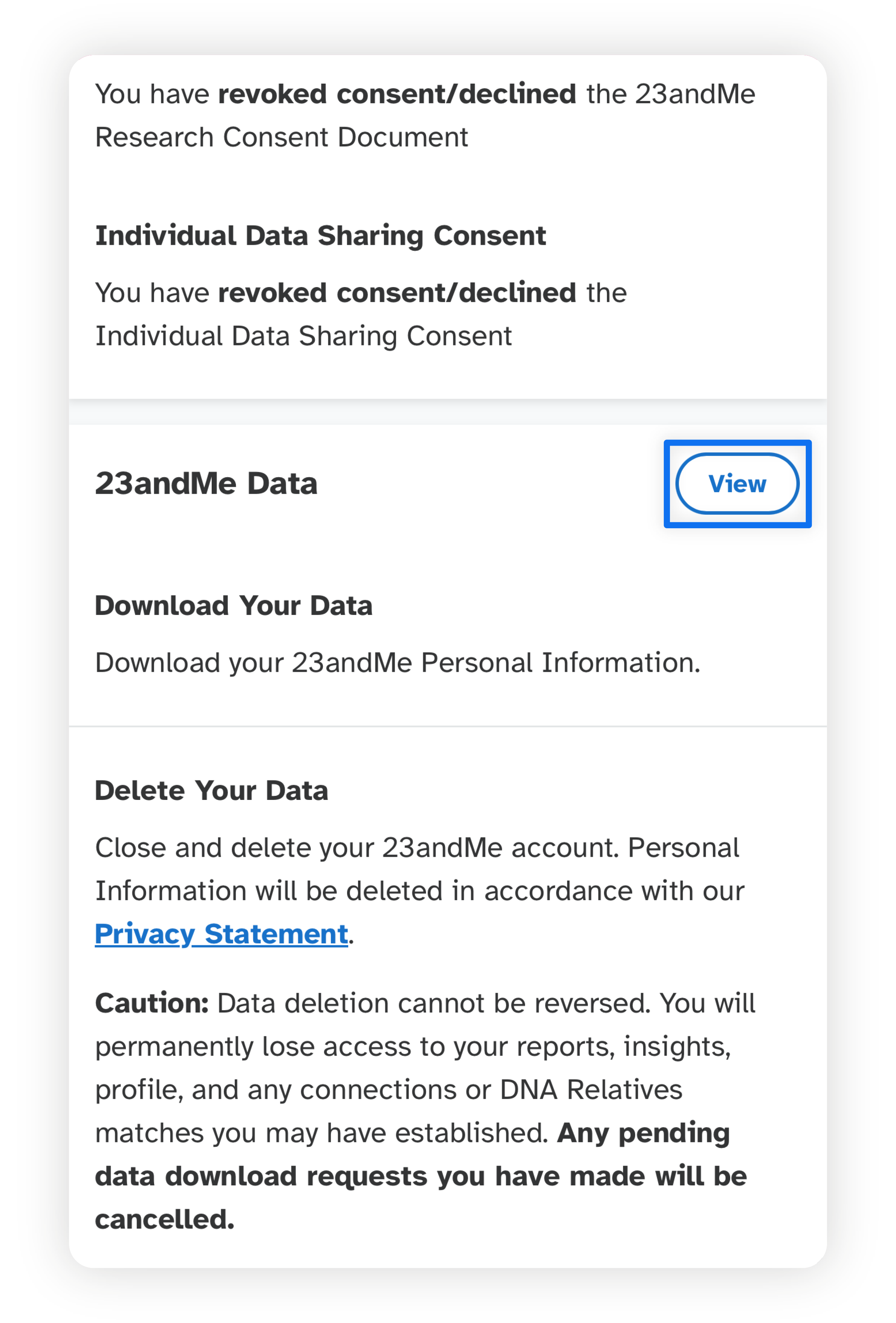
23andMe operates under strict privacy statements that prohibit the sale or sharing of individual-level genetic data with third parties, including insurance companies, employers, and law enforcement, without explicit, informed user consent or a valid court order. Under standard operational protocols:
- No Bulk Access: Insurers cannot browse 23andMe databases or purchase customer rosters.
- Consent Requirements: Data cannot be handed over to a third party unless the account holder explicitly authorizes the transfer.
- Legal Subpoenas: Like any digital or physical record, genetic testing company records can theoretically be subpoenaed in civil or criminal litigation, though such subpoenas face steep legal hurdles and privacy challenges.
Therefore, the primary risk of genetic data entering an insurance file does not stem from a direct corporate data leak or backroom sale between DNA testing labs and insurance carriers. Instead, it arises primarily through the formal application process and medical record disclosures.
How Medical Underwriting Actually Evaluates Health Risk
When an individual applies for a term or whole life insurance policy, the underwriting department reviews a comprehensive set of documents to determine mortality risk and assign a rate class. Understanding this workflow helps clarify where—and if—genetic data ever enters the equation.
Traditional life insurance underwriting relies on several standard components:
- The Application Questionnaire: Applicants answer detailed health history questions covering personal diagnoses, surgeries, hospitalizations, and family medical history (such as histories of heart disease, cancer, or diabetes in immediate family members).
- Medical Information Bureau (MIB) Report: A shared database containing coded medical information reported by member insurance companies regarding previous applications, flagging conditions like elevated risk factors or past denials.
- Prescription Database Checks: Insurers routinely check national prescription history databases to see what medications an applicant has been prescribed, revealing conditions that may not have been explicitly listed on the application.
- Paramedical Exam: Often including blood draws, urine samples, and physical measurements (height, weight, blood pressure, cholesterol levels).
The Role of Phenotype vs. Genotype
It is vital to distinguish between a genotype (the genetic predisposition or mutation found on a DNA test) and a phenotype (the actual physical manifestation of a disease or condition).
If a 23andMe test reveals a genetic variant associated with an elevated risk of a specific condition—such as a BRCA mutation for breast cancer or APOE variants linked to Alzheimer's disease—that result is a probabilistic indicator, not a definitive diagnosis. If the applicant has not developed the disease, many underwriters focus primarily on current health status, screening frequency, and medical examinations. However, if the genetic marker has already led to clinical interventions, preventative surgeries, or active treatments, those clinical events will appear in medical records and must be disclosed.
Disclosure Obligations on Insurance Applications
When completing a life insurance application, applicants must answer all medical history questions truthfully and completely. Intentionally omitting material health information constitutes material misrepresentation, which can give the insurance company grounds to rescind the policy or deny a death benefit during the contestability period (typically the first two years of the policy).
The core questions regarding genetic testing usually depend on how the application is phrased:
- Have you ever undergone predictive genetic testing? If an applicant has used a direct-to-consumer kit that provides health reports (such as genetic risk reports for specific diseases), answering "no" when they know they received health-related interpretations could be viewed as a misrepresentation.
- Family History vs. Personal Test Results: Traditional family history questions ask whether parents or siblings suffered from specific conditions. Having a genetic test showing a familial predisposition can inform how an applicant understands their family history, but purely recreational or ancestry-only tests generally do not generate medical diagnostic records.
Applicants should review the specific wording of the application forms and consult with an independent insurance broker or legal counsel if they are uncertain how to disclose direct-to-consumer health reports legally and accurately.
Steps to Protect Privacy and Navigate Life Insurance Applications
Navigating life insurance applications while maintaining personal privacy requires proactive planning, honesty, and strategic engagement with the underwriting process.
- Review State Laws: Determine whether your state of residence restricts life insurers from utilizing genetic information. This establishes your baseline legal protections.
- Understand Your Testing History: Know whether the genetic test you took was purely for ancestry or if it included health risk reports. Pure ancestry data generally carries no clinical underwriting weight.
- Work with an Independent Broker: Captive agents work for a single insurance company and must follow strict, rigid underwriting manuals. Independent brokers can shop across multiple carriers, identifying companies with more favorable or progressive underwriting guidelines regarding family history and genetic testing.
- Focus on Controllable Health Metrics: Underwriters heavily weigh current, objective health markers—such as blood pressure, cholesterol, BMI, and non-smoking status. Demonstrating healthy lifestyle habits often mitigates theoretical risks found on genetic profiles.
- Never Misrepresent Medical History: Always disclose diagnosed conditions and formal medical treatments. While genetic predispositions can be complex, active medical diagnoses must be reported accurately to ensure policy validity.
Frequently Asked Questions
Can a life insurance company force me to take a 23andMe test?
No. Life insurance companies cannot force applicants to undergo commercial direct-to-consumer genetic testing. While insurers can require standard paramedical exams, blood tests, and urinalysis to check for common markers like cholesterol, glucose, or nicotine, they cannot mandate that you purchase or submit a commercial DNA profile.
Do life insurance companies ask if you have used 23andMe?
Application wording varies by carrier. Some modern applications include specific questions about whether an applicant has undergone predictive genetic testing or received a clinical genetic diagnosis. Traditional applications often focus strictly on diagnosed medical conditions and standard family health history rather than commercial DNA kits.
What happens if I have a genetic mutation but no symptoms?
If a genetic test indicates a predisposition to a condition but you remain entirely asymptomatic and have no clinical diagnosis, the impact depends on the insurer's underwriting guidelines and state laws. In states with strict privacy protections, insurers cannot use the marker. In other states, underwriters may request attending physician statements to evaluate how closely you are monitored or screened for the condition.
Can my family's genetic data affect my life insurance rates?
Life insurance applications routinely ask about family medical history (such as parents or siblings diagnosed with heart disease or cancer before age 60). If a family member discovers a genetic condition and shares that clinical diagnosis with you, standard family history underwriting guidelines apply, regardless of whether a commercial DNA kit was involved.
Does GINA protect my life insurance policy?
No. GINA specifically excludes life insurance, disability insurance, and long-term care insurance from its federal protections. Federal law prohibits genetic discrimination only in health insurance and employment, leaving life insurance regulation to individual state laws.
Conclusion
The intersection of 23andMe data and life insurance underwriting involves a complex balance between federal statutory gaps, state-level regulations, and traditional medical risk assessment. While federal law does not bar life insurers from utilizing genetic information, direct-to-consumer companies maintain strict privacy barriers that prevent bulk data sharing without explicit consent or legal compulsion. Applicants should understand their state's specific laws, answer application questions truthfully, and work with knowledgeable independent brokers to secure appropriate coverage without compromising personal privacy.