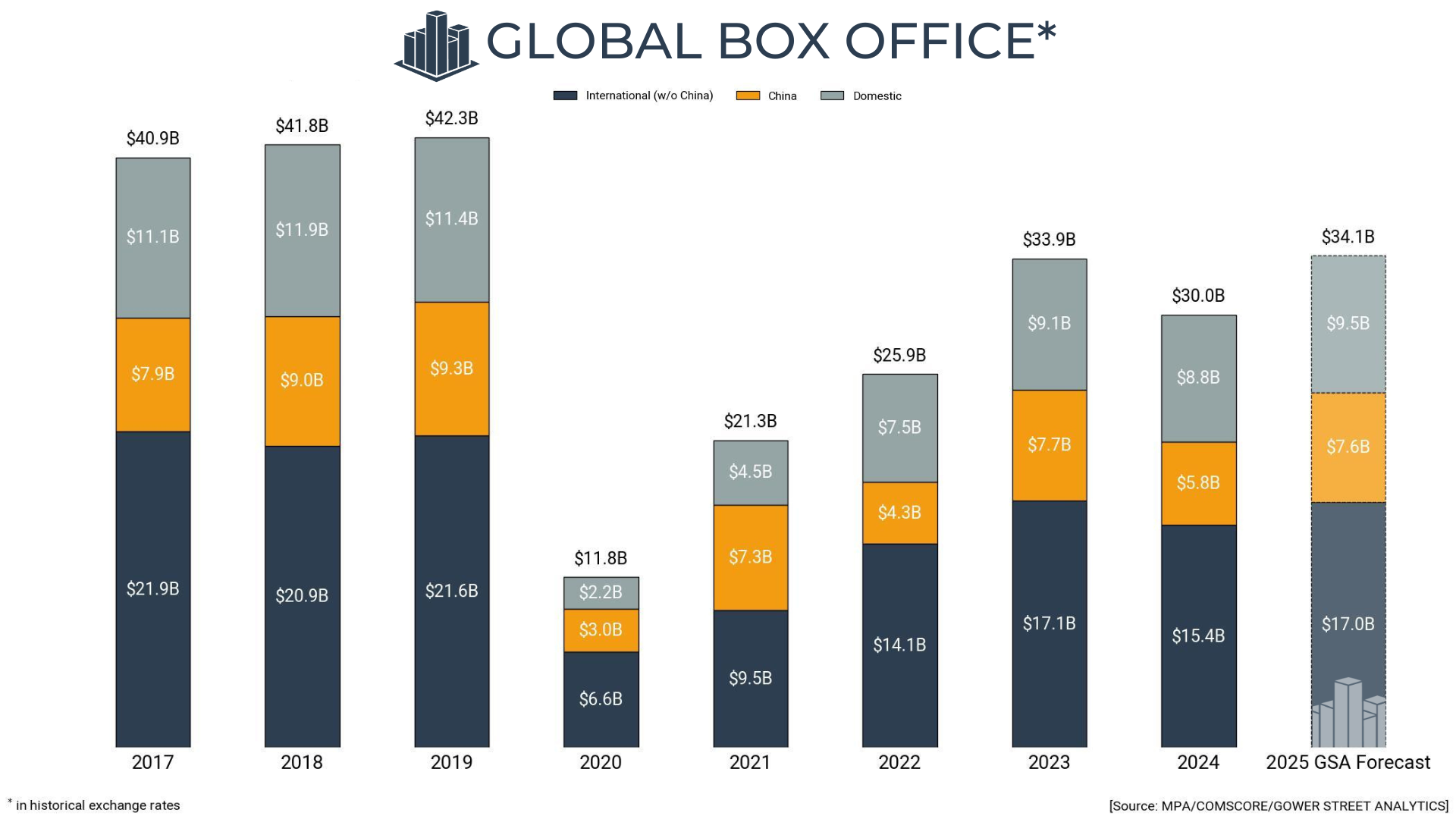
The 2025 American film box office marked a critical period of theatrical stabilization, generating approximately $9.1 billion in domestic ticket sales. Driven by a normalized release calendar following prior labor disruptions, the year saw franchise recalibrations, robust animated performances, and surging reliance on premium large format auditoriums to secure steady theatrical attendance.
Macro Performance: Domestic Gross and Theatrical Recovery
The domestic box office in 2025 operated as the first uninterrupted theatrical slate since the resolution of the 2023 Hollywood guild strikes. With production pipelines restored across major and mini-major studios, the North American marketplace tracked roughly 110 wide releases throughout the calendar year—a vital volume increase over 2024's depleted schedule.
While domestic revenue crossed the $9 billion threshold for the first time in several years, theatrical attendance patterns revealed clear behavioral changes among domestic moviegoers. Overall admission counts remained below the historical highs of the late 2010s, with ticket price inflation and premium format surcharges buffering the headline gross. Consumers demonstrated increased selectivity, concentrating spending on experiential cinema and heavily branded properties while mid-budget titles faced compressed windows.
The gap between theatrical ceiling and floor widened. The traditional "middle tier"—films budgeted between $40 million and $80 million aiming for a modest $70 million to $120 million domestic return—frequently struggled unless tied to sharp concept horror, distinct genre hooks, or strong event-driven word of mouth. Exhibitors adapted by curating specialized repertoire programming, expanding concession offerings, and prioritizing screens with proprietary high-end projection technology.
Top Domestic Earners: Franchise Recalibration and Original Breakouts
The 2025 release slate tested multiple major creative reboots and long-awaited franchise extensions. The domestic market responded with enthusiasm when established intellectual property offered visual reinvention or genuine narrative novelty, while rejecting formulaic entries.
The Return of Heavyweight Franchises
- Avatar: Fire and Ash (20th Century Studios / Disney): Arriving in mid-December, James Cameron’s third entry instantly dominated holiday box office charts. Benefiting from virtually uncontested control over IMAX and 3D auditoriums, its domestic gross anchored late fourth-quarter totals, continuing the franchise's trajectory of exceptional week-to-week holds.
- Jurassic World Rebirth (Universal Pictures): Serving as a creative reset directed by Gareth Edwards, this entry revived the prehistoric franchise with a streamlined, survival-focused narrative. Opening in July, it capitalized on peak summer family demand and strong international co-distribution.
- Superman (Warner Bros. / DC Studios): Directed by James Gunn, this high-stakes release launched the overhauled DC Universe. Strong advance tracking, critical acclaim, and positive word of mouth propelled the title to an exceptional domestic run, reversing a series of commercial disappointments for the comic book brand.
- The Fantastic Four: First Steps (Marvel Studios / Disney): Entering the late summer market, Marvel’s 1960s-set period adventure offered visual distinction from standard superhero formula. The film generated sustained engagement from core comic fans and casual family audiences alike.
Family, Animation, and Video Game Adaptations
Family demographics drove some of the most consistent theatrical patterns across the entire year:
- Zootopia 2 (Walt Disney Animation Studios): Nine years after the original surpassed $1 billion worldwide, the November release delivered massive Thanksgiving returns. It capitalized on an underserved all-ages demographic in the pre-holiday corridor.
- A Minecraft Movie (Warner Bros. / Legendary): Capitalizing on one of the largest active intellectual properties in global gaming, this hybrid live-action title drew heavy youth and teen demographics in the spring, proving that video game adaptations remain a foundational pillar of modern box office infrastructure.
- How to Train Your Dragon (Universal / DreamWorks): Dean DeBlois's live-action translation retained the emotional core of the animated original, demonstrating that well-timed live-action remakes can achieve strong domestic velocity if visual effects execution remains high.
2025 Domestic Box Office Breakdown
The following table summarizes the performance dynamics of defining 2025 theatrical releases across release strategy, format reliance, and estimated domestic totals.
| Title | Studio / Distributor | Release Window | Primary Domestic Demographic | Estimated Domestic Total | Key Performance Driver |
|---|---|---|---|---|---|
| Avatar: Fire and Ash | 20th Century / Disney | December | Broad Multi-demo / 25+ | $410M+ (calendar 2025) | Near-total monopoly on PLF and 3D; long holiday legs |
| Superman | Warner Bros. Discovery | July | 18–34 / Comic Enthusiasts | $355M | Critical goodwill, brand reset momentum, strong weekday holds |
| A Minecraft Movie | Warner Bros. / Legendary | April | Kids / Teens / Families | $325M | Massive organic brand recognition; high repeat youth attendance |
| Jurassic World Rebirth | Universal Pictures | July | General Summer Audiences | $315M | IP equity combined with Gareth Edwards' creature-feature aesthetic |
| Zootopia 2 | Walt Disney Studios | November | Families / All-Ages | $295M (calendar 2025) | Nine-year built-up demand; minimal direct family competition |
| The Fantastic Four: First Steps | Marvel Studios / Disney | July | 18–49 / Core Marvel Fans | $280M | Visual distinction, retro-futuristic marketing campaign |
| Mission: Impossible – The Final Reckoning | Paramount Pictures | May | 25–54 / Action Enthusiasts | $230M | Stunt-driven spectacle, older male demographic retention |
| Captain America: Brave New World | Marvel Studios / Disney | February | Comic Enthusiasts / 18–34 | $205M | Early-year tentpole positioning; steady Presidents' Day debut |
Note: Figures reflect calendar-year 2025 domestic accruals; late-December releases accumulated additional grosses into early 2026.
Studio Market Share Dynamics
The distribution hierarchy in 2025 demonstrated the advantage of balanced slates spanning animation, low-budget genre titles, and global event films.
2025 Domestic Box Office Market Share (Estimated) ================================================== Walt Disney Studios [###################] 27% Universal Pictures [#################] 24% Warner Bros. Discovery [##############] 20% Sony Pictures [########] 11% Paramount Pictures [#######] 10% Lionsgate / Others [####] 8%
Walt Disney Studios
Disney reclaimed the top domestic market-share position in 2025 through comprehensive slate diversification. Rather than relying entirely on Marvel Studios, the studio deployed an aggressive combination of 20th Century Studios tentpoles (Avatar: Fire and Ash), internal animation (Zootopia 2), and MCU titles (Captain America: Brave New World, Thunderbolts*, and The Fantastic Four: First Steps). This multi-label strategy insulated Disney from underperformance in any single franchise line.
Universal Pictures
Universal maintained its position near the top of the box office through release frequency and production cost discipline. Balancing massive franchise updates like Jurassic World Rebirth and How to Train Your Dragon with reliable mid-budget horror engines via Blumhouse and Monkeypaw Productions, Universal protected its margins. Its dynamic theatrical-to-home-entertainment windowing model continued to maximize post-theatrical returns without cannibalizing initial cinema ticket sales.
Warner Bros. Discovery
Warner Bros. posted its most balanced theatrical year since the pandemic. The successful dual execution of A Minecraft Movie in the spring and James Gunn’s Superman in the midsummer corridor demonstrated that the studio’s IP realignment was taking hold. By avoiding congested release dates and providing long theatrical runways before digital monetization, Warner Bros. restored consumer confidence in its event cinema slate.
Structural Industry Shifts Impacting Box Office Grosses
The 2025 box office was defined as much by exhibition technology and windowing contracts as it was by the films themselves.
The Rise of Premium Large Formats (PLF)
Premium screens—including IMAX, Dolby Cinema, ScreenX, and proprietary exhibitor brands like Cinemark XD and Regal RPX—accounted for an unprecedented percentage of total domestic revenue. In 2025, PLF auditoriums regularly represented 25% to 40% of an opening weekend’s gross for major action and sci-fi films, despite accounting for less than 15% of total domestic screens.
Audiences repeatedly signaled an unwillingness to pay standard admission prices for standard 2D projection on conventional screens when the alternative was waiting for a home release. However, when presented with bespoke sound design, expanded aspect ratios, and superior projection, domestic consumers readily paid premium surcharges of 20% to 50% above standard ticket costs.
Windowing Standardization
The contentious debate surrounding theatrical exclusivity settled into a functional, two-tiered framework by late 2025:
- Tier One (Event Pictures & Mega-Budgets): Films budgeted over $100 million or those demonstrating strong week-to-week holds maintained a strict 45-to-60-day window of exclusive theatrical play before appearing on Premium Video on Demand (PVOD).
- Tier Two (Mid-Budgets & Horror): Titles that grossed the majority of their theatrical lifetime total within the first three frames were shifted to digital rental platforms between Day 21 and Day 31, providing vital ancillary cash flow without blunting the initial theatrical marketing push.
Streaming-first studios, notably Apple Original Films and Amazon MGM Studios, continued adjusting their distribution models. Recognizing that vast global marketing spends are difficult to recoup solely through streaming subscriber additions, both companies committed to full theatrical rollouts for major projects, partnering with traditional distributors like Warner Bros. and Sony to access physical exhibition footprints.
Production Budget Rationalization
The era of unchecked $250 million to $300 million net budgets faced severe pushback throughout 2025. Following several high-profile write-downs across the industry in previous years, studio boards instituted strict budgetary caps on non-Cameron productions.
Writers, directors, and VFX supervisors were tasked with planning practical locations and tighter shooting schedules. Films that were budgeted responsibly—in the $80 million to $140 million range—demonstrated much clearer paths to theatrical profitability, easing the pressure to cross arbitrary $700 million worldwide breakeven thresholds.
Genre Winners and Losers
The Resilience of Mid-Budget Horror
Horror remained the most cost-efficient genre in the theatrical ecosystem. Titles developed under $20 million production budgets consistently turned net profits during their domestic runs. The genre benefited from communal viewing dynamics that streaming cannot replicate at home, drawing robust Friday and Saturday night business from young adult demographics.
The Specialization of Adult Dramas and Auteur Cinema
Mid-tier adult dramas continued their migration toward prestige festival launches and platform release schedules. Rather than opting for wide national breaks across 3,000 screens on day one, distributors returned to platforming: opening in New York and Los Angeles, gathering press momentum, and slowly rolling out across 500 to 1,200 curated screens. This mitigated upfront marketing waste and protected per-theater averages.
High-Budget Comedies
The standalone studio comedy remained almost completely absent from wide theatrical release schedules. Consumer expectations around comedies remain largely anchored to digital platforms. The exceptions were hybrid projects: action-comedies featuring established movie stars or high-concept horror-comedies that provided sufficient sensory scale to justify an in-theater ticket purchase.
Frequently Asked Questions
What was the total domestic box office gross in 2025?
The 2025 North American theatrical box office finished at approximately $9.1 billion. This represented steady growth compared to 2024, driven by a reliable cadence of major releases that restored wide-release theatrical volume.
Did the domestic box office return to pre-2020 levels in 2025?
No. While annual revenue crossed $9 billion, it remained below the $11 billion-plus benchmarks recorded between 2015 and 2019. Increased ticket prices helped bridge the financial gap, but total individual ticket admissions remained below historical highs due to changed consumer viewing habits.
What was the single highest-grossing domestic film of 2025?
Avatar: Fire and Ash led late-year velocity and carried the highest lifetime domestic total of films released during the calendar year, alongside massive summer performances from Superman, Jurassic World Rebirth, and A Minecraft Movie.
How did the theatrical window change in 2025?
The standard theatrical window established a dynamic equilibrium. Blockbusters maintained theatrical exclusivity for 45 to 60 days, while smaller mid-budget or underperforming releases were made available on Premium Video on Demand (PVOD) within 21 to 31 days to maximize overall distributor recovery.
Why did Premium Large Formats (PLF) gain so much market share?
Consumers showed a distinct preference for superior viewing experiences—such as IMAX and Dolby Cinema—that cannot be replicated by home theaters. Premium screens regularly delivered outsized percentages of opening weekend grosses because audiences considered the elevated presentation worth higher ticket prices.
Strategic Guidance for Film Industry Stakeholders
The performance of the 2025 domestic box office clarifies how theatrical distribution must operate going forward. For producers, exhibitors, and studio executives navigating future slates, direct resources toward the following operational strategies:
- Budget for Reality, Not Peak Anomalies: Greenlight theatrical tentpoles under realistic domestic gross assumptions ($150 million to $250 million) rather than assuming every comic or action property will reach $400 million domestically. Capping core production costs at $120 million to $150 million creates viable theatrical paths to profitability.
- Prioritize the PLF Footprint Early: When designing and scheduling major visual projects, secure premium format commitments early in pre-production. The difference between securing IMAX/Dolby exclusivity versus sharing screens with competing studio tentpoles can swing domestic grosses by 20% or more.
- Deploy Fluid Windowing Pragmatically: Avoid rigid dogmas on window length. Match the theatrical window to the organic trajectory of the film: extend exclusivity for titles showing exceptional weekend-to-weekend holds, and utilize early PVOD monetization for specialized genres that burn through audience demand within three weeks.