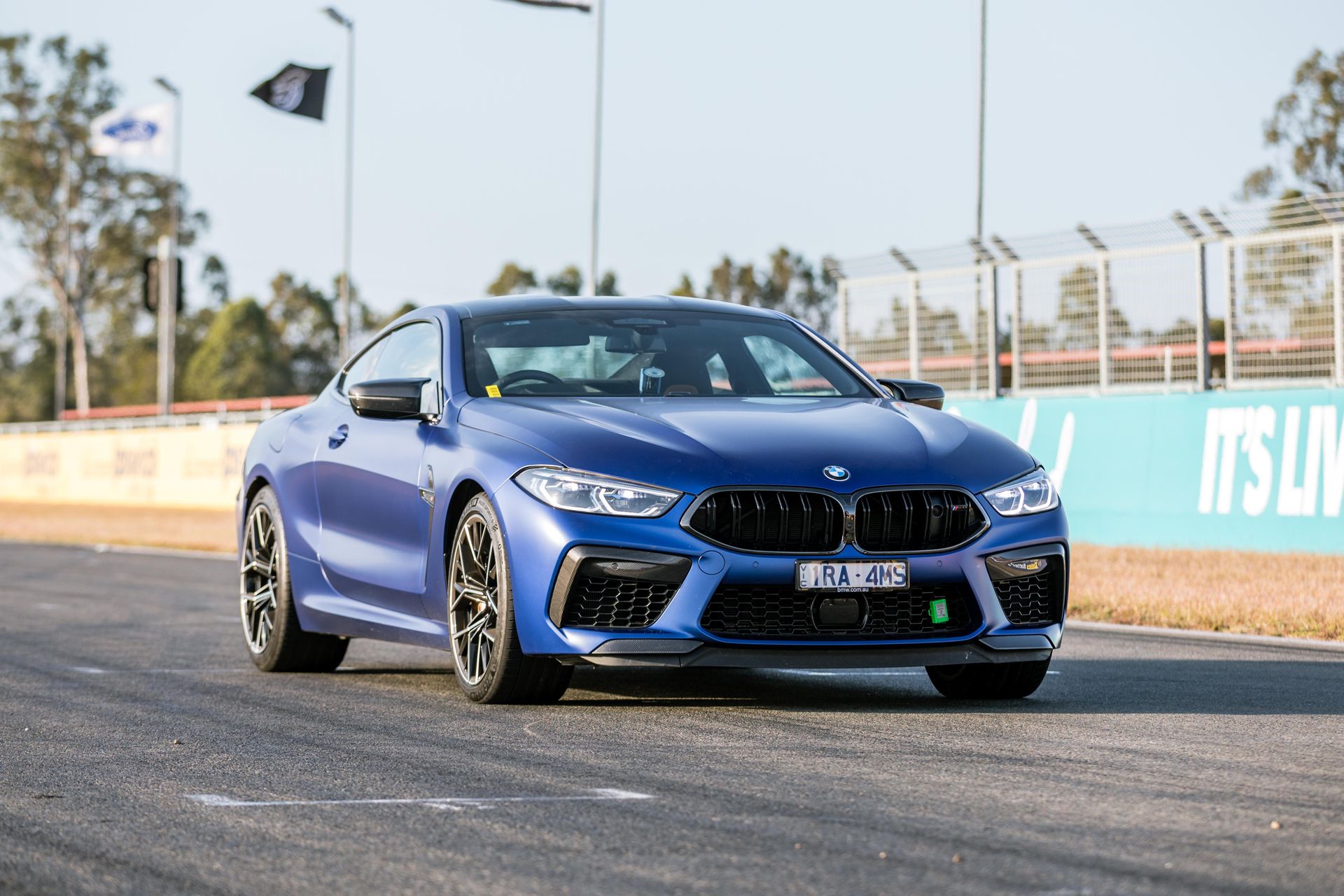
The 2020 BMW M8 Competition produces an official output of 617 horsepower (625 PS) and 553 lb-ft of torque from its 4.4-liter twin-turbocharged V8 engine. In the contemporary automotive landscape, this performance baseline remains exceptionally potent, holding its own against newer electrified and traditional high-performance grand tourers through raw engineering, all-weather traction, and relentless power delivery.
Introduction to the 2020 BMW M8 Competition
When BMW introduced the F92 M8 Competition for the 2020 model year, it arrived at the apex of the brand's luxury performance lineup. Serving as the spiritual and mechanical successor to the classic 8 Series lineage, the M8 Competition was engineered to blend ultra-long-distance grand touring comfort with supercar-slaying track capabilities. At the center of this machine is the S63B44T4 engine, a heavily massaged, dual-turbocharged 4.4-liter V8 powerplant.
As the automotive industry pivots increasingly toward hybridization and pure electrification, high-displacement internal combustion engines of this caliber face a changing regulatory and consumer environment. Examining the 2020 BMW M8 Competition horsepower figures in the modern era offers valuable insight into how legacy internal combustion engineering holds its ground. Rather than fading into obsolescence, the 617-horsepower output of the S63 engine serves as a benchmark for effortless, high-speed velocity that electric motors and hybrid setups complement or chase rather than instantly render obsolete.
Engine Architecture and Performance Specifications
To understand the enduring nature of the 2020 BMW M8 Competition horsepower, one must examine the hardware responsible for generating it. The S63 engine utilizes a "hot-V" configuration, placing the twin turbochargers inside the V-shape of the cylinders. This layout shortens the exhaust paths, minimizing turbo lag and ensuring instantaneous throttle response—a critical requirement for a heavy, high-performance grand tourer.
| Specification | 2020 BMW M8 Competition Value |
|---|---|
| Engine Type | 4.4L Twin-Turbocharged V8 (S63) |
| Horsepower | 617 hp @ 6,000 rpm |
| Torque | 553 lb-ft @ 1,800–5,860 rpm |
| Transmission | 8-Speed M Steptronic with Drivelogic |
| Drivetrain | M xDrive All-Wheel Drive (Rear-Biased) |
| 0–60 mph Time | ~3.0 seconds (Independent Testing) |
The torque curve is particularly noteworthy. Delivering its peak 553 lb-ft across a wide band from 1,800 rpm all the way up to 5,860 rpm, the engine eliminates the need to aggressively rev the motor to access usable power. Peak horsepower arrives at 6,000 rpm and holds steady until redline, providing an aggressive, sustained push at triple-digit speeds.
Real-World Power Delivery and Dyno Realities
Factory ratings from German manufacturers have long been suspected by enthusiasts and automotive journalists of being conservative, and the 2020 BMW M8 Competition is no exception. Independent chassis dyno testing of stock M8 Competition models frequently reveals that the engine puts down close to 600 horsepower at the wheels, suggesting that actual crank horsepower is significantly higher than the official 617 hp rating once drivetrain parasitic loss is accounted for.
This under-reported power output translates directly into real-world performance. While BMW officially claimed a 0–60 mph time of 3.0 seconds for the coupe, numerous independent automotive publications routinely clocked the car at 2.7 to 2.8 seconds on standard asphalt using launch control. In the modern era, where hyper-fast electric vehicles boast instantaneous torque, the M8 Competition counters with a linear, rolling-start acceleration profile that excels at highway passing speeds, pulling aggressively well past legal speed limits without dropping off in momentum.
The M xDrive System and Power Management
Generating 617 horsepower is only half the engineering challenge; successfully channeling that power to the pavement is another. The 2020 M8 Competition utilizes the M xDrive all-wheel-drive system paired with an Active M Differential on the rear axle.
- Driver Input
- M xDrive Splitter
- Active M Differential
- 4WD Sport Mode: Rear-biased power for balanced grip
- 2WD Pure RWD: Completely decoupled front axle for drifting
- Active M Differential
- M xDrive Splitter
Unlike traditional permanent all-wheel-drive systems, M xDrive operates with a distinct rear bias. Under normal driving conditions, power is routed primarily to the rear wheels to preserve classic BMW steering dynamics. When slip is detected, or under aggressive throttle application, the multi-plate clutch system seamlessly transfers torque to the front wheels.
For purists, the system includes a fully configurable 2WD mode, which completely decouples the front driveshaft. This transforms the heavy grand tourer into a traditional rear-wheel-drive machine, allowing experienced drivers to explore the limits of the 617-horsepower engine through controlled cornering slides.
Comparative Context in the Contemporary Market
Evaluating the M8 Competition requires looking at how its power metrics compare against contemporary rivals. While newer hybrid performance cars achieve higher peak numbers through the addition of heavy battery packs, the M8 maintains a distinct mechanical character.
- Porsche 911 Turbo S (992 generation): Offers similar or quicker straight-line acceleration and sharper track focus, but commands a substantially higher price point and offers less interior passenger space.
- Mercedes-AMG S 63 E Performance: Relies on plug-in hybrid technology to produce staggering combined horsepower figures, but carries hundreds of pounds of extra weight from the electrical hardware, altering cornering agility.
- Audi RS7 / RS e-tron GT: Provides compelling alternative styling and dual-motor or twin-turbo V8 propulsion, yet the BMW M8 Competition strikes a closer balance between executive luxury and raw track-day aggression.
The absence of heavy hybrid batteries in the non-plug-in 2020 M8 Competition means the car maintains a more organic weight transfer profile during hard braking and cornering, appealing directly to drivers who prefer traditional combustion dynamics.
Tuning Potential and Aftermarket Longevity
Another reason the 2020 BMW M8 Competition remains intensely relevant in the modern era is its vast aftermarket headroom. The S63 engine is notoriously over-engineered, featuring forged internal components designed to withstand pressures well beyond factory specifications.
- Stage 1 ECU Tunes: Simply flashing the engine control unit via an OBD-II port can unlock outputs exceeding 700 to 750 horsepower on stock hardware, capitalizing on the factory turbochargers' efficiency.
- Downpipes and Exhaust Upgrades: Removing secondary catalytic converters and upgrading to freer-flowing exhaust systems reduces backpressure, unleashing a deeper V8 roar while enhancing high-rpm breathing.
- Transmission Tuning: Upgrading the 8-speed ZF-based transmission software firms up shift speeds, reducing slip times during aggressive track use.
For enthusiasts seeking modern supercar performance without purchasing a brand-new vehicle, a pre-owned 2020 M8 Competition represents a high-value platform for modification and power extraction.
Operational Considerations and Maintenance Realities
Owning a high-output, twin-turbocharged V8 grand tourer in the modern era requires adherence to strict maintenance schedules. The S63 engine is sensitive to fluid quality and thermal management.
- Oil Change Intervals: Cutting factory-recommended oil change intervals in half (every 5,000 miles rather than 10,000 miles) is widely recommended by BMW master technicians to prevent carbon buildup and protect turbocharger bearings.
- Cooling System Monitoring: The engine bay operates under extreme thermal stress due to the hot-V turbo layout. Regular inspection of auxiliary water pumps, coolant lines, and heat exchangers is mandatory.
- Tire Management: With 553 lb-ft of torque channeled through performance rubber, rear tires experience high wear rates, particularly during spirited driving or frequent use of launch control.
Frequently Asked Questions
Is the 2020 BMW M8 Competition horsepower underrated from the factory?
Yes, independent dynamometer testing consistently reveals that the S63 engine puts down power figures at the wheels that suggest true engine output is closer to 650 horsepower, meaning BMW intentionally listed a conservative 617 hp rating for marketing and insurance consistency across global markets.
Can the 2020 BMW M8 Competition run on standard pump gas?
The high compression ratio and forced induction setup require premium gasoline, typically 91 to 93 octane. Using lower-grade fuel will trigger knock sensors, causing the engine management computer to retard ignition timing and noticeably reduce performance.
How does the M8 Competition differ mechanically from the standard M8?
While both models share the same 4.4-liter twin-turbo V8, the Competition variant raises the output from 600 hp to 617 hp, features a stiffer engine mount calibration, a louder M Sport exhaust system, revised suspension kinematics with stiffer bushings, and unique forged wheels.
Is the 2020 BMW M8 Competition difficult to drive daily?
Despite its supercar-level performance, the car is designed as a luxury grand tourer. In Comfort mode, the transmission shifts smoothly, the suspension absorbs road imperfections effectively, and the cabin remains insulated, making it entirely suitable for daily commuting or long-distance road trips.
What is the top speed of the 2020 BMW M8 Competition?
Out of the box, the car is electronically limited to 155 mph. However, when equipped with the optional M Driver’s Package, the electronic limiter is raised to 190 mph, allowing the vehicle to fully utilize its aerodynamic stability and horsepower at high velocities.
Conclusion and Recommendations
The 2020 BMW M8 Competition proves that high-output internal combustion engineering retains an enduring appeal. With 617 officially certified horsepower—and a real-world capability that frequently punches above its weight—it delivers a driving experience defined by effortless acceleration, luxurious touring comfort, and configurable traction. For buyers and enthusiasts evaluating high-performance luxury cars, the M8 Competition stands out as a formidable, timeless engineering achievement. Prospective buyers should prioritize vehicles with documented maintenance histories, inspect brake and tire wear thoroughly, and consider professional pre-purchase inspections to ensure the complex mechanical and electronic systems remain in peak condition.