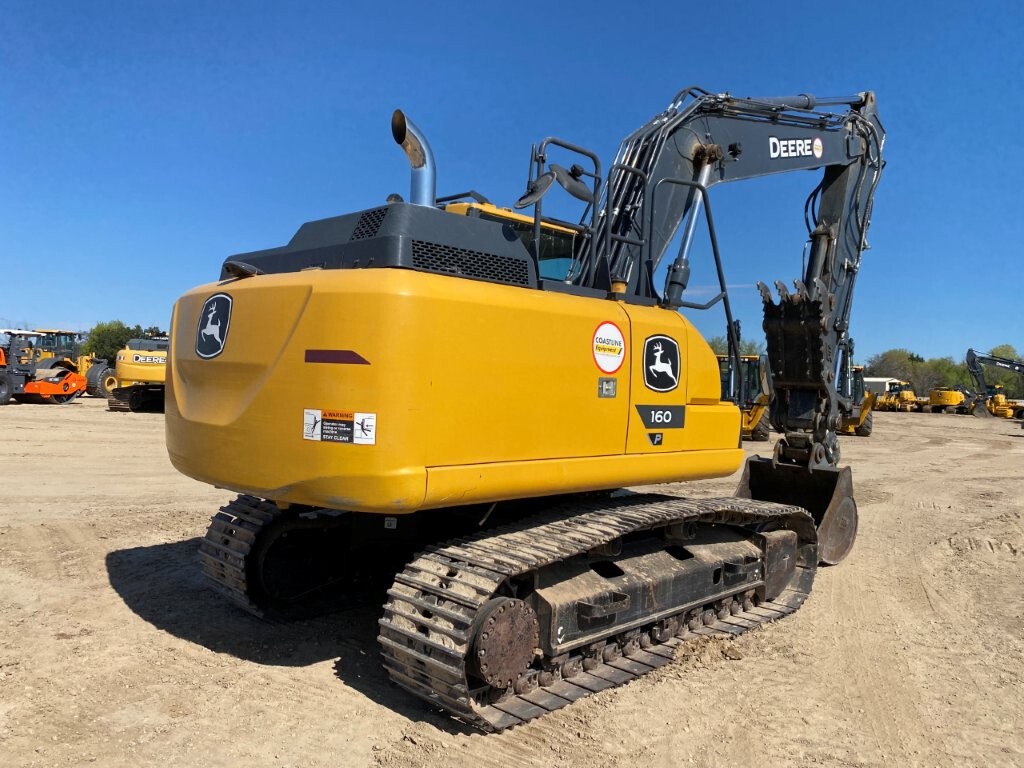
The John Deere 160G LC excavator is a versatile mid-size machine featuring a net power of 121 hp (90 kW) and an operating weight ranging from 38,447 to 39,501 lbs. Designed for utility work, residential site development, and road building, it offers a maximum digging depth of 21 feet 4 inches and a bucket breakout force of 24,954 lbs.
As of 2026, the 160-class excavator remains a cornerstone of the John Deere construction lineup, specifically the G-Series models which have established a reputation for balancing fuel efficiency with high-performance hydraulics. Whether you are evaluating a new unit for your fleet or researching a pre-owned machine, understanding the precise technical specifications and the evolution of the 160 series is essential for maximizing operational uptime and ensuring the machine meets your project requirements.
Evolution of the 160 Series: From LC to G-Series
The John Deere 160 has undergone several iterations, most notably progressing from the C-series and D-series into the modern G-series. The "LC" suffix, which stands for "Long Carriage," has become a standard feature in this weight class to provide a larger footprint, which translates to better stability when lifting heavy loads or working on uneven terrain.
The transition to the G-series introduced significant advancements in emissions technology and hydraulic management. While the older 160C and 160D models were favorites for their simplicity, the 160G LC integrated the Powerwise III hydraulic management system, which more effectively balances engine performance with hydraulic flow. This evolution was driven by the need to meet EPA Final Tier 4 (FT4) and EU Stage IV emissions standards while simultaneously reducing the total cost of ownership through improved fuel economy and extended service intervals.
Engine Specifications and Powertrain Performance
At the heart of the John Deere 160G LC is the John Deere PowerTech PSS 4.5L engine. This is a 4-cylinder, turbocharged diesel engine designed specifically for the rigors of heavy construction.
Power and Torque
The engine delivers a net power of 121 hp (90 kW) at 2,000 rpm. What makes this engine notable is its torque rise and the way it maintains power under heavy hydraulic loads. The 4.5L displacement provides enough "grunt" to handle tough digging conditions, such as frost or compacted clay, without significant engine droop.
Emissions Technology
To comply with modern environmental regulations, the PowerTech PSS engine utilizes a combination of technologies:
- Cooled Exhaust Gas Recirculation (EGR): This reduces nitrogen oxide (NOx) emissions by lowering the combustion temperature.
- Diesel Particulate Filter (DPF): This captures soot and particulate matter. In the 160G LC, the DPF is designed to be service-free for many hours, with automatic regeneration that does not interrupt the work cycle.
- Selective Catalytic Reduction (SCR): This system uses Diesel Exhaust Fluid (DEF) to further treat the exhaust, converting NOx into harmless nitrogen and water vapor.
Fuel Efficiency Features
In 2026, fuel costs remain a primary concern for contractors. The 160G LC includes several "smart" features to minimize consumption. The auto-idle feature automatically reduces engine speed when the control levers are not in use, and the auto-shutdown feature can be programmed to turn the engine off after a specific period of inactivity. Additionally, the machine offers three power modes—High Productivity (HP), Power (P), and Economy (E)—allowing the operator to match the machine’s output to the specific task at hand.
Hydraulic System and Powerwise III Technology
The hydraulic system is where the 160 John Deere excavator distinguishes itself from competitors in the 17.5-metric-ton class. The machine uses a Powerwise III management system, which is a proprietary John Deere technology that coordinates engine speed and pump flow.
Pump Performance
The system features two variable-displacement axial-piston pumps. Each pump provides a maximum flow rate of approximately 41.2 gallons per minute (156 L/min), resulting in a total system flow that allows for smooth multi-function operation. This means an operator can swing, boom up, and retract the arm simultaneously without experiencing the "jerky" movements common in older or less sophisticated hydraulic systems.
Productivity Modes
The Powerwise III system offers distinct modes that change the hydraulic profile:
- High Productivity (HP): Provides more power and faster hydraulic response for moving large amounts of material quickly.
- Power (P): The standard operating mode, offering a balance of power, speed, and fuel economy.
- Economy (E): Limits engine rpm and adjusts hydraulic flow to maximize fuel savings during lighter work, such as finishing or light trenching.
Control and Precision
For tasks requiring extreme precision, such as laying pipe or working near existing utilities, the 160G LC features a "power boost" button on the right-hand joystick. When pressed, it provides a momentary increase in hydraulic pressure to help the machine break through a stubborn obstacle or lift a particularly heavy segment of concrete.
Operating Weights and Undercarriage Dimensions
Stability is a product of the undercarriage design. The "LC" (Long Carriage) designation on the 160 means the machine has an elongated track frame compared to standard configurations in other regions.
Weight Distribution
The operating weight of the 160G LC is approximately 38,447 lbs (17,439 kg) when equipped with standard 24-inch (600 mm) triple semi-grouser shoes, a standard arm, and a 0.63 cubic yard bucket. If the machine is outfitted with wider 32-inch (800 mm) shoes, the weight increases to roughly 39,501 lbs (17,917 kg), but the ground pressure decreases significantly.
Ground Pressure
Lower ground pressure is vital when working on soft terrain, such as wetlands or soft topsoil.
- 24-inch shoes: Approximately 6.24 psi (43.0 kPa).
- 28-inch shoes: Approximately 5.42 psi (37.4 kPa).
- 32-inch shoes: Approximately 4.82 psi (33.2 kPa).
Dimension Specifications for Transport
Contractors must know the machine’s footprint for transport and site access. The 160G LC has a transport length of approximately 28 feet 3 inches (8.61 m) and a transport height of 9 feet 10 inches (3.01 m). Its overall width with 28-inch shoes is 8 feet 10 inches (2.69 m), making it relatively easy to move on a standard lowboy trailer without requiring extensive wide-load permits in many jurisdictions.
Working Ranges and Digging Capabilities
The utility of an excavator is measured by its reach and digging depth. The 160 series offers two primary arm (stick) lengths: the standard 8-foot 7-inch (2.62 m) arm and a longer 10-foot 2-inch (3.10 m) arm.
Standard Arm Performance
With the 8-foot 7-inch arm, the 160G LC provides:
- Max Digging Depth: 19 feet 10 inches (6.05 m).
- Max Reach at Ground Level: 28 feet 11 inches (8.82 m).
- Max Dumping Height: 21 feet 3 inches (6.47 m).
- Digging Force (Bucket): 24,954 lbs (111 kN).
Long Arm Performance
With the 10-foot 2-inch arm, the machine extends its reach:
- Max Digging Depth: 21 feet 4 inches (6.49 m).
- Max Reach at Ground Level: 30 feet 5 inches (9.27 m).
- Max Dumping Height: 22 feet 1 inch (6.73 m).
- Digging Force (Bucket): 24,954 lbs (111 kN). Note that while digging force remains the same, the arm breakout force typically decreases slightly with a longer stick.
160 John Deere Excavator Specifications Table
The following table summarizes the key technical data for the 160G LC model, which represents the current standard for the 160 series in 2026.
| Specification | Metric Value | Imperial Value |
|---|---|---|
| Engine Model | John Deere PowerTech PSS 4.5L | John Deere PowerTech PSS 4.5L |
| Net Power (ISO 9249) | 90 kW @ 2,000 rpm | 121 hp @ 2,000 rpm |
| Operating Weight | 17,439 – 17,917 kg | 38,447 – 39,501 lbs |
| Max Digging Depth | 6.49 m | 21 ft 4 in |
| Max Reach (Ground Level) | 9.27 m | 30 ft 5 in |
| Bucket Breakout Force | 111 kN | 24,954 lbs |
| Arm Digging Force | 82 kN | 18,434 lbs |
| Total Hydraulic Flow | 312 L/min | 82.4 gpm |
| Tail Swing Radius | 2.45 m | 8 ft 0 in |
| Fuel Tank Capacity | 285 L | 75.3 gal |
| DEF Tank Capacity | 27 L | 7.1 gal |
Cab Features and Operator Environment
A productive machine requires a comfortable operator. The G-Series cab on the 160 John Deere is designed with visibility and ergonomics in mind.
Visibility and Controls
The cab features a large expanse of glass, providing excellent visibility to the tracks and the trench. The slim-profile front window bars and large overhead glass help when loading high-sided trucks. The controls are low-effort joysticks that are integrated into the seat consoles, meaning the controls move with the operator as the seat suspension reacts to terrain.
Monitor and Diagnostics
The multi-language LCD monitor provides critical data at a glance, including fluid levels, temperatures, and maintenance intervals. One of the most significant features for owners is the integration of JDLink telematics. JDLink allows fleet managers to remotely monitor machine location, fuel consumption, idle time, and diagnostic trouble codes (DTCs). In 2026, these data points are essential for predictive maintenance, allowing service teams to identify potential issues before they result in catastrophic failure.
Climate and Comfort
The cab is pressurized to keep dust out and features a high-capacity HVAC system. Standard features often include a heated air-suspension seat, an AM/FM radio with auxiliary ports, and ample storage space for the operator's personal items and tools.
Maintenance and Serviceability
John Deere has prioritized "ground-level" service for the 160G LC. This design philosophy ensures that daily checks can be performed quickly, reducing the likelihood that maintenance is skipped.
- Grouped Service Points: Fuel filters, oil filters, and the air cleaner are located behind large service doors that can be reached from the ground.
- Cooling System: The machine features a side-by-side cooling core design rather than a stacked design. This makes it much easier to clean out debris with compressed air or water, which is vital for preventing overheating in dusty environments.
- Extended Intervals: The engine oil and filter change interval is typically 500 hours, while hydraulic oil can last up to 5,000 hours under normal operating conditions.
- Fluid Sampling: The machine includes easy-access ports for taking oil and coolant samples, which is a standard practice for sophisticated fleet management programs in 2026.
Frequently Asked Questions
What is the difference between a John Deere 160G and a 160G LC?
In North America, the 160G is almost exclusively sold as the 160G LC. The "LC" stands for Long Carriage. This longer track frame provides superior stability and lower ground pressure compared to a standard-length undercarriage. While a non-LC version may exist in certain global markets to accommodate tight transport restrictions, the LC is the standard for the power and weight class in domestic construction.
How much does a John Deere 160 excavator weigh?
The operating weight depends on the configuration but generally falls between 38,400 and 40,000 pounds. Choosing wider track shoes or a longer arm will push the weight toward the higher end of that spectrum. This weight puts it in the "mid-size" or "utility" excavator category, making it heavy enough for serious excavation but small enough to be transported without specialized heavy-haul equipment.
Does the John Deere 160G LC require DEF?
Yes, the 160G LC uses a Final Tier 4 engine that requires Diesel Exhaust Fluid (DEF) to reduce NOx emissions. The DEF tank is sized to last through several tanks of diesel fuel, and the level is clearly displayed on the in-cab monitor. Operators should only use high-quality, ISO 22241-compliant DEF to avoid damaging the SCR system.
What size bucket fits on a 160 John Deere excavator?
The 160G LC is typically paired with buckets ranging from 0.48 to 0.96 cubic yards (0.37 to 0.73 cubic meters). The choice of bucket depends on the material density. For heavy rock, a smaller, reinforced bucket is used. For light topsoil or loading sand, a larger capacity bucket is appropriate.
Can the 160G LC handle hydraulic attachments?
Absolutely. The 160G LC is frequently used with hydraulic thumbs, hammers (breakers), plate compactors, and rotary cutters. John Deere offers auxiliary hydraulic packages that allow the operator to control these attachments through the joysticks. The Powerwise III system ensures that the hydraulic flow is optimized for the specific attachment being used.
Recommendations for Buyers and Operators
When evaluating the 160 John Deere excavator, first define your primary application. If your work involves significant amounts of pipe-laying or deep trenching, prioritize the 10-foot 2-inch long arm for the extra reach. However, if you are working in tight residential quarters, the standard arm may offer slightly better cycle times and maneuverability.
For those purchasing in the secondary market in 2026, prioritize machines with a documented JDLink history. This data provides an objective view of how the machine was treated, showing the ratio of idle time to working time and confirming that all scheduled maintenance was performed on time. Finally, always match your track shoe width to your primary soil conditions; while 32-inch shoes offer the best flotation, they also increase wear on the undercarriage components when used primarily on hard, rocky ground.