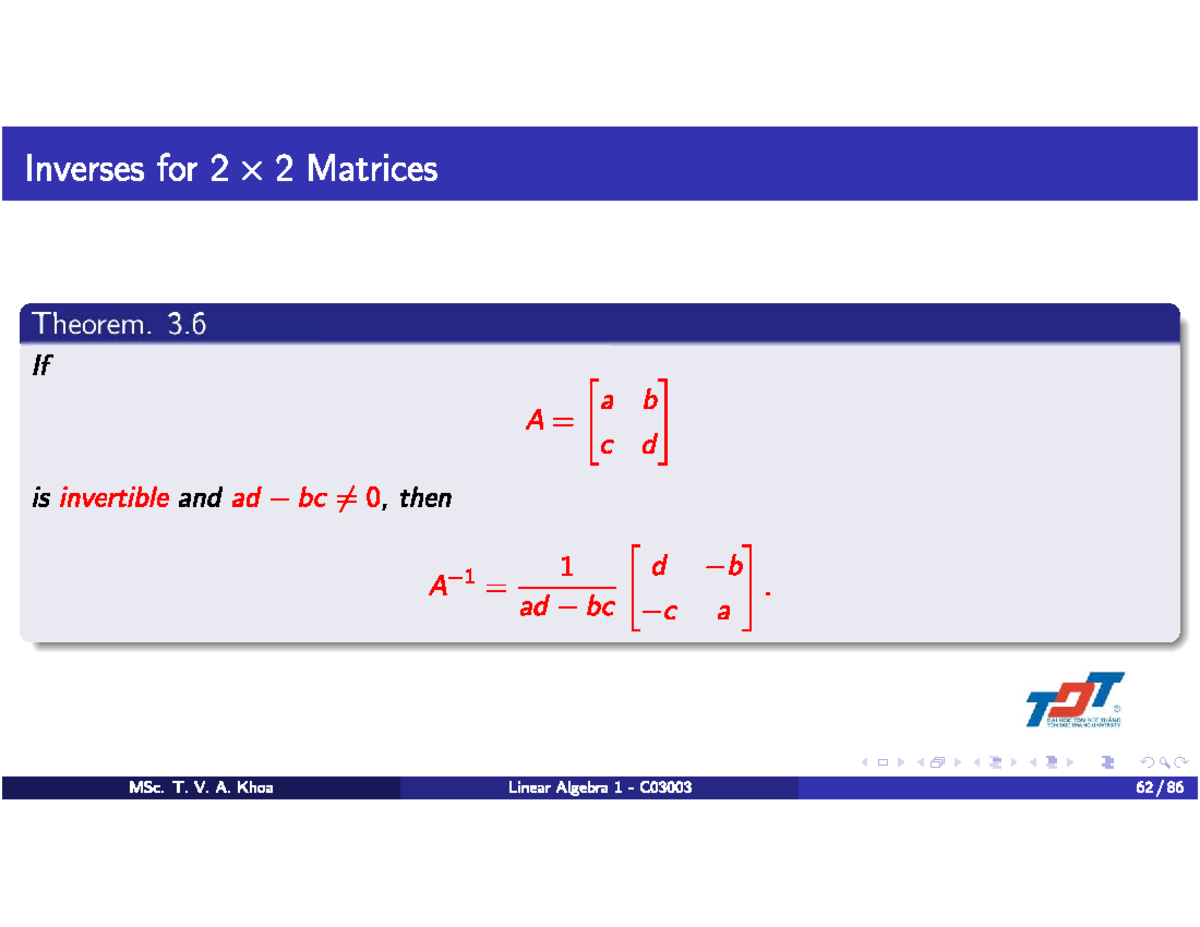
To find the inverse of a 2x2 matrix, identify the matrix as A = [[a, b], [c, d]], calculate its determinant (ad - bc), and verify it is non-zero. If the determinant is non-zero, swap the elements on the main diagonal (a and d), change the signs of the off-diagonal elements (b and c), and multiply the resulting matrix by the reciprocal of the determinant.
Understanding the 2x2 Matrix Inverse
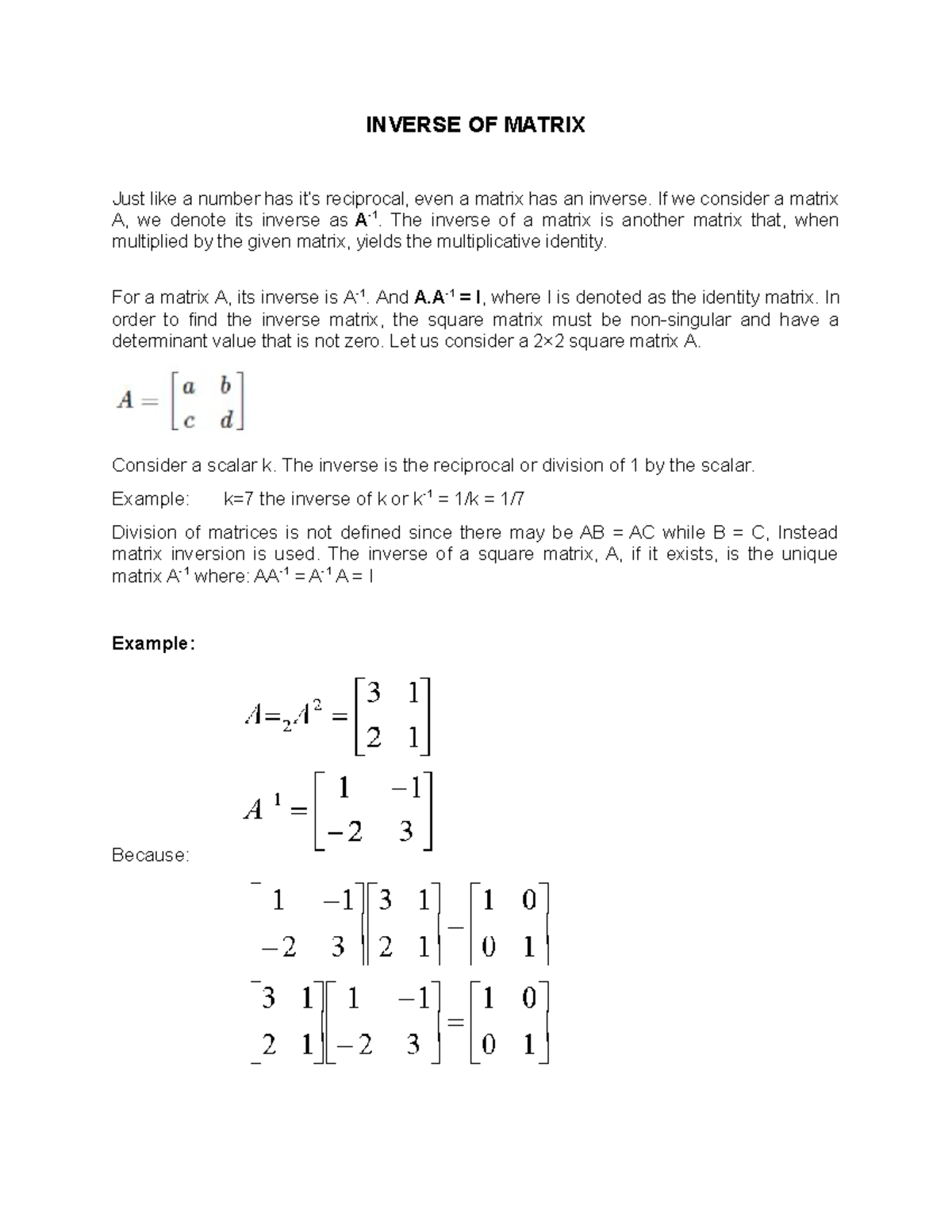
In linear algebra, the inverse of a matrix is a fundamental concept analogous to the reciprocal of a real number. Just as dividing by a number is equivalent to multiplying by its reciprocal (for instance, multiplying by 1/5 is the same as dividing by 5), multiplying a matrix by its inverse results in the identity matrix. The identity matrix for a 2x2 system is represented as:
I = [[1, 0], [0, 1]]
When you have a square matrix A, its inverse, denoted as A⁻¹, is defined by the relationship AA⁻¹ = I = A⁻¹A. Not every matrix has an inverse; if a matrix is "singular"—meaning its determinant is zero—it cannot be inverted. Understanding how to find the inverse of a 2x2 matrix is the foundation for solving systems of linear equations, performing coordinate transformations in computer graphics, and conducting data analysis in various scientific fields.
Prerequisites: Matrix Anatomy and Notation
Before performing the calculation, it is essential to define the components of your matrix. A 2x2 matrix consists of four numbers arranged in two rows and two columns:
A = [[a, b], [c, d]]
In this notation:
- a is the element in the first row, first column.
- b is the element in the first row, second column.
- c is the element in the second row, first column.
- d is the element in the second row, second column.
The "main diagonal" runs from the top left to the bottom right (elements a and d). The "secondary diagonal" or "off-diagonal" runs from the top right to the bottom left (elements b and c). Familiarity with this layout is critical for the transposition and sign-flipping steps required during the inversion process.
Step-by-Step Calculation Procedure
Calculating the inverse is a systematic process. By following these steps, you ensure accuracy and minimize the risk of arithmetic errors.
1. Calculate the Determinant
The determinant is a scalar value that tells you whether an inverse exists. For a matrix [[a, b], [c, d]], the determinant (often written as |A| or det(A)) is calculated using the formula:
det(A) = (a * d) - (b * c)
If the result is zero, the matrix is singular, and no inverse exists. This is the most common stopping point if you are working with matrices that are not invertible.
2. Create the Adjugate Matrix
To create the adjugate (or adjoint) matrix, you must perform two operations simultaneously:
- Swap: Swap the positions of the elements on the main diagonal (a and d become d and a).
- Negate: Change the sign of the elements on the off-diagonal (b becomes -b, and c becomes -c).
The resulting matrix looks like this: [[d, -b], [-c, a]].
3. Multiply by the Scalar
Finally, multiply every element in the new matrix by the reciprocal of the determinant (1 / det(A)). The final formula for the inverse is:
A⁻¹ = (1 / det(A)) * [[d, -b], [-c, a]]
This results in a new matrix where each element is scaled by the inverse of the determinant.
Comparison of Matrix Operations
| Operation | Objective | Mathematical Effect |
|---|---|---|
| Determinant | Check for invertibility | Returns a scalar representing scaling factor |
| Adjugate | Prepare components | Transposes and flips signs of specific elements |
| Scalar Multiplication | Finalize Inverse | Scales elements by 1/det(A) |
| Inverse Check | Verify solution | Produces the Identity Matrix (I) |
Common Pitfalls and Troubleshooting
The most frequent error in matrix inversion is the sign-flip step. It is easy to mistakenly flip the signs of all four numbers or flip the wrong diagonal. Always remember: keep the main diagonal elements, but change their positions; keep the off-diagonal elements in their positions, but change their signs.
Another common mistake is neglecting the determinant check. If you calculate the inverse of a matrix where the determinant is zero, you will be dividing by zero, which is undefined. If you find your determinant is zero, you must stop immediately, as the matrix does not have an inverse.
If you are working with large numbers, simplify the fractions as much as possible before multiplying them into the matrix. This reduces the likelihood of calculation errors. If the elements are decimals, ensure your arithmetic remains consistent throughout the process.
Verification of the Result
To verify your work, perform a matrix multiplication of the original matrix A and your calculated inverse A⁻¹. If the result is the identity matrix [[1, 0], [0, 1]], your calculations are correct.
Example: If A = [[3, 1], [5, 2]], the determinant is (32) - (15) = 1. The adjugate is [[2, -1], [-5, 3]]. Multiplying by 1/1 results in the inverse [[2, -1], [-5, 3]]. Checking this: [[3, 1], [5, 2]] * [[2, -1], [-5, 3]] equals [[(6-5), (-3+3)], [(10-10), (-5+6)]], which is [[1, 0], [0, 1]]. Verification successful.
Frequently Asked Questions
What happens if the determinant is 0? If the determinant is 0, the matrix is singular. This means the matrix does not have an inverse. Geometrically, this often implies that the transformation represented by the matrix collapses space onto a line or a point, losing information that cannot be reversed.
Do these steps work for 3x3 matrices? No. This specific method—swapping the main diagonal and negating the off-diagonal—applies exclusively to 2x2 matrices. Inverting 3x3 or larger matrices requires more complex methods, such as Gaussian elimination, row reduction, or using the cofactor method.
Can the inverse of a matrix contain fractions? Yes. In many cases, the inverse will contain fractions if the determinant is not 1 or -1. It is standard practice in mathematics to leave these as fractions rather than converting them to repeating decimals, as fractions maintain exact precision.
Why is it called an "inverse" matrix? It is called an inverse because it represents the "opposite" operation of the original matrix transformation. If a matrix represents a transformation like rotation or scaling, the inverse matrix performs the reverse operation, returning the object to its original state.
Practical Recommendation
For quick verification of your manual calculations, you can use standard scientific calculators or software environments like Python with the NumPy library. If you are calculating inverses for academic purposes, practice with matrices containing small integers first to ensure you understand the mechanics of the determinant and the adjugate before moving to matrices with complex fractions or large values. Always double-check your arithmetic in the determinant calculation, as it is the most frequent source of error.