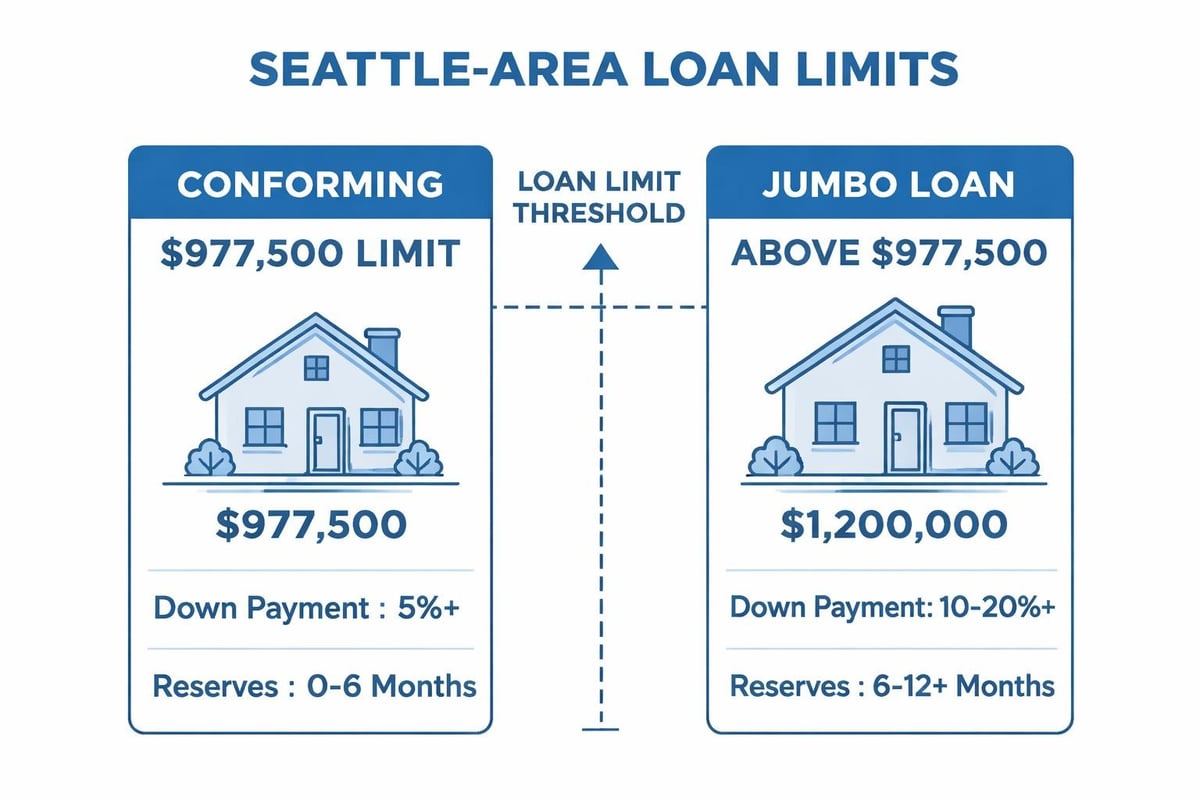
For high-net-worth homebuyers in the Seattle metropolitan area, jumbo loans—mortgages that exceed the conforming loan limits set by the Federal Housing Finance Agency (FHFA)—are often the only viable path to financing a property. Determining if these loans are "worth the risk" depends on your liquidity, long-term financial goals, and comfort with the specific underwriting standards, interest rate environments, and debt-to-income requirements associated with non-conforming debt.
Understanding the Seattle Jumbo Loan Landscape in 2026
In the Seattle housing market, price points frequently push well beyond the limits established for government-backed loans. A jumbo loan is a non-conforming loan, meaning it does not meet the standards set by Fannie Mae or Freddie Mac. Because these loans cannot be sold to these government-sponsored enterprises, lenders hold the risk on their own balance sheets.
The "risk" associated with these loans typically refers to two distinct areas: the borrower’s financial exposure and the lender’s stringent criteria. As a borrower, the risk is that these loans often require larger down payments, higher credit scores, and significant cash reserves compared to conventional financing. However, in the high-cost Seattle market, the alternative—paying cash—might tie up capital that could otherwise yield higher returns if invested elsewhere.
Comparing Conforming and Jumbo Loan Mechanics
To assess whether a jumbo loan is a sound financial move, you must compare it against the conventional conforming loan structures. The most critical differentiator is the loan limit, which is updated annually by the FHFA based on average home price increases.
Key Differences Table
| Feature | Conforming Loan | Jumbo Loan |
|---|---|---|
| Loan Limit | Up to set FHFA caps | Exceeds FHFA caps |
| Down Payment | Typically 3%–20% | Typically 10%–20%+ |
| Credit Score | Usually 620+ | Often 700–740+ |
| Cash Reserves | Minimal requirement | Often 6–12 months of payments |
| Interest Rates | Market standard | Competitive, but can fluctuate |
| Underwriting | Standardized | Highly customized/manual |
Analyzing the Financial Risk Factors
When considering if a jumbo loan is worth it, you must evaluate the opportunity cost of your capital.
The Opportunity Cost of Capital
If you have enough cash to purchase a Seattle property outright, you might wonder why you would take on a jumbo loan. The risk of the loan is the interest paid over the life of the mortgage. However, if you take that same cash and invest it in a diversified portfolio that outperforms your mortgage interest rate, the "risk" of the debt is mitigated by the "gain" of your investments. In 2026, many savvy investors choose to leverage jumbo loans to keep their capital deployed in liquid assets.
Cash Reserves and Liquidity Requirements
Lenders view jumbo loans as higher risk because they represent larger amounts of capital. Consequently, they often mandate that borrowers maintain significant liquid reserves—money in savings, checking, or brokerage accounts—following the closing of the loan. This is a form of protection for the lender, but for the borrower, it means your money is locked away, unable to be deployed for other business or investment opportunities.
Market Volatility in Seattle
Seattle has historically been a robust real estate market, but it is not immune to cyclical adjustments. Taking a jumbo loan means carrying a larger debt load. If the market dips and you need to sell, you might find yourself with negative equity if your down payment was thin. The "risk" is that your mortgage balance exceeds the current market value of your home, limiting your options for relocation or refinancing.
Eligibility and Documentation Hurdles
Qualifying for a jumbo loan in 2026 requires meticulous preparation. Unlike conforming loans, where automated underwriting systems handle much of the heavy lifting, jumbo loans often undergo manual underwriting.
- Credit History: You will need a stellar credit profile. Any minor blemish, such as a missed credit card payment or a high utilization ratio, can disqualify you or lead to a significantly higher interest rate.
- Income Verification: Because these loans are for higher amounts, lenders require proof of stable, consistent income. If you are self-employed, expect to provide two years of tax returns, profit and loss statements, and potentially a letter from a CPA verifying the health of your business.
- Debt-to-Income (DTI) Ratio: Lenders are more conservative with jumbo loans. While a 43% DTI is often the ceiling for conforming loans, many jumbo lenders prefer a ratio closer to 36%–40% to ensure you can handle the larger monthly payment without strain.
Strategies to Mitigate Risk
If you decide that a jumbo loan is the right tool for your Seattle property purchase, there are several ways to manage the associated risks effectively.
1. Optimize Your Down Payment
While many jumbo programs allow for 10% or 15% down, putting down 20% remains the gold standard. It removes the need for Private Mortgage Insurance (PMI), which can be quite costly on a large jumbo loan, and it lowers your principal balance, thereby reducing your monthly interest payments.
2. Shop Multiple Lenders
Not all jumbo lenders are the same. Some are local credit unions with deep knowledge of the Seattle market, while others are large national banks. Large banks may offer relationship discounts—such as lower interest rates if you move your liquid assets to their brokerage division—which can drastically reduce the "risk" of the loan over time.
3. Maintain an Emergency Fund
Never use all your available liquid assets for the down payment and closing costs. Ensure that after the transaction, you have enough cash to cover at least six to twelve months of mortgage payments, taxes, insurance, and unexpected home repairs.
Frequently Asked Questions
Is a jumbo loan always more expensive than a conventional loan?
Not necessarily. While jumbo loans were historically known for having higher interest rates, they have become more competitive. In some market conditions, jumbo rates can be equal to or even lower than conventional rates due to the high quality of the borrowers these lenders target.
What happens if I want to pay off my jumbo loan early?
Most modern jumbo loans do not have prepayment penalties. However, always review your specific loan agreement. Paying off the principal early can be an excellent way to reduce your long-term interest costs, provided it doesn't deplete your necessary liquid reserves.
Can I get a jumbo loan with a low credit score?
It is extremely difficult. Because the lender is holding the risk, they prioritize borrowers with high credit scores and robust financial histories. If your score is below 700, you will likely face significant difficulty securing a competitive jumbo loan.
Is the appraisal process for jumbo loans different?
Yes. For very high-value properties in Seattle, lenders may require two full appraisals rather than one to ensure the property value is accurately assessed. You should be prepared for a longer and more rigorous appraisal timeline compared to a standard home sale.
Should I prioritize a fixed or adjustable-rate jumbo loan?
This depends on your time horizon. If you plan to stay in the home for 10+ years, a fixed-rate loan provides stability. If you plan to sell within 5–7 years, an adjustable-rate mortgage (ARM) might offer a lower initial interest rate, potentially saving you money during your period of ownership.
Next Steps for Prospective Borrowers
Before committing to a jumbo loan, consult with a financial advisor to ensure the debt aligns with your overall tax and investment strategy. Once you have a clear picture of your financial standing, reach out to at least three different lenders—a national bank, a regional bank, and a mortgage broker—to compare interest rates and closing costs. In the Seattle market, where speed and certainty are highly valued by sellers, having a pre-approval from a reputable lender that understands the jumbo underwriting process can be a decisive advantage in securing your desired property.